Timelines and Roadmaps: The Complete Guide for Strategic Planning
Compare timelines vs roadmaps, learn 6 visualization types, and master best practices for creating strategic timelines, product roadmaps, and project plans.
The average executive sees five roadmaps per quarter—product, technology, organizational, project, and strategic. Yet 71% of product managers report that stakeholders do not understand their roadmaps, and timeline formats vary so widely across teams that cross-functional planning becomes a translation exercise. The problem is not the concept—it is the absence of shared definitions for what roadmaps and timelines communicate, which visualization formats suit which planning needs, and how these tools work together rather than duplicate effort.
After building roadmaps and timelines for 60+ transformation programs, product launches, and strategic initiatives spanning 6 months to 5 years, we have tracked which structures clarify direction (phased roadmaps with measurable outcomes, timelines with realistic buffers) and which create confusion (roadmaps with task-level detail, timelines without dependencies, plans that mix strategic and tactical levels).
This guide explains the difference between roadmaps and timelines, covers six visualization formats with use cases, provides templates for product, technology, project, and strategic roadmaps, and gives you decision criteria for matching format to planning context.
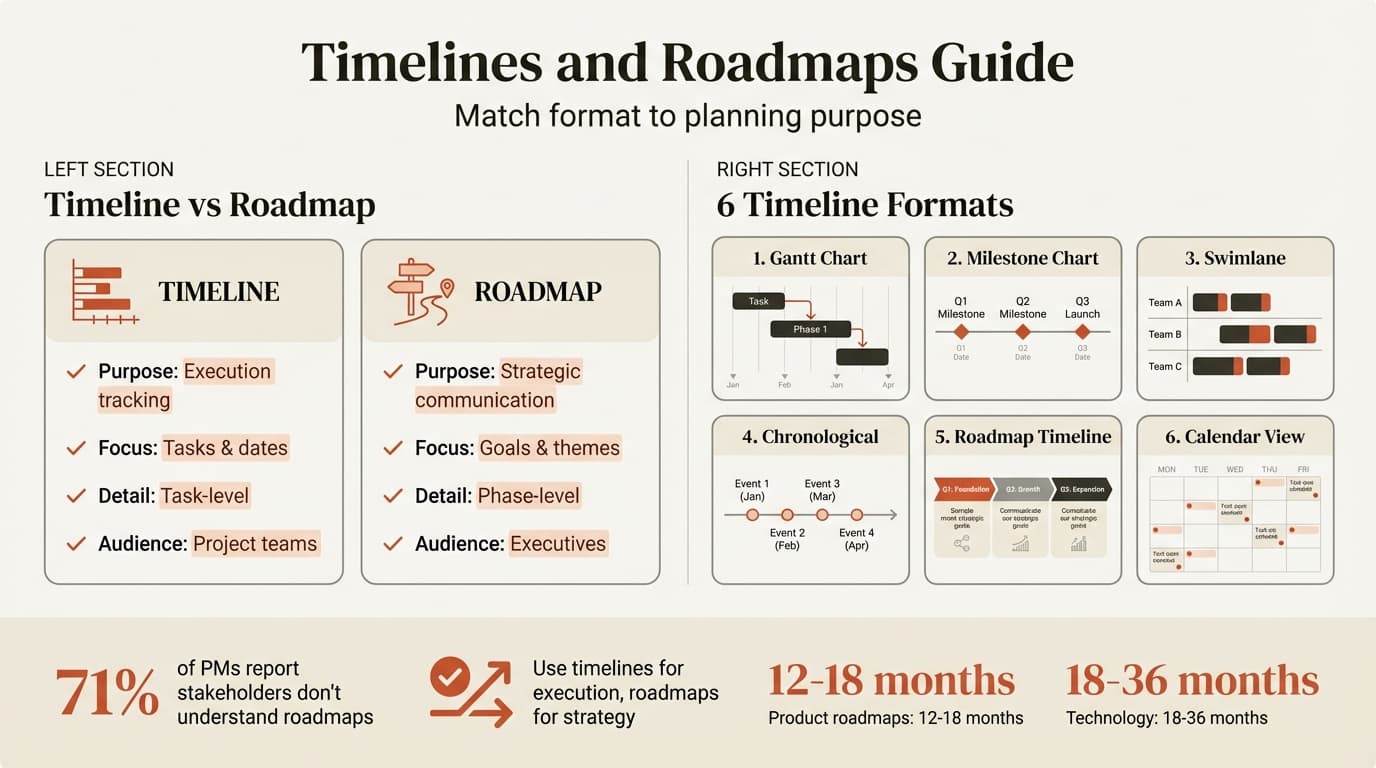
Timeline vs Roadmap: The Critical Difference
The terms "timeline" and "roadmap" are often used interchangeably, but they serve fundamentally different planning purposes.
What Is a Timeline?
A timeline is a chronological sequence of events or activities that need to be completed within a specific timeframe. Timelines cover all the stages within a life cycle—the more short-term and individual stages that go on. They essentially break bigger goals down into concrete steps.
Timelines answer:
- When: Specific start and end dates for tasks
- How long: Duration of each activity
- What order: Sequence and dependencies between tasks
- Who does what: Resource allocation across the schedule
Timelines are tactical execution tools. A project manager uses a timeline to track whether deliverables are on schedule, identify delays, and communicate progress against plan.
What Is a Roadmap?
A roadmap is a strategic planning tool that provides a visual representation of goals, milestones, and timelines. It serves as a guide for project managers and stakeholders, outlining the overall direction and strategic objectives. By breaking down a complex project into manageable phases, the roadmap ensures that goals are achieved step by step.
A roadmap gives you the macro view, while a timeline ensures timely execution via detailed visualization. More specifically, a roadmap is about communicating your goals, while a timeline is about your outputs on those goals.
Roadmaps answer:
- Why: Strategic rationale for initiatives
- What: Themes, capabilities, or features being built
- For whom: Target customers, users, or business units
- Expected impact: Business outcomes or value delivered
Roadmaps are strategic communication tools. A product leader uses a roadmap to align stakeholders on vision, set expectations about sequencing, and explain trade-offs.
Key Differences Summary
| Dimension | Timeline | Roadmap |
|---|---|---|
| Purpose | Execution tracking | Strategic communication |
| Focus | Tasks and dates | Goals and themes |
| Detail Level | Task-level specifics | Phase or initiative-level |
| Flexibility | Low—dates matter | High—themes can shift |
| Primary Audience | Project teams, executors | Executives, stakeholders, customers |
| Time Horizon | Project duration (weeks to months) | Strategic horizon (quarters to years) |
| Update Frequency | Weekly or daily | Monthly or quarterly |
| Typical Format | Gantt chart, calendar view | Swimlane, phase-based visual |
When to Use Each
Use a timeline when:
- Managing project execution with fixed deadlines
- Tracking dependencies between tasks
- Coordinating resource allocation across teams
- Reporting detailed progress to project sponsors
- Planning construction, manufacturing, or sequential work
Use a roadmap when:
- Communicating product vision to stakeholders
- Aligning cross-functional teams on strategic direction
- Setting expectations when specific dates are uncertain
- Planning technology investments over multiple quarters
- Showing organizational transformation phases
Use both when:
- Running enterprise programs requiring strategic alignment and detailed execution
- Managing product development with quarterly planning cycles (roadmap) and sprint-level execution (timelines)
- Presenting to mixed audiences—executives need the roadmap view, teams need the timeline view
Timeline Visualization Formats
Timelines take multiple visual forms depending on detail level, audience, and the type of information being communicated.
1. Gantt Charts
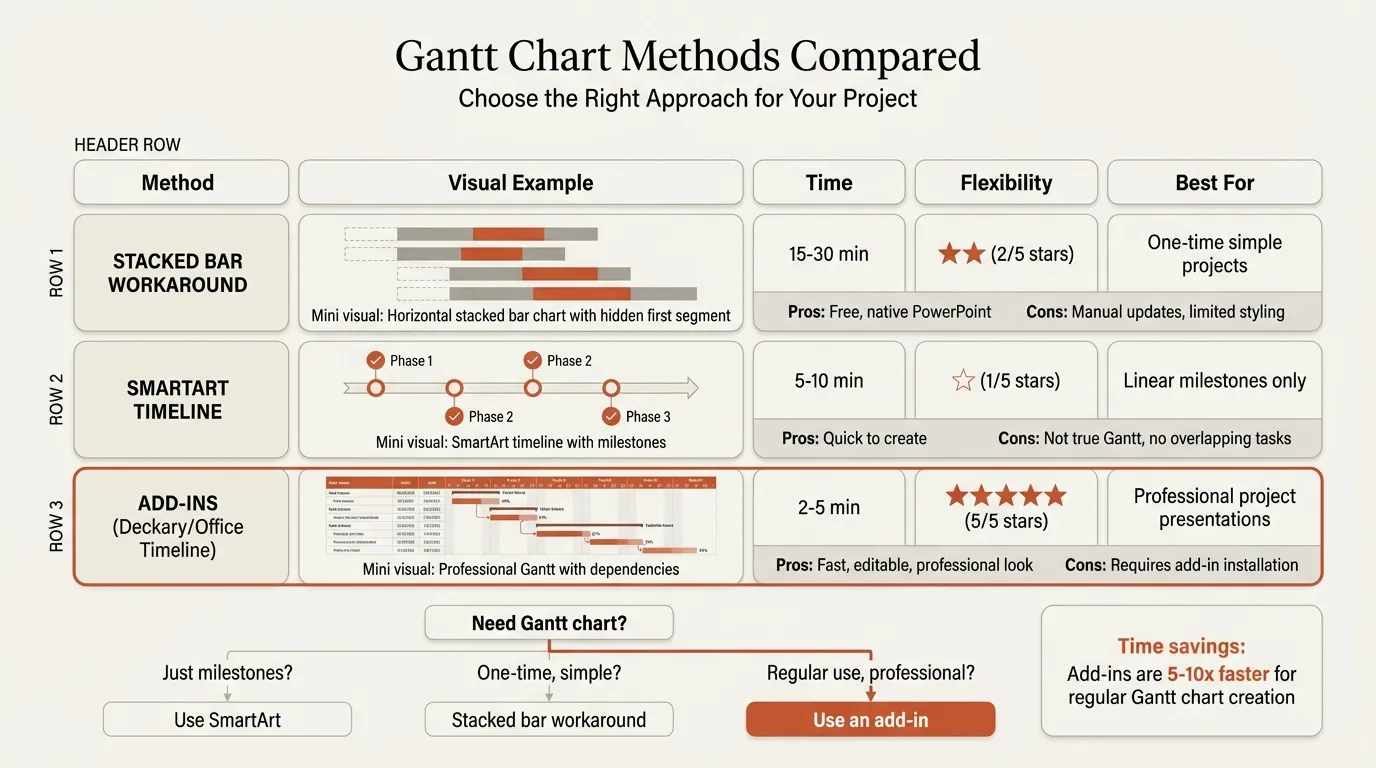
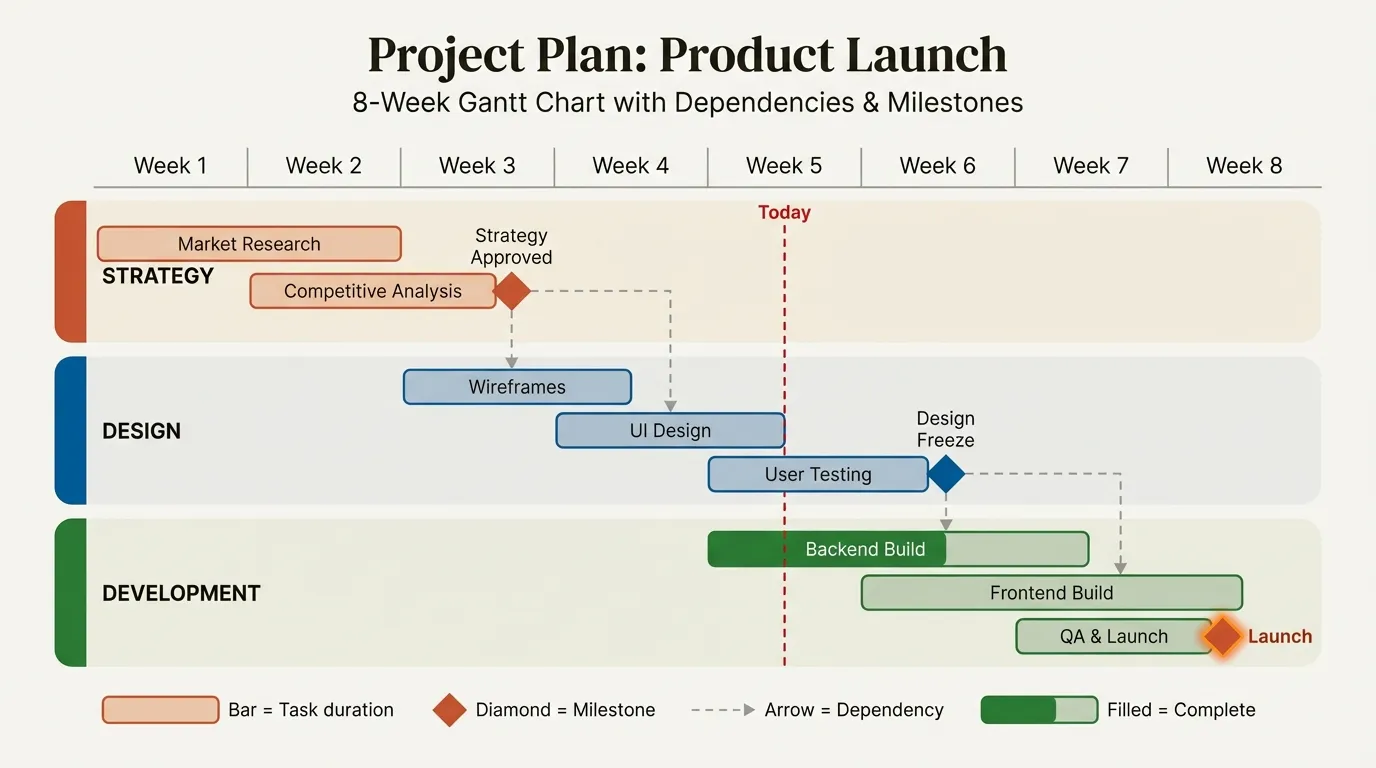
A Gantt chart visually presents the timeline of a project as a horizontal bar chart, where tasks are lined up by start date, with length visualized by the width of each bar, and resources allocated with precision. Gantt charts are best suited for projects where timing matters more, with multiple dependencies and numerous tasks. For ready-to-use layouts, see our Gantt Chart Template.
When to use:
- Projects with task dependencies (task B cannot start until task A finishes)
- Resource-constrained schedules where multiple teams share capacity
- Construction, software development, product launches with parallel workstreams
- When stakeholders need visibility into critical path and schedule risk
Key components:
- Task list with start and end dates
- Duration bars showing task length
- Dependency arrows linking related tasks
- Milestones marking key events
- Resource assignments or swimlanes by team
For creating Gantt charts in PowerPoint, see our guide on Gantt chart creation.
2. Milestone Charts
Milestones are tools typically utilized on timelines to mark a turning point in the schedule, signifying the completion of a phase, the starting or end point of the project, and virtually anything that must be highlighted along the way. Unlike tasks which have duration, milestones represent events with zero duration and primarily mark achievements or the completion of specific project phases.
When to use:
- Executive summaries where task detail would overwhelm
- Stage-gate processes with clear decision points
- Product launches with release dates and key events
- High-level stakeholder communication
Key components:
- Milestone labels (event names)
- Target dates
- Phase groupings or categories
- Status indicators (completed, on track, at risk)
Milestone charts eliminate clutter for audiences who care about "what gets delivered when" but not "how we get there."
3. Swimlane Diagrams
A swimlane diagram is a type of flowchart that outlines who does what in a given process, placing process steps within horizontal or vertical "swimlanes" of a particular department, work group or employee. This provides clarity and accountability.
A swimlane timeline is a visual representation of a timeline in which tasks or activities are placed in separate lanes or rows. Timelines, Gantt charts, roadmaps, but also flowcharts or Kanban boards can be considered swimlane diagrams, as long as they feature multiple lanes.
When to use:
- Multi-team projects requiring coordination
- Programs with parallel workstreams by function (design, engineering, marketing)
- Transformation initiatives with distinct phases across departments
- When accountability by team or role matters
Key components:
- Horizontal or vertical lanes by team, phase, or responsibility
- Tasks or milestones placed within appropriate lanes
- Dependencies crossing lanes where coordination is needed
- Timeline axis showing chronological progression
Swimlane timelines clarify who owns what and when handoffs occur between teams.
4. Chronological Timelines
A linear, left-to-right timeline showing events in sequential order. The simplest timeline format, ideal for historical context or storytelling.
When to use:
- Company history or product evolution narratives
- Onboarding new employees on organizational milestones
- Case studies showing project progression
- Marketing content explaining development journey
Key components:
- Horizontal axis representing time (days, months, years)
- Events plotted chronologically
- Brief descriptions or annotations per event
- Visual markers (icons, images) to enhance readability
Chronological timelines prioritize clarity over detail—they communicate sequence and context, not execution specifics.
5. Roadmap Timelines
A roadmap timeline bridges strategic planning and detailed scheduling. It shows themes or initiatives organized by time period (quarters, semesters, years) but with less task-level detail than Gantt charts.
When to use:
- Product planning across multiple releases
- Technology infrastructure planning spanning quarters
- Strategic initiatives with flexible delivery windows
- Stakeholder communication balancing direction and dates
Key components:
- Time buckets (Q1, Q2, H1, H2, Year 1, Year 2)
- Initiatives or themes within each time bucket
- Dependencies between initiatives
- Swim lanes by team, product, or strategic pillar
Roadmap timelines give stakeholders enough timing specificity to plan dependencies without overcommitting to dates that may shift.
6. Calendar Views
Month-by-month or week-by-week grids showing scheduled activities.
When to use:
- Marketing campaign schedules with specific publish dates
- Event planning with fixed dates
- Sprint planning in Agile teams
- Short-duration projects (under 3 months)
Key components:
- Calendar grid (days, weeks, months)
- Scheduled activities or events per day
- Color coding by category or priority
- Availability or resource allocation
Calendar views work best when dates are firm and the planning horizon is short—they lose readability beyond a quarter.
Roadmap Types and Templates
Popular roadmap templates include product, project, technology, IT, strategy, and agile roadmaps. Each type serves a different audience and planning purpose.
Product Roadmaps
Structure:
- Organized by quarters or releases (Q1, Q2, Q3, Q4)
- Features or capabilities grouped by theme
- Outcome metrics (customer adoption, revenue impact)
- Dependencies on other teams or systems
Variants:
Outcome-Based Roadmaps: These focus on achieving specific goals rather than detailing every feature or release date, grouping initiatives into themes and tying them to clear outcomes and key metrics.
Agile Roadmaps: These are detail-oriented and easy to update as development teams iterate on a set of features, making them ideal for technical, sprint-based projects.
Visual Roadmaps: These provide a condensed, bird's-eye view of your product's future and are ideal for communicating with stakeholders.
Typical time horizon: 12-18 months, with detailed planning for next 2-3 quarters and themes for quarters beyond.
Primary audience: Product teams, engineering, leadership, customers (for external roadmaps).
Technology and IT Roadmaps
Structure:
- Infrastructure modernization initiatives (cloud migration, platform upgrades)
- Security and compliance projects
- System retirements and technical debt reduction
- Integration and data platform development
Typical time horizon: 18-36 months, often aligned with budget cycles.
Primary audience: CTO, IT leadership, engineering teams, finance (for budget planning).
Strategic Roadmaps
Strategic roadmaps typically have a longer timeframe, often 12-18 months, and focus on organizational direction and goals.
Structure:
- Strategic initiatives by strategic pillar
- Market expansion or new business lines
- Partnerships and M&A activity
- Cultural or operational transformation programs
Typical time horizon: 3-5 years with annual milestones, though plans beyond 18 months remain high-level.
Primary audience: Executive team, board of directors, investors.
Project Roadmaps
A project roadmap outlines deliverables and milestones for a specific program or initiative.
Structure:
- Project phases (planning, execution, deployment, handoff)
- Major deliverables per phase
- Go/no-go decision gates
- Resource requirements and budgets
Typical time horizon: Project duration, with detailed planning for the next 3-6 months.
Primary audience: Project sponsors, cross-functional teams, governance committees.
For creating project roadmaps that include timelines, see our Project Plan Template and our guides on 30-60-90 day plans and digital transformation roadmaps.
Continue reading: Strategic Frameworks · How to Make a Gantt Chart in PowerPoint (Free Template) · Investment Banking Pitch Book
Create professional charts in PowerPoint
Build native waterfall, Mekko, Gantt, and business charts without manual formatting. 10 free AI prompts. No credit card required.
Best Practices for Creating Roadmaps and Timelines
After reviewing 60+ roadmaps and timelines across product launches, technology programs, and strategic initiatives, these practices consistently separate effective planning from documents that get ignored.
Start with Strategy, Not Tools
Before opening PowerPoint or a project management tool, answer:
- What business problem are we solving?
- What outcomes define success?
- Who are the stakeholders, and what do they need to understand?
- What decisions will this roadmap or timeline inform?
Roadmaps built from templates without strategic grounding become feature lists. Timelines created without understanding critical dependencies become outdated by week two.
Match Detail Level to Audience and Purpose
Most types of strategic roadmaps, such as product roadmaps and IT strategy roadmaps, should focus on general timeframes. Keeping these roadmaps at a higher level—months or even quarters—will both help you manage stakeholder expectations and help your team focus more on delivering excellent work than meeting specific deadlines.
For executives: High-level roadmaps with quarterly themes and outcome metrics. Avoid task-level detail.
For cross-functional teams: Swimlane roadmaps showing dependencies and handoffs. Include enough specificity to coordinate work.
For project teams: Detailed Gantt timelines with task dependencies and resource allocation.
For customers or external stakeholders: Outcome-focused roadmaps emphasizing value delivered, not internal implementation steps.
Mismatched detail creates problems. Executives given Gantt charts tune out. Teams given theme-only roadmaps cannot execute.
Be Realistic About Timeframes
Make sure your timeframes are realistic and your milestones achievable. Ask your team for feedback on what they can realistically produce in a timeframe.
The most common roadmap mistake is aggressive timelines built without input from the people doing the work. Product managers who commit to Q1 launches without consulting engineering create credibility problems when Q1 becomes Q3.
Build buffers into timelines for:
- Unexpected dependencies discovered during execution
- Approval cycles that take longer than planned
- Team capacity constraints (vacations, competing priorities)
- External dependencies outside your control (vendor delays, regulatory reviews)
A timeline that hits 80% of dates is more credible than one that misses 60%.
Keep Roadmaps Living Documents
Roadmaps are living documents—that means they are dynamic and always open to change. The reality is, there are many unplanned variables that pop up and cause projects to veer off course. Your roadmap needs to be able to adjust for a pivot at any given moment.
Update frequency by type:
- Product roadmaps: Monthly or after each sprint review
- Project timelines: Weekly during active execution
- Strategic roadmaps: Quarterly reviews with annual refresh
- Technology roadmaps: Bi-annually or when major initiatives shift
When roadmaps become outdated, stakeholders stop trusting them. When updates happen without communication, teams lose alignment.
Visualize Dependencies Explicitly
Most delays come not from individual tasks running long but from dependencies between teams or systems. A good roadmap clearly shows what depends on what.
For timelines, use:
- Dependency arrows in Gantt charts
- Swim lanes showing handoffs between teams
- Milestones marking integration points
For roadmaps, call out:
- Which initiatives must complete before others can start
- External dependencies (vendor deliveries, partner integrations)
- Shared resource constraints (limited platform capacity, same team needed for multiple initiatives)
When dependencies are invisible, delays surprise stakeholders. When dependencies are clear, teams can proactively address blockers.
Communicate the "Why" Behind Sequencing
Roadmaps that show "what" without explaining "why" invite stakeholder challenges. Why is initiative X in Q2 instead of Q1? Why is feature Y prioritized over feature Z?
For each major initiative or phase, include:
- Business rationale: What outcome does this enable?
- Dependencies: What must happen first?
- Trade-offs: What did we choose not to do, and why?
This context prevents roadmaps from becoming negotiation documents where the loudest stakeholder wins.
Define Success Metrics Upfront
A good product roadmap is simple, concise, and easy to understand. It contains a clear plan with specific goals, work items, and timelines, so everyone involved gains context and is on the same page.
Every roadmap or timeline should answer: how will we know if this worked? Defining OKRs upfront ensures each initiative has measurable targets tied to strategic outcomes.
For product roadmaps: Customer adoption rates, usage metrics, revenue impact. For technology roadmaps: System uptime, migration completion percentage, technical debt reduction. For project timelines: On-time delivery, budget adherence, stakeholder satisfaction.
Metrics create accountability. Without them, "done" is ambiguous.
Common Mistakes When Building Roadmaps and Timelines
Confusing Roadmaps with Detailed Project Plans
Roadmaps show direction and phases. They are not task lists. When roadmaps include task-level detail (150+ items across 12 months), they become unreadable and impossible to maintain.
Keep roadmaps at the theme, initiative, or capability level. Save task detail for project management tools and Gantt timelines used by execution teams.
Committing to Dates Without Team Input
Product managers, CTOs, and program leads often build roadmaps in isolation, then present timelines to teams as commitments. The team points out dependencies or capacity constraints, but the roadmap has already been socialized to executives.
Involve delivery teams early. Draft roadmaps collaboratively, pressure-test timelines with the people doing the work, and adjust before presenting to stakeholders.
No Governance or Update Cadence
Roadmaps and timelines that never get updated become shelfware. Teams stop referring to them because they know the information is stale.
Establish governance:
- Review cadence: Monthly for product roadmaps, weekly for active project timelines
- Update ownership: Who updates the roadmap when priorities shift?
- Communication plan: How do stakeholders learn about changes?
Roadmaps without governance create alignment at kickoff, then drift.
Ignoring Dependencies and Sequencing
Launching three initiatives in parallel that all depend on the same platform team creates a bottleneck. Scheduling a product launch before the required API integration completes sets up failure.
Map dependencies explicitly:
- Which teams or systems are shared across initiatives?
- What external dependencies exist (vendor timelines, regulatory approvals)?
- Which initiatives must complete sequentially vs. can run in parallel?
For dependency management frameworks, see our guide on RACI matrices.
Building Roadmaps Without Business Outcomes
A roadmap that lists initiatives without explaining the expected business impact invites stakeholder skepticism. Why are we investing here? What value does this create?
Tie every major initiative to measurable outcomes:
- Product roadmaps: customer acquisition, retention, revenue per user
- Technology roadmaps: cost savings, risk reduction, scalability improvements
- Strategic roadmaps: market share growth, operational efficiency, employee satisfaction
When initiatives lack clear outcomes, they are candidates for descoping.
Treating Roadmaps as Promises, Not Plans
Roadmaps are planning tools, not contracts. Market conditions change, customer needs evolve, technical challenges emerge. Roadmaps need to adjust.
Set stakeholder expectations:
- Near-term commitments (next quarter): high confidence
- Medium-term plans (2-3 quarters out): directional, subject to change
- Long-term themes (beyond 3 quarters): strategic intent, not firm commitments
Over-committing to distant timelines creates credibility problems when plans inevitably shift.
Using PowerPoint for Roadmaps and Timelines
Most roadmaps and timelines are presented to steering committees, leadership teams, and cross-functional stakeholders in PowerPoint. A well-structured visual communicates strategy and execution plans more effectively than spreadsheets or Word documents. Using keyboard shortcuts to align and distribute timeline elements speeds up slide creation significantly.
Recommended slide structure for roadmap presentations:
- Executive summary: Strategic goals, time horizon, key outcomes
- Roadmap overview: High-level visual showing phases or quarters
- Detailed roadmap by phase: Initiatives, milestones, dependencies per quarter or phase
- Timeline view: Gantt chart for execution teams showing task-level detail
- Risks and dependencies: Callout of critical path items and external dependencies
- Next steps and success metrics: Action items and how progress will be measured
Deckary provides roadmap and timeline templates inside PowerPoint with pre-built consulting charts, swimlane layouts, milestone timelines, and phase-based roadmap formats optimized for strategic presentations. For creating timeline visuals, see our guide on timeline slides in PowerPoint.
Emerging Trends in Timeline and Roadmap Planning
AI-Powered Roadmap Generation
AI tools now suggest:
- Optimal sequencing based on dependency analysis
- Realistic timeline estimates based on historical velocity
- Risk hotspots where delays are likely
- Resource allocation strategies to avoid bottlenecks
Early AI adopters see measurable improvements. The shift is from manual roadmap construction to AI-assisted planning with human validation. Deckary's AI Slide Builder can generate roadmap and timeline slides from text descriptions, turning strategic plans into presentation-ready visuals in seconds.
Data-Driven Roadmap Prioritization
Leading teams use data to prioritize:
- Customer demand signals (feature requests, usage analytics)
- Technical health metrics (system performance, incident rates)
- Market opportunity sizing (TAM, competitive gaps)
- ROI modeling (investment vs. expected return)
Roadmaps built on opinion give way to roadmaps validated by evidence.
Real-Time Roadmap Collaboration
Static PowerPoint roadmaps updated monthly are being replaced by living roadmaps in collaborative tools (Miro, ProductPlan, Aha!) that update in real time as execution progresses.
Benefits include:
- Stakeholders see current state, not month-old snapshots
- Teams update status without recreating visuals
- Dependencies auto-update when timelines shift
- Version control eliminates "which roadmap is current?" confusion
The shift is from roadmaps as presentation artifacts to roadmaps as continuously updated planning systems.
Shorter Planning Horizons with More Frequent Updates
Strategic roadmaps that planned 3-5 years out are shifting to 12-18 month horizons with quarterly updates. The pace of change—technology, market conditions, competitive dynamics—makes long-term commitments less credible.
Technology roadmaps now focus on 18-36 month horizons with annual reviews rather than fixed multi-year plans. Product roadmaps emphasize the next 2-3 quarters in detail, with themes beyond that.
Key Takeaways
- Roadmaps and timelines serve different purposes. Roadmaps communicate strategic direction, themes, and outcomes. Timelines track detailed execution, dependencies, and dates. Most programs need both—roadmaps for stakeholder alignment, timelines for team execution.
- The six main timeline formats are Gantt charts (dependencies and duration), milestone charts (key events only), swimlane diagrams (multi-team coordination), chronological timelines (sequential storytelling), roadmap timelines (strategic phases), and calendar views (date-specific scheduling). Match format to detail level and audience needs.
- The four primary roadmap types are product roadmaps (features and customer outcomes), technology roadmaps (infrastructure and systems), strategic roadmaps (organizational goals and initiatives), and project roadmaps (deliverables and milestones). Each serves different planning horizons and stakeholders.
- Best practices include starting with strategy before tools, matching detail level to audience, building realistic timeframes with team input, treating roadmaps as living documents with regular updates, visualizing dependencies explicitly, and defining success metrics upfront.
- Common mistakes include confusing roadmaps with detailed project plans, committing to dates without team input, no governance or update cadence, ignoring dependencies, building roadmaps without business outcomes, and treating roadmaps as promises instead of plans.
- Emerging trends point toward AI-powered roadmap generation, data-driven prioritization, real-time collaborative planning tools, and shorter planning horizons (12-18 months) with more frequent updates. AI adoption in project management improves on-time delivery by 14 percentage points.
Effective roadmaps and timelines clarify direction, align teams, and create accountability. Poorly constructed planning artifacts confuse stakeholders, overcommit teams, and lose credibility when plans inevitably shift. The difference comes from matching format to purpose, grounding plans in realistic capacity, and updating regularly as execution progresses.
Related Guides
- 30-60-90 Day Plan Template — structured onboarding roadmap with phase-based milestones
- Digital Transformation Roadmap — phased technology transformation planning
- Timeline Slide PowerPoint — creating timeline visuals for presentations
- Gantt Chart PowerPoint — building dependency-based timelines
- Agile vs Waterfall — methodology selection affecting roadmap structure
- Project Plan Examples — detailed planning templates across methodologies
- RACI Matrix Examples — accountability framework for roadmap execution
Sources
- Product School: Timeline Roadmap—How and When to Use It Effectively
- LaunchNotes: Comparing Roadmap, Timeline, and Deadline
- Medium: Product Roadmap and Project Timeline—What's the Difference?
- Fibery: Roadmaps vs. Timelines vs. Deadlines
- Aha!: Roadmapping Best Practices
- Atlassian: Project Roadmap Explained
- Office Timeline: Swimlane Diagrams Definitions and Uses
- Office Timeline: Milestone Chart Templates
- Gleek: Visual Project Management—Gantt Charts vs. Timelines
- Product School: 7 Expert-Vetted Product Roadmap Examples
- Miro: Technology Roadmap Templates
- Atlassian: Technology Roadmap Guide
- AI Infra Link: 2026 Platform Roadmap Guide
- Medium: Digital Roadmap 2026—A Practical Guide
- Parallel HQ: What Is a Technology Roadmap? Guide (2026)
- Monday.com: Creating Effective Engineering Roadmaps—Complete Guide for 2026
- SharpCloud: Top Roadmapping Tools for Large Organizations in 2026
Create professional charts in PowerPoint
Build native waterfall, Mekko, Gantt, and business charts without manual formatting. 10 free AI prompts. No credit card required.