McKinsey Slides: 150+ Public Presentations and Reports
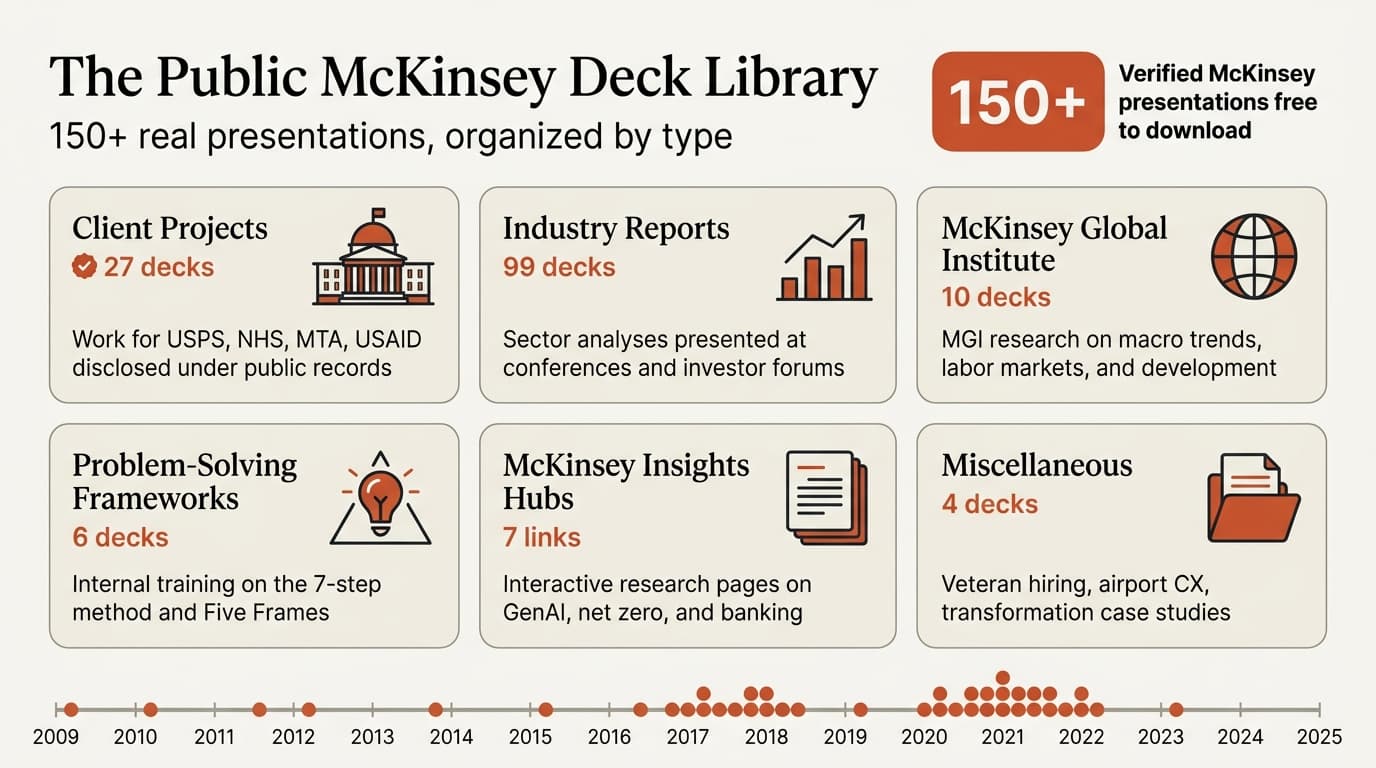
Study 150+ publicly accessible McKinsey presentations, reports, client-project documents, MGI research, and consulting slide examples organized by category.
- Bob · Former McKinsey and Deloitte consultant with 6 years of experience
- August 9, 2026
- 16 min read
McKinsey slides are widely studied because they combine answer-first titles, structured arguments, data-dense exhibits, and explicit sources. The useful lesson is not a logo, font, or color palette; it is how the deck makes a recommendation understandable when the reader scans only the titles and evidence.
Most client work is confidential. Public examples usually come from government or institutional records, McKinsey-published research, conference material, or documents released by a client. This library organizes more than 150 links by source and topic so you can study the structure without confusing a public report with an internal template.
Last reviewed: 9 August 2026. Links on government and third-party hosts can move. We do not claim that every linked document is free of login requirements or that public availability grants reuse rights. Prefer original institutional and McKinsey sources over reuploads.
Adapt the structure with an original starter
Study the public examples below for their argument and use of evidence. For a deck you can edit yourself, download Deckary's filled QBR and blank PowerPoint starter. These are original Deckary materials, not McKinsey templates or an endorsed product.
Here is an illustrative action-title rewrite:
- Topic title: “Customer onboarding update.”
- Action title: “Assign two specialists to reduce onboarding from 21 to 14 days.”
- Evidence: Show the actual onboarding time next to the target and identify the delayed launch milestones.
- Decision: State who approves the temporary staffing and who reports progress.
Use one claim per slide and keep the source and period under the supporting exhibit. For a single-slide layout, explore the executive summary template. For a custom deck from your own sources, see the AI slide builder.
Why McKinsey Slides Are Worth Studying
Across the public examples, several conventions recur: answer-first titles, disciplined grids, direct chart labels, clear source lines, and sections that move from recommendation to supporting evidence. Not every public report uses the same template, and a research publication should not be mistaken for a client deck.
For consultants, investment bankers, and corporate strategists, these decks are the closest thing to a free masterclass in executive communication. For anyone building a pitch deck or board report, they are a reference library of how to compress a complex argument onto a single slide without losing precision.
Public examples are scattered across client websites, government archives, research pages, and third-party hosts. No single source functions as a complete public McKinsey deck archive.
Client Project Decks (Government & Institutional)
These are the most valuable decks for studying McKinsey's work on transformation, operations, and strategy. They exist on public record because the clients are government agencies, universities, or public institutions subject to disclosure rules.
- SAIL Digital Transformation Roadmap (2025) — 115-page digital transformation for Steel Authority of India.
- The Future of Trash: NYC Waste Containerization (2023) — 95-page report on containerization viability in New York City.
- MTA COVID-19 Financial Impact Assessment (2020) — 38-page revenue model for the Metropolitan Transportation Authority.
- COVID-19 Business Recovery — City of Vancouver (2020) — 26-page report on pandemic economic recovery.
- Chilean Hydrogen Pathway — Final Report (2020) — 65-page strategy for domestic hydrogen production and export.
- DC Transportation & Warehousing Sector Analysis (2020) — 40-page baseline and best-practice review.
- Building a Best-in-Class DOT — NCDOT Review (2019) — 24-page financial improvement plan.
- Customs and Border Protection — Full Strategy (2018) — 200-page multi-deck strategy project.
- University of Arizona 2018 Strategic Plan — 25-page strategic plan with five pillars.
- Lebanon Economic Vision — Full Report (2018) — 1,274-page national economic strategy.
- King County & Seattle Homelessness — Final Report (2017) — 25-page intervention analysis.
- Purdue University Market Access (2017) — high-impact intervention recommendations.
- WMATA Financial & Operational Readout (2016) — Washington Metro board presentation.
- Danish Energy Sector Efficiency Potential (2016) — sector efficiency findings (in Danish).
- Refueling the Innovation Engine in Vaccines (2016) — 40-page NVAC discussion document.
- Armenia 2020 Strategic Development (2015) — national long-term strategy.
- NHS Digitally-Enabled Processes Model (2014) — quantitative benefit model for the UK NHS.
- Capturing UK Electricity Efficiency Potential (2012) — 61-page main deck plus 68-page appendix.
- USPS Retail Channel Strategy (2012) — retail modernization analysis.
- Kimberly-Clark Digital Opportunity Kickoff (2011) — project kickoff deck.
- Accion Strategic Lending Plan (2011) — microfinance strategic lending framework.
- Columbia Arts & Sciences Review (2011) — administrative and financial review summary.
- McKinsey Core Beliefs on Quality (2010) — foundational discussion document.
- USPS Selected Slides (2010) — postal service strategic analysis excerpts.
- USPS Envisioning America's Future Postal Service (2010) — strategic options deck.
- USPS Future Business Model (2010) — 39-page change-lever analysis.
- Stop TB Partnership Global Health Impact (2009) — 54-page board presentation.
Industry Reports and Market Overviews
McKinsey's industry research decks are usually released at conferences, investor forums, or through co-branded publications. These are the most common source of public McKinsey slides.
2023-2025
- Building the Bridge to Global Innovation — China Healthcare (2025)
- Grocery Profitability Outlook — Europe (2025)
- Emerging Generative AI Use Cases in Credit (2025)
- Global Economics Intelligence — February 2024
- Overcoming the European Tech IPO Challenge (2024)
- The State of Fashion 2024
- Global Banking Annual Review — Nordics (2023)
- US Credit Card Issuer Performance — 1Q 2023
- GenAI Effects on the German Labor Market (2023)
- Economic Potential of Generative AI in Norway (2023)
- The Age of Generative AI — Digital Procurement (2023)
- Global Economics Intelligence — April 2023
- Global Economics Intelligence — June 2023
- Global Economics Intelligence — August 2023
- Quantum Technology Monitor — April 2023
2022
- McKinsey Technology Trends Outlook 2022 — annual tech trends report.
- Quantum Technology Monitor — June 2022
- Global Hydrogen Flows — Decarbonization (2022)
- Women in the Workplace 2022
- Battery Materials Demand & Supply Perspective (2022)
- European Consumer Sentiment Survey (2022)
- A Changing Fitness Consumer (2022)
- Driving Innovation at Scale — CalSTRS (2022)
- Global Energy Perspective 2022 — Executive Summary
- Data & Analytics Innovations in Credit Portfolio Management (2022)
2021
- Global Gas Outlook to 2050
- Global Oil Outlook to 2040
- Quantum Technology Monitor — September 2021
- Women in the Workplace 2021
- The Press Forward — Women in News Leadership (2021)
- Diversity Wins: How Inclusion Matters (2021)
- Cloud Value in Cash Management (2021)
- Top Trends in Tech — Executive Summary (2021)
- Race in the Workplace — The Black Experience (2021)
- Accelerating Hybrid-Cloud Adoption in Banking (2021)
- Global Energy Perspective 2021
- Consumer Sustainability Sentiment & Behavior (2021)
- Accelerating Sustainable & Inclusive Growth — ESG Report (2021)
2020
- Diversity, Equity & Inclusion Post-COVID (2020)
- COVID-19 Auto & Mobility Consumer Insights
- Customer-Back Reinvention of the Commercial Domain (2020)
- Accelerating Hybrid Cloud Adoption — Banking (2020)
- New Horizons in Transportation (2020)
- Women's Executive Roundtable (2020)
- COVID-19 & Advancing Asian American Recovery (2020)
- Shattering the Glass Screen — Gender Inequality in Media (2020)
- Addressing Homelessness in King County (2020)
- COVID-19 Briefing Note (2020)
- Responding to COVID-19 — Economic Impact (2020)
- COVID-19 Digital Sentiment Insights (2020)
- COVID-19 Facts & Insights — November Update (2020)
- Global View of Consumer Behavior Amid COVID-19 (2020)
- Quantum Technology Monitor — December 2020
2017-2019
- SDG Guide for Business Leaders (2019) — competitive advantage through the UN Sustainable Development Goals.
- Future of the Finance Function — US Public Sector (2019)
- Future of Work Tripartite Forum — New Zealand (2019)
- Digital & Innovation Strategies — Infrastructure Industry (2018)
- Moving Laggards to Early Adopters — Manufacturing (2018)
- Investment & Industrial Policy: A Perspective on the Future (2018)
- Medical Affairs Perspectives — Japan (2018)
- European Banking Summit 2018
- Future Energy Landscape — Netherlands (2017)
- Technology's Role in Mineral Criticality (2017)
- Digital Luxury Experience (2017)
- Using AI to Prevent Healthcare Errors (2017)
- Cybersecurity Attack — Step-by-Step Overview (2017)
2015-2016
- The CEO Guide to China's Future (2016)
- The Emerging Markets Growth Story (2016)
- Winning Competition Through Organizational Agility (2016)
- Digital Globalization — New Era of Global Flows (2016)
- Overview of M&A, 2016
- Five Keys to Marketing's New Golden Age (2015)
- Changing Landscape in Container Shipping (2015)
- IoT, Mobile Internet & Cloud — Public Services 2030 (2015)
- Restoring Economic Health to the North Sea (2015)
- Challenges in Mining: Scarcity or Opportunity? (2015)
- Insurance Trends — Growth Opportunities for Poland (2015)
Earlier (2009-2013)
- Manufacturing the Future — Global Growth & Innovation (2013)
- Laying Foundations for a Financially Sound Steel Industry (2013)
- Internet of Things & Big Data — Value Creation (2013)
- Mobile Device Market, Trends & Vendors (2012)
- Smart Grid as Disruption — 10 Years Ahead (2011)
- Private Sector Partnerships — African Agriculture (2011)
- Mobile Data — Time for Rationality (2010)
- US Call Center Outsourcing Market Assessment (2010)
- Value Propositions for the Utility Industry (2010)
- Climate Change & the Chemical Industry (2009)
- The Changed Agenda in the Global Sourcing Industry (2009)
Undated Industry Decks
- Leading the Digital Transformation Toward Made in China 2025
- Fab Automation — Artificial Intelligence
- Quality 4.0 — The Future of Quality in Pharma
- Impact of Consumer Trends in Logistics
- Brazil Digital Report
- Blockchain & Digital Assets — NH Governor's Office
- How Nine Digital Frontrunners Can Lead on AI in Europe
- A Future That Works — AI, Automation, Employment & Productivity
- Best Practices in Private Sector Sustainable Procurement
- The Future Trends in the ASEAN Steel Market
- Digital Economy — Trends, Opportunities & Challenges
Continue reading: Fishbone Diagram Examples · Timeline Slides in PowerPoint · Pitch Deck Guide
McKinsey Global Institute (MGI) Research
MGI is McKinsey's in-house think tank. Its research decks are the firm's most-cited public work and often set the narrative for the following year's partner discussions. These are essential references for anyone studying macro trends.
- Outperformers — High-Growth Emerging Economies (2018) — 16-page economic drivers analysis.
- Reinventing Construction — Route to Higher Productivity (2017) — 14-page productivity framework.
- Jobs Lost, Jobs Gained — Workforce Transitions Under Automation (2017) — 16-page projection.
- A Labor Market That Works — Digital Talent Connections (2015)
- Blueprint for the Global Affordable Housing Challenge (2015) — 49-page MGI deck on affordability levers.
- Global Flows in a Digital Age (2014) — trade, finance, people and data flows.
- Attracting Responsible Mining Investment in Fragile States (2014)
- From Poverty to Empowerment — India's Jobs & Services Imperative (2014)
- Perspectives on Manufacturing & Industry 4.0 (2014)
- Context for Global Growth & Development (2014)
Problem-Solving and Framework Training Decks
These are the most-read internal McKinsey decks on the firm's methodology. If you want to learn the thought process behind the slides, start here.
- 7 Steps of Problem Solving — Case Analysis Training (2014) — the canonical problem-solving framework.
- Persuasive Problem Solving in 7 Steps — Training (2011)
- The Five Frames — Guide to Transformational Change — 33-page transformation playbook.
- Business Plan Preparation — Manual for Entrepreneurs
- Global Best Practices in Culture & Capability Building
- McKinsey Quarterly 50th Anniversary Highlights (2015)
Miscellaneous Client & Training Decks
- The Secret of Transformations (2019) — change management principles.
- From Touchpoints to Journeys — Airport Customer Experience (2016) — top ten airport complaints.
- How Companies Can Capture the Veteran Opportunity (2012) — 34-page hiring business case.
- The Business of Empowering Women (2009) — corporate opportunity analysis.
McKinsey Insights — Online Research Hubs
Beyond downloadable decks, several McKinsey Insights pages host interactive versions of the firm's most-cited current research. These are worth bookmarking for live updates.
- The Economic Potential of Generative AI (2023)
- What Could a New Era Mean for Latin America (2023)
- Reimagining Economic Growth in Africa (2023)
- An Affordable, Reliable, Competitive Path to Net Zero (2023)
- Commercial Satellite Constellations — Expectations vs Reality (2023)
- A New Future of Work — AI & Reskilling in Europe (2024)
- Banking on Interest Rates — Playbook for Volatility (2024)
What Makes McKinsey Slides Effective
Reading 150+ decks in sequence exposes the formatting discipline that the firm enforces internally. These are the patterns that appear in almost every deck, regardless of industry or office.
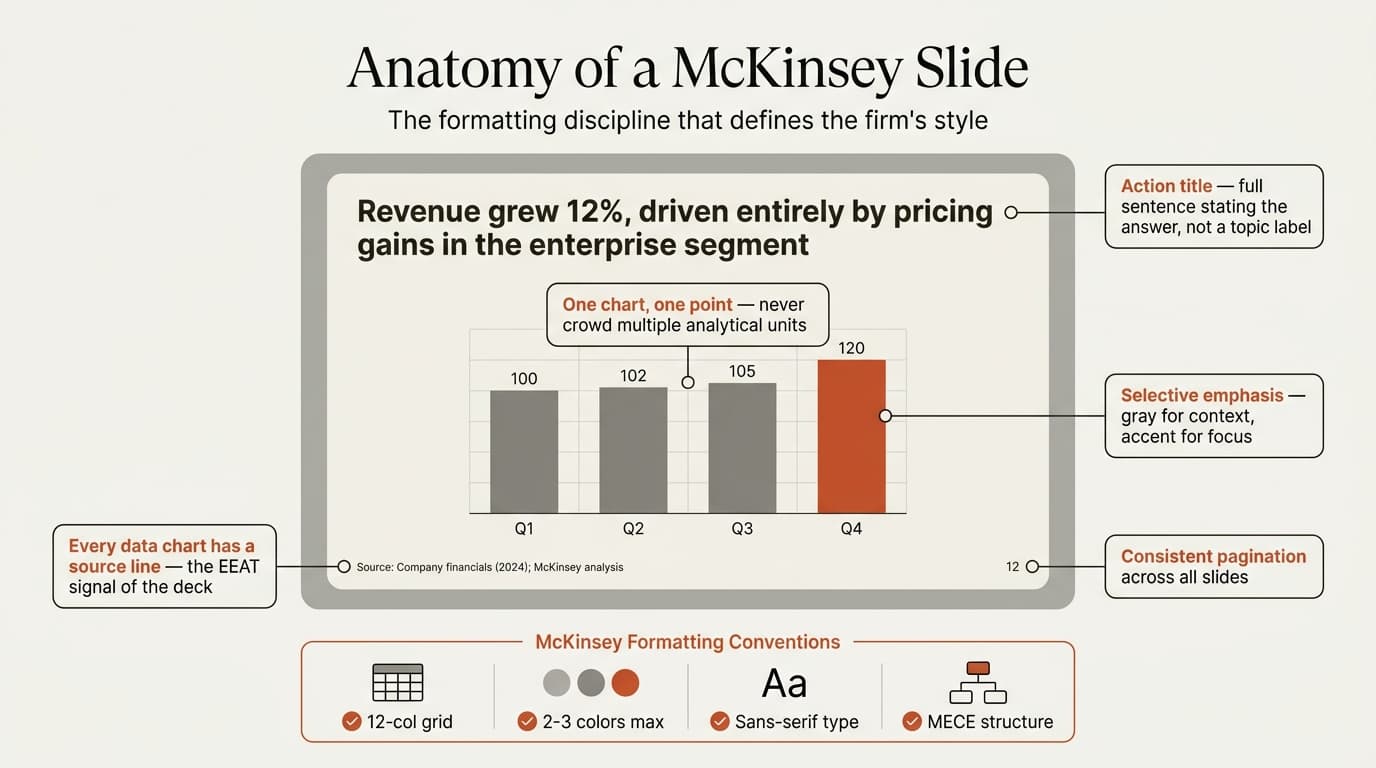
Action titles carry the argument. Every slide title is a full sentence that states the answer, not a topic label. "Revenue grew 12% driven by pricing, not volume" replaces "Revenue Analysis." A reader can flip through the deck reading only titles and come away with the full narrative — this is the Pyramid Principle in action.
One chart, one point. McKinsey slides rarely crowd more than one analytical unit onto a page. Dense financial exhibits get their own slide; supporting context lives in a footnote or appendix. This is the opposite of most corporate decks, which try to cram three charts and a table onto a single page.
Austere formatting. Two or three colors maximum. Sans-serif type (usually Arial or Helvetica). Tight margins. No drop shadows, no gradients, no decorative elements. The visual restraint forces the content to do the work.
Footnoted sources on every data chart. Every number ties back to a specific source, usually in 7-point text below the chart. This is the EEAT signal inside the deck itself — the partner-level reader trusts the chart only when the source is visible.
MECE category structures. When the deck decomposes a problem into parts, the parts are Mutually Exclusive and Collectively Exhaustive. You see this most clearly in issue trees and in BCG-style 2x2 matrices where the four quadrants cover the full logical space.
Grid-aligned layouts. Every shape, chart, and text box aligns to a consistent grid. The effect is calm and easy to read even when a slide is information-dense. This is where most non-consulting decks fall apart — inconsistent alignment reads as amateur even when the content is strong.
Formatting Patterns You Can Copy
- Write the action title first, build the chart second. If you cannot state the answer in one sentence, you do not yet know what the slide is saying.
- Put the executive summary on page 2. One slide, three bullets, stated as conclusions. Executives read this and nothing else.
- Use waterfall charts for bridges. Revenue bridges, cost walks, margin walks — the waterfall is McKinsey's default for any "explain the delta" slide.
- Use Mekko charts for market sizing. Width and height both carry meaning, making it the natural choice for market share by segment analyses.
- Use Gantt charts for roadmaps. Implementation timelines and transformation roadmaps almost always use a Gantt layout with phases on the Y-axis and time on the X-axis.
- Footnote every number. Source, date, methodology. If you cannot footnote it, you should not be citing it.
- Align to a 12-column grid. Set your PowerPoint guides at 12 equal columns and snap everything to them. The discipline is immediate and visible.
- Limit the palette. Two brand colors plus black, white, and two grays. Every other deck that tries more ends up looking cluttered.
Building McKinsey-Style Slides in PowerPoint
The formatting work behind a McKinsey-quality deck is mechanical — grid alignment, consistent spacing, waterfall connectors, footnote positioning. It is the part of consulting work that is most amenable to automation.
Deckary is built for the same professional workflow without presenting itself as an official McKinsey product. Use AI for a first draft, then refine the action title, evidence, chart, sources, and layout inside PowerPoint. The add-in also includes consulting charts, templates, icons, and shortcuts for the manual production work that remains.
For a practical starting point, open the McKinsey-style slide guide, choose a relevant consulting template, and rebuild the pattern with your own evidence rather than copying a public slide.
Responsible Use of Public Consulting Decks
- Use examples to study structure, not to imply firm affiliation.
- Do not copy confidential, personal, client-sensitive, or proprietary material.
- Check the original host's copyright and reuse terms.
- Replace all example data, logos, sources, and recommendations with your own.
- Link to the original public source when discussing or quoting a deck.
- Treat third-party uploads cautiously; they may be incomplete, outdated, or unauthorized.
If you want to rebuild any of the patterns in the decks above — an issue tree, a 2x2 matrix, a competitive landscape table — the slide library has pre-formatted versions of all of them. For the step-by-step slide build process, see how to make McKinsey-style slides in PowerPoint.
Frequently Asked Questions About McKinsey Slides
Why are most McKinsey presentations confidential? Client confidentiality is central to the consulting contract. Decks enter the public record only when the client is legally obligated to disclose (government agencies, public universities), when McKinsey publishes research under its own name (MGI, McKinsey Insights, McKinsey Quarterly), or when a deck is presented at an industry forum with the client's permission.
What is the McKinsey presentation template? There is no single public “McKinsey template.” Public examples show recurring patterns—action titles, structured evidence, restrained formatting, and source notes—but layouts vary by document type, client, practice, and publication format.
How long is a typical McKinsey deck? There is no reliable public standard. Length depends on the decision, audience, project phase, and whether the file is a client readout, working deck, appendix, or published research report. Study structure and information density rather than copying a slide count.
What chart types does McKinsey use most? Public consulting decks commonly use waterfalls for reconciliations, stacked bars for composition, scatter plots for two-variable analysis, timelines for implementation, and matrices for strategic choices. Select the chart that proves the slide's claim rather than copying a firm-specific convention.
Can I use a McKinsey slide verbatim in my own work? No. The decks are copyrighted even when publicly posted. Study them as references, rebuild the layouts with your own data, and cite McKinsey when you are borrowing an analytical framework.
Related Guides
- The Pyramid Principle: Structuring Arguments Like McKinsey
- MECE Framework: The McKinsey Structure for Problem Solving
- McKinsey 7S Framework
- GE–McKinsey Matrix Guide
- Waterfall Charts in PowerPoint: The Complete Guide
- Mekko Chart in PowerPoint: When to Use and How to Build
- Pitch Deck Template for Founders
- Consulting Slide Templates — Free Download