30-60-90 Day Plan Template: Guide, Examples, and Best Practices
30-60-90 day plan template guide with structure, examples, and best practices for new hires, managers, and executives. Learn what to include in each phase.
One in three new hires leaves within the first 90 days. The problem is not capability—it is the absence of structure. When new employees lack clear priorities, measurable milestones, and phase-specific goals, they spend weeks guessing what success looks like instead of delivering it.
A 30-60-90 day plan divides the first three months into learning, contributing, and full ownership phases. The plan aligns expectations between the new hire and manager, accelerates time to productivity, and surfaces issues early when they are still fixable. After building 30-60-90 day plans for 50+ new hires and managers across strategy consulting, due diligence, and enterprise software implementations, we have tracked which structures reduce early turnover (specific milestones, weekly check-ins, measurable outcomes) and which create false confidence until the 90-day mark reveals misalignment.
This guide covers what to include in each phase, template examples for employees and managers, measurement frameworks, and common mistakes that turn structured onboarding into a checkbox exercise.
What Is a 30-60-90 Day Plan?
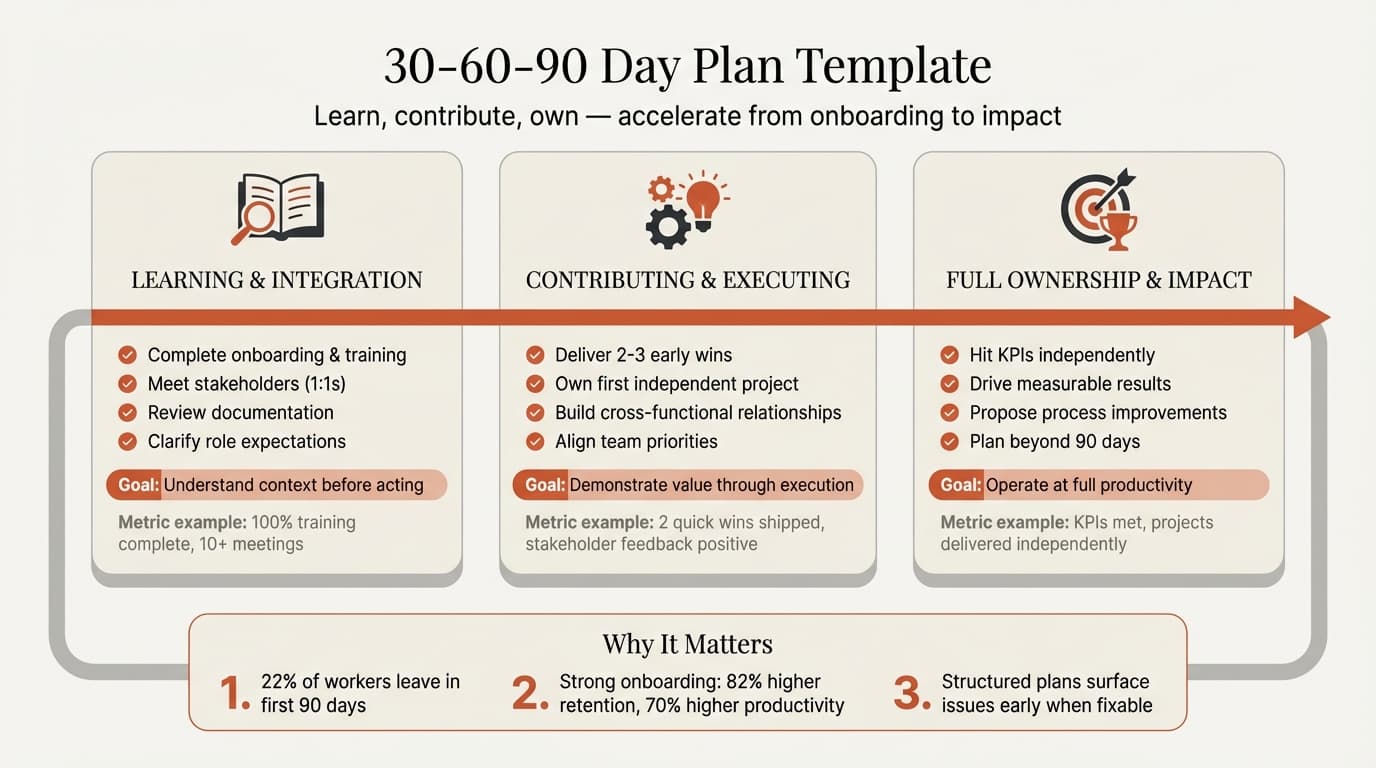
A 30-60-90 day plan is a structured roadmap outlining goals and milestones for the first 30, 60, and 90 days in a new role. It divides the onboarding period into three phases: learning and integration (days 1-30), contributing and executing (days 31-60), and full contribution with independent ownership (days 61-90).
The plan serves multiple purposes:
- For new hires: Provides clear expectations, measurable success criteria, and a framework for prioritizing early work when everything feels urgent
- For managers: Establishes accountability, surfaces skill gaps early, and creates checkpoints for course correction before small issues become performance problems
- For organizations: Reduces early turnover, accelerates time to full productivity, and standardizes onboarding across teams
30-60-90 day plans originated in sales roles where quota attainment timelines drove structured ramp plans. The framework now applies to new employees, newly promoted managers, executives joining organizations, and anyone transitioning into a role where early wins and relationship building determine long-term success.
Why 30-60-90 Day Plans Matter
Organizations with strong onboarding processes see 82% higher retention and 70% higher productivity from new hires. Without structure, 22% of workers leave within the first 90 days—before they have delivered meaningful value.
30-60-90 day plans reduce early turnover by clarifying expectations upfront, creating scheduled check-ins at days 30, 60, and 90, and surfacing misalignment early when there is still time to course-correct.
For new managers specifically, up to 60% fail within the first 24 months. A 30-60-90 plan creates structure—managers spend days 1-30 listening and learning before making decisions they cannot reverse.
30-60-90 Day Plan Structure
The plan follows a three-phase progression: learn, contribute, own. Each phase has distinct goals, deliverables, and success measures.
Days 1-30: Learning and Integration
The first 30 days prioritize learning—company processes, team dynamics, stakeholder relationships, and role-specific knowledge. New hires should resist the urge to deliver early wins before they understand the context. Premature action creates rework.
Phase 1 goals:
- Complete onboarding and training. Finish compliance training, system access setup, and role-specific certifications.
- Meet stakeholders. Schedule 1:1 meetings with team members, cross-functional partners, and leadership to understand priorities and working styles.
- Review existing documentation. Read process docs, past project reports, strategic plans, and performance data to understand what has been tried and what succeeded.
- Clarify role expectations. Align with your manager on success metrics, decision-making authority, and which projects or responsibilities take priority in the first quarter.
Deliverables for days 1-30:
- List of completed training modules
- Notes from stakeholder meetings (pain points, priorities, improvement suggestions)
- Summary of learnings from document review
- Draft priorities for days 31-60, reviewed with manager
Success measures:
- Training completion percentage
- Number of stakeholder meetings held
- Manager sign-off on understanding of role scope
This phase is not passive. Learning happens through active inquiry—asking questions, identifying gaps, and testing assumptions. The output is not deliverables; it is context that informs better decisions in phases 2 and 3.
Days 31-60: Contributing and Executing
By day 31, new hires should shift from learning to contributing. The goal is not full ownership yet—it is demonstrating capability through early wins while building competency on core responsibilities.
Phase 2 goals:
- Deliver early wins. Identify small, high-visibility improvements that demonstrate value without requiring deep organizational knowledge.
- Take on independent projects. Begin owning work end-to-end with manager review, rather than shadowing or assisting.
- Refine team priorities. For managers, this is the phase to align the team's work with business goals based on observations from days 1-30.
- Build cross-functional relationships. Move beyond introductory meetings to active collaboration—co-owning projects, resolving blockers, negotiating trade-offs.
Deliverables for days 31-60:
- 2-3 completed early wins with measurable impact
- First independently owned project or deliverable
- Revised team priorities (for managers) or skill development plan (for individual contributors)
- Feedback from peers and manager on collaboration and execution
Success measures:
- Early wins delivered on time with measurable outcomes
- Stakeholder feedback on collaboration quality
- Manager assessment of independent work quality
Days 61-90: Full Contribution and Independent Ownership
By day 61, new hires should operate at or near full productivity. The training wheels come off—work is independently owned, decisions are made without constant manager review, and contributions drive measurable business results.
Phase 3 goals:
- Own projects independently. Deliver work without manager review on execution details (managers review outcomes, not process).
- Drive measurable results. Hit KPIs, close deals, ship features, reduce cycle time—deliver outcomes tied to business metrics.
- Improve processes. Based on 60 days of observation, propose process improvements, eliminate bottlenecks, or introduce new tools.
- Plan beyond 90 days. Identify longer-term strategic initiatives, skill development needs, or team changes (for managers) to own in months 4-6.
Deliverables for days 61-90:
- Major project or initiative delivered independently
- Measurable contribution to team KPIs or business metrics
- Process improvement proposal or implemented change
- 90-day performance review with manager, covering accomplishments and next-phase priorities
Success measures:
- KPIs met or exceeded
- Projects delivered on time and on scope without escalation
- Stakeholder confidence in independent decision-making
- Manager assessment: new hire operates at expected level for role
By day 90, new hires should no longer feel "new." They understand the organization, own their responsibilities, and deliver results without requiring disproportionate manager time. If that is not true by day 90, the 30-60-90 plan surfaced the gap—which is its value.
Continue reading: 5 Whys Examples · Timeline Slides in PowerPoint · Investment Banking Pitch Book
Use consulting-grade layouts in PowerPoint
Start from structured business slides and customize them in your own deck. 10 free AI prompts. No credit card required.
30-60-90 Day Plan Template Examples
New Employee 30-60-90 Day Plan Template
ROLE: Senior Analyst, Strategy Team
EMPLOYEE: [Name]
START DATE: March 1, 2026

DAYS 1-30: LEARNING AND INTEGRATION

Goals:
- Complete onboarding (compliance, system access, training modules)
- Meet all team members (8 analysts, 3 managers, 1 partner)
- Review past 5 client projects to understand methodology and deliverables
- Shadow 2 client meetings to observe partner engagement style
- Clarify role expectations and success metrics with manager

Deliverables:
- Onboarding checklist 100% complete by March 7
- 1:1 meeting notes from all 12 team members by March 14
- Summary of learnings from project review (2-page memo) by March 21
- Draft priorities for days 31-60, reviewed with manager by March 28

Success Measures:
- Training modules completed
- Manager sign-off on understanding of role scope and success criteria
- Positive feedback from team members on engagement during 1:1s

Check-in: March 28 (end of day 28)

---

DAYS 31-60: CONTRIBUTING AND EXECUTING

Goals:
- Lead one workstream on active client engagement (competitive analysis)
- Deliver 2 early wins (update analysis template, automate data pull)
- Present findings to client in final presentation (with partner review)
- Build relationship with 3 cross-functional partners (data, design, tech)

Deliverables:
- Competitive analysis workstream complete by April 15
- 2 early wins implemented with measurable impact (time saved, error reduction)
- Client presentation delivered (partner feedback: ready to present solo next time)
- Feedback from cross-functional partners on collaboration quality

Success Measures:
- Workstream delivered on time, partner rates quality as "meets expectations"
- Early wins show measurable improvement (quantify time/quality gains)
- Client feedback positive (via partner debrief)

Check-in: April 28 (end of day 59)

---

DAYS 61-90: FULL CONTRIBUTION AND INDEPENDENT OWNERSHIP

Goals:
- Own full client workstream independently (no partner review before delivery)
- Hit utilization target (75% billable hours)
- Propose one process improvement based on 60 days observation
- Plan skill development for next quarter (advanced Excel, SQL, presentation coaching)

Deliverables:
- Complete workstream delivered to client independently by May 20
- Utilization target met (track weekly, report monthly)
- Process improvement proposal (automation, template, workflow change) by May 25
- 90-day performance review with manager and skill development plan by May 28

Success Measures:
- Client satisfaction score (via partner feedback): meets or exceeds expectations
- Utilization: 75% or higher
- Manager assessment: operates independently, ready for increased responsibility

Check-in: May 28 (end of day 90)
New Manager 30-60-90 Day Plan Template
ROLE: Engineering Manager, Product Team
MANAGER: [Name]
START DATE: March 1, 2026

DAYS 1-30: LEARNING AND LISTENING

Goals:
- Meet 1:1 with all 8 direct reports to understand their work, challenges, and career goals
- Observe team rituals (standup, sprint planning, retros) without making changes
- Review team metrics (velocity, cycle time, bug rates, satisfaction scores)
- Clarify expectations with own manager (priorities, decision authority, success metrics)
- Meet cross-functional partners (product, design, QA) to understand collaboration patterns

Deliverables:
- 1:1 notes from all 8 direct reports by March 10
- Summary of team health assessment (strengths, gaps, risks) by March 21
- Expectations alignment doc with own manager by March 14
- Cross-functional stakeholder feedback (what is working, what needs improvement) by March 25

Success Measures:
- Direct reports feel heard (anonymous feedback: new manager listened and asked good questions)
- Manager sign-off on team assessment and day 31-60 priorities

Check-in: March 28 (end of day 28)

---

DAYS 31-60: CONTRIBUTING AND ALIGNING

Goals:
- Identify 2-3 quick wins that improve team effectiveness without major disruption
- Refine team priorities to align with business goals (based on day 1-30 observations)
- Begin 1:1 coaching with direct reports on performance or career development
- Address one process issue flagged in team assessment (meeting overload, unclear priorities, tool friction)

Deliverables:
- 2-3 quick wins implemented (examples: reduce meeting time 20%, clarify sprint goals, improve documentation)
- Revised team priorities doc, reviewed with own manager and team by April 15
- 1:1 coaching plans started for all direct reports by April 20
- Process improvement implemented with measurable impact (time saved, clarity improved) by April 28

Success Measures:
- Quick wins show measurable improvement (team velocity, satisfaction, or cycle time)
- Team feedback: priorities are clearer, manager is adding value
- Own manager assessment: aligning team work with business goals effectively

Check-in: April 28 (end of day 59)

---

DAYS 61-90: FULL OWNERSHIP AND STRATEGIC PLANNING

Goals:
- Own team performance independently (hiring, performance management, delivery)
- Hit team KPIs (ship 2 features, maintain velocity, reduce bug escape rate by 15%)
- Propose strategic initiative for next quarter (new tool, process change, team expansion)
- Complete performance reviews for all direct reports (if timing aligns)

Deliverables:
- Team KPIs met or progress clearly on track by May 20
- Strategic initiative proposal (business case, resource needs, timeline) by May 25
- Performance reviews complete (if applicable) or development plans updated by May 28
- 90-day retrospective with own manager and team (what is working, what to adjust) by May 28

Success Measures:
- Team KPIs: on track or exceeded
- Direct report satisfaction: manager is effective, providing clear direction and support
- Own manager assessment: ready for full ownership, no longer "new"

Check-in: May 28 (end of day 90)
Best Practices for Creating 30-60-90 Day Plans
Start with the end in mind. Define what "successful 90 days" looks like. Work backward to identify what must be true at day 60 and day 30. This prevents front-loading easy tasks and back-loading critical learning.
Make goals measurable. "Learn the team's workflow" is vague. "Shadow 3 team members for a full day each, document their process, and identify 2 pain points per role" is measurable.
Balance learning and doing. New hires operate at 25% productivity in the first 30 days, with productivity increasing another 25% each subsequent month. Resist the pressure to deliver immediately in days 1-30.
Schedule check-ins at each phase boundary. Schedule 60-minute meetings with your manager at days 30, 60, and 90 to review progress, adjust priorities, and surface issues.
Collaborate with your manager. The new hire drafts the plan, but the manager must approve it. Draft your plan within the first week, review it with your manager by day 10, and finalize it by day 14.
Identify early wins strategically. The best early wins are high visibility, low risk, and demonstrate skills the team values. Automating a manual report is better than volunteering for a complex strategic project you lack context to execute well.
Update the plan as you learn. Review the plan weekly and adjust based on new information. The plan is a roadmap, not a script.
For managers: listen before changing. Spend the first 30 days listening and observing. Save changes for days 31-60 when you have context.
Measuring Success in a 30-60-90 Day Plan
Success metrics vary by role, but every plan should include measurable outcomes at each phase boundary. Vague goals ("build relationships") are not accountable. Measurable goals ("meet 1:1 with all 8 team members by day 20") create clarity.
| Phase | Individual Contributors | Managers |
|---|---|---|
| Days 1-30 | Training modules completed (target: 100%), stakeholder meetings held (target: 10+), documentation reviewed (pages/reports) | 1:1s with direct reports (target: 100%), team metrics reviewed (velocity, satisfaction, cycle time), expectations aligned with own manager |
| Days 31-60 | Early wins delivered (target: 2-3), first independent project completed, peer feedback score (target: 4/5 or higher) | Quick wins implemented (target: 2-3), team priorities revised and approved, process improvement shipped |
| Days 61-90 | KPIs met (sales quota, feature shipped, tickets closed), project delivered independently, process improvement proposal submitted | Team KPIs on track (velocity, quality, satisfaction), strategic initiative proposed, direct report development plans updated |
Red Flags at Each Phase
If these patterns appear, escalate immediately:
- Day 30: New hire has not met key stakeholders, completed training, or clarified role expectations → Manager needs to intervene and create structure
- Day 60: No early wins delivered, first independent project missed deadline or required excessive manager intervention → Skill gap or misaligned role level
- Day 90: KPIs not met, stakeholders lack confidence in independent work, manager still heavily involved in execution → Performance issue or role mismatch
Identifying issues at day 30 or 60 creates time to course-correct. Identifying them at day 90 leaves no buffer.
Common 30-60-90 Day Plan Mistakes
1. Creating a plan and never revisiting it. Review the plan weekly, update priorities based on what you learn, and adjust goals if context changes.
2. Front-loading easy tasks to appear productive. Structure the plan to tackle the most important learning and relationship-building tasks first, even if they are less comfortable.
3. Skipping the learning phase to deliver early. New hires who jump into execution on day 1 create rework. Organizations with onboarding programs extending beyond 90 days see 31% higher productivity. Spend days 1-30 learning.
4. Setting vague, unmeasurable goals. "Build relationships with stakeholders" is not a goal. "Meet 1:1 with 10 cross-functional partners by day 25, document their priorities and pain points" is a goal.
5. No manager buy-in. Collaborate on the plan within the first two weeks and get explicit sign-off on goals and success criteria.
6. For managers: changing too much too fast. New managers who reorganize the team, change processes, and shift priorities in days 1-30 lose credibility. Spend days 1-30 listening. Make changes in days 31-60 when you have earned trust and gathered context.
7. Treating day 90 as the finish line. At day 90, the new hire should transition to normal performance management—quarterly goals, ongoing 1:1s, skill development.
Using PowerPoint for 30-60-90 Day Plans
Most 30-60-90 day plans are presented during interviews or onboarding meetings. A slide deck communicates the plan more effectively than a Word document because it forces conciseness and supports visual elements like timelines and milestone charts.
Recommended slide structure:
- Title slide (role, name, start date)
- Overview slide (goals for each phase)
- Days 1-30, 31-60, and 61-90 slides (priorities, deliverables, success measures)
- Timeline slide (Gantt chart or roadmap showing milestones)
- Success metrics slide (measurement framework)
Deckary provides 30-60-90 day plan templates inside PowerPoint with pre-built milestone timelines, Gantt charts, and dashboard layouts. For visualizing roadmaps and phase-based plans, see our guide on creating timelines in PowerPoint.
Key Takeaways
- A 30-60-90 day plan divides onboarding into learning (days 1-30), contributing (days 31-60), and full ownership (days 61-90). Each phase has distinct goals, deliverables, and success measures that accelerate time to productivity.
- Organizations with strong onboarding processes see 82% higher retention and 70% higher productivity. 30-60-90 plans provide the structure that makes onboarding work.
- Days 1-30 prioritize learning—stakeholder meetings, documentation review, training completion. Resist the pressure to deliver early wins before understanding context.
- Days 31-60 shift to contributing—deliver 2-3 early wins, take on independent projects, and build cross-functional relationships. This is when credibility is earned.
- Days 61-90 require full ownership—hit KPIs, deliver projects independently, and propose process improvements. By day 90, new hires should no longer feel "new."
- The new hire drafts the plan, but the manager must approve it. Collaborate within the first two weeks and schedule check-ins at days 30, 60, and 90 to review progress and adjust priorities.
- For new managers, spend days 1-30 listening and observing before making changes. Up to 60% of new managers fail within 24 months—structured onboarding reduces that risk.
Related Guides
- Progress Report Template — weekly and monthly reporting for tracking milestones against 30-60-90 day plans
- Status Report Template — daily or weekly updates during onboarding phases
- Agile vs Waterfall — methodology-specific onboarding patterns for technical roles
- Scrum Framework Guide — sprint-based onboarding for engineering teams
- RACI Matrix Examples — accountability framework for defining responsibilities in new roles
Sources
- TMI: The Complete Guide to Creating Effective 30-60-90 Day Plans
- AIHR: Employee Onboarding Statistics & Trends 2026
- Yomly: 50+ Employee Onboarding Statistics Impacting Hiring
- Eddy: 35 Great Statistics About Employee Onboarding
- Preppio: Employee Onboarding Research & Statistics
- AMA: New Manager's 30-60-90 Day Plan for Success
- LeadDev: A New Manager's Guide to a 30-60-90-Day Plan
Use consulting-grade layouts in PowerPoint
Start from structured business slides and customize them in your own deck. 10 free AI prompts. No credit card required.