After Action Review Template: Guide, Examples, and Best Practices
After action review template guide with structure, format, and examples. Learn the 4 key AAR questions, best practices, and how AARs differ from post-mortems.
The most common failure in organizational learning is skipping the review entirely. Projects end, teams disband, and the same mistakes repeat in the next initiative because no one paused to ask: what did we intend, what actually happened, and why was there a difference?
After action reviews solve this by creating a structured reflection process immediately after events conclude. The format centers on four questions designed to extract actionable lessons before context fades and team members move on. After conducting AARs for 35+ transformation programs and product launches—covering strategy engagements, due diligence sprints, and executive presentations—we have tracked which review structures produce genuine learning (blame-free, conducted within 48 hours, all participants included) and which become perfunctory check-the-box exercises that generate no behavioral change.
This guide covers AAR structure, the four core questions, facilitation techniques, and the critical differences between AARs and post-mortems that determine whether your team learns from experience or repeats the same patterns.
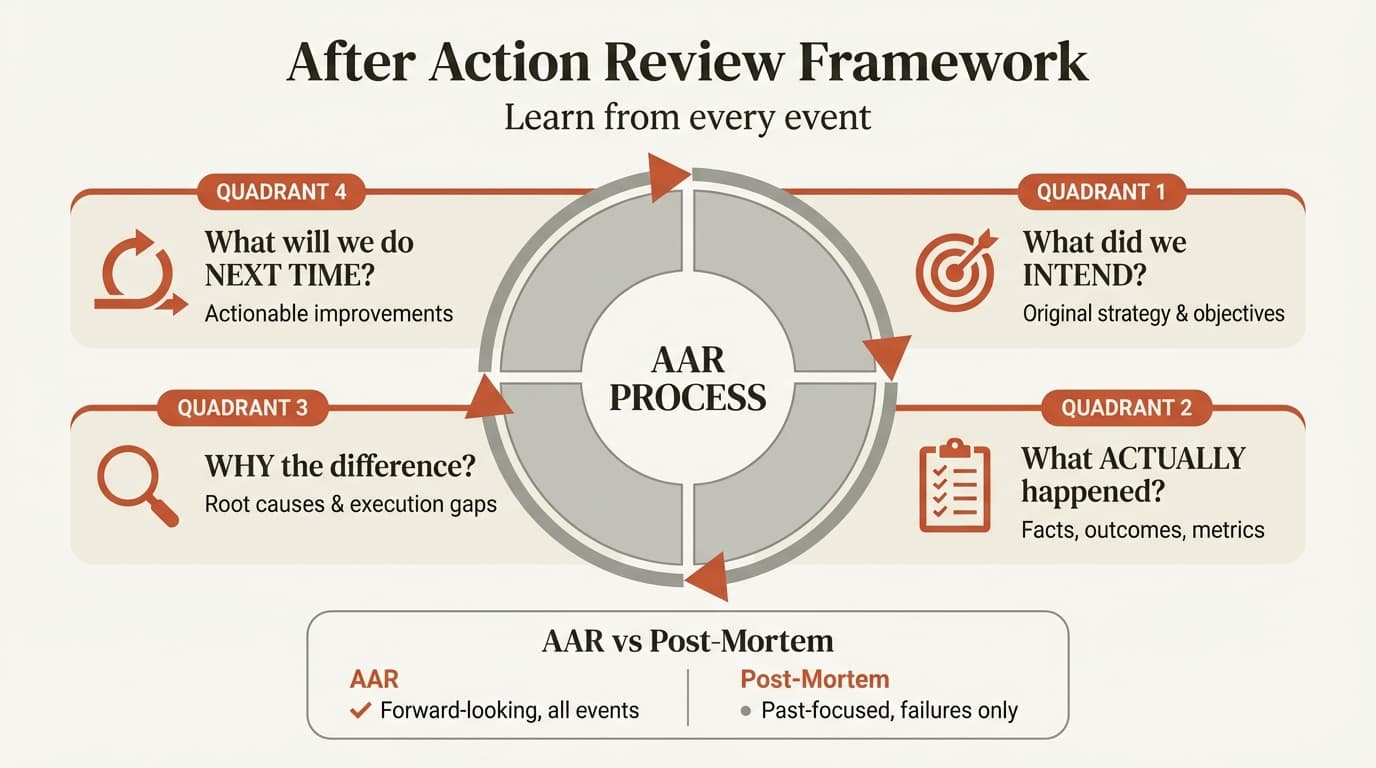
What Is an After Action Review?
An after action review (AAR) is a structured discussion designed to help teams learn from completed events by comparing intended strategy to actual execution. Developed by the U.S. Army in the 1970s, the AAR was originally used to capture lessons from simulated battles at National Training Centers. The technique took nearly a decade to fully embed in military culture before migrating to corporate settings in the 1990s when former military leaders joined management teams.
The AAR differs from traditional performance reviews in three ways:
- Forward-looking — The goal is preparing for the next challenge, not assigning blame for past failures
- All participants included — Leaders and individual contributors analyze performance together, not hierarchically
- Immediate timing — Conducted within 24-48 hours while memory is fresh, not weeks later when context has faded
AARs work for any completed event: finished projects, product launches, major client presentations, quarterly initiatives, critical incidents, or training exercises. Wharton Executive Education uses AARs to debrief simulations. Leaders analyze execution gaps and adapt decision-making frameworks for future scenarios.
AAR vs Post-Mortem
The terms sound similar but represent different approaches to organizational learning. AARs focus on preparing for future challenges; post-mortems explain what went wrong.
| Factor | After Action Review (AAR) | Post-Mortem |
|---|---|---|
| Purpose | Prepare for next event by learning from this one | Explain what happened and why it failed |
| Time focus | Future-oriented—what to do next time | Past-oriented—dissecting what went wrong |
| Scope | Includes successes and failures | Typically triggered only by failures |
| Tone | Blame-free, learning-focused | Often investigative, can assign accountability |
| Timing | Immediately after event (24-48 hours) | Weeks or months after event concludes |
| Participants | All team members, including leaders | Often conducted by separate review team |
When to use AARs: After any significant completed event, successful or not. The project launched on time and under budget? Run an AAR to capture what worked so you can replicate it. The client presentation went poorly? Run an AAR to identify execution gaps before the next pitch.
When to use post-mortems: When something failed and stakeholders need a formal explanation. Post-mortems answer "what happened and who was responsible?" AARs answer "what do we do differently next time?"
Many organizations skip AARs for successful projects, assuming there is nothing to learn. This is a mistake. As Peter Senge notes in The Fifth Discipline, the most valuable lessons often come from understanding why something succeeded—so you can repeat it deliberately rather than accidentally.
The 4 Core AAR Questions
Every AAR is structured around four questions. The questions appear simple, but answering them honestly requires psychological safety—team members must feel comfortable challenging current practices and acknowledging where their own performance contributed to gaps.
1. What Did We Intend to Accomplish?
Start by restating the original strategy, objective, or desired outcome. This is not a trick question—the goal is alignment, not catching people who forgot the plan.
Example answers:
"We intended to deliver the Phase 1 requirements document to the steering
committee by Feb 15, with full sign-off so we could begin vendor selection
the next week."

"Our strategy was to close the enterprise deal by EOQ by focusing on the
CFO's cost-reduction mandate, with pricing positioned at a 30% discount
to the incumbent."

"The objective was to complete 50 customer interviews in 2 weeks to validate
product-market fit for the new pricing tier."
If team members disagree about what the original plan was, that misalignment itself is a critical learning. Note the discrepancy and return to it in question 3.
2. What Actually Happened?
Describe execution without judgment. State facts: timelines, deliverables, metrics, outcomes. Avoid interpreting or assigning blame at this stage—that comes in question 3.
Example answers:
"We delivered the requirements document on Feb 18, 3 days late. The steering
committee approved it with 12 minor revisions. Vendor selection started
Feb 21, 4 days behind plan."

"The CFO declined to move forward after the final presentation. Her stated
reason was that the 30% discount did not justify switching costs. She
mentioned two features the incumbent had that we do not."

"We completed 32 customer interviews in 2 weeks, 18 short of target. Of
the 32, 22 said they would upgrade to the new tier, 8 said no, 2 were
undecided."
If participants disagree on what happened, capture both perspectives. The facilitator should not adjudicate—document the divergence and explore it in question 3.
3. Why Was There a Difference Between Intent and Execution?
This is where learning happens. Identify root causes for execution gaps. The key is creating psychological safety—assigning blame or issuing reprimands is antithetical to the purpose of an AAR. Leaders must openly share where their decisions contributed to gaps. Team members must feel safe acknowledging mistakes without fear of repercussions.
Example root causes:
"We underestimated how long legal review would take. We assumed 3 days
based on previous contracts, but this was a new vendor relationship that
required General Counsel approval. We should have flagged this risk
during planning."

"The CFO cares about feature parity, not just cost savings. We focused
our pitch entirely on ROI without addressing switching friction or feature
gaps. We did not ask her what success criteria mattered most before
building the presentation."

"We scheduled 10 interviews per day but did not account for no-shows and
cancellations. Our actual interview completion rate was 64%. We also spent
the first 3 days refining the script instead of booking interviews in
parallel."
Avoid vague attributions like "communication breakdown" or "insufficient planning." Drill into specifics: what decision, assumption, or action directly caused the gap? For structured root cause analysis techniques, see our guide on root cause analysis examples.
4. What Will We Do Differently Next Time?
Translate insights into actionable changes. Distinguish between one-time fixes (specific to this event) and systematic improvements (apply to all future events).
Example actions:
ONE-TIME FIX: "For the Phase 2 document, we will submit to legal 7 days
before the steering committee deadline instead of 3 days."

SYSTEMATIC IMPROVEMENT: "Add a checklist item to all project plans: identify
contracts requiring General Counsel approval during kickoff, not during
execution. Budget 2 weeks for GC review."

ONE-TIME FIX: "Before the next enterprise pitch, send a pre-call survey
asking the buyer to rank decision criteria: cost, features, implementation
time, vendor stability."

SYSTEMATIC IMPROVEMENT: "Require discovery calls with economic buyers before
building pitch decks. Create a standard discovery template covering budget
authority, decision criteria, incumbent strengths, and evaluation timeline."

SYSTEMATIC IMPROVEMENT: "Set interview targets at 150% of needed sample to
account for 35% no-show rate. Begin outreach and scheduling before finalizing
the script."
For systematic improvements, assign owners and deadlines. "We should do better discovery" is not actionable. "Sarah to create discovery template by Mar 1, team to pilot it on next 3 deals" is.
Continue reading: Lessons Learned Template · Timeline Slides in PowerPoint · Startup Pitch Deck
Use consulting-grade layouts in PowerPoint
Start from structured business slides and customize them in your own deck. 10 free AI prompts. No credit card required.
AAR Template Structure
A formal AAR follows a consistent structure to ensure all perspectives are heard and insights are documented. The template below works for both written reports and live facilitated discussions.
AAR Template Format
EVENT: [Project name, launch, presentation, initiative]
DATE CONDUCTED: [When the AAR happened]
PARTICIPANTS: [All attendees, including facilitator]

1. WHAT DID WE INTEND TO ACCOMPLISH?
   [Original strategy, objectives, success criteria]

2. WHAT ACTUALLY HAPPENED?
   [Facts: timelines, deliverables, outcomes, metrics]

3. WHY WAS THERE A DIFFERENCE?
   [Root causes for gaps, including leadership decisions and team execution]

4. WHAT WILL WE DO NEXT TIME?
   [Specific, assigned actions—both one-time fixes and systematic improvements]

KEY INSIGHTS: [3-5 bullet points capturing major learnings]
ACTIONS: [Action] | Owner: [Name] | Due: [Date]
Facilitation timing: Open with blame-free framing (2 min), Question 1 (5 min), Question 2 (10 min), Question 3 (20 min), Question 4 (15 min), closing recap (3 min). Total: 55 minutes.
AAR Best Practices
Conduct AARs immediately. Research from the U.S. Army shows that AAR effectiveness drops sharply after 48 hours as context fades and participants rationalize outcomes. Schedule the AAR during project kickoff, not as an afterthought.
Create psychological safety. AARs fail when team members fear repercussions. Leaders must model vulnerability by acknowledging their own mistakes first. "I underestimated legal review time" invites others to share execution gaps without fear.
Include everyone who contributed. AARs conducted only by leadership miss frontline insights. The junior analyst may have noticed a client signal that the partner missed. All perspectives matter.
Document and share learnings. J.M. Huber Corporation posts AAR learnings to an internal database so all teams can access them. Without documentation, lessons remain siloed with the original team.
Follow up on assigned actions. AARs that generate action items but no follow-through become performative. Assign owners, deadlines, and accountability for systematic improvements.
Run AARs for successes, not just failures. Understanding why something worked allows you to replicate it deliberately. "We landed the deal—why did our pitch resonate this time when similar pitches failed last quarter?"
AAR Examples
Example 1: Product Launch AAR
EVENT: Mobile App Beta Launch
DATE CONDUCTED: Feb 18, 2026

1. INTENT: Launch beta to 500 users by Feb 15, achieve 70% DAU in week 1.

2. ACTUAL: Launched Feb 17 (2 days late) to 380 users. Week 1 DAU: 52%.

3. GAP CAUSES:
- SSL cert took 5 days instead of 1 day. DevOps queue backlog.
- Recruitment email had generic CTA ("Try the beta"). Only 18% conversion.
- 38% of users never completed onboarding. Exit survey: confusing flow.

4. NEXT TIME:
- Submit SSL requests 10 days in advance (Owner: Marcus, Due: Mar 1)
- Test email CTAs with specific value props sent Tuesday AM (Owner: Marketing, Due: Feb 25)
- Require usability testing before beta launches (Owner: Sarah, Due: Mar 15)

KEY INSIGHTS: Infrastructure takes 2x longer than planned. Generic CTAs don't convert. Onboarding clarity beats feature count.
Example 2: Enterprise Sales Pitch AAR
EVENT: Acme Corp CFO Pitch
DATE CONDUCTED: Feb 20, 2026

1. INTENT: Close deal by EOQ. Position as 30% cost reduction vs incumbent.

2. ACTUAL: CFO declined. Reason: switching costs not justified. Missing SSO and audit logs.

3. GAP CAUSES:
- Pitched cost savings only, ignored switching friction and feature parity.
- No CFO discovery call—only spoke to IT Director (different priorities).
- Used generic deck, not customized for financial services compliance needs.

4. NEXT TIME:
- Require discovery with economic buyers before enterprise pitches (Owner: Tom, Due: Feb 28)
- Create discovery template covering decision criteria, incumbent strengths, compliance (Owner: Priya, Due: Feb 25)
- Build industry-specific decks for regulated sectors (Owner: Rachel, Due: Mar 15)

KEY INSIGHTS: IT buyers care about cost. CFOs care about risk. "Cut spend" means "justify switching costs," not "pick cheapest option."
Common AAR Mistakes
Skipping AARs entirely. The most common failure is not running AARs at all. Projects end, teams disband, and lessons evaporate. Schedule a 30-minute AAR before team members move on.
Conducting AARs weeks after the event. Context fades rapidly. Run AARs within 24-48 hours while memory is fresh.
Turning AARs into blame sessions. If participants fear repercussions, the AAR becomes performative. Everyone agrees the project was great, no one identifies real gaps, and the same mistakes repeat.
Leaders not participating. If leadership skips the AAR or does not share their own mistakes, team members will not be honest. Leaders must model vulnerability: "I should have escalated the legal blocker earlier."
Documenting insights but not acting on them. Convert insights into specific, owned, dated tasks. Otherwise, the same issues reappear in the next project.
Generic root causes. "Communication breakdown" and "insufficient planning" are symptoms, not root causes. Drill into specifics: what communication failed? What planning step was skipped?
Key Takeaways
- After action reviews focus on preparing for the next challenge by comparing intended strategy to actual execution, not assigning blame for past failures. Run them within 24-48 hours while the event is fresh.
- The four core AAR questions are: What did we intend to accomplish? What actually happened? Why was there a difference? What will we do next time? Answer them honestly and document specific, assigned actions.
- AARs differ from post-mortems: AARs are forward-looking and include successes; post-mortems are backward-looking and typically focus on failures. Use AARs for all completed events, not just failures.
- Create psychological safety by having leaders share their mistakes first. Team members will not be honest if they fear repercussions. Blame-free discussion is the prerequisite for genuine learning.
- Document and share AAR insights in a searchable format so other teams can access lessons. Organizations like J.M. Huber and Microsoft post AAR reports to internal databases for company-wide learning.
- Run AARs for successes, not just failures. Understanding why something worked allows you to replicate it deliberately rather than accidentally.
For structuring project reviews with visual timelines and dashboards, Deckary provides AAR templates, Gantt charts, and project tracking layouts inside PowerPoint—see our guide on making Gantt charts in PowerPoint for timeline visualization.
Related Guides
- Progress Report Template — retrospective reporting for tracking project accomplishments over time
- Status Report Template — snapshot reporting for capturing current project conditions
- Root Cause Analysis Examples — structured techniques for identifying why execution gaps occurred
- Lessons Learned Template — project closeout documentation for capturing retrospective insights
- RACI Matrix Examples — accountability framework for defining roles in project reviews
Sources
Use consulting-grade layouts in PowerPoint
Start from structured business slides and customize them in your own deck. 10 free AI prompts. No credit card required.