Investment Banking Pitch Book: Structure, Content & Best Practices
Master investment banking pitch books with proven frameworks for M&A, capital markets, and IPO transactions. Learn structure, valuation methodologies, and what clients expect.
After reviewing 80+ investment banking pitch books from bulge bracket and boutique firms across M&A, capital markets, and restructuring mandates, one pattern emerges consistently: clients allocate less than 10 minutes to initial review. Banks that structure pitch books to surface credibility signals and strategic recommendations within that constraint win mandates. Those that bury insights under generic content lose.
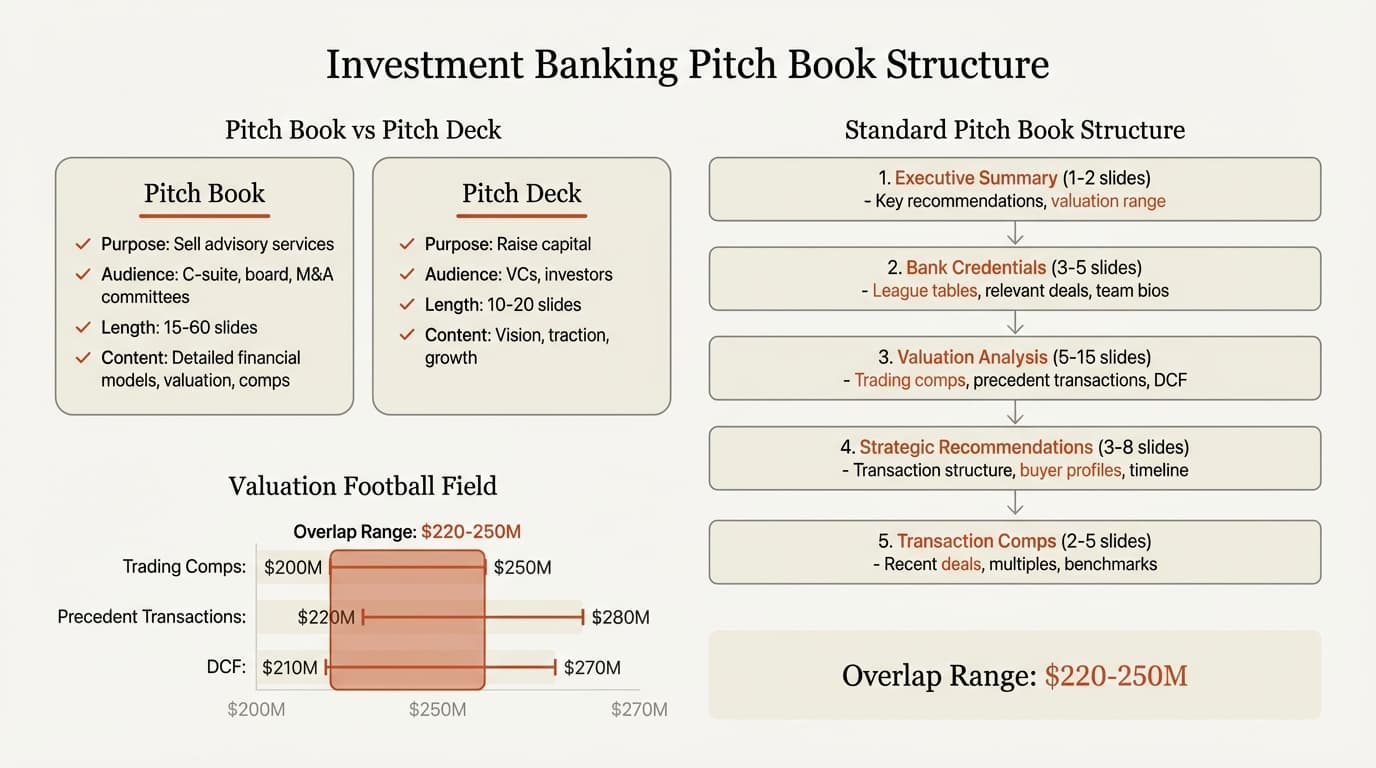
Investment banking pitch books differ fundamentally from startup pitch decks. A pitch book is a strategic presentation created by investment banks to promote advisory services, including detailed buyer/seller analysis, risk minimization strategies, and comprehensive financial models. While pitch books range from 15-25 slides for initial presentations, they often extend to 30-60 slides for comprehensive transaction proposals depending on complexity.
This guide focuses on investment banking pitch book structure, content, and best practices for M&A, capital markets, and IPO transactions. For startup fundraising presentations, see our pitch deck template. For venture capital requirements, see venture capital pitch deck.
What Makes Investment Banking Pitch Books Different
Investment banking pitch books serve a distinct audience with unique evaluation criteria. Understanding what separates IB pitch books from startup pitch decks clarifies structure and content priorities.
Pitch Book vs Pitch Deck
Pitch books are for people who've already shown interest and are now vetting your proposal, including board members, finance heads, legal teams, and M&A committees focused on how, what, and at what risk. Pitch decks are for people who need to be sold on the idea, including early-stage investors who evaluate vision and team.
| Attribute | Investment Banking Pitch Book | Startup Pitch Deck |
|---|---|---|
| Purpose | Sell advisory services to corporate clients | Raise capital from investors |
| Audience | C-suite, board, M&A committees | VCs, angels, growth equity |
| Length | 15-60 slides depending on complexity | 10-20 slides |
| Content depth | Detailed financial models, comps, analysis | High-level metrics, growth trajectory |
| Key focus | Valuation, transaction execution, credentials | Vision, traction, market opportunity |
| Stage | Vetting phase—buyer evaluates execution | Idea phase—seller pitches vision |
Pitch books delve into granular details, making them ideal for formal presentations, while pitch decks emphasize storytelling and visual appeal, making them perfect for initial investor meetings. Investment banking pitch books are typically longer and more information-dense than startup pitch decks, diving deep into transaction details.
Types of Investment Banking Pitch Books
Investment banking pitch books vary by transaction type and mandate:
M&A Pitch Books — Sell-side M&A pitch books include potential buyer lists, valuation summaries, strategic recommendations, and successful deal credentials. Buy-side books profile acquisition targets with valuation ranges, integration plans, and financing structures.
Capital Markets Pitch Books — For equity, debt, and restructuring deals, pitch books emphasize the client's growth story and investment thesis, capital needs and uses, market conditions for fundraising, and comparison of financing alternatives (equity vs debt, public vs private).
IPO Pitch Books — If a tech startup is considering an IPO, pitch books review recent tech IPOs from the past 6-12 months, explain performance, and discuss company profiles that successfully went public. Include financing models showing valuation ranges, proceeds, and post-deal equity structures.
Restructuring Pitch Books — Focus on distressed company analysis, capital structure optimization, liability management, and creditor negotiations with detailed waterfall analysis showing recovery rates by creditor class.
Standard Investment Banking Pitch Book Structure
Almost all investment banking pitch books use a similar structure: Situation (current state), Complication (problem), Hypothesis (solution), then details showing why the hypothesis might be true—including team qualifications, similar transactions, and expected valuation.
Universal Pitch Book Framework
The template is typically divided into five main sections: Company Overview, Industry Overview, Valuation, Transaction Opportunities, and Team Overview. Investment banking pitch books typically include eight core sections: situation overview, bank credentials, market analysis, company analysis, valuation, strategic recommendations, transaction comps, and next steps with appendix.
Standard pitch book outline:
- Cover Page — Bank branding, client name, transaction type, date, confidentiality notice
- Executive Summary — Transaction rationale, key recommendations, valuation range (1-2 slides)
- Situation Overview — Current business position, strategic objectives, market context (2-3 slides)
- Bank Credentials — Relevant experience, league tables, team bios, similar transactions (3-5 slides)
- Market Analysis — Industry trends, competitive landscape, market conditions (3-5 slides)
- Company Analysis — Financial performance, operational metrics, competitive positioning (3-5 slides)
- Valuation Analysis — Comps, precedent transactions, DCF with football field chart (5-15 slides)
- Strategic Recommendations — Transaction structure, buyer/seller profiles, deal timeline (3-8 slides)
- Next Steps — Process, timeline, key milestones, required decisions (1-2 slides)
- Appendix — Detailed financial models, additional comps, legal considerations, supporting materials
The valuation section has the widest range—as little as 1-2 slides in a short pitch book or 20+ slides in a longer one depending on transaction complexity and number of valuation methodologies presented.
Pitch Book Length Guidelines
Investment banking pitch books often range between 15 and 25 slides, though comprehensive presentations can extend to 30-60 slides depending on deal complexity. Real-world examples vary significantly:
- Initial pitch meetings: 15-20 slides covering situation, credentials, high-level valuation
- Comprehensive sell-side M&A books: 30-50 slides with buyer universe, detailed comps, transaction alternatives
- Capital markets IPO books: 40-60 slides including market conditions, roadshow prep, peer performance analysis
The development timeline varies—the process can take anywhere from a couple of days to a few weeks, depending on the client's timeline and team workload.
The Five Critical Pitch Book Sections
Five sections consistently determine whether investment banking pitch books advance to mandate stage: Executive Summary, Bank Credentials, Valuation Analysis, Strategic Recommendations, and Transaction Comps.
1. Executive Summary (First Impression)
The executive summary explains why you're giving the pitch and the call to action or recommendation on one page. This determines whether CFOs and board members read further or dismiss the proposal.
What to include:
- Transaction type and rationale in one sentence
- Indicative valuation range with supporting methodology
- Key strategic benefits (quantified where possible)
- Recommended timeline and next steps
- Clear call to action
Credibility markers:
- Specific valuation range, not vague "We can maximize value"
- Quantified benefits: "$250M enterprise value vs current $180M book value"
- Named comparable transactions with actual multiples
- Concrete timeline with milestone dates
Common mistake: Generic language that could apply to any transaction. "We recommend exploring strategic alternatives to enhance shareholder value" says nothing. "We recommend a sell-side process targeting strategic acquirers, expecting 8-10x EBITDA ($240-300M enterprise value) based on three recent sector transactions, with closing in Q3 2026" is specific and actionable.
2. Bank Credentials (Trust Signal)
The credentials section includes numerous biographies and league tables that show why the bank is the right choice. Clients need proof your team has executed similar transactions successfully.
What to include:
- Team biographies with specific relevant experience
- League tables showing sector rankings
- Recent comparable transactions led by your team
- Sector expertise depth and relationships
- Client testimonials or case studies
Structuring credentials effectively:
- Lead with most relevant experience: if pitching a software M&A deal, lead with software M&A transactions, not generic credentials
- Quantify outcomes: "$850M exit for SaaS company at 12x revenue, 40% premium to initial indicative offers"
- Show consistent sector focus: 15+ enterprise software transactions signals expertise vs 2 software deals among 100 random transactions
Red flags clients see:
- Generic credentials that don't match transaction type
- No recent relevant transactions (nothing in past 12-18 months)
- Junior team with limited sector experience
- League table rankings that cherry-pick favorable time periods or narrow categories
3. Valuation Analysis (Core Deliverable)
Valuation analysis proves your firm can accurately value the business and justify a transaction price. Investment banking pitch books use three core methodologies: comparable company analysis (trading comps), precedent transaction analysis (M&A comps), and discounted cash flow (DCF) analysis.
Comparable Company Analysis (Trading Comps): Trading comps value a company by comparing it to similar public companies—if comparable businesses trade at 10x EBITDA, and your company generates $100M EBITDA, it's worth approximately $1B. Select 5-10 truly comparable public companies based on business model, size, growth, and profitability.
Precedent Transaction Analysis: Precedent transactions value a company based on what acquirers have actually paid for similar companies, reflecting control value—what someone paid to own the entire business. Deals often involve control premiums that inflate valuation, generally resulting in a valuation range higher than public comparables. Select transactions from the past 12-36 months with similar characteristics.
Discounted Cash Flow (DCF): DCF projects future cash flows and discounts to present value using weighted average cost of capital (WACC). Most sensitive to terminal value assumptions and discount rate selection. Provides intrinsic value independent of market sentiment.
Football Field Chart: All three methodologies are presented side by side in a "football field" chart showing the valuation range from each method, with the overlap zone where multiple methodologies agree typically being the most defensible valuation range.
Waterfall charts effectively communicate valuation bridges, showing how adjustments to EBITDA, working capital, debt, and other factors flow through to equity value. Mekko charts can show market segmentation and competitor positioning simultaneously.
4. Strategic Recommendations (Action Plan)
Strategic recommendations discuss the investment bank's services and transaction process along with proposed deal structure and strategic alternatives. This section translates valuation analysis into actionable transaction strategy.
For M&A sell-side pitch books:
- Buyer universe segmentation: strategic vs financial, tier ranking
- Process options: broad auction, targeted process, negotiated sale
- Expected timeline with key milestones
- Price expectations by buyer type
- Risks to address proactively
For capital markets pitch books:
- Financing alternatives comparison: equity vs debt vs hybrid
- Market timing considerations and optimal window
- Investor targeting strategy
- Valuation positioning vs peers
- Deal structure and terms optimization
For M&A buy-side pitch books:
- Target screening criteria and prioritization
- Indicative valuation ranges by target
- Integration planning and synergy quantification
- Financing structure and sources
- Negotiation strategy and timeline
Credibility markers:
- Specific buyer names and rationale for targeting
- Quantified synergy opportunities: "$40M annual cost synergies from platform consolidation"
- Risk mitigation strategies for known obstacles
- Alternative scenarios with probability weighting
5. Transaction Comps (Validation)
Precedent transaction analysis provides market-validated benchmarks for valuation and deal structure. Key selection criteria include industry and sub-industries, deal size, deal type, buyer characteristics, strategic rationale, financing mix, and timing—with more recent transactions containing the most relevant information.
Essential transaction comp details:
- Acquirer and target names
- Transaction date and closing timeline
- Enterprise value and equity value
- Valuation multiples: EV/Revenue, EV/EBITDA, EV/EBIT
- Transaction structure: cash vs stock, earnouts, contingent consideration
- Strategic rationale if disclosed
- Premium paid to unaffected trading price
Presentation format: Transaction comps typically appear in a table format showing 5-15 comparable deals sorted by date (most recent first) or by multiple (highest to lowest). Summary statistics show mean, median, 25th percentile, and 75th percentile for key multiples.
Selection discipline: Only include truly comparable transactions. A $50M software acquisition doesn't validate valuation for a $500M hardware business. Better to show fewer highly relevant comps than pad the list with marginally relevant deals.
Continue reading: How to Prioritize Tasks · Bar Charts in PowerPoint · Sales Presentation Template
Create an editable presentation in your browser
Turn a prompt or source files into slides you can edit and export to PowerPoint. 10 free AI prompts. No credit card required.
M&A Pitch Book Specifics
M&A pitch books require distinct content depending on whether you're representing the seller (sell-side) or advising on acquisitions (buy-side).
Sell-Side M&A Pitch Books
A sell-side M&A pitch book comprises a list of potential buyers, valuation summary, strategic recommendations, the bank's successful deals in the client's industry, and an appendix. The goal is convincing the client to hire your bank to run a sale process.
Unique sell-side sections:
Buyer Universe Analysis: Segment potential buyers into strategic acquirers (platform companies seeking market share, competitors, adjacent players) and financial buyers (PE firms, growth equity, family offices). Tier rank by likelihood, capacity, and expected valuation. Include rationale for why each buyer would be interested and expected synergies they could achieve.
Process Alternatives: Compare broad auction (maximize competitive tension, 15-30+ buyers contacted), targeted auction (controlled process, 8-15 qualified buyers), negotiated sale (single or dual track with pre-identified buyer), and considerations for each approach including expected valuation, timeline, confidentiality, and management distraction.
Information Memorandum Preview: Outline the confidential information memorandum (CIM) content that will be prepared: company overview, products/services, customer base, financial performance, growth initiatives, management team, and transaction structure.
Buy-Side M&A Pitch Books
Buy-side pitch books help corporate clients identify, evaluate, and execute acquisitions aligned with strategic objectives.
Unique buy-side sections:
Target Screening: Define acquisition criteria (sector, size, geography, business model), screen universe of potential targets, prioritize based on strategic fit and attractiveness, and present top 10-20 targets with rationale for consideration.
Target Profiles: For priority targets, provide company overview, financial snapshot, strategic rationale for acquisition, indicative valuation range, integration complexity assessment, and key risks and mitigants.
Synergy Analysis: Quantify revenue synergies (cross-selling, geographic expansion, new products), cost synergies (overhead elimination, purchasing power, redundant functions), and implementation timeline with costs.
Capital Markets Pitch Book Specifics
IPO Pitch Books
IPO pitch books must convince private company boards that going public makes strategic sense and your bank can execute the offering successfully.
Unique IPO sections:
Market Conditions Analysis: The market update section provides charts illustrating current capital markets conditions and is intended to convince clients that now is the right time to carry out a transaction. Include IPO market activity (volume, pricing, aftermarket performance), sector-specific trends, investor appetite for similar companies, and recent comparable IPO performance.
Valuation Range and Proceeds: Show the range of multiples at which the company could go public, the range of proceeds it might receive, and how its value might change after the deal. Model multiple scenarios varying offering size, valuation multiple, and market conditions.
Equity Story Development: Articulate the investment thesis institutional investors will buy: growth narrative, competitive differentiation, market opportunity, financial profile vs public peers, and management track record.
IPO Process and Timeline: Cover typical 4-6 month timeline from board approval through pricing, roadshow logistics, SEC registration process, quiet period restrictions, and post-IPO responsibilities including investor relations and quarterly reporting.
Debt and Equity Financing Pitch Books
For private capital raises, pitch books must demonstrate financing need, use of proceeds, and optimal capital structure.
Unique financing sections:
Capital Needs Analysis: Show current capital structure, uses of new capital with expected returns, alternatives considered and rationale for recommendation, and impact on leverage ratios and financial flexibility.
Financing Alternatives Comparison: Compare senior debt vs subordinated debt vs preferred equity vs common equity across dimensions including cost of capital, dilution impact, covenant restrictions, timeline to close, and market accessibility.
Investor Targeting: Identify potential investors by type (banks, institutional investors, private credit, growth equity), outline expected terms and structures each investor type typically requires, and recommend optimal mix of investor types.
Pitch Book Design and Presentation
Investment banking pitch book design emphasizes clarity and professionalism over creativity. Clients expect consistent formatting, data density, and Wall Street aesthetic conventions.
Design Principles
Consistency: Use identical slide layouts throughout. Title positioning, logo placement, page numbers, and footer information should appear in identical locations on every slide. Inconsistency signals carelessness.
Data visualization: Charts, graphs, and tables should dominate over text. A waterfall chart showing valuation bridge components communicates more efficiently than bullet points describing adjustments. Football field charts, trading comp tables, and transaction timelines are standard visual formats.
Minimal text: Pitch books are reference documents, not scripts. Slides should contain data, analysis, and recommendations—not paragraphs explaining what the slide shows. If you need three paragraphs to explain a chart, redesign the chart.
Source attribution: Every data point, statistic, comparable company, and precedent transaction must include source citations. Use small footer text citing Capital IQ, FactSet, company filings, PitchBook, or public disclosures.
Professional polish: Design matters for creating credibility. While substance outweighs aesthetics, formatting errors, misaligned elements, or inconsistent fonts undermine perceived competence. Banks spend significant time on visual polish because clients judge attention to detail.
Common Design Mistakes
Cluttered slides: Trying to fit too much information on one slide forces small fonts and dense layouts. Split complex analysis across 2-3 slides rather than cramming everything onto one.
Inconsistent formatting: Using different table styles, chart colors, or fonts across sections looks unprofessional. Establish a template and stick to it.
Generic visuals: Stock photos, generic icons, or decorative elements waste space. Every visual element should communicate information—comps, charts, timelines, organizational structures.
Poor print quality: Pitch books get printed and bound for board meetings. Test print quality and ensure charts remain readable when printed in black and white.
Building Your Investment Banking Pitch Book
Creating a winning pitch book requires systematic preparation:
Gather intelligence (1-2 weeks): Research the client's business, financial performance, competitive position, strategic challenges, and prior transaction discussions. Understand decision makers, board composition, and organizational dynamics. Review recent earnings calls, investor presentations, and public filings.
Develop valuation (3-5 days): Build comparable company analysis, precedent transaction analysis, and DCF model. Triangulate valuation ranges and test sensitivity to key assumptions. Prepare supporting schedules and detailed methodology documentation for appendix.
Create content (1 week): Draft situation overview, credentials, market analysis, and strategic recommendations. Write executive summary last after all analysis is complete. Ensure every recommendation links directly to supporting analysis.
Design and format (3-5 days): Build slides following consistent template. Create charts and visualizations for all quantitative analysis. Format tables for readability. Add source citations for all external data.
Internal review (2-3 days): Senior bankers review for accuracy, completeness, and positioning. Check all calculations, verify comparable selections, and stress test recommendations. Refine messaging based on feedback.
Finalize and print (1-2 days): Incorporate final edits, run comprehensive quality checks, verify page numbers and cross-references, and prepare printed copies if needed for in-person presentations.
Deckary creates professional waterfall charts and Mekko charts for valuation bridges and market analysis—both standard visualizations in investment banking pitch books.
Common Pitch Book Mistakes
Recycling generic content: Tailor your pitch book to the specific client. Generic content won't win deals. Research your target audience and their specific needs. Address their pain points and demonstrate how your bank's expertise aligns with their goals.
Burying recommendations: Don't make clients hunt for your point of view. The executive summary should contain your clear recommendation with supporting rationale. Clients hire banks for advice, not just analysis.
Inflated comparables: Including marginally relevant comps to show favorable multiples destroys credibility. One software CFO spotted a hardware company in the "comparable" set and dismissed the entire valuation analysis.
No clear differentiation: If your pitch book could have been produced by any bank, you haven't explained why the client should hire you specifically. Highlight unique sector relationships, proprietary insights, or differentiated execution approach.
Ignoring objections: Anticipate why the client might not move forward—integration concerns, valuation expectations, timing, market conditions—and address those obstacles proactively with data and recommendations.
Underestimating questions: Every number in your pitch book is fair game for client questions. If you can't defend how you calculated a multiple, selected a comparable, or arrived at a synergy estimate, don't include it.
Summary
Investment banking pitch books serve as detailed sales presentations banks use to win M&A advisory, capital markets, and IPO mandates. They differ from startup pitch decks in purpose, depth, and audience—pitch books target sophisticated corporate clients vetting execution capability while pitch decks target investors evaluating vision and potential.
Standard pitch books range from 15-25 slides for initial presentations to 30-60 slides for comprehensive proposals, organized around eight core sections: situation overview, bank credentials, market analysis, company analysis, valuation, strategic recommendations, transaction comps, and next steps. The valuation section—featuring comparable company analysis, precedent transactions, and DCF—typically drives client decision-making alongside bank credentials proving relevant experience.
The difference between winning and losing pitch books comes down to specificity and credibility. Generic recommendations that could apply to any company lose to tailored analysis addressing specific strategic challenges. Inflated comparables and unsupported assertions lose to disciplined valuation methodology with clear source attribution. Polish matters but substance determines outcomes.
For professional pitch book creation, Deckary offers investment banking-quality chart tools including waterfall charts for valuation bridges and Mekko charts for market analysis. Browse ready-made layouts in the slide library, or use the AI Slide Builder to generate professional slides from descriptions. For startup fundraising, see pitch deck template. For venture capital requirements, see venture capital pitch deck.
Sources
- Investment Banking Pitch Books: Structure, Samples & Templates | Mergers & Inquisitions
- Investment Banking Pitchbook | Wall Street Prep
- Investment Banking Pitch Book: The Best Example Template in 2026 | FinanceWalk
- How to Make an Investment Banking Pitch Book | Wall Street Oasis
- Investment Banking Pitch Book - Overview and Guide | CFI
- What is Pitchbook in Investment Banking | SG Analytics
- Pitch Deck vs Pitch Book: Key Differences | Qubit Capital
- Pitchbook vs Pitch Deck: How to Choose | Ink Narrates
- Master Your Investment Banking Pitchbook | Zell Education
- Pitch Book Structure: What Goes in Each Section | IB Interview Questions
- How to create an investment banking pitch book | VIP Graphics
- CPG Valuation Methods: DCF, Comps & Precedents | Auxo Capital
- Trading Comps vs. Precedent Transactions | Wall Street Playbook
- How to Use Precedent Transaction Analysis | StableBread
- Investment Banking Pitch Books | Slidebook
Create an editable presentation in your browser
Turn a prompt or source files into slides you can edit and export to PowerPoint. 10 free AI prompts. No credit card required.