Venture Capital Pitch Deck: What VCs Actually Look for in 2026
Master the VC pitch deck with proven frameworks. Learn what venture capitalists evaluate, deck structure by funding stage, and the metrics that matter most.
After sitting through 60+ VC pitch meetings as an observer and reviewing partner feedback on 200+ decks that crossed the table, one pattern became undeniable: VCs make their initial go/no-go decision within the first three slides. They scan for market size, team credibility, and early traction signals. Everything else either reinforces or undermines that initial read.
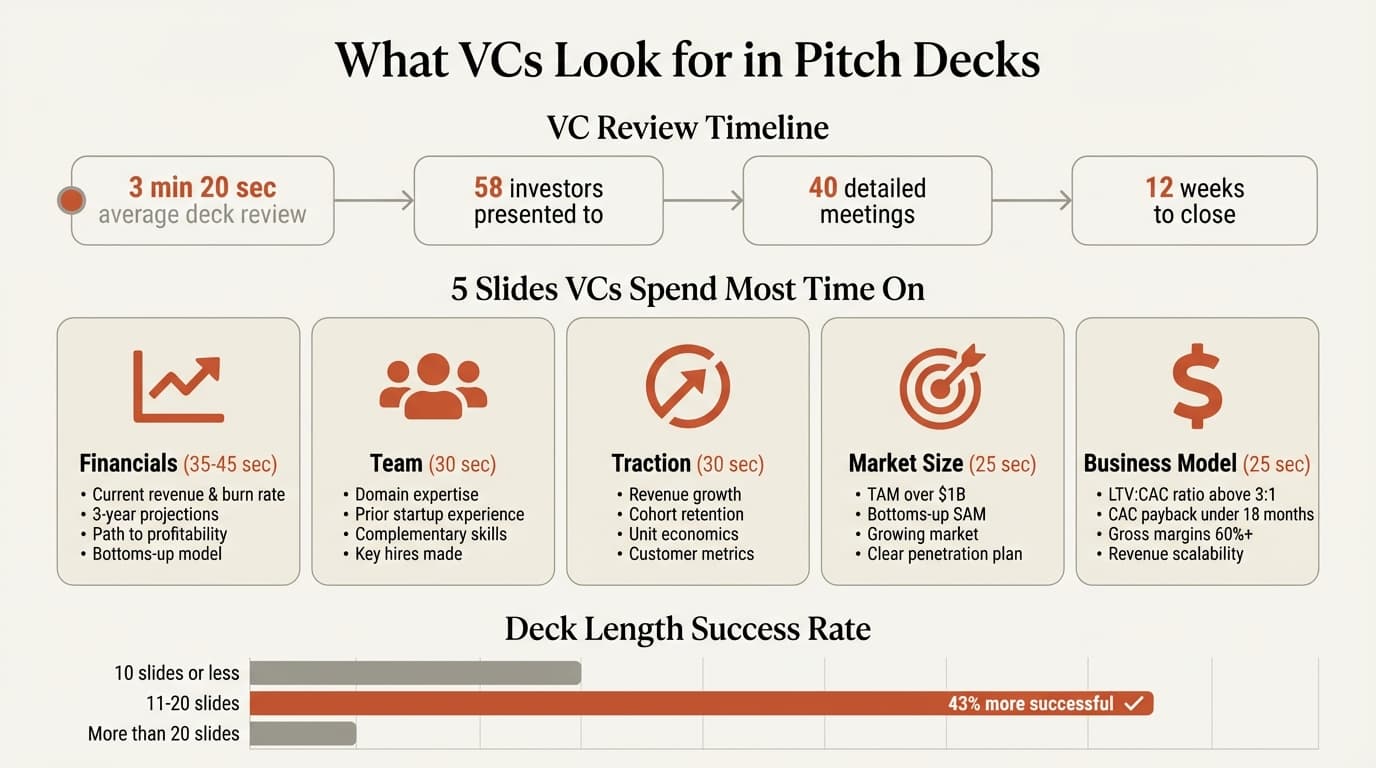
Venture capitalists see hundreds of pitch decks yearly. Research shows VCs spend an average of 3 minutes and 20 seconds reviewing each deck before deciding whether to take a meeting. That time constraint forces brutal prioritization: the slides that matter most get under 30 seconds each, while everything else gets skimmed or skipped entirely.
This guide focuses on what venture capital firms actually evaluate when reviewing pitch decks—the metrics they prioritize, the structure they expect, and how requirements shift from pre-seed through Series A. For a comprehensive slide-by-slide walkthrough, see our Pitch Deck Guide. For seed-specific templates, see pitch deck template. For Series A requirements, see Series A pitch deck.
What Makes VC Pitch Decks Different
Venture capital pitch decks serve a specific audience with unique evaluation criteria. Understanding what separates VC decks from other fundraising presentations clarifies what to emphasize.
VC Evaluation Framework
Venture capitalists use pitch decks to make rapid filtering decisions. The classical pitch deck format helps VCs quickly locate essential information and make efficient go/no-go decisions. They rely on stable deck structure because they need to process volume—often reviewing 400+ decks annually per partner.
| What VCs Evaluate | Why It Matters | Where They Look |
|---|---|---|
| Market size | Needs to support venture returns (10x+) | Market Size slide, TAM calculation |
| Traction proof | Past performance predicts future | Traction slide, growth metrics |
| Team capability | Execution risk is highest risk | Team slide, founder backgrounds |
| Unit economics | Path to profitability | Business Model, Financials |
| Competitive position | Defensibility determines durability | Competition slide, differentiation |
| Capital efficiency | Determines future dilution | Use of Funds, CAC/LTV |
2026 VC Environment
The venture capital landscape shifted significantly coming into 2026, changing what investors prioritize.
Global venture funding reached $126 billion in Q3 2025, marking the fourth consecutive quarter above $100 billion. However, deal count fell 13% year-over-year, signaling a shift toward fewer, larger bets. VCs are concentrating capital in proven companies rather than spreading bets across early-stage speculation.
Key 2026 trends affecting pitch deck expectations:
- AI dominance — US AI startups captured 85% of global AI funding and 53% of AI deals. If your product intersects with AI or machine learning, VCs expect clear articulation of the AI moat.
- Unit economics scrutiny — VCs demand transparent assumptions and solid unit economics rather than path-to-profitability hand-waving. Every projection needs bottoms-up support.
- Proven traction requirement — Almost half of founders who secured financing had already launched products, with another 38% in alpha or beta. Pre-product raises are increasingly rare outside of repeat founders.
- Liquidity focus — After two years of limited exits, VCs prioritize companies with clearer paths to acquisition or IPO.
VC vs Angel vs Strategic Investor Decks
While pitch deck fundamentals remain consistent, different investor types prioritize different elements.
| Investor Type | Primary Focus | Deck Emphasis | Typical Round |
|---|---|---|---|
| Angels | Team, vision, early validation | Problem/Solution, Founder story | Pre-seed, Seed |
| VCs | Market size, traction, scalability | TAM, Metrics, Unit economics | Seed, Series A+ |
| Corporate VCs | Strategic fit, partnership potential | Integration, Market overlap | Series A+ |
| Growth equity | Proven model, expansion opportunity | Financials, Scale plan | Series B+ |
This guide focuses on institutional VC requirements—the firms writing $1M-$20M checks from dedicated venture funds.
VC Pitch Deck Structure by Stage
Venture capital pitch decks evolve as your company matures. The core slides remain consistent, but content depth and emphasis shift significantly from pre-seed through Series A.
Universal VC Deck Framework
VCs expect a standard structure that allows rapid navigation. At minimum, every VC pitch deck needs:
- Title/Cover — Company name, one-liner, contact
- Problem — Specific pain point with quantified impact
- Solution — Your product and key differentiation
- Market Size — TAM/SAM/SOM with bottoms-up calculation
- Business Model — How you make money, pricing, unit economics
- Traction — Current metrics and growth trajectory
- Competition — Competitive landscape and your position
- Team — Founders and key hires with relevant experience
- Financials — Current state and 3-year projections
- The Ask — Amount, use of funds, milestones
Decks with 11-20 slides are 43% more successful in raising funds. Stay within that range—longer decks signal unfocused thinking, shorter ones raise questions about preparation depth.
Stage-Specific Requirements
Seed (10-12 slides): VCs evaluate team and vision. Expect pre-revenue to $500K ARR with 20%+ monthly growth. Lead with problem framing and team credibility. Unit economics can be hypothetical with clear assumptions. Most founders secure financing after product launch, so show early customers, pilots, or waitlist demand. See our pitch deck template for seed-stage guidance.
Series A (12-18 slides): VCs buy proven scale. Need $1-3M+ ARR, 100%+ YoY growth, net revenue retention above 100%, CAC payback under 18 months. Lead with traction on slide 2. Include cohort analysis showing 12+ month retention and expansion. Bottoms-up financial projections tied to current metrics. See Series A pitch deck for detailed benchmarks.
Continue reading: Business Case Template · Stacked Bar Charts in PowerPoint · Go-to-Market Slide
Create an editable presentation in your browser
Turn a prompt or source files into slides you can edit and export to PowerPoint. 10 free AI prompts. No credit card required.
The Five Slides VCs Spend Most Time On
DocSend research tracking VC eye movement and slide duration reveals which slides get the most scrutiny. These five determine whether your deck advances to partner meetings.
1. Financials (Most Time Spent)
VCs spend more time on financials than any other slide—average 35-45 seconds at seed, 60+ seconds at Series A.
What VCs evaluate:
- Current revenue run rate and burn rate
- Three-year projections with clear assumptions
- Path to profitability or next funding milestone
- Gross margin structure
- Key drivers behind growth projections
Credibility markers:
- Bottoms-up revenue model (not top-down percentage grabs)
- Conservative assumptions VCs can adjust upward
- Clear milestones this funding achieves
- Historical actuals that validate projection methodology
Red flags:
- Hockey stick projections disconnected from current traction
- Vague "market capture" assumptions
- Missing gross margin detail
- No path to profitability articulated
Financial charts matter. Waterfall charts effectively show revenue bridges and margin breakdowns, making complex financial stories clearer in limited time.
2. Team (Second Most Time)
Having a top-notch team is one of the most critical factors for VCs. VCs know most startups pivot—strong teams execute through uncertainty.
What to include:
- Founder names, titles, and one-sentence relevant background
- Specific domain expertise that maps to your market
- Complementary skills across product, growth, operations
- Key hires already made (CTO, Head of Sales if not founder-led)
- Advisory board if includes recognized names
Credibility markers:
- Prior startup experience (especially exits)
- Deep domain knowledge from industry roles
- Technical expertise for tech products
- Sales/distribution experience for B2B
- Prior working relationships between co-founders
Red flags:
- Single founder with no co-founders or key hires
- All founders from same background (engineering-only teams)
- No one with go-to-market experience
- Recent co-founder departures
3. Traction (Critical Validation)
Past performance is the best predictor of future performance. Traction proves your team can execute and that customers want what you built.
Stage-appropriate traction metrics:
| Stage | Primary Metrics | Supporting Metrics |
|---|---|---|
| Pre-seed | Pilots, LOIs, beta users | Customer interviews, waitlist size |
| Seed | Paying customers, MRR | User growth, engagement rate, NPS |
| Series A | ARR, MoM growth | NRR, cohort retention, sales efficiency |
Presentation format: Always show a chart, not just a number. A line graph demonstrating 15% month-over-month growth is far more compelling than stating "$50K MRR" in text. Trajectory matters more than absolute numbers at early stages.
Common mistake: Hiding weak traction behind vanity metrics. VCs know the difference between "50,000 app downloads" and "2,000 monthly active users with 30% retention." If you're pre-revenue, own it and show demand signals instead.
4. Market Size (Gateway Decision)
You need a big enough market for VCs to justify their time. VCs target portfolio companies that can reach $100M+ revenue to generate fund-level returns.
Required calculations:
- TAM (Total Addressable Market) — Total potential if you captured 100%
- SAM (Serviceable Available Market) — Portion you can realistically reach
- SOM (Serviceable Obtainable Market) — What you expect to capture in 3-5 years
Credibility markers:
- Bottoms-up calculation: (number of potential customers) × (revenue per customer)
- Third-party market research citations with specific sources
- Conservative penetration rate assumptions (3-10% SOM)
- Growing market with visible tailwinds
Red flags:
- Top-down only: "1% of a $500B market"
- Markets under $1B TAM
- Declining or flat markets
- No supporting data sources
Mekko charts can effectively show market segmentation and competitive positioning simultaneously, communicating more information per slide than standard charts.
5. Business Model (Unit Economics)
VCs need to understand how you make money and whether the model scales profitably.
Essential components:
- Pricing model (subscription, transaction, usage-based, etc.)
- Revenue streams (primary and secondary)
- Customer acquisition cost (CAC) by channel
- Lifetime value (LTV) calculation
- LTV:CAC ratio and payback period
- Gross margin structure
Series A requirements:
- LTV:CAC ratio above 3:1
- CAC payback under 18 months
- Gross margins above 60% (SaaS) or 40% (marketplace)
- Clear path to improve unit economics at scale
Credibility signals:
- Actual data from customer cohorts, not projections
- Breakdown by customer segment or acquisition channel
- Honest assessment of early inefficiencies with improvement plan
- Comparison to relevant public company benchmarks
Common VC Pitch Deck Mistakes
Burying the lede: Building to your metrics reveal on slide 10 fails because VCs spend under 4 minutes scanning decks. Lead with your strongest proof—traction, team, or differentiation—on slides 2-3.
"No direct competitors": Claiming no competition signals naivety. VCs see hundreds of decks yearly and know every market has alternatives. Map the landscape honestly and show why you win on dimensions customers care about.
Vague use of funds: "40% product, 30% marketing" says nothing. Get specific: "Hire 3 engineers for mobile app (Q2 launch), 2 AEs targeting 20 enterprise deals, $200K paid acquisition at $500 CAC with 12-month payback." Track sales compensation efficiency as you scale with Carvd.
No exit roadmap: VCs need 10x returns and evaluate whether your market supports $500M+ exits. Reference comparable acquisitions showing $100M+ outcomes have precedent.
Design over substance: Beautiful slides don't compensate for weak metrics. VCs prioritize content—strong traction in inconsistent fonts beats gorgeous design with no product-market fit proof.
Building Your VC Pitch Deck
Creating a funded deck requires systematic preparation:
Gather metrics first (1-2 weeks): Financial data, customer metrics, unit economics, market sizing, competitive landscape, team backgrounds, traction proof, product screenshots.
Draft content (3-5 days): Write all slide content in a text document before designing. Focus on one clear idea per slide with specific numbers.
Design simply (1 week): One idea per slide, minimal text (under 30 words), consistent formatting, high contrast, white space. Use 24pt minimum body text. Deckary creates professional waterfall charts and Mekko charts for financial data.
Test rigorously (2-3 weeks): Practice with friendly investors, track which slides generate questions, send to lower-priority VCs first, iterate based on feedback. Test on mobile—many VCs review decks on phones.
Build appendix: Detailed financial model, cohort analysis, customer case studies, product roadmap, competitive deep dive, go-to-market detail. Ready for due diligence questions.
Maximizing Your Odds
Only 1% of pitch decks secure funding. On average, closing a seed round takes 58 investor presentations, 40 detailed meetings, and 12 weeks.
Target 40-60 VCs based on stage, sector, and geography fit. Secure warm introductions—cold emails get under 1% response rates. Run a tight 6-8 week process to create momentum. Update metrics weekly. Track feedback patterns and iterate on weak slides. Maintain active pipeline until term sheet signed.
Summary
Venture capital pitch decks follow predictable patterns because VCs use standardized evaluation frameworks to process volume. Understanding what they prioritize—market size, traction proof, unit economics, team capability—and structuring your deck to surface that evidence quickly determines whether you advance past initial screening.
VCs spend under 4 minutes on first review. Your job is making the evidence impossible to miss within that constraint. Lead with your strongest proof points. Use data to back every claim. Show honest competitive positioning. Build bottoms-up financial projections. Be specific about capital deployment.
The structure is proven. The difference between funded and rejected decks comes down to evidence quality and clarity of presentation. Focus on those.
For professional deck creation, Deckary offers consulting-quality chart tools including waterfall charts and Mekko charts. Browse ready-made pitch deck layouts in the slide library, or use the AI Slide Builder to generate professional slides from descriptions. For comprehensive slide-by-slide guidance, see our Pitch Deck Guide.
Sources
- How VCs And Investors Read A Pitch Deck
- The Optimal VC Pitch Deck Structure And Why It Matters
- Pitch Deck Statistics | 22 Must Know Stats and Facts
- How Elite VCs Read Startup Pitch Decks In 3 Minutes
- What VCs really want to see inside your seed deck | DocSend
- Pitch Deck Analysis: What VCs Actually Want to See in 2025
- Here's Exactly What You Should Include in Your VC Pitch Deck, According to Data
- 8 Global Venture Capital Trends to Watch in 2026
- 2026 US VC Outlook: Early-Stage Strength and AI Momentum
- 5 biggest VC market trends shaping startup fundraising in 2026
- How to create a winning Series A VC pitch deck
- Pitch Deck Funding Stages: Difference, Requirements & Tips
- Seeking Funding? Does Your Pitch Deck Need A Seed Or Series A Focus
Create an editable presentation in your browser
Turn a prompt or source files into slides you can edit and export to PowerPoint. 10 free AI prompts. No credit card required.