Private Equity Pitch Deck: What PE Firms Actually Evaluate
Master private equity pitch decks with proven frameworks. Learn what PE investors prioritize, growth equity vs buyout requirements, and financial benchmarks that matter.
After reviewing 70+ private equity pitch decks across growth equity, middle market buyouts, and expansion capital deals, one pattern emerges: PE investors allocate under 5 minutes to initial review. Firms that structure decks to surface proven financial performance, operational efficiency, and management depth within that constraint secure meetings. Those that bury evidence under vision statements or rely on hockey stick projections lose.
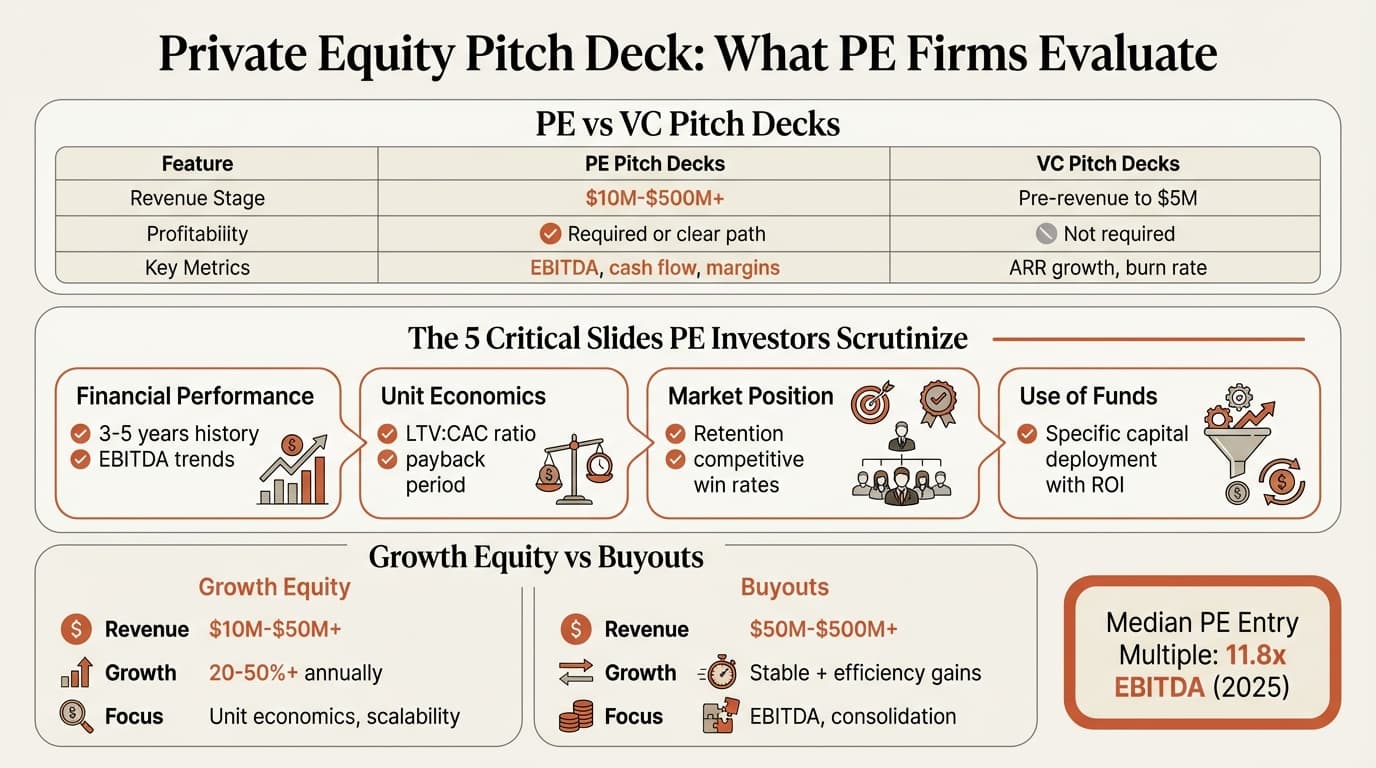
Private equity investors evaluate companies fundamentally differently than venture capitalists. PE firms prioritize essential financial and operational data combined with growth potential, not market opportunity and vision. While VCs invest in startups with innovative ideas carving new industry niches, PE firms acquire established businesses generating meaningful revenue and target operational improvements, market consolidation, or strategic repositioning.
This guide focuses on what private equity firms evaluate when reviewing pitch decks—the metrics they prioritize, structural differences between growth equity and buyout presentations, and how requirements differ from venture capital. For venture capital fundraising, see our venture capital pitch deck guide. For investment banking contexts, see investment banking pitch book.
What Makes PE Pitch Decks Different
Private equity pitch decks serve a distinct audience with unique evaluation criteria. Understanding what separates PE decks from VC presentations clarifies content priorities and structural emphasis.
PE vs VC: Core Differences
PE firms acquire enterprises suffering from financial stress, poor management, or crippling debt and restructure them to improve operational procedures, while venture capitalists fund startups and small businesses with potential for high growth rates. A VC pitch deck is built around scale, prioritizing scalability, unit economics logic, and exit potential, whereas PE decks emphasize proven operations, financial performance, and efficiency gains.
| Attribute | Private Equity Pitch Deck | Venture Capital Pitch Deck |
|---|---|---|
| Revenue stage | $10M+ (growth equity) to $50M+ (buyouts) | Pre-revenue to $5M ARR |
| Profitability | Required or clear path with timeline | Not required—focus on growth |
| Key metrics | EBITDA, cash flow, margins, efficiency | ARR growth, CAC, LTV, burn rate |
| Management team | Deep operational bench required | Founders + key hires sufficient |
| Market position | Established with proven retention | Early traction or validation signals |
| Investment size | $10M-$500M+ depending on revenue | $500K-$20M depending on stage |
| Ownership | Often majority stake (buyouts) | Minority stake (growth equity style) |
Growth Equity vs Buyout Presentations
Private equity encompasses different investment strategies requiring distinct deck approaches:
Growth Equity targets high-growth companies needing capital to scale. Most growth equity investors want $10M+ revenue and strong unit economics. Decks emphasize proven growth rates (20-50%+ annually), clear path to profitability if not yet profitable, retention and expansion metrics showing customer stickiness, capital efficiency demonstrating disciplined spending, and addressable market with credible expansion plan.
Middle Market Buyouts target established businesses with $50M-$500M+ revenue. Small and middle-market PE firms create value through growth and operational improvements rather than financial engineering. Decks emphasize historical EBITDA performance and consistency, operational efficiency opportunities, management team capability and depth, market leadership or strong #2-3 position, and clear add-on acquisition pipeline for consolidation.
Large Buyouts ($500M+ revenue) follow similar patterns to middle market but with greater emphasis on debt capacity, existing cash flow generation, enterprise value range supporting leverage, and regulatory or competitive moats.
PE Pitch Deck Structure
Private equity pitch decks follow predictable structures because PE investors use standardized evaluation frameworks. Unlike VC decks that lead with problem and vision, PE decks lead with financial proof.
Universal PE Deck Framework
PE pitch decks typically include executive summary, market overview, and detailed financial projections. Standard 15-25 slide structure:
Opening (3-5 slides): Cover with key metrics, executive summary with investment thesis and valuation range, business overview showing what you do and market position.
Core Analysis (8-12 slides): Market analysis (TAM/SAM/SOM, competitive landscape), financial performance (3-5 years revenue and EBITDA history), operational metrics (retention, sales efficiency, margins), growth strategy with expansion plans.
Closing (3-5 slides): Management team with operational bios, use of funds with specific deployment plans, financial projections (3-5 years with assumptions).
Add detailed appendix: customer case studies, cohort analysis, financial models, competitive deep dives.
Lead with proof: Growth equity decks show revenue growth chart (20-50%+ CAGR) on slide 2. Buyout decks show EBITDA history demonstrating consistent profitability. Don't bury evidence—PE investors reviewing 100+ decks quarterly need it immediately.
The Five Slides PE Investors Scrutinize Most
Five sections consistently determine whether PE pitch decks advance to management meetings: Financial Performance, Unit Economics, Market Position, Management Team, and Use of Funds.
1. Financial Performance (Most Critical)
PE investors spend more time on historical financials than any other section. They're buying proven results, not projected potential.
What PE investors evaluate: Revenue history (3-5 years) showing consistency, EBITDA margins and trends, cash flow and working capital efficiency, revenue composition, seasonality.
Credibility markers: Audited financials, consistent methodology, gross margin trends, Rule of 40 performance for software.
Red flags: Declining margins, revenue concentration above 20%, inconsistent accounting, working capital issues, hockey stick projections.
Median private equity purchase multiples increased from 11.3x EBITDA in 2024 to 11.8x in 2025, reflecting competitive deal markets. Strong EBITDA performance justifies premium valuations.
Waterfall charts effectively show revenue and EBITDA bridges, making complex financial movements clear. One software company used a waterfall chart showing how $45M revenue grew to $67M through existing customer expansion, new customer acquisition, and price increases—immediately demonstrating diversified growth.
2. Unit Economics (Growth Sustainability)
Unit economics prove the business model scales profitably. PE investors need evidence growth doesn't require proportional capital consumption.
Essential metrics: CAC by channel, LTV with churn assumptions, LTV:CAC ratio (3:1+ target), CAC payback under 18 months, contribution margin by segment, sales efficiency (Magic Number for SaaS).
Growth equity requirements: Strong unit economics showing capital efficiency. PE-backed middle market companies have grown revenues five percentage points faster than non-PE-backed peers, demonstrating PE's operational value-add.
Buyout requirements: Proven profitability at scale with margin expansion opportunities through operational improvements.
Presentation format: Show cohort analysis. Graph displaying customer cohorts over 24-36 months demonstrating retention curves and expansion revenue patterns proves business model durability better than single-period snapshots.
Common mistake: Hiding weak unit economics behind aggregate growth numbers. If CAC payback is 30 months, own it and show the improvement roadmap supported by specific initiatives and historical optimization results.
3. Market Position (Defensibility)
PE investors evaluate whether your market position is defensible and expandable. They're buying market share they can grow or consolidate.
What to demonstrate: Market share with sources, competitive positioning, win rates, customer retention (90%+ NRR for SaaS), switching costs, brand strength.
Credibility signals: Named customer logos (marquee brands), case studies with outcomes, third-party validation (G2, analysts, awards), organic growth rates, testimonials with results.
Red flags: Vague market share, mismatched win rates, high churn (above 10% B2B), commoditized products, competitors with better economics.
Mekko charts can show market segmentation and your position simultaneously—one middle market software company used a Mekko showing the $2.4B total market split across 8 segments, with their 12% share concentrated in two high-growth verticals. Clear positioning.
4. Management Team (Execution Capability)
PE investors look for deep operational bench strength, not just founder brilliance. They're buying a management team that can operate independently and execute growth plans.
What to include: CEO and C-suite with operational experience, functional leaders with achievements, board composition, advisory board, organizational depth.
Credibility markers: Prior scaling experience ("Built sales team 5 to 40 reps, $30M incremental ARR"), industry expertise (15+ years), prior exits or PE experience, complementary skills, low turnover.
Red flags: Founder-dependent operations, recent departures, inexperienced CFO, no sales leader at revenue stage, gaps in critical functions.
5. Use of Funds (Capital Deployment)
PE investors evaluate how efficiently you'll deploy capital and what milestones investment achieves. Vague spending plans signal unfocused strategy.
Required specificity:
- Exact hiring plan: "3 enterprise AEs ($180K OTE each) closing 12 deals average at $85K ACV"
- Product investment with ROI: "$2M platform rebuild enabling $500K cost reduction and 40% faster feature velocity"
- Geographic expansion with unit economics: "UK market entry targeting $8M ARR by Year 2 with 15-month CAC payback"
- M&A pipeline if relevant: "$5M allocated for two tuck-in acquisitions adding $3M EBITDA"
- Marketing spend tied to CAC: "$1.5M paid acquisition at $400 CAC with 10-month payback"
Credibility signals:
- Milestones tied to specific funding tranches
- Conservative assumptions PE can adjust upward
- Historical proof of execution: past capital deployed efficiently
- Clear success metrics for each initiative
- Risk mitigation if plans change
What PE firms actually fund: Growth equity and buyout firms invest $10M-$500M+ depending on revenue and growth profile. Capital supports scaling (growth equity), operational improvements (middle market buyouts), or acquisition financing (large buyouts).
Continue reading: BCG Matrix Examples · Stacked Bar Charts in PowerPoint · Go-to-Market Slide
Create an editable presentation in your browser
Turn a prompt or source files into slides you can edit and export to PowerPoint. 10 free AI prompts. No credit card required.
Growth Equity vs Buyout Deck Requirements
Growth Equity Specifics
Most growth equity investors want $10M-$50M+ ARR for software companies with 20-50%+ year-over-year growth. Profitability isn't always required but needs clear path. Rule of 40 (growth rate + profit margin) above 40% for software signals health.
Key sections: 24-36 month cohort retention analysis above 100% through expansion, sales efficiency metrics (Magic Number above 0.75), product roadmap tied to expansion opportunities, and geographic or vertical market penetration plans with supporting unit economics.
Buyout Specifics
Traditional PE buyout firms target $50M-$500M+ revenue with required profitability and consistent EBITDA margins. Median purchase multiples reached 11.8x EBITDA in 2025. Strong free cash flow supports debt capacity—buyouts use leverage requiring consistent performance.
Key sections: Operational improvement opportunities with quantified EBITDA gains, add-on acquisition pipeline showing consolidation targets with synergies, management equity structure and retention packages, and debt capacity analysis with pro forma leverage ratios (3-5x EBITDA typical).
Common PE Pitch Deck Mistakes
Projections without historical support: Hockey stick forecasts disconnected from past performance fail immediately. If you've grown 25% annually for three years, projecting 80% growth needs extraordinary evidence.
Ignoring competition: PE firms conduct extensive diligence. Claiming "no competitors" signals naivety. Map the landscape honestly and explain why you win.
Weak management depth: Founder-dependent businesses struggle with PE. Firms want operational teams executing independently. Show C-suite depth or hiring plans.
Vague operational metrics: Surface CAC, retention rates, sales cycles, and margin trends by segment. Don't hide behind aggregate revenue.
Generic growth strategy: "Expand to new markets" says nothing. Get specific: which markets, what entry strategy, required investment, expected outcomes, pilot data.
Unrealistic valuations: Entry multiples reached 11.8x EBITDA in 2025. Research comparable transactions and understand your position based on growth and margins.
Building Your PE Pitch Deck
Gather financial data (2-3 weeks): Audit financials (3-5 years), unit economics by cohort, retention analysis, operational KPIs, competitive positioning, market sizing.
Draft content (1-2 weeks): Emphasize financial proof over vision. Every claim needs supporting data. Focus on historical results and conservative projections.
Design simply (1 week): Tables for financials, charts for trends, minimal text, consistent formatting. Deckary creates professional waterfall charts and Mekko charts for financial and market analysis.
Prepare appendix: Detailed financial model, customer case studies, cohort analysis, competitive deep dive, org chart, capital deployment timeline.
Test rigorously (2-3 weeks): Practice with PE-experienced advisors, track recurring questions, send to lower-priority firms first, iterate on feedback.
Maximizing Your Odds
PE fundraising takes 3-6 months. Target 20-40 firms matching your sector, size, and stage. Secure warm introductions via board members or portfolio CEOs—cold emails rarely work.
Run staggered timing: meet in waves to create momentum while incorporating feedback. Update financials monthly. Track feedback from passes to strengthen weak slides.
Prepare for extensive diligence: financial, legal, operational, and commercial review. Quality of earnings reports, customer calls, and management assessments are standard. Clean financials and organized data rooms accelerate close.
Summary
Private equity pitch decks differ fundamentally from venture capital presentations. PE firms prioritize financial and operational data over vision and market opportunity, evaluating proven business models rather than speculative potential.
Growth equity firms target companies with $10M-$50M+ revenue and strong unit economics, while traditional buyout firms invest in $50M-$500M+ revenue businesses with established profitability. Both require demonstrated financial performance, operational metrics proving efficiency, management teams with depth, defensible market positions, and specific capital deployment plans with measurable milestones.
Entry multiples reached 11.8x EBITDA in 2025, reflecting competitive PE markets. Strong decks surface financial proof immediately, demonstrate operational excellence through metrics, show management capability beyond founders, and articulate specific growth plans with historical support.
The difference between funded and rejected PE decks comes down to evidence quality and specificity. Focus on those. Projections without historical validation fail. Vague operational plans fail. Shallow management teams fail. Strong financial performance, proven efficiency, and clear deployment plans win.
For professional deck creation, Deckary offers PE-grade chart tools including waterfall charts for financial bridges and Mekko charts for competitive analysis. Browse ready-made layouts in the slide library, or use the AI Slide Builder to generate professional slides. For venture capital fundraising, see venture capital pitch deck. For investment banking contexts, see investment banking pitch book. For comprehensive pitch guidance, see our Pitch Deck Guide.
Sources
- How to Make a Private Equity Pitch Deck | Ink Narrates
- Private Equity vs. Venture Capital | HuntClub
- PE Investors 2026: Growth Equity & Buyout Firms | Ellty
- Private Equity Outlook 2026 | WithIntelligence
- Small and Middle-Market Private Equity Investments | J.P. Morgan Asset Management
- Angel vs VC Pitch Deck | OGS Capital
Create an editable presentation in your browser
Turn a prompt or source files into slides you can edit and export to PowerPoint. 10 free AI prompts. No credit card required.