Pre-Seed Pitch Deck: What to Include When You Have No Product
Master the pre-seed pitch deck with proven frameworks for pre-product startups. Learn what early-stage investors evaluate, validation signals that matter, and deck structure by funding stage.
After reviewing over 180 pre-seed decks that crossed partner desks at early-stage funds—from YC applicants to angel-backed founders—the pattern is consistent: investors spend 15% of their review time on the team slide, scan the problem in under 20 seconds, and make their initial go/no-go decision based on whether you demonstrate founder-market fit before product-market fit exists.
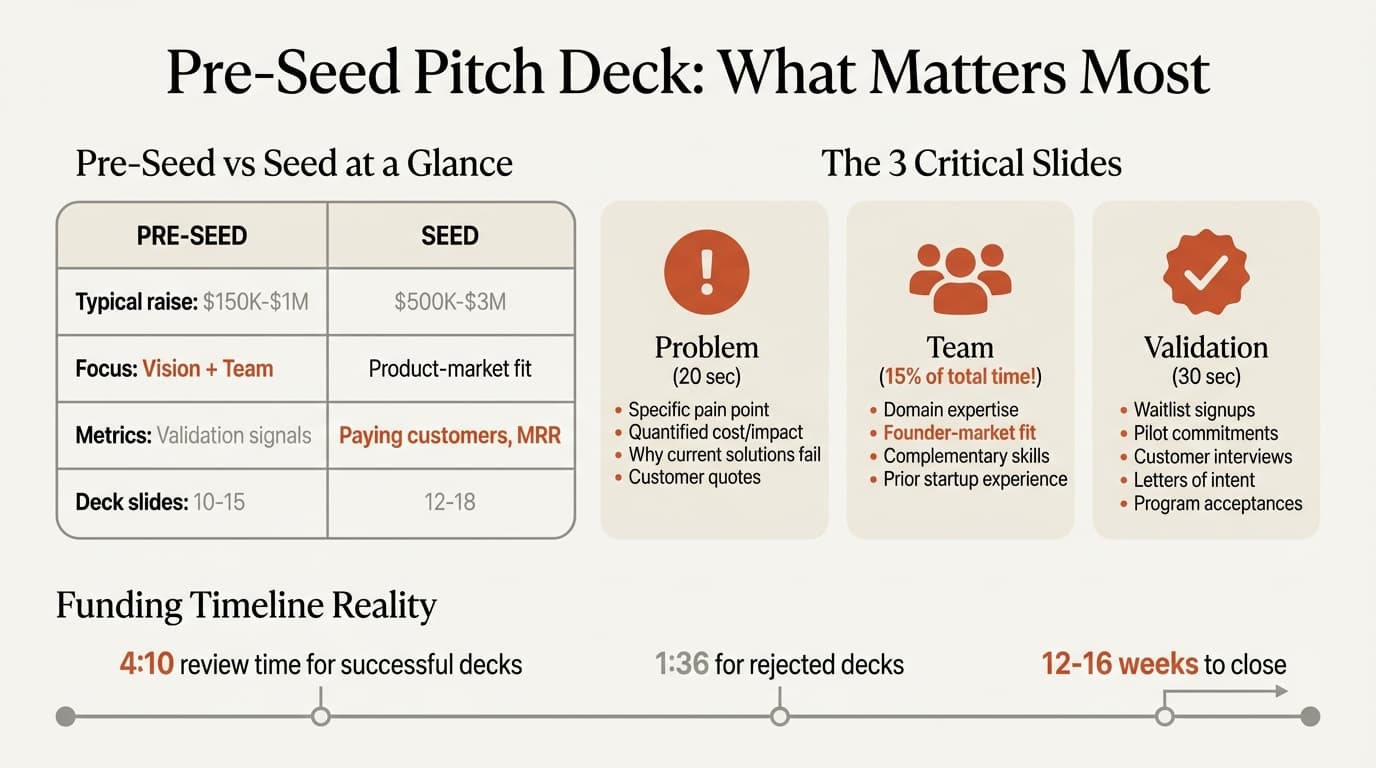
Pre-seed investors spend an average of 4 minutes and 10 seconds evaluating decks. Successful decks hold attention for 4:10, while rejected decks average just 1:36—a dramatic difference that comes down to how well you prove you understand the problem, why you're uniquely positioned to solve it, and what early validation signals exist.
This guide focuses on what distinguishes pre-seed pitch decks from seed-stage presentations—the validation signals investors prioritize, how to frame capability before metrics, and which slides drive funding decisions when you're pre-product or pre-revenue. For comprehensive slide-by-slide guidance across all funding stages, see our Pitch Deck Guide. For seed-stage requirements, see pitch deck template.
What Makes Pre-Seed Decks Different
Pre-seed pitch decks serve a distinct function. Pre-seed investors back you before product-market fit proof points exist. They're pattern matchers evaluating whether you see something others miss and can execute on it.
Pre-Seed vs Seed vs Series A
Understanding where pre-seed sits in the funding spectrum clarifies what to emphasize.
| Stage | Primary Focus | Typical Raise | Key Metrics | Deck Emphasis |
|---|---|---|---|---|
| Pre-seed | Problem + team validation | $150K-$1M | Waitlist, LOIs, pilots | Vision, founder-market fit |
| Seed | Product-market fit signals | $500K-$3M | Paying customers, MRR growth | Traction, unit economics |
| Series A | Proven scalability | $3M-$15M | $1M+ ARR, retention, CAC/LTV | Growth metrics, scale plan |
The median pre-seed SAFE raise amount is $700K in 2025, with typical dilution ranging from 10-15%. Nearly half (45%) of pre-seed rounds in Q3 2025 raised less than $250K, reflecting a trend toward smaller initial rounds since 2023.
What Pre-Seed Investors Evaluate
Founder-market fit: Do you have domain expertise that maps directly to the problem? Prior startup experience? Technical depth? At pre-seed, investors are primarily betting on your ability to execute. The team slide matters more at this stage than at any other.
Problem validation: Can you articulate why this problem matters with specific examples and quantified impact? Do potential customers recognize the pain? Have you interviewed 30+ people in the target market?
Market opportunity: Is the addressable market large enough to support venture returns? Pre-seed investors need to see that your market can sustain $100M+ companies, even if you're capturing a small percentage initially.
Early demand signals: Waitlists, letters of intent, competitive program acceptances, pilot commitments, advisor involvement. Validation signals carry significant weight. They prove early interest before meaningful traction exists.
2026 Pre-Seed Environment
The pre-seed market tightened considerably coming into 2026. Pre-seed investment fell 25% in Q2 2025 in terms of cash raised, dropping from $1.1 billion in Q1 to $822 million in Q2.
Key 2026 trends affecting pre-seed expectations:
- Smaller round sizes — Pre-seed fund amounts have trended smaller on average since 2023, though valuation caps increased, resulting in lower dilution for founders who can command premium valuations.
- Product expectations shifting — Almost half of founders who secured pre-seed financing had already launched products, with another 38% in alpha or beta. Pure idea-stage raises are increasingly rare outside repeat founders.
- AI skipping stages — AI startups are increasingly skipping pre-seed and seed rounds and moving straight to Series A, creating a new category of "mega-pre-seed" rounds that don't fit traditional benchmarks.
- Longer fundraising cycles — Expect 12-16 weeks to close a pre-seed round in 2026, versus 8-10 weeks in 2021-2022.
Pre-Seed Pitch Deck Structure
Pre-seed decks follow a recognizable framework but emphasize different elements than seed or Series A presentations. The goal is proving you can find product-market fit, not that you already have it.
Essential Pre-Seed Deck Framework
A strong pre-seed pitch deck highlights the problem, your solution, early validation, market size, team, and a clear funding ask. The best structure uses 10-15 slides that follow a clear narrative.
Core pre-seed structure:
- Title/Cover — Company name, one-liner, founder contact
- Problem — Specific pain with quantified impact and urgency
- Solution — Product concept, key differentiation, screenshots or mockups
- Why Now — Market timing, recent shifts that create the opportunity
- Market Size — TAM/SAM/SOM with bottoms-up calculation
- Product — Detailed product vision, wireframes, demos, feature highlights
- Validation — Demand signals: waitlist, pilots, LOIs, customer interviews
- Business Model — How you'll make money (can be hypothetical)
- Competition — Competitive landscape and your unique position
- Team — Founders with domain expertise and complementary skills
- Traction — Any early wins: advisor commitments, press, partnerships
- The Ask — Amount, use of funds, milestones this funding achieves
Where Pre-Seed Decks Differ from Seed
Product comes earlier: The product section comes earlier in pre-seed pitch decks than later-stage decks. At seed, you lead with traction. At pre-seed, you lead with problem-solution fit and product vision.
"Why Now" matters more: Market timing matters at pre-seed because you're convincing investors that a problem is newly solvable or newly urgent. What changed recently that makes this the right moment?
Validation over metrics: Replace the traditional "Traction" slide with "Validation." Show demand signals rather than revenue numbers. Waitlists, pilot commitments, competitive program acceptances, and customer interview insights replace MRR charts.
Team gets more space: For successful pre-seed decks, investors spend 15% of total time on the Team slide. Give this slide the depth it deserves—include specific, relevant experience that maps to your startup's needs.
Continue reading: Product Lifecycle Management · Stacked Bar Charts in PowerPoint · Go-to-Market Slide
Create an editable presentation in your browser
Turn a prompt or source files into slides you can edit and export to PowerPoint. 10 free AI prompts. No credit card required.
The Three Slides That Determine Pre-Seed Funding
While every slide matters, three consistently separate funded pre-seed decks from rejected ones: Problem, Team, and Validation.
1. Problem: Most Critical at Pre-Seed
92% of successful decks globally had a slide explaining the problem. At pre-seed, problem framing carries more weight than at any later stage because you can't yet prove solution effectiveness with metrics.
What works: Specific examples with quantified costs. The strongest problem slides name a specific persona, describe a specific pain, and attach a specific cost or time waste. "Sales reps spend 6 hours per week searching for customer data across Slack, email, and CRM, costing companies $35K per rep annually in lost productivity" beats "Enterprise communication is inefficient."
Credibility markers:
- Customer quotes from discovery interviews (with permission)
- Industry data showing problem prevalence
- Personal experience that validates deep understanding
- Current workaround costs (time, money, missed opportunity)
Common mistake: Describing symptoms without explaining why current solutions fail. Every problem has attempted solutions—show why they're inadequate and what's changed to make your approach viable now.
Real-world pattern: The best pre-seed problem slides feel obvious in hindsight but non-obvious before you explain them. If investors say "of course that's a problem," you nailed the framing.
2. Team: 15% of Total Review Time
Investors spend 15% of their limited time on the Team slide at pre-seed—more proportional time than at any later stage. This is where founder-market fit gets evaluated.
What to include:
- Founder names, titles, and one-sentence relevant background
- Domain expertise that directly maps to your market
- Technical capability if building a technical product
- Sales or go-to-market experience for B2B products
- Prior startup experience (especially exits)
- Prior working relationships between co-founders
- Key advisors if they're recognizable names
Credibility markers:
- Lived experience with the problem you're solving
- 5+ years in the industry you're disrupting
- Prior company founding experience
- Complementary skills across product, engineering, and go-to-market
- Full-time commitment from all co-founders
Red flags investors see:
- Single founder with no co-founders or key advisors
- All founders from identical backgrounds (engineering-only teams)
- No one with domain expertise in your target market
- Part-time commitment from founders
- Recent co-founder departures
Structuring the Team slide: Include photos, names, titles, and 2-3 bullet points per founder highlighting relevant experience. If you have impressive advisors (YC partner, former exec from target market), list them with affiliations.
3. Validation: Proving Demand Without Revenue
Validation signals carry significant weight at pre-seed. They prove that someone besides you believes this problem matters and your approach is credible.
Validation signals investors value:
| Signal Type | What It Proves | Example |
|---|---|---|
| Waitlist | Market interest | 500+ signups, 20% qualified enterprise leads |
| LOIs/Pilots | Purchase intent | 3 pilot agreements with Fortune 500 companies |
| Customer interviews | Problem validation | 40+ customer discovery calls, 85% confirmed pain |
| Advisor involvement | Credibility | Former Salesforce VP advising on go-to-market |
| Competitive programs | External validation | YC interview finalist, Techstars accepted |
| Partnerships | Distribution potential | Partnership with industry association (5K members) |
| Press/visibility | Market awareness | TechCrunch coverage, 10K impressions |
Presenting validation effectively: Use numbers wherever possible. "We interviewed customers" is weak. "We conducted 42 customer discovery interviews across 8 target accounts. 38 confirmed the problem costs them $50K+ annually" is strong.
Common mistake: Confusing vanity metrics with validation. Social media followers, website visitors, or app downloads don't prove purchase intent. Focus on signals that demonstrate someone would pay to solve this problem.
What Pre-Seed Investors Skip
Understanding what pre-seed investors don't expect clarifies where to focus effort.
Detailed financial projections: Pre-seed investors know your three-year forecast is speculative. Include a simple revenue model showing unit economics assumptions, but don't build a 40-tab Excel model. Save that for Series A.
Proven unit economics: You can show hypothetical CAC/LTV based on customer research and comparable companies. You don't need to prove these numbers yet—but your assumptions must be defensible.
Cohort retention data: You don't have cohorts yet. Show interview feedback suggesting customers would pay, renew, or expand usage based on problem severity.
Go-to-market execution: At pre-seed, a high-level distribution strategy suffices. "We'll target mid-market SaaS companies through outbound sales, content marketing, and partner channels" is enough. You don't need a full playbook.
Product roadmap detail: A 2-3 quarter product vision matters. A 24-month feature roadmap with engineering timelines is premature.
Common Pre-Seed Pitch Deck Mistakes
Overemphasizing product before problem: There was a 46% increase in investor time spent on the product section in recent years, but product must come after establishing the problem. If investors don't understand why the problem matters, they won't care about your solution.
Claiming no competition: This signals naivety. Every problem has attempted solutions—direct competitors, workarounds, or manual processes. Map the landscape honestly and show why existing approaches fail.
Vague founder backgrounds: "Ex-Google engineer" says nothing about why you're qualified to solve this specific problem. Be specific: "Built the payments infrastructure serving 10M users at Google Wallet" demonstrates relevant technical depth.
No clear ask: In early-stage rounds, the fundraising ask is the final section. State the exact amount, instrument (SAFE, convertible note, priced round), and what this capital achieves.
Too much text: Common mistakes include too much text, overcomplicating the problem and solution, and using too much jargon. Every slide should communicate one idea clearly. If you need paragraphs, your thinking isn't clear yet.
Design over substance: Beautiful slides don't compensate for weak validation. A clean layout, consistent branding, and minimal text per slide make decks easier to digest, but investors prioritize evidence over aesthetics.
Building Your Pre-Seed Deck: Step-by-Step
Creating a fundable pre-seed deck requires systematic preparation:
Validate the problem (2-4 weeks): Conduct 30+ customer discovery interviews. Document specific pain points, current workarounds, and willingness to pay. Quantify problem costs where possible.
Gather validation signals (ongoing): Build waitlist, secure pilot agreements, apply to competitive programs, recruit advisors with industry credibility.
Draft content first (3-5 days): Write all slide content in a document before designing. One clear idea per slide. Use specific numbers and examples throughout. Y Combinator recommends describing your startup in 2 sentences plus one specific example.
Design simply (1 week): Y Combinator advises that visually stunning slides often hurt seed-stage pitches. Use large, clear text with white space. Minimum 24pt body text. Consistent formatting throughout. One idea per slide.
For financial projections and market sizing visuals, waterfall charts effectively show revenue bridges and assumptions. Mekko charts can illustrate market segmentation and competitive positioning simultaneously.
Test with friendly audiences (1-2 weeks): Practice with mentors, advisors, and friendly investors. Track which slides generate questions or confusion. Iterate based on feedback patterns.
Build appendix: Include supporting materials for Q&A: detailed financial assumptions, customer interview summaries, competitive deep dive, technical architecture, full product roadmap.
Fundraising Strategy for Pre-Seed
Only 1% of pitch decks secure funding. Expect to present to 30-50 investors before closing.
Target the right investors: Pre-seed specialists, angel syndicates, accelerators, and micro-VCs. Don't pitch growth-stage funds that write $10M+ checks—they won't engage at your stage regardless of deck quality.
Secure warm introductions: Cold emails get under 1% response rates. Every investor conversation should come through a warm introduction from a founder they've backed, a co-investor, or a trusted advisor.
Run a tight process: 6-8 week fundraising window creates momentum. Update validation metrics weekly during the raise. Track feedback patterns and iterate on slides that consistently trigger questions.
Lead with your strongest proof: Y Combinator advises leading with whatever is most impressive about your company, not what comes first in a template. If your team is exceptional, put Team on slide 2. If you have pilots with three Fortune 500 companies, lead with Validation.
Summary
Pre-seed pitch decks differ fundamentally from seed-stage presentations. Pre-seed investors back teams before product-market fit exists, evaluating founder-market fit, problem validation, and early demand signals over revenue metrics.
Investors spend under 4 minutes on pre-seed decks, with 15% of that time on the Team slide. Your job is proving you understand a problem deeply, have unique insight into solving it, and can execute before meaningful traction exists.
Focus on three critical elements: frame the problem with specific, quantified examples; demonstrate founder-market fit through relevant domain expertise; show validation signals that prove demand exists before you've built the full product. These three determine whether your deck advances past initial screening.
The structure is straightforward. The challenge is proving capability without metrics. Show evidence of insight, preparation, and early validation. Be specific about what this funding achieves. Own your stage—pre-seed is about proving you can find product-market fit, not that you already have it.
For professional deck creation, Deckary offers consulting-quality chart tools including waterfall charts and Mekko charts for financial projections and market sizing. Browse ready-made pitch deck layouts in the slide library, or use the AI Slide Builder to generate professional slides from descriptions. For seed-stage requirements, see pitch deck template. For comprehensive slide-by-slide guidance, see Pitch Deck Guide.
Sources
- Here's how to create a pre-seed pitch deck that gets you funded | DocSend
- Building your pre-seed pitch deck? Here's a guide | DocSend
- How to Nail the 3 Most Scrutinized Sections in Your Pre-Seed Pitch Deck | DocSend
- How to build your seed round pitch deck | Y Combinator
- The Ultimate Guide to Building a Pre-Seed Pitch Deck
- How To Build A Winning Pre-Seed Pitch Deck
- State of Pre-Seed Q3 2025 | Carta
- 2025 Benchmarks: Average Pre-Seed Round Size, Valuation | Metal
- Pre-Seed Funding Benchmarks: Valuations, Equity, and Timeframes
- Pre-seed valuations in 2026: What founders need to know
- Pre-Seed VS Series A Pitch Decks: What's The Difference? - Viktori
- Pre-Seed Pitch Deck: Structure, Examples & Best Practices
- Pitch Deck Statistics | 22 Must Know Stats and Facts
- VC Expectations in 2025 | Spectup
Create an editable presentation in your browser
Turn a prompt or source files into slides you can edit and export to PowerPoint. 10 free AI prompts. No credit card required.