Pitch Deck Guide: Create Investor-Ready Presentations That Get Funded
Build a pitch deck that gets meetings. The 12 slides VCs expect, real examples from funded startups, and section-by-section writing tips.
After reviewing 500+ pitch decks across pre-seed through Series B raises, one pattern separates funded companies from the rest: the decks that close rounds tell a story investors can repeat to their partners in 30 seconds. "They're solving X problem for Y customer, they have Z traction, and they need $N to reach the next milestone." Everything else is supporting evidence.
Key Takeaways:
- The optimal pitch deck is 10-15 slides with one clear message per slide
- Investors spend an average of 3 minutes 44 seconds reviewing a deck
- Lead with your strongest traction metrics early in the presentation
- Ground financial projections in bottom-up assumptions, not top-down market math
- Design quality signals execution capability to investors
- Your deck gets the meeting; the meeting closes the deal
This comprehensive guide covers everything founders need to create investor-ready presentations: the essential slides every pitch deck needs, what to include at each funding stage, how to present traction that impresses, building credible financial projections, competitive positioning that builds confidence, and the design principles that signal professional execution.
Whether you're raising your first pre-seed round or preparing for Series A, this guide provides the frameworks, examples, and practical advice to build a deck that gets you funded.
What Makes Pitch Decks Effective
A pitch deck is a visual presentation that communicates your startup's opportunity to potential investors. Its purpose is simple but often misunderstood: get the meeting, not close the deal.
According to DocSend research, investors spend an average of 3 minutes and 44 seconds reviewing a pitch deck. That's roughly 20 seconds per slide in a 12-slide deck. Your deck isn't competing for deep attention--it's competing against hundreds of other decks for those 4 minutes.
| What a Pitch Deck Is | What a Pitch Deck Isn't |
|---|---|
| A storytelling framework | A comprehensive business plan |
| An invitation to learn more | All the answers upfront |
| 10-15 focused slides | A 50-slide encyclopedia |
| Optimized for quick scanning | Designed for deep reading |
| Evidence of opportunity | Guarantee of success |
Effective pitch decks share common characteristics:
Ruthless simplicity. One message per slide. Minimal text. Clear visuals. Investors scan rather than read, so every element must communicate immediately.
Story-driven structure. The narrative flows logically: here's a painful problem, here's how we solve it, here's how big the opportunity is, here's proof it's working, here's why we'll win, here's what we need.
Evidence over claims. Metrics that prove traction, customer quotes that validate the problem, market data that supports opportunity. Claims without evidence get discounted.
Professional execution. Design quality signals capability. Consistent formatting, quality charts, and visual hierarchy demonstrate attention to detail that investors associate with execution ability.
For a detailed walkthrough of the foundational slide structure, see our pitch deck template guide with examples from companies like Airbnb and Buffer.
The 10-12 Essential Slides
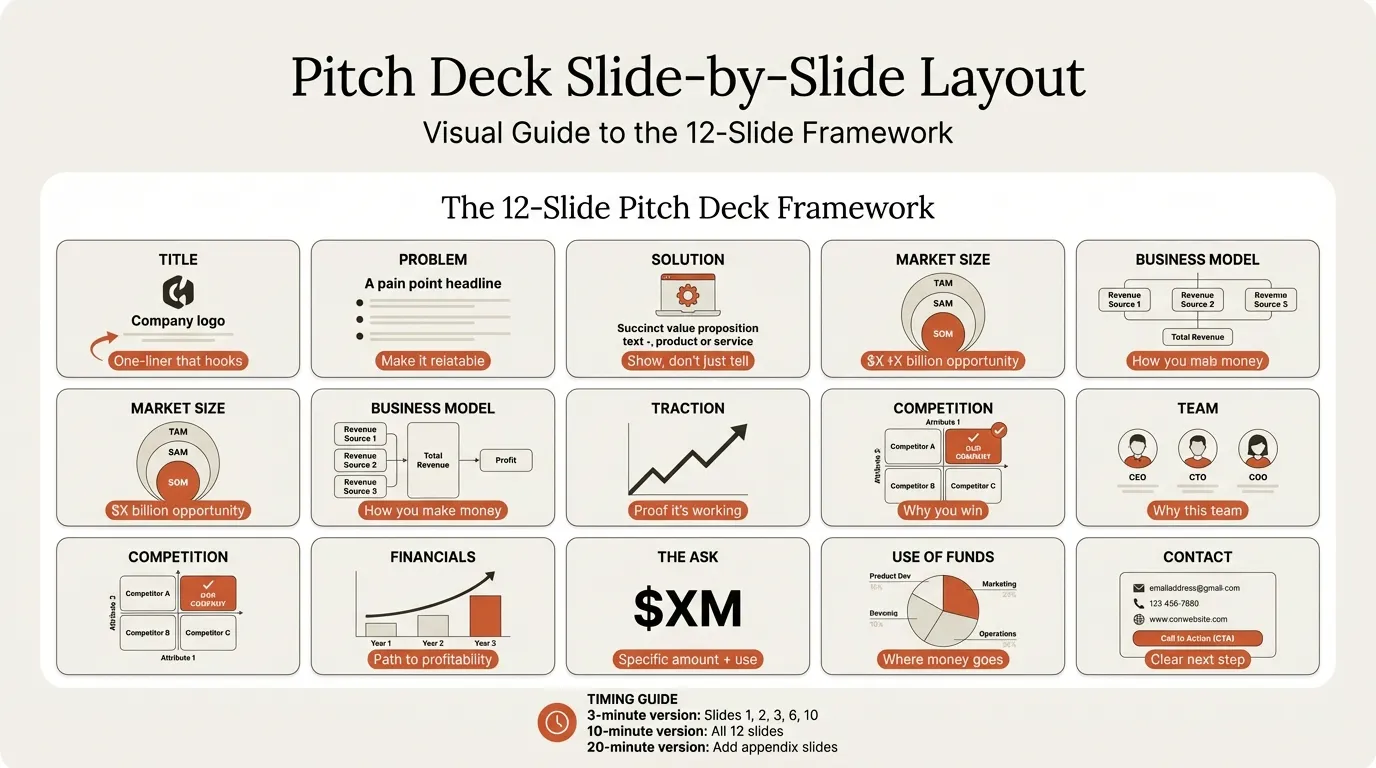
Based on analyzing hundreds of successful fundraises, this structure covers what investors need to see. The specific emphasis shifts by stage, but the core framework remains consistent.
Slide 1: Title/Cover
Your opening slide has five seconds to communicate what you do.
What to include:
- Company name and logo
- One-sentence description of your business
- Contact information
- Funding stage and key metric (for later-stage companies)
The one-liner is everything. Compare these:
Weak: "AI-powered platform for enterprise digital transformation"
Strong: "Stripe: Payments infrastructure for the internet"
The strong version immediately tells you the customer (internet businesses), the product (payments infrastructure), and the value proposition. No jargon, no complexity.
Slide 2: Problem
The problem slide explains why your company needs to exist.
What to include:
- The core pain point in one clear statement
- Who experiences this problem (your target customer)
- The cost of the problem (financial, time, emotional)
- Why existing solutions fail
Make problems specific and quantified:
Weak: "Enterprise communication is inefficient."
Strong: "Sales teams waste 4 hours per week searching for customer information across Slack, email, and CRM systems. That's $50,000 per sales rep per year in lost productivity."
The second version is immediately understandable. An investor can feel the pain.
Slide 3: Solution
The solution slide explains what you've built.
What to include:
- What your product does in one sentence
- How it solves the problem from the previous slide
- Product screenshot or demo visual
- Key benefits (not features)
Show, don't tell. A product screenshot communicates faster than paragraphs of description. Focus on outcomes: investors don't care that you have "AI-powered natural language processing." They care that "customers get answers in 2 seconds instead of 2 hours."
Slide 4: Market Size (TAM/SAM/SOM)
The market size slide proves the opportunity is large enough to build a significant company.
| Term | Definition | Example |
|---|---|---|
| TAM (Total Addressable Market) | Everyone who could theoretically buy your product | All businesses worldwide needing CRM ($100B) |
| SAM (Serviceable Addressable Market) | The segment you can realistically reach | SMBs in North America ($15B) |
| SOM (Serviceable Obtainable Market) | What you can capture in 3-5 years | 2% of North American SMBs ($300M) |
Bottom-up beats top-down. "500,000 target customers x $2,000/year = $1B SAM" is more credible than "We'll capture 0.5% of a $200B market." For a ready-made layout with the nested circle visual and space for your calculations, try our TAM SAM SOM template.
Slide 5: Business Model
The business model slide explains how you make money.
What to include:
- Revenue model (subscription, transaction, licensing)
- Pricing structure and tiers
- Unit economics (CAC, LTV, margins)
- Revenue drivers
Show the math works. For SaaS businesses, investors want to see LTV exceeding 3x CAC. Keep it simple--if you have multiple revenue streams, focus on the primary one. A business model canvas template can help you map out revenue streams, cost structure, and key partners before distilling it into a single slide.
Slide 6: Traction
The traction slide is often the most scrutinized. It proves you're not just an idea.
Metrics by stage:
| Stage | Key Metrics |
|---|---|
| Pre-revenue | Waitlist signups, LOIs, pilot users, engagement |
| Early revenue | MRR, paying customers, MoM growth rate |
| Scaling | ARR, net revenue retention, growth rate |
Show a chart, not just numbers. A growth curve showing 20% month-over-month growth is dramatically more compelling than stating the percentage. For detailed guidance on presenting growth metrics, see our traction slide guide.
Slide 7: Competition
The competition slide shows you understand your market.
What to include:
- Key competitors (direct and indirect)
- Your differentiation on dimensions that matter to customers
- Why customers choose you
Use a 2x2 matrix or comparison table. Pick the two dimensions where you're strongest, then plot yourself and competitors. Never claim you have no competition--every solution has alternatives, even "doing nothing."
For templates and examples of effective competitive positioning, see our competitive landscape slide guide.
Slide 8: Team
The team slide explains why you're the right people to build this.
What to include:
- Founders with relevant background
- Key hires if notable
- Specific experience relevant to this startup
- Advisors if genuinely involved
Focus on "why us" for this specific problem. Domain experience matters more than generic credentials. A former healthcare executive building healthtech has clear founder-market fit. Show complementary skills across product, technical, and go-to-market.
For layouts and best practices, see our team slide guide.
Slide 9: Financials
The financials slide shows your current state and projections.
What to include:
- Current financial state (revenue, burn rate, runway)
- 3-5 year projections
- Key assumptions underlying projections
- Path to profitability or next funding milestone
Use charts, not spreadsheets. Ground projections in current traction--show the math: "X customers at $Y average contract value with Z% retention = revenue." Be realistic; VCs mentally cut projections in half.
For detailed guidance on presenting numbers, see our financial projections slide guide.
Slide 10: The Ask
The ask slide states exactly what you need.
What to include:
- Amount you're raising
- Type of round (Seed, Series A, SAFE)
- Use of funds breakdown
- Milestones this funding achieves
Be specific. "$1.5M on $8M post-money SAFE" beats "raising a seed round." Match your ask to milestones--investors want to know what $2M gets you to.
Continue reading: Brainstorming Template · Line Charts in PowerPoint · Problem Solution Slide
Use consulting-grade layouts in PowerPoint
Start from structured business slides and customize them in your own deck. 14-day free trial. No credit card required.
Team Slides That Build Credibility
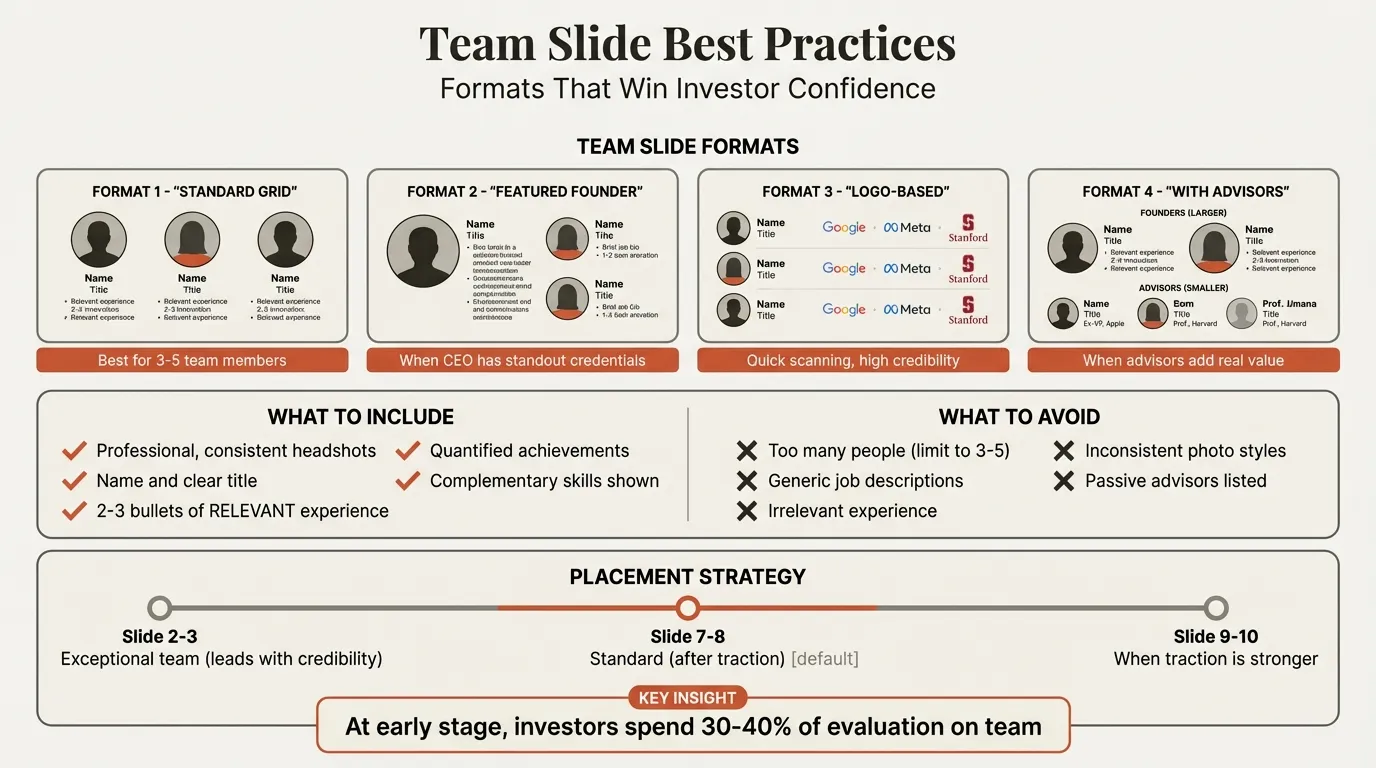
At early stages, investors bet more on team than idea. According to research from First Round Capital, team evaluation accounts for roughly 40% of pre-seed decisions and remains significant through Series A.
The Founder-Market Fit Question
The best team slides answer one fundamental question: Why is this team uniquely qualified to solve this specific problem?
| What Investors Evaluate | What Team Slide Should Show |
|---|---|
| Can they build the product? | Technical expertise, past projects |
| Can they sell it? | Sales/marketing experience, domain knowledge |
| Will customers trust them? | Industry credibility, previous success |
| Can they recruit talent? | Network, reputation, leadership |
| Will they persevere? | Grit indicators, founder-market fit |
Best Practices for Team Slides
Lead with relevance, not prestige. Generic credentials (Harvard MBA, ex-Google) matter less than specific relevance:
Weak: "Sarah has 10 years of experience in technology and business development"
Strong: "Former Stripe BD lead; closed $50M in enterprise partnerships. Previously scaled sales at Square from $10M to $100M ARR"
Show complementary skills. Investors look for teams with coverage across product, technical, and commercial functions. Your slide should implicitly demonstrate you have all bases covered.
Keep it to 3-4 people. Focus on decision-makers, not your entire org chart. Save the full team for appendix materials.
Include advisors strategically. Only include advisors who are genuinely involved and add credibility you don't otherwise have. Name-dropping uninvolved advisors backfires with sophisticated investors.
For detailed templates and formatting guidance, see our complete team slide guide.
Traction Slides That Impress
Analyzing traction slides from 75 funded startups revealed a counterintuitive pattern: the absolute numbers mattered less than the shape of the growth curve. A company at $50K MRR growing 25% month-over-month consistently outperformed companies at $200K MRR with flat or erratic growth. Investors buy trajectory, not snapshots.
Metrics by Funding Stage
The metrics that matter change significantly as you progress:
| Stage | Primary Metrics | Benchmarks |
|---|---|---|
| Pre-seed | Waitlist, LOIs, pilots | 1,000+ signups, 5-10 LOIs |
| Seed | MRR, paying customers | $10-50K MRR, 15-25% MoM growth |
| Series A | ARR, NRR, unit economics | $1-3M ARR, 100%+ YoY growth, 120%+ NRR |
| Series B+ | ARR, efficiency metrics | $8-15M+ ARR, path to profitability |
Types of Traction
Revenue traction is the clearest signal of product-market fit. If customers are paying, they've voted with their wallets.
Engagement traction matters for consumer products and freemium models. DAU/MAU ratios above 50% signal habitual use.
Retention traction proves customers stick around. Cohort analysis showing 100%+ revenue retention at month 12 is extremely compelling.
Partnership traction provides third-party validation. A distribution deal with Salesforce validates product quality and market fit.
Visualizing Traction
Lead with your strongest metric. Show a chart, not just numbers. A growth curve communicates momentum instantly.
For financial metrics like revenue growth, waterfall charts can effectively show what's driving your numbers--new customers, expansion revenue, and churn broken down visually.
For comprehensive guidance including examples by stage, see our traction slide guide.
Financial Projections That Build Confidence
The financial projections slide separates credible founders from wishful thinkers. The difference lies not in projecting larger numbers, but in grounding every number in defensible assumptions.
Bottom-Up vs. Top-Down
Top-down (weak):
Total market: $50B
Our segment: 10% = $5B
Market share: 2% = $100M
Bottom-up (strong):
Sales reps: 20
Quota per rep: $500K
Attainment rate: 80%
New ARR: $8M
Expansion revenue: $2M
Total Year 1 ARR: $10M
Bottom-up models are defensible because investors can evaluate each assumption independently. If they think your quota attainment is optimistic, they can adjust that single input and see the impact. If your pitch includes sales team metrics, Carvd tracks commissions and quota attainment.
Essential Financial Metrics
| Metric | What It Shows | SaaS Benchmark |
|---|---|---|
| ARR/MRR | Revenue scale | Stage-dependent |
| Gross Margin | Unit economics health | 65-80% |
| CAC | Acquisition efficiency | Varies by segment |
| LTV | Customer value | 3x+ CAC |
| CAC Payback | Capital efficiency | Under 18 months |
| Net Revenue Retention | Expansion vs churn | 100%+ (ideally 120%+) |
Best Practices
Show your assumptions explicitly. Don't hide the drivers of your projections. Call out sales productivity, conversion rates, and expansion assumptions.
Ground projections in historical data. If you have traction, use it as the foundation. Projections that extend current trends with clear drivers are more credible.
Be realistic. VCs mentally cut projections in half. Wildly optimistic numbers (zero to $100M ARR in 12 months) destroy credibility for everything else in your deck.
Visualize effectively. A waterfall chart can show how you bridge from current state to projected state, breaking down growth into new sales, expansion, and churn components.
For detailed guidance on building credible forecasts, see our financial projections slide guide.
Competitive Landscape Analysis
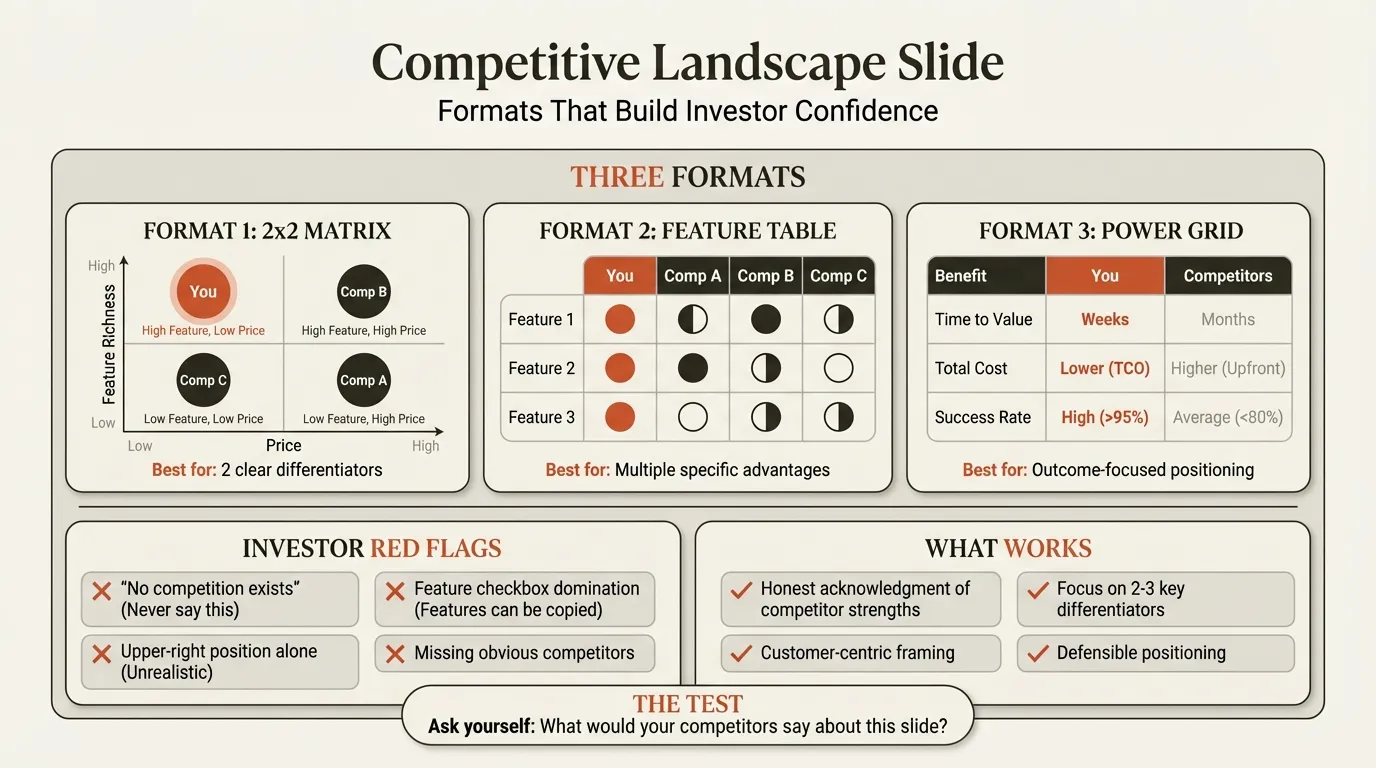
The competitive landscape slide is what investors call a "make or break" moment. Get it right, and you demonstrate deep market understanding. Get it wrong--by claiming no competition or positioning yourself unrealistically well--and you signal naivety or dishonesty.
What Investors Evaluate
Market awareness: Do you know who you're competing against? Missing obvious competitors is a red flag.
Honest self-assessment: Where do you actually sit in the market? VCs expect nuanced positioning, not fantasy.
Strategic thinking: How will you win over time? Features can be copied--what's your sustainable advantage?
Competitive Slide Formats
| Format | Best For | Example |
|---|---|---|
| 2x2 Matrix | Two clear differentiators | Airbnb (Price vs. Online) |
| Feature Table | Multiple specific advantages | B2B SaaS comparisons |
| Power Grid | Benefit-focused positioning | Enterprise sales |
| Positioning Map | Market segment clarity | Market entry strategy |
Critical Mistakes to Avoid
Claiming no competition. Every solution has alternatives, even "doing nothing." This signals poor market research.
The unrealistic upper-right position. Positioning yourself alone in the "best" quadrant while competitors cluster in inferior positions destroys credibility.
Feature-only thinking. Features can be copied. Focus on sustainable advantages: network effects, proprietary data, ecosystem lock-in, go-to-market advantages.
For templates and real examples, see our competitive landscape slide guide. You can also start with our competitive analysis template for a pre-built layout with comparison tables and positioning matrices.
Seed vs. Series A Differences
The core structure remains consistent, but the emphasis shifts dramatically between stages.
Seed Stage Focus
Primary question investors ask: Can this team build something customers want?
| Element | Seed Emphasis |
|---|---|
| Team | 40% of decision; domain expertise and grit |
| Traction | Early validation signals (pilots, waitlist, LOIs) |
| Vision | Compelling problem and solution narrative |
| Market | Opportunity size and timing |
Seed investors are buying a lottery ticket. They know most investments will fail, so they optimize for upside potential. A compelling founder with a big vision in a large market can raise seed funding with minimal traction.
For comprehensive seed-stage guidance, see our startup pitch deck guide with real examples.
Series A Focus
Primary question investors ask: Is there proven product-market fit that can scale?
| Element | Series A Emphasis |
|---|---|
| Metrics | $1-2M+ ARR, 100%+ YoY growth, strong retention |
| Unit Economics | Proven CAC, LTV, payback period |
| Cohorts | Retention analysis proving product-market fit |
| Team | Execution capability; key hires beyond founders |
Series A investors aren't buying potential anymore--they're underwriting a growth machine. The conversation shifts from "What could this become?" to "Show me the data proving this is already working."
Numbers replace narrative. Charts replace stories. Execution replaces vision.
For detailed Series A preparation, see our Series A pitch deck guide covering the specific metrics VCs expect.
Design Best Practices
Design isn't decoration. It's communication. Professional presentation signals professional execution capability.
Visual Principles
| Principle | Application |
|---|---|
| One idea per slide | If you have two ideas, make two slides |
| Minimal text | 30 words maximum per slide |
| Consistent formatting | Same fonts, colors, alignment throughout |
| White space | Let content breathe; don't fill every inch |
| High contrast | Dark text on light background for readability |
Typography Guidelines
- One or two font families maximum - Mix creates visual clutter
- Large, readable text - Minimum 24pt for body text
- Clear hierarchy - Title (36-44pt), subtitle (24-30pt), body (18-24pt)
- Left-aligned text - Easier to scan than centered
Data Visualization
Your traction and financial slides live or die on chart quality.
For growth metrics:
- Line charts for trends over time
- Bar charts for comparisons across periods
- Waterfall charts for revenue bridges showing drivers
For market sizing:
- Nested circles for TAM/SAM/SOM (see our market size template)
- Mekko charts for segment analysis
Tools like Deckary offer consulting-quality chart templates that create professional visualizations quickly. The difference between amateur Excel charts and professional presentations is immediately apparent to investors who review hundreds of decks.
The Mobile Test
Many investors review decks on their phones--between meetings, in Ubers, at airports. If your text is unreadable or charts are incomprehensible on a 6-inch screen, your deck fails before it's even considered.
Test your deck on mobile. Can you understand each slide's message without zooming?
Common Pitch Deck Mistakes
Based on VC feedback and reviewing hundreds of pitch decks, these mistakes consistently kill fundraising momentum.
Mistake 1: Information Overload
The problem: Cramming slides with text, charts, and bullet points.
Why it fails: Investors scan, they don't read. Dense slides create cognitive overload and signal inability to prioritize.
The fix: Each slide gets one message. If you can't explain it in 20 seconds, simplify or split into multiple slides.
Mistake 2: Burying the Traction
The problem: Hiding traction metrics on slide 9 after extensive market analysis.
Why it fails: Investors jump to traction first. If they can't find strong metrics quickly, they assume you don't have them.
The fix: Feature traction prominently. Many successful decks put traction data on slide 2 or 3.
Mistake 3: Unrealistic Projections
The problem: Hockey-stick growth from $0 to $100M without explaining the mechanics.
Why it fails: VCs see inflated projections constantly. Unrealistic numbers make them question everything else in your deck.
The fix: Build from the bottom up. Show the math: customers x price x growth rate = revenue.
Mistake 4: Claiming No Competition
The problem: "We have no direct competitors."
Why it fails: Every solution has alternatives. Claiming otherwise signals naivety about your market.
The fix: Acknowledge all alternatives and explain your differentiation honestly.
Mistake 5: Missing or Vague Ask
The problem: Ending without stating what you're raising, or with vague language.
Why it fails: Investors need to know what you want to decide if they're interested.
The fix: Be specific. Amount, terms, timeline, and what you'll accomplish with the capital.
Mistake 6: Amateur Design
The problem: Default templates, inconsistent fonts, misaligned elements, 3D chart effects.
Why it fails: Design signals professionalism and attention to detail.
The fix: Invest in professional templates or tools. Consistent formatting and clean charts matter.
Templates and Tools
The right tools make pitch deck creation significantly faster and more professional.
Building Your Deck
For overall structure:
- Start with our pitch deck template for the proven 12-slide framework, or download the pitch deck PowerPoint template with all 12 slides pre-designed
- Use investor presentation template for later-stage raises
For individual slides:
- Team slide guide for presenting founders effectively
- Traction slide guide for growth metrics
- Financial projections guide for credible forecasts
- Competitive landscape guide for positioning
For professional visuals:
- Deckary for consulting-quality charts and professional templates
- Waterfall charts for revenue bridges
- Mekko charts for market sizing
- Icon library for professional visual elements
Chart Types for Pitch Decks
| Use Case | Best Chart Type |
|---|---|
| Revenue growth over time | Line chart or bar chart |
| Revenue composition | Waterfall chart |
| Market segmentation | Mekko chart |
| Competitive positioning | 2x2 matrix |
| Feature comparison | Table with Harvey balls |
Summary
Creating an investor-ready pitch deck requires understanding what investors actually evaluate and presenting that information clearly.
Essential slides:
- Title/Cover - Who you are
- Problem - Why you exist
- Solution - What you've built
- Market Size - How big the opportunity is
- Business Model - How you make money
- Traction - Proof it's working
- Competition - Why you'll win
- Team - Why you're the right people
- Financials - The numbers
- The Ask - What you need
Key principles:
Clarity beats comprehensiveness. Investors spend under 4 minutes per deck. Every slide must communicate its message immediately.
Evidence beats claims. Metrics that prove traction, customer validation, market data. Claims without evidence get discounted.
Design signals capability. Professional presentation = professional execution in investors' minds.
Your deck gets the meeting. The deck creates enough interest for follow-up conversations. It doesn't close the deal on its own.
Calibrate to your stage. Seed decks emphasize vision and team. Series A decks lead with metrics and unit economics.
The founders who successfully raise capital don't have decks with every possible detail. They have decks that clearly communicate the essential information investors need to say yes to the next conversation. If you need a concise closing slide that ties everything together, an executive summary template can help you distill the key points into one final, compelling view.
For professional charts that make your traction and financial slides stand out, Deckary offers consulting-quality templates in the slide library for waterfall charts, growth visualizations, and market sizing. The AI Slide Builder can help you create polished slides from descriptions quickly. Combined with professional icons and alignment shortcuts, you can build investor-ready presentations without the time investment of manual formatting.
Related Guides
- Pitch Deck Template: The 12-Slide Framework - Core structure with examples
- Startup Pitch Deck: Examples from Funded Companies - Real deck analysis
- Series A Pitch Deck: What Investors Want to See - Growth-stage requirements
- Investor Presentation Template - Later-stage guidance
- Team Slide: How to Present Your Founders - Team slide best practices
- Traction Slide: How to Show Growth Metrics - Metrics by stage
- Financial Projections Slide - Building credible forecasts
- Competitive Landscape Slide - Positioning templates
Use consulting-grade layouts in PowerPoint
Start from structured business slides and customize them in your own deck. 14-day free trial. No credit card required.