Team Slide: How to Present Your Founders and Key Hires
Team slide guide with examples from funded startups. What investors look for, best layouts, and a free PowerPoint template.
- Bob · Former McKinsey and Deloitte consultant with 6 years of experience
- December 19, 2025
- 13 min read
After reviewing over 100 team slides from successful seed and Series A fundraises, one mistake appears in nearly half of rejected decks: leading with credentials instead of relevance. Founders list Harvard MBAs and Google tenure when investors are asking a simpler question—why are YOU the right people to solve THIS specific problem?
According to TechCrunch's analysis, investors spend more time on the team slide than almost any other in a pitch deck. At pre-seed and seed stages, where traction is limited, the team slide often determines whether you get a second meeting. But most founders approach it backwards, showcasing prestige rather than founder-market fit.
This guide covers what belongs on your team slide and what to leave out, the formats that actually work (based on decks that closed rounds), the specific mistakes that cost founders funding, and how to connect your background to the problem you're solving. For a complete pitch deck framework showing how the team slide fits alongside the other 11 essential slides, see our Pitch Deck Guide.
Why Investors Care About the Team Slide
Investors have been pitched hundreds of ideas. What separates funded companies from rejected pitches is the team's ability to execute. Sequoia Capital's presentation guide emphasizes that around 80% of fundraising success comes from your ability to tell a story--and the team slide is where you prove you're the right storytellers to make that narrative reality.
The concept investors focus on most is "founder-market fit"--the alignment between founders' backgrounds and the problem they're solving. According to OpenVC's team slide analysis, the best team slides answer one fundamental question: Why is this team uniquely qualified to solve this specific problem? A former healthcare executive building a healthtech startup has obvious founder-market fit. Three consultants with no industry experience building a niche SaaS tool? That's a harder sell. Your team slide must make this fit immediately apparent.
The importance of the team slide also varies by stage. At pre-seed and seed, when there is little traction to evaluate, the team slide may be the deciding factor--investors are betting almost entirely on people. At Series A and beyond, metrics carry more weight, but the team still matters. As Vestbee's fundraising research notes: "If the team has a prominent figure onboard, it would be wise to put the Team slide at the start of the deck."
What to Include on Your Team Slide
Essential Elements
Every team slide needs four components. First, professional headshots--high-quality, consistent photos with matching backgrounds and lighting. Basetemplates' team slide guidance emphasizes: "Make sure always to use high-quality photographs instead of selfies made with your mobile phone." Avoid low-resolution LinkedIn crops, casual selfies, or stock placeholders.
Second, names and clear titles. Investors need to know who is ultimately responsible. Use standard titles (CEO, CTO, VP Sales) that communicate roles without ambiguity.
Third, relevant experience in 2-3 bullets--the most critical element. Focus on why each person is qualified for this specific startup: previous companies, quantified accomplishments, exits, and domain expertise. Leave out generic job descriptions, unrelated experience, and educational credentials alone (unless exceptional).
| Bad Bio | Good Bio |
|---|---|
| "Sarah has 10 years of experience in technology and business development" | "Former Stripe BD lead; closed $50M in enterprise partnerships. Previously scaled sales at Square from $10M to $100M ARR" |
| "John is an experienced software engineer with a CS degree from MIT" | "Built ML infrastructure at Google serving 100M+ users. MIT CS. Previously CTO at acquired startup (2019)" |
Fourth, complementary skills. Your slide should implicitly show coverage across technical, commercial, industry, and operational expertise. If one person covers multiple areas, make that clear.
Optional Elements (Use Strategically)
Advisors and Board Members. Include advisors only if they are genuinely involved, have directly relevant expertise, and add credibility you don't otherwise have. According to VIP Graphics' pitch deck guidance, advisors strengthen a team slide when they fill gaps in the founding team's experience--but "name dropping" uninvolved advisors backfires with sophisticated investors.
Key Hires. For Series A and beyond, showing VP-level hires signals your ability to recruit talent and scale beyond founder-led functions. See our Series A pitch deck guide for more on team slides at later stages.
Company Logos. Instead of text-heavy experience descriptions, consider using logos from previous employers. Logos communicate credibility faster than text and make slides more scannable.
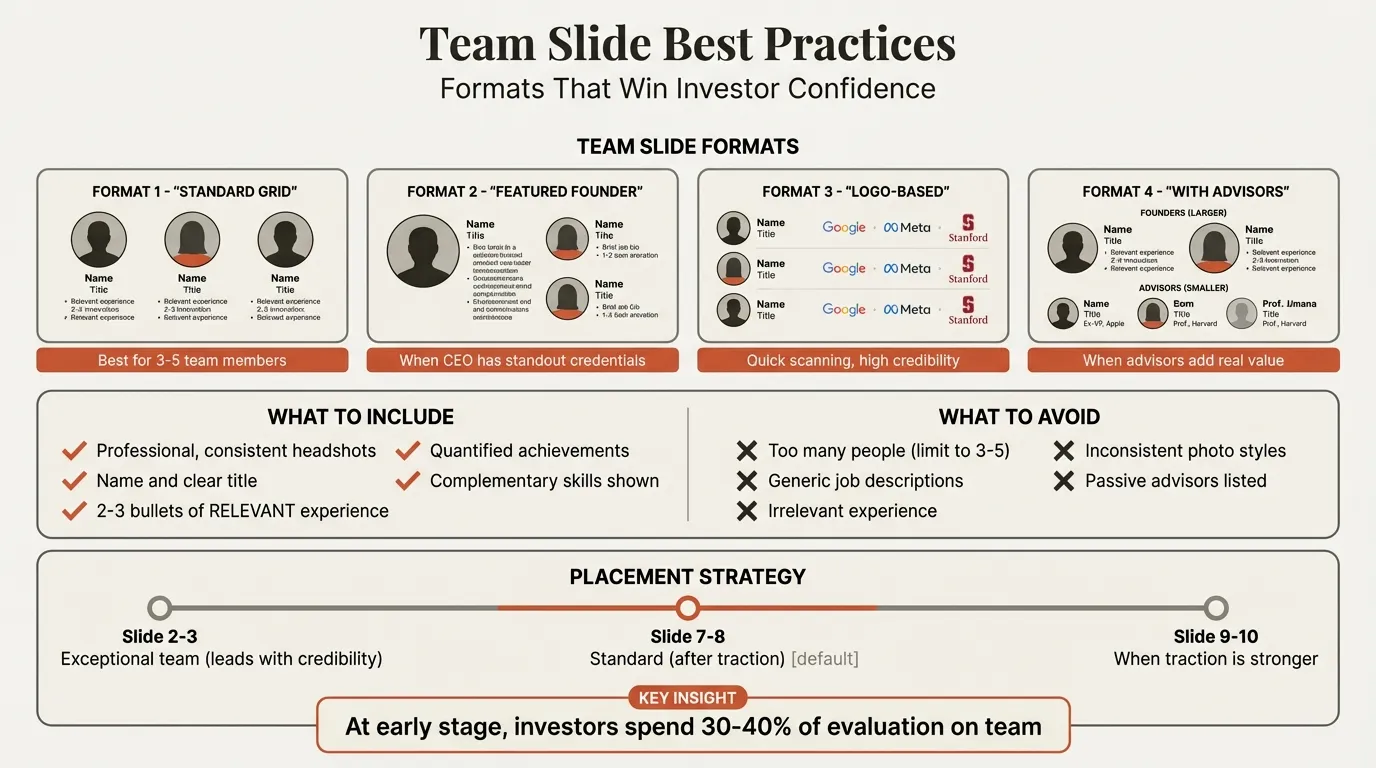
Team Slide Formats That Work
The layout of your team slide matters almost as much as the content. Here are proven formats:
Format 1: The Standard Grid
The most common and effective format for 3-4 team members:
[Photo]          [Photo]          [Photo]
Name, Title      Name, Title      Name, Title
- Experience 1   - Experience 1   - Experience 1
- Experience 2   - Experience 2   - Experience 2
- Experience 3   - Experience 3   - Experience 3
When to use: Default choice for most pitch decks. Works well with 3-5 team members.
Best practices:
- Equal-sized photos and text blocks
- Consistent formatting across all team members
- Left-aligned text for readability
- Adequate spacing between members
For professional headshot layouts and consistent formatting, Deckary's icon library includes 2,000+ professional icons for team structures, org charts, and people representations.
Format 2: Featured Founder + Team
When one founder has exceptional credentials that should lead:
+------------------+    +--------+--------+
|                  |    | Photo  | Photo  |
|  CEO Large Photo |    | Name   | Name   |
|  Detailed Bio    |    | Brief  | Brief  |
|                  |    |        |        |
+------------------+    +--------+--------+
When to use:
- When CEO has standout credentials (successful exit, famous company, industry legend)
- When co-founders have supporting but less notable backgrounds
- When raising from investors who may recognize the lead founder
Format 3: Timeline/Journey
For teams with shared history or narrative arc:
2015: Met at Google     2018: First startup      2022: This company
   [Photo + Photo]         [Photo + Photo]          [Full team]
   Built X together        Acquired by Y            Solving Z problem
When to use:
- Co-founders have meaningful shared history
- Previous ventures are relevant to current startup
- The journey itself is compelling
Format 4: Skills Matrix
When emphasizing complementary capabilities:
                    Technical  Commercial  Industry
Sarah (CEO)           ●●○        ●●●         ●●●
John (CTO)            ●●●        ●○○         ●●○
Maria (VP Sales)      ●○○        ●●●         ●●●
When to use:
- Team diversity is a key strength
- You want to highlight coverage across all critical functions
- Addressing investor concerns about gaps
Format 5: Advisor Integration
When advisors add significant credibility:
+-------------+-------------+-------------+
| Founders                                 |
| [Photo] [Photo] [Photo]                 |
| Full bios with experience               |
+-------------+-------------+-------------+
| Advisors                                 |
| [Small photo + logo] [Small photo + logo]|
| Name, Title at Famous Company            |
+------------------------------------------+
When to use:
- Advisors are well-known in the investor's network
- Advisors fill clear gaps in founder experience
- Advisors are genuinely committed (not just names)
Continue reading: Decision Matrix Template · How to Make a Gantt Chart in PowerPoint (Free Template) · Business Model Slide
Best Practices for Team Slides
Based on reviewing hundreds of pitch decks and feedback from investors, here are the practices that consistently work:
1. Lead with Relevance, Not Prestige
The most common team slide mistake: leading with prestigious credentials that aren't relevant.
Mistake: "Sarah, CEO - Harvard MBA, Goldman Sachs, BCG"
Better: "Sarah, CEO - Built 3 fintech products; 10 years payments experience; previously at Stripe"
For a fintech startup, Stripe experience matters more than Goldman. Match your credentials to your startup's needs.
2. Show Founder-Market Fit Explicitly
Don't make investors connect the dots. State clearly why your background makes you the right team.
According to Storydoc's team slide research, the best team slides include a narrative explaining why this team is uniquely positioned to solve this problem--not just a list of credentials.
Add a framing statement:
"Our team combines 25+ years of enterprise software experience with deep healthcare domain expertise. We've seen this problem firsthand and built the solution customers asked for."
3. Use Consistent Visual Formatting
Visual inconsistency signals lack of attention to detail. Ensure:
- Same photo dimensions and quality
- Same background or treatment for all headshots
- Consistent font sizes and spacing
- Aligned text and elements
For quick alignment and professional formatting, PowerPoint alignment shortcuts can save significant time.
4. Keep Bios Concise
Investors scan slides in 15-30 seconds. According to Qubit Capital's research, you should use no more than 500 characters of text for each bio.
Rule of thumb: 2-3 bullet points per person, maximum 15 words per bullet.
5. Include Quantified Achievements
Numbers are more credible than adjectives:
| Weak | Strong |
|---|---|
| "Led a successful sales team" | "Built sales from $0 to $20M ARR" |
| "Experienced engineer" | "Scaled systems to 50M+ users" |
| "Strong network in healthcare" | "Launched products in 500+ hospitals" |
6. Use Logos Instead of Text Where Possible
Company logos communicate faster than text and save space:
[Photo] John Smith, CTO
[Google logo] [Meta logo] [Stanford logo]
Built ML systems serving 100M+ users
7. Address Obvious Gaps
If your team has an obvious gap (no technical founder, no sales experience), address it:
- Mention hiring plans: "Recruiting VP Sales with enterprise SaaS experience"
- Highlight advisors who fill gaps
- Show how current team compensates
Pretending gaps don't exist damages credibility. Acknowledging them shows self-awareness.
Common Mistakes to Avoid
These errors consistently hurt team slides:
Mistake 1: Too Many People
The problem: Including 8-10 team members, including junior employees and peripheral advisors.
Why it fails: Dilutes focus on the people who matter. Investors want to know about decision-makers, not your entire org chart.
The fix: Limit to 3-5 people maximum. Include founders and C-level only. Save the full team for an appendix.
Mistake 2: Irrelevant Experience
The problem: Listing every job a founder ever had, regardless of relevance.
Why it fails: Makes investors question your judgment about what matters.
The fix: Only include experience directly relevant to this startup. A 10-year career should become 2-3 targeted bullets.
Mistake 3: No Photos or Bad Photos
The problem: Missing photos, placeholder icons, or low-quality images.
Why it fails: Creates an impersonal impression. Suggests lack of professionalism or commitment.
The fix: Invest in professional headshots with consistent style. If budget is limited, take photos against a plain background with good lighting.
For placeholder people icons when drafting slides, see our guide on person icons for PowerPoint.
Mistake 4: Generic Role Descriptions
The problem: "Sarah is responsible for product strategy and vision."
Why it fails: Tells investors nothing about Sarah's qualifications or track record.
The fix: Replace responsibilities with achievements: "Built products used by 2M+ users at Uber."
Mistake 5: Misleading Titles
The problem: Using inflated or misleading titles ("Growth Hacker," "Chief Evangelist," "Marketing Ninja").
Why it fails: Signals immaturity. Investors see through title inflation immediately.
The fix: Use standard titles that communicate roles clearly (CEO, CTO, VP Sales).
Mistake 6: Listing Advisors Who Aren't Involved
The problem: Name-dropping famous advisors who gave one phone call and won't engage further.
Why it fails: Sophisticated investors will check. Discovery destroys credibility.
The fix: Only include advisors who are genuinely committed. If asked, you should be able to describe their specific contributions.
Mistake 7: Inconsistent Formatting
The problem: Different photo sizes, varying bio lengths, misaligned elements.
Why it fails: Signals lack of attention to detail--a red flag for execution ability.
The fix: Use a template with fixed dimensions. Audit for consistency before sending.
Design Tips and Tools
Beyond content, design quality signals professionalism and attention to detail.
Photo Guidelines
| Element | Recommendation |
|---|---|
| Resolution | Minimum 400x400 pixels |
| Background | Neutral, consistent across team |
| Lighting | Even, professional lighting |
| Expression | Approachable but professional |
| Cropping | Shoulders up, centered |
| Style | Consistent treatment (all color or all B&W) |
Budget tip: If you can't afford a professional photographer, use a smartphone with portrait mode against a plain wall. Consistency matters more than perfection.
Layout and Alignment
Leave adequate whitespace between team members--cramped slides look unprofessional. Every element should align to a grid. Use PowerPoint's alignment tools or keyboard shortcuts for precision.
Related Resources
- Deckary's icon library includes professional person icons for team structures
- Person icons for PowerPoint for headshot placeholders
- Pitch deck template guide for the complete 12-slide framework
- Traction slide examples and metrics
- TAM SAM SOM market sizing
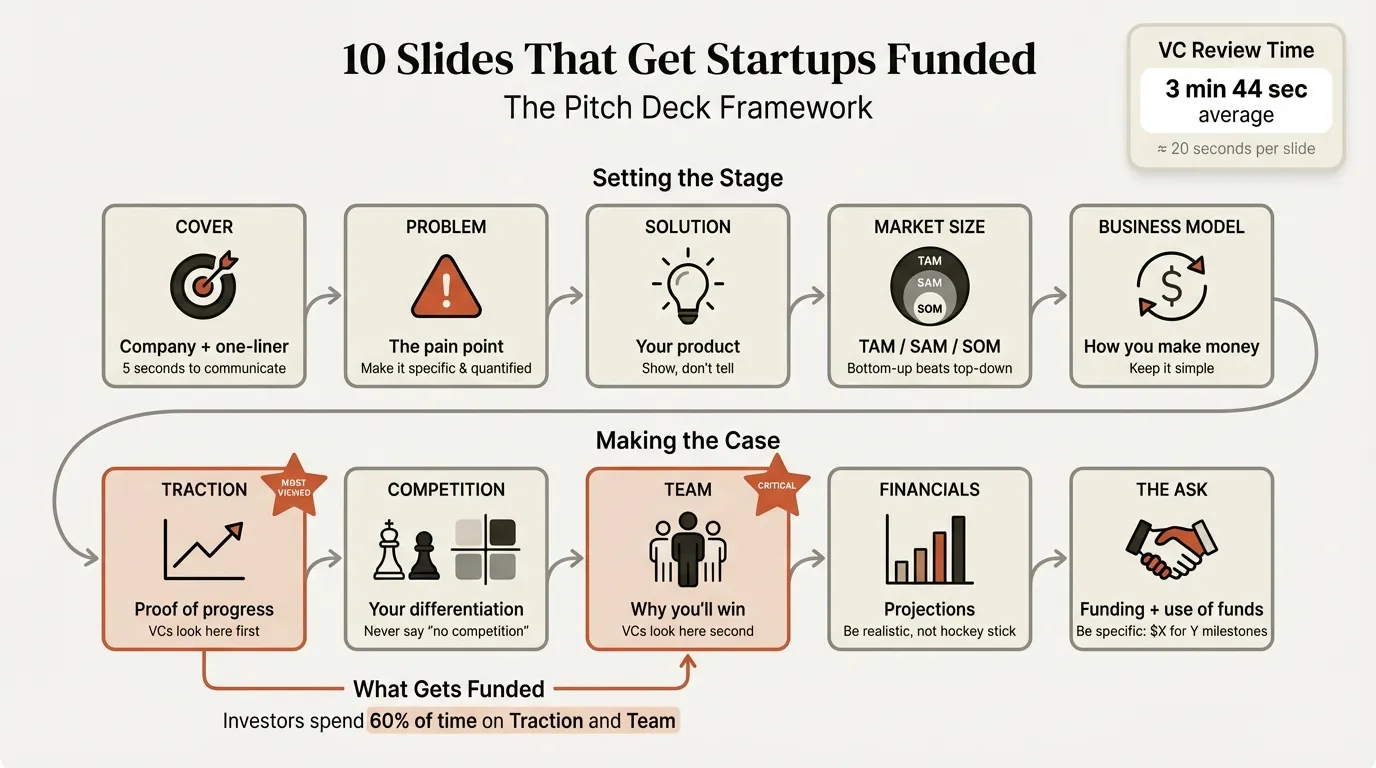
Team Slide Placement Strategy
Where you place your team slide affects how investors perceive your pitch.
Standard Placement: Slide 7-8
For most startups, the team slide comes after:
- Title
- Problem
- Solution
- Market Size
- Business Model
- Traction
This placement works when your traction or product is your strongest selling point.
Early Placement: Slide 2-3
Move the team slide earlier when:
- Founders have exceptional credentials (successful exits, famous companies)
- You're pre-product and team is your main asset
- Investors already know a team member by reputation
- Industry expertise is critical and you have deep domain experience
According to Papermark's research on pitch deck analytics, investors spend 30% more time on the first few pages. If your team is exceptional, capitalize on early attention.
Late Placement: Slide 9-10
Move the team slide later when:
- Your traction is your strongest asset
- The team, while capable, isn't a standout differentiator
- You want investors focused on metrics and opportunity
Summary
The team slide is often the difference between getting a meeting and getting passed on. The best team slides tell a simple story: here are the people who will make this company successful, and here is exactly why they are the right ones for this challenge.
Lead with relevance over prestige. Show founder-market fit explicitly. Keep bios to 2-3 bullets with quantified achievements. Use consistent visual formatting with professional headshots. Limit your slide to 3-5 core members, and address obvious gaps proactively rather than hoping investors won't notice.
For placement, put exceptional teams early (slide 2-3), most teams at standard position (slide 7-8), and traction-led decks late (slide 9-10). Connect your team slide to your broader narrative--reference the problem slide if founders experienced the pain firsthand, and mention hiring plans in your ask if you are addressing team gaps with the raise.
For professional team icons and consistent slide formatting, Deckary offers 2,000+ icons including people and team representations that help create polished, investor-ready decks.