Agile vs Waterfall: How to Choose the Right Methodology
Agile vs waterfall comparison with decision framework, pros and cons, and hybrid approaches. Learn when each methodology fits your project.
Most teams default to agile without analyzing whether their project actually fits an iterative model. The result: agile ceremonies layered onto fundamentally sequential work, sprint planning meetings for projects where requirements were fixed six months ago, and retrospectives that cannot change anything because the contract was already signed.
The agile vs waterfall decision is structural, not ideological. It depends on three factors: how certain your requirements are at kickoff, whether you can deliver value incrementally, and how much your stakeholders tolerate ambiguity. After advising on 50+ transformation programs spanning ERP migrations, product launches, and digital transformations, we have seen both methodologies succeed and fail -- and the failures almost always trace back to choosing the wrong approach for the project's characteristics.
This guide covers the core differences between agile and waterfall, provides a side-by-side comparison, explains when each methodology fits, and gives you a decision framework for recommending one to clients or leadership.
What Is Waterfall Methodology?
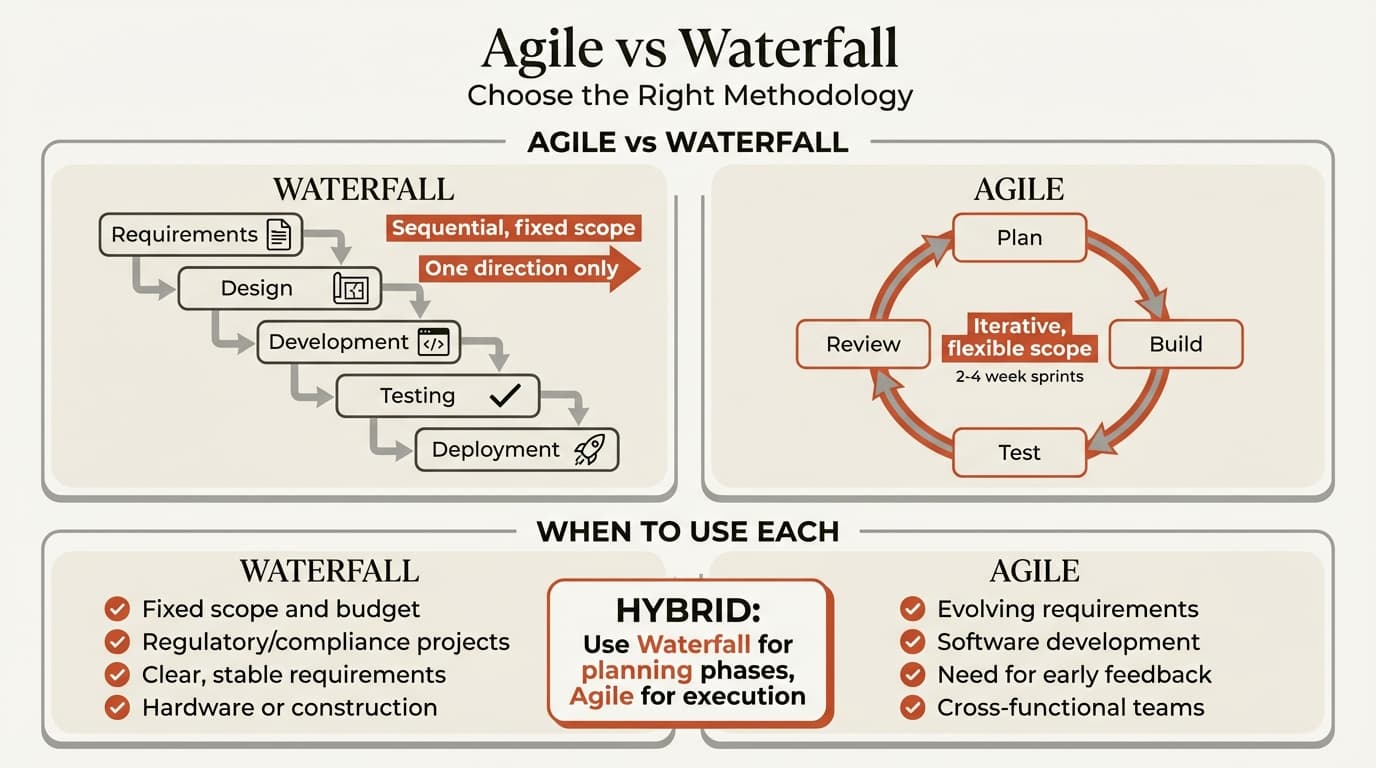
Waterfall is a linear, sequential approach where each phase must complete before the next begins. The model originated in manufacturing and construction, where rework costs are prohibitive and requirements must be locked before execution starts.
The standard waterfall phases are:
- Requirements -- gather and document all specifications upfront
- Design -- create detailed technical or solution design
- Implementation -- build the deliverable
- Testing -- verify against requirements
- Deployment -- release to production or hand off to the client
- Maintenance -- ongoing support and fixes
Each phase produces a defined deliverable that serves as the entry criteria for the next. Changes after a phase closes require formal change control, which introduces cost and timeline impact assessments.
What Is Agile Methodology?
Agile delivers work in short, iterative cycles (typically 1-4 week sprints), with each cycle producing a working increment that stakeholders can review and redirect. The approach emerged from the Agile Manifesto in 2001 as a response to the high failure rate of large waterfall software projects.
Core agile principles relevant to methodology selection:
- Working deliverables over documentation -- progress is measured by output, not reports
- Responding to change over following a plan -- scope adjusts based on feedback
- Customer collaboration over contract negotiation -- stakeholders are embedded in the process
- Individuals and interactions over processes -- team autonomy drives execution speed
Agile does not mean unplanned. Every sprint has a goal, a prioritized backlog, and defined acceptance criteria. The difference is that planning happens continuously rather than once at the start.
Agile vs Waterfall: Side-by-Side Comparison
| Factor | Waterfall | Agile |
|---|---|---|
| Planning horizon | Full project planned upfront | Rolling plan, 1-4 sprints ahead |
| Requirements | Fixed at project start | Evolve based on feedback |
| Phases | Sequential, non-overlapping | Iterative, overlapping |
| Deliverables | Single output at project end | Incremental releases each sprint |
| Flexibility to change | Low -- formal change control | High -- backlog reprioritization |
| Documentation | Heavy -- each phase produces artifacts | Light -- working software preferred |
| Team structure | Specialized teams per phase | Cross-functional, stable teams |
| Client involvement | Bookend (kickoff and delivery) | Continuous (every sprint review) |
| Risk visibility | Late -- issues surface in testing | Early -- issues surface in sprint demos |
| Timeline predictability | High if requirements are stable | Lower for total scope, high per sprint |
The fundamental trade-off: waterfall optimizes for predictability when you know what you are building. Agile optimizes for adaptability when you will learn what to build along the way.
When to Use Waterfall
Waterfall works when three conditions are met: requirements are well-understood and unlikely to change, the deliverable cannot be released incrementally, and stakeholders need fixed milestones for governance or contracts.
Strong waterfall candidates:
- ERP implementations -- SAP, Oracle, and similar platforms have defined configuration paths. Requirements are gathered from existing processes and regulatory mandates. Scope changes mid-build cascade across modules.
- Construction and infrastructure -- you cannot iteratively build a bridge. The design must be complete before construction starts.
- Regulatory compliance programs -- documentation at each stage is mandatory. Auditors need traceable evidence that requirements were defined, tested, and validated sequentially.
- Fixed-price vendor contracts -- when a contract specifies deliverables, timelines, and acceptance criteria upfront, waterfall provides the structure for both parties to manage scope.
- Hardware development -- physical product manufacturing has tooling costs that make late-stage changes prohibitively expensive.
Waterfall strengths: clear milestones for executive reporting, well-defined handoff points between teams, easier to estimate total cost and timeline, strong audit trail.
Waterfall risks: late discovery of problems (nothing is tested until the testing phase), expensive rework when requirements were wrong, and stakeholders who see the deliverable for the first time at the end and request changes.
Continue reading: Project Management Frameworks · Flowchart in PowerPoint · Competitive Landscape Slide
Create professional charts in PowerPoint
Build native waterfall, Mekko, Gantt, and business charts without manual formatting. 14-day free trial. No credit card required.
When to Use Agile
Agile works when requirements will evolve based on user feedback, the deliverable can be released in increments, and the team can operate with autonomy between governance checkpoints.
Strong agile candidates:
- Software product development -- user needs become clearer once people interact with working features. Releasing incrementally captures value early.
- Marketing campaigns with testing cycles -- A/B testing, creative iteration, and channel optimization benefit from sprint-based execution. See our guide on how to prioritize tasks for managing sprint backlogs.
- Innovation and R&D -- when the outcome is uncertain, short iterations with frequent pivots outperform a fixed plan.
- Internal digital transformations -- process changes that affect employee workflows benefit from iterative rollout and feedback.
- Consulting engagements with evolving scope -- strategy projects where the initial hypothesis may shift based on findings (common in due diligence and market entry work).
Agile strengths: early risk identification through sprint demos, faster time to value with incremental delivery, higher stakeholder satisfaction from continuous involvement, and better adaptation to changing priorities.
Agile risks: scope creep without disciplined backlog management, difficulty providing fixed cost and timeline estimates, and stakeholders who expect waterfall-style milestone reporting from an agile team.
Hybrid Approaches: Combining Agile and Waterfall
Most enterprise projects do not fit neatly into one methodology. Hybrid approaches take the governance structure of waterfall and the execution flexibility of agile.
Common hybrid patterns:
1. Waterfall phases with agile execution. The project follows sequential phases (Discovery, Build, Test, Deploy) with phase gates and milestone reporting. Within each phase, work is executed in sprints. This is the most common enterprise pattern and what we recommend for most transformation programs. For structuring the phase-level plan, see our project plan examples.
2. Agile core with waterfall dependencies. The primary team operates in sprints, but external dependencies (vendor contracts, regulatory reviews, infrastructure provisioning) follow a waterfall schedule with fixed dates. The agile team plans sprints around these fixed external milestones.
3. Scaled agile with governance layers. Frameworks like SAFe (Scaled Agile Framework) formalize this hybrid by adding program-level planning increments (typically 8-12 weeks) on top of team-level sprints. Useful for programs with 5+ teams that need coordination.
| Hybrid Pattern | Best For | Governance Model |
|---|---|---|
| Waterfall phases + agile execution | Enterprise transformations, ERP with custom modules | Phase gates at milestone level, sprint reviews within |
| Agile core + waterfall dependencies | Software teams with external vendor timelines | Sprint planning around fixed external dates |
| Scaled agile (SAFe) | Programs with 5+ teams | Program increment planning every 8-12 weeks |
Decision Framework: How to Choose
Use this matrix to match project characteristics to the right methodology. Score each factor for your project and see where the weight falls.
| Decision Criteria | Points to Waterfall | Points to Agile |
|---|---|---|
| Requirement certainty | Requirements documented and signed off | Requirements will evolve with feedback |
| Deliverable type | Single output (building, report, system) | Incremental releases possible |
| Stakeholder availability | Available at start and end only | Available for regular reviews |
| Regulatory requirements | Phase-level documentation mandatory | Lightweight compliance acceptable |
| Contract structure | Fixed-price, fixed-scope | Time and materials or internal |
| Team experience | Familiar with sequential execution | Experienced with sprints and self-organization |
| Change tolerance | Low -- changes are expensive | High -- changes are expected |
| Risk profile | Risks are known and manageable | Risks need early discovery through iteration |
Scoring guide: If five or more factors point in one direction, use that methodology. If it is split, use a hybrid. Most enterprise programs land in hybrid territory because requirements are partially fixed (business case, budget, compliance) but execution details evolve.
When presenting this recommendation to clients or steering committees, structure the slide around the decision matrix with a clear recommendation. Deckary has Gantt chart and project management templates inside PowerPoint that help you visualize timelines for whichever methodology you choose -- see our guide on making Gantt charts in PowerPoint.
Agile vs Waterfall: Pros and Cons Summary
| Dimension | Waterfall Pros | Waterfall Cons | Agile Pros | Agile Cons |
|---|---|---|---|---|
| Planning | Full plan upfront, clear milestones | Rigid, changes are costly | Adaptive, responds to learning | Hard to estimate total scope |
| Stakeholder visibility | Predictable reporting | Late feedback loop | Continuous feedback | Requires ongoing commitment |
| Quality | Structured testing phase | Defects found late | Continuous testing | Quality depends on team discipline |
| Documentation | Comprehensive audit trail | Heavy overhead | Lean and focused | May be insufficient for compliance |
| Team dynamics | Clear roles per phase | Siloed handoffs | Cross-functional collaboration | Requires experienced self-managing teams |
Common Mistakes When Choosing a Methodology
1. Choosing agile because it sounds modern. Agile is not inherently better. An ERP implementation forced into two-week sprints creates chaos: incomplete configurations, untestable modules, and sprint reviews where nothing works because the system requires end-to-end integration. Match the methodology to the work, not the trend.
2. Running waterfall but calling it agile. If your sprints have no working deliverable at the end, you have fixed scope with no flexibility, and stakeholders only see output at project close, you are running waterfall with daily standups. Renaming it does not change the outcome.
3. No governance in agile projects. Agile does not mean no milestones. Stakeholders and sponsors still need visibility into progress, budget burn, and risk. Build governance checkpoints into your sprint cadence -- RACI matrices work just as well in agile contexts for defining who approves what.
4. Ignoring team capability. Agile requires teams that can self-organize, estimate their own capacity, and make decisions without escalating everything. If your team has never worked in sprints, a pilot project is cheaper than converting an entire program. For managing stakeholder expectations during this transition, see our stakeholder mapping guide.
5. Treating hybrid as "do both." Hybrid does not mean running waterfall documentation requirements on top of agile sprints. It means choosing which elements of each methodology serve the project. Define explicitly which decisions follow waterfall governance (budget, scope boundaries, phase gates) and which follow agile practices (sprint planning, backlog prioritization, daily execution).
Key Takeaways
- The agile vs waterfall decision depends on requirement certainty, incremental delivery potential, and stakeholder change tolerance -- not industry trends or team preference.
- Waterfall fits projects with fixed requirements, single deliverables, regulatory documentation needs, and fixed-price contracts.
- Agile fits projects with evolving requirements, incremental delivery potential, available stakeholders, and teams experienced in self-organization.
- Most enterprise projects need a hybrid: waterfall governance structure with agile execution within phases.
- The biggest mistake is choosing a methodology for ideological reasons rather than matching it to the project's actual characteristics. Use the decision matrix to make a defensible recommendation.
Related Guides
- Project Plan Examples -- five real project plans across industries with agile, waterfall, and hybrid formats
- RACI Matrix Examples -- accountability framework that works in both agile and waterfall contexts
- How to Make a Gantt Chart in PowerPoint -- step-by-step guide for building timeline visuals
- Stakeholder Mapping Guide -- managing expectations across methodology transitions
- How to Prioritize Tasks -- backlog prioritization for agile sprint planning
Create professional charts in PowerPoint
Build native waterfall, Mekko, Gantt, and business charts without manual formatting. 14-day free trial. No credit card required.