Project Plan Examples: 5 Real Templates Across Industries
Project plan examples for IT, marketing, product development, office relocation, and consulting. Includes key components, formats, and common mistakes.
The difference between a project plan that drives execution and one that gathers dust on SharePoint comes down to specificity. Generic plans list tasks and dates. Effective project plan examples include the scope boundaries that prevent creep, the dependencies that determine critical path, and the accountability structure that ensures nothing falls through the cracks.
After building and reviewing project plans across 80+ enterprise programs -- ERP implementations, post-merger integrations, market launches, and consulting engagements -- we have identified which planning patterns consistently deliver on time and which create the illusion of control while deadlines slip.
This guide provides five project plan examples across industries, breaks down the components every plan needs, compares formats, and covers the agile vs. waterfall decision. For the broader strategic framework context, see our Strategic Frameworks Guide.
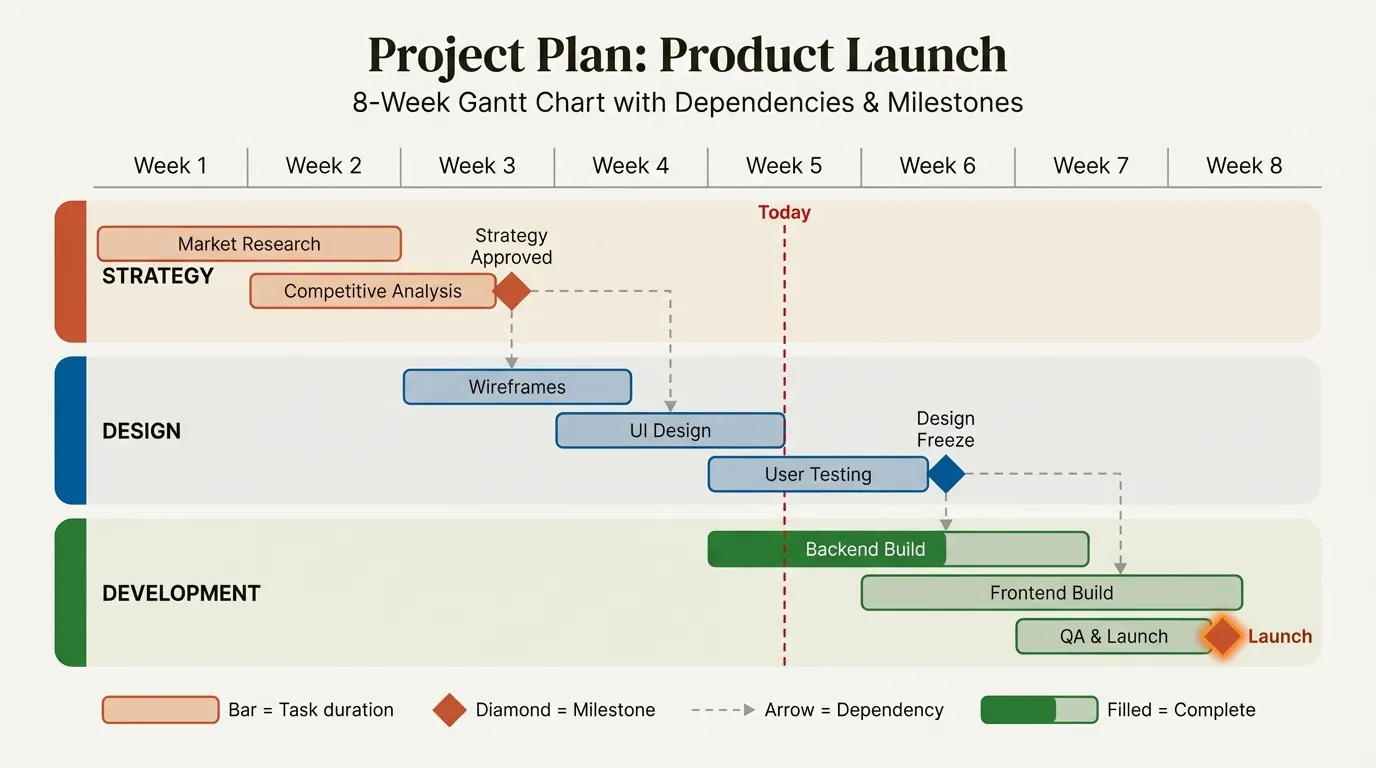
Key Components of Every Project Plan
A project plan answers six questions: what are we delivering (scope), when does each phase complete (timeline), who is doing what (resources), what could go wrong (risks), what depends on what (dependencies), and how do we track accountability (RACI).
| Component | Purpose | Common Failure Mode |
|---|---|---|
| Scope statement | Defines what is included and excluded | Scope described so broadly that stakeholders assume different deliverables |
| Timeline and milestones | Anchors progress to checkpoints | Milestones set as date ranges instead of specific deliverables |
| Resource allocation | Assigns people, budget, tools to workstreams | Resources assigned at 100% utilization with no buffer |
| Risk register | Identifies risks with probability, impact, mitigation | Created at project start and never updated |
| Dependency map | Shows which tasks must complete before others begin | Dependencies tracked informally or not at all |
| RACI matrix | Clarifies Responsible, Accountable, Consulted, Informed | Everyone listed as "Responsible" with no single accountable owner |
For a deep dive on accountability structures, see our guide on RACI matrix examples. For stakeholder identification that feeds into the RACI, see stakeholder mapping.
5 Project Plan Examples by Industry
1. IT System Implementation (ERP Migration)
Scope: Migrate from SAP ECC to S/4HANA across finance, procurement, and supply chain for a 3,000-person manufacturer. Excludes HR module (Phase 2) and custom warehouse integrations.
Timeline: 14 months, four phases.
| Phase | Duration | Key Milestones | Dependencies |
|---|---|---|---|
| Discovery and blueprint | Months 1-3 | Requirements signed off by all module owners | Stakeholder interviews by Week 4 |
| Build and configure | Months 4-8 | Configuration complete; unit testing passed | Blueprint approval gates build |
| Testing and training | Months 9-12 | UAT sign-off; training completion above 90% | Build completion gates UAT |
| Go-live and stabilization | Months 13-14 | Cutover weekend; 30-day hypercare | UAT sign-off gates go-live |
Top risks: Data migration quality (30% of ERP projects experience data issues post-go-live per Panorama Consulting), key user attrition, and scope creep from custom report requests during build.
The explicit exclusion of the HR module prevents the most common ERP planning failure -- trying to do everything at once.
2. Marketing Campaign Launch
Scope: Integrated Q3 brand campaign across paid digital, owned channels (email, blog, website), and one trade show. Excludes TV/radio and influencer partnerships.
Timeline: 10 weeks.
| Week | Workstream | Deliverable | Owner |
|---|---|---|---|
| 1-2 | Strategy | Campaign brief, audience segmentation, KPIs | Marketing Director |
| 2-4 | Creative | Three concepts, final creative suite (6 formats) | Creative Lead |
| 3-5 | Media | Media plan, budget allocation, platform setup | Media Manager |
| 4-6 | Content | Landing pages, email sequences, blog posts | Content Lead |
| 5-7 | Legal | Creative review, claim substantiation, disclaimers | Legal |
| 8 | QA | End-to-end testing across channels and devices | QA Lead |
| 9-10 | Launch | Go-live, daily monitoring, creative rotation | Campaign Manager |
Critical dependency: Legal review (Weeks 5-7) is on the critical path. If creative slips past Week 4, legal compresses and either delays launch or forces a quality shortcut. Build buffer into creative timelines to protect this.
3. Product Development (SaaS Feature)
Scope: Dashboard analytics module for existing SaaS platform. Includes charts, tables, export, date ranges, and role-based access. Excludes predictive analytics, custom report builder, and API access (backlog items).
Timeline: 12 weeks.
| Phase | Duration | Deliverables | Success Criteria |
|---|---|---|---|
| Discovery | 2 weeks | User interviews (8-10), competitive audit | Problem statement validated; scope locked |
| Sprint 1 | 2 weeks | Data pipeline, chart rendering, date selector | Stakeholder demo; benchmarks met |
| Sprint 2 | 2 weeks | Role-based access, export, responsive layout | QA pass; security review complete |
| Sprint 3 | 2 weeks | Polish, edge cases, accessibility | Accessibility audit passed |
| Beta | 2 weeks | 10% rollout, monitoring, bug fixes | Error rate below 0.1% |
| GA release | 2 weeks | Full rollout, docs, support training | All P0/P1 bugs resolved |
Listing explicit backlog items as out-of-scope prevents the mid-sprint scope creep that happens when stakeholders assume "dashboard analytics" includes every feature they can imagine.
4. Office Relocation
Scope: Relocate 250-person headquarters to new location (same city). Includes physical move, IT infrastructure, furniture, and employee transition. Excludes satellite office consolidation.
Timeline: 16 weeks.
| Phase | Weeks | Key Activities | Dependencies |
|---|---|---|---|
| Planning and contracts | 1-4 | Lease, space planning, IT audit, vendor selection | Lease signed before vendor contracts |
| Infrastructure build-out | 5-10 | Network cabling, server room, security, furniture | Building permits gate construction |
| Testing and prep | 11-13 | IT testing, desk assignments, logistics planning | Infrastructure complete before testing |
| Move execution | 14-15 | Phased move by department over two weekends | IT validation gates each department |
| Stabilization | 16 | Issue resolution, mail forwarding, old lease handback | All departments operational |
Critical dependency chain: Lease signing (Week 2) triggers permits (Week 3), which gate construction (Week 5). A two-week delay in lease negotiation compresses the entire program with no recovery option.
5. Consulting Engagement (Strategy Project)
Scope: Market entry assessment for a mid-market industrial company evaluating Southeast Asian expansion. Three workstreams: market sizing, competitive landscape, go-to-market options. Deliverable: board-ready recommendation deck.
Timeline: 8 weeks.
| Week | Workstream | Deliverable | SteerCo Gate |
|---|---|---|---|
| 1 | All | Hypothesis tree, interview guide, data request | Kickoff alignment |
| 2-3 | Market sizing | Top-down and bottom-up models for 5 markets | -- |
| 2-3 | Competitive | Competitor profiles, market share estimates | -- |
| 4 | All | Market prioritization (top 3), competitive assessment | SteerCo 1: Direction check |
| 5-6 | Go-to-market | Channel options, partnership vs. organic, projections | -- |
| 7 | All | Draft final deck with recommendation | SteerCo 2: Draft review |
| 8 | All | Final deck with implementation roadmap | Final SteerCo |
Top risk: Client data access. Market sizing needs internal sales data that often takes 2-3 weeks to extract. Mitigation: build the model with public top-down estimates first, calibrate with internal data when it arrives.
Steering committee dates anchor the plan around decision points rather than task completion, forcing synthesis at regular intervals instead of saving it all for the final week.
Continue reading: Case Study Template PowerPoint · How to Make a Gantt Chart in PowerPoint (Free Template) · Competitive Landscape Slide
Create professional charts in PowerPoint
Build native waterfall, Mekko, Gantt, and business charts without manual formatting. 14-day free trial. No credit card required.
Project Plan Formats Compared
| Format | Best For | Audience | Detail Level |
|---|---|---|---|
| Gantt chart | Execution tracking, dependency management | Project team, PMO | High -- tasks and dependencies |
| RACI-integrated plan | Cross-functional accountability | Workstream leads | Medium -- workstreams with role assignments |
| One-page summary | Executive communication | C-suite, board, sponsors | Low -- phases, milestones, status |
Gantt charts are the standard for execution planning because they make dependencies visible. Use them when your project has 20+ tasks with dependencies or multiple parallel workstreams. For building Gantt charts in PowerPoint, see our step-by-step guide. Deckary creates Gantt charts directly inside PowerPoint with automatic date calculations and Excel linking, eliminating the 30-60 minutes of manual formatting.
RACI-integrated plans combine timelines with accountability. Each workstream row includes start/end dates plus who is Responsible, Accountable, Consulted, and Informed. Best when coordination is the primary challenge. See our RACI matrix examples for the full framework.
One-page summaries distill the plan into a single slide for executives: phases, milestones, status indicators, top risks. A steering committee does not need 200 tasks. They need to know if you are on track, what the risks are, and whether they need to make decisions.
For building one-page project summaries, Deckary's project plan template provides pre-formatted layouts with milestone markers and status indicators that follow consulting standards.
Agile vs. Waterfall Project Plan Examples
The choice is structural, not ideological. It depends on requirement certainty and whether you can deliver incrementally.
| Factor | Waterfall | Agile | Hybrid |
|---|---|---|---|
| Requirements | Fixed upfront | Expected to evolve | Core fixed, details flexible |
| Deliverable | Single output at end | Incremental releases | Phased within fixed structure |
| Change management | Formal change control | Backlog reprioritization | Change control at phase level |
| Best for | ERP, construction, compliance | Software, product, marketing | Most enterprise projects |
Most enterprise projects use a hybrid. The ERP example above uses waterfall phases but could run agile sprints within the Build phase. The SaaS example is agile by design but still needs fixed milestones (beta date, GA date) for stakeholder alignment.
The key insight: agile does not mean unplanned. Every agile project still needs scope boundaries, resource allocation, and risk identification. The format changes; the components do not.
Common Project Planning Mistakes
1. No explicit scope exclusions. "Implement CRM system" without exclusions invites scope creep. Every plan should list 3-5 items that are explicitly out of scope.
2. Dependencies tracked informally. When dependencies live in someone's head, they are invisible until they cause a delay. Map every cross-workstream dependency and assign an owner.
3. Resources at 100% utilization. People get sick, priorities shift, unexpected work appears. Build 15-20% buffer into resource plans.
4. Risk register never updated. The risk landscape at Week 1 is different from Week 8. Review risks at every milestone. Remove passed risks, add new ones, update probability assessments.
5. Plan too detailed to maintain. A 500-row plan that no one updates after Week 2 is worse than a 30-row plan reviewed weekly. Match granularity to your team's discipline for maintaining it.
Key Takeaways
- Every project plan needs six components: scope, timeline, resources, risks, dependencies, and RACI. Missing any one creates a predictable failure mode.
- Scope exclusions matter as much as inclusions. They prevent the creep that derails more projects than bad estimation.
- Match format to audience: Gantt for execution teams, RACI-integrated for cross-functional coordination, one-page summaries for executives.
- Agile and waterfall are not mutually exclusive. Most projects benefit from a hybrid with fixed milestones and flexible execution within phases.
- A medium-detail plan maintained weekly beats a detailed plan no one updates.
Download the project plan template or the Gantt chart template to start with pre-formatted PowerPoint layouts that follow the structures in this guide.
Related Guides
- Strategic Frameworks Guide -- the broader framework context for project planning
- Stakeholder Mapping -- identifying and engaging the people who determine project success
- How to Make a Gantt Chart in PowerPoint -- step-by-step guide for building timeline visuals
- RACI Matrix Examples -- accountability framework with worked examples
Create professional charts in PowerPoint
Build native waterfall, Mekko, Gantt, and business charts without manual formatting. 14-day free trial. No credit card required.