Stakeholder Mapping: The Complete Guide for Consultants and PMs
Stakeholder mapping identifies who matters, how much power they hold, and what engagement strategy they need. Step-by-step process with worked examples.
Stakeholder mapping is the difference between a project that stalls in committee and one that clears every approval gate on schedule. The framework itself is straightforward — plot stakeholders by power and interest, then tailor engagement accordingly. The hard part is doing it honestly, identifying the stakeholders who don't appear on org charts, and updating the map when political dynamics shift mid-project.
After applying stakeholder mapping across 60+ enterprise transformation programs — ERP migrations, operating model redesigns, post-merger integrations — we have tracked which engagement strategies actually move projects forward and which create the illusion of alignment while decisions stall behind the scenes.
This guide covers the core stakeholder mapping methodology, the four main models and when each applies, a step-by-step mapping process, and a worked example for a digital transformation initiative. For the broader strategic toolkit these frameworks fit into, see our Strategic Frameworks Guide.
What Is Stakeholder Mapping?
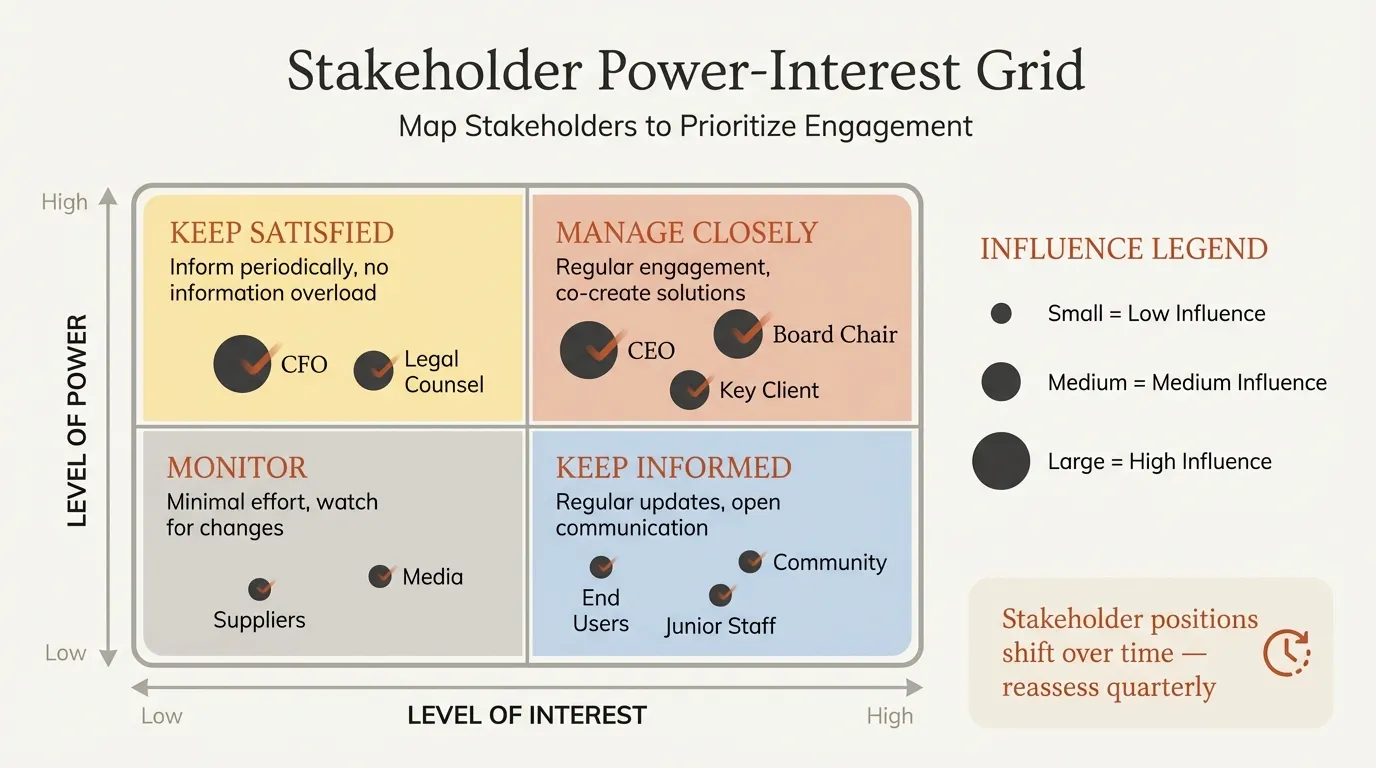
Stakeholder mapping is the process of identifying every individual or group that can influence or is affected by a project, then classifying them based on attributes like power, interest, legitimacy, or urgency. The output is a visual map — typically a 2x2 grid — that dictates how you engage each stakeholder throughout the project lifecycle.
The concept originates from R. Edward Freeman's 1984 stakeholder theory, as outlined in his foundational text Strategic Management: A Stakeholder Approach, but the version consultants and project managers use most often is Aubrey Mendelow's Power-Interest Grid, introduced in 1991. It classifies stakeholders along two dimensions:
- Power: The ability to influence project outcomes, resources, or decisions
- Interest: The degree to which the stakeholder is affected by or concerned with the project
This creates four quadrants, each with a distinct engagement strategy. We will break down those strategies in detail below.
The critical distinction from a simple stakeholder list is that mapping forces you to differentiate engagement. A flat list treats the CFO and a mid-level analyst the same. A map tells you the CFO needs monthly executive briefings while the analyst needs access to a project dashboard. That differentiation is what prevents the two most common failure modes: over-communicating to disengaged stakeholders (wasting their time and your credibility) and under-communicating to powerful ones (creating blockers you didn't see coming).
Stakeholder Mapping Models Compared
The Power-Interest Grid is the most common model, but it is not the only option. Different models suit different project contexts.
| Model | Dimensions | Best For | Limitation |
|---|---|---|---|
| Power-Interest Grid (Mendelow) | Power, Interest | General project management, consulting engagements | Doesn't capture urgency or legitimacy |
| Salience Model (Mitchell et al.) | Power, Legitimacy, Urgency | Complex multi-party projects, regulatory environments | More time-consuming to complete; requires judgment on 3 dimensions |
| RACI Matrix | Responsible, Accountable, Consulted, Informed | Task-level accountability and workflow clarity | Doesn't capture power dynamics or engagement strategy |
| Influence-Impact Grid | Influence over project, Impact of project on them | Change management, organizational redesign | Can overlap with Power-Interest when influence and power are similar |
Our recommendation: Start with the Power-Interest Grid for engagement strategy, then layer a RACI matrix on top for task-level accountability. The Salience Model adds value when you are navigating regulatory stakeholders or multi-party negotiations where legitimacy and urgency differ significantly from raw power.
For a ready-made layout you can populate directly, see our Stakeholder Analysis Template.
The Power-Interest Grid: Four Quadrants
The Power-Interest Grid is the backbone of stakeholder mapping in consulting. Here is what each quadrant means in practice and — more importantly — what engagement actually looks like for each.
High Power, High Interest: Manage Closely
These are your project sponsors, steering committee members, and senior leaders whose departments are directly affected. They have the authority to kill the project and the motivation to pay attention.
Engagement strategy:
- Weekly or biweekly one-on-one briefings
- Early involvement in key decisions (before they are finalized)
- Direct access to project leadership
- Tailored communications that address their specific concerns
Common mistake: Treating "manage closely" as "send them every document." These stakeholders want concise updates that surface risks and decisions — not 40-page status reports. Use the Pyramid Principle for all communications with this quadrant: lead with the recommendation, then provide supporting detail only if they ask.
High Power, Low Interest: Keep Satisfied
These stakeholders can block your project but are not actively engaged. Think of the CIO who approved the budget but has moved on to other priorities, or the board member who will only re-engage if something goes wrong.
Engagement strategy:
- Monthly executive summaries (one page maximum)
- Proactive escalation of risks before they become issues
- Minimal demands on their time
- Frame updates in terms of their priorities, not your project's details
Common mistake: Ignoring these stakeholders because they seem disengaged. Their low interest can flip to high interest overnight if a risk materializes or if someone else raises concerns. By then, you have lost the narrative.
Low Power, High Interest: Keep Informed
End users, team members, and subject matter experts who care deeply about the project but lack authority over its direction. Their buy-in matters for adoption; their resistance can create operational friction even if it cannot stop the project formally.
Engagement strategy:
- Regular newsletters or project dashboards
- Feedback channels (surveys, town halls, office hours)
- Transparent communication about timelines and changes
- Recognize their input visibly so they feel heard
Common mistake: Dismissing this group because they lack formal power. As the Project Management Institute's stakeholder engagement guidance emphasizes, end-user resistance is the number one cause of implementation failure. Their informal influence — hallway conversations, team chats, union representatives — can shift the political landscape faster than any steering committee meeting. See our Change Management Models guide for frameworks that address this.
Low Power, Low Interest: Monitor
Peripheral stakeholders with minimal influence and minimal concern. External vendors, tangential departments, or industry observers.
Engagement strategy:
- Quarterly or milestone-based updates
- Standard project communications (no custom content)
- Monitor for shifts in power or interest that would move them to another quadrant
Common mistake: Spending zero time on this group. Monitor does not mean ignore. A vendor who seems peripheral today may become critical when their contract is up for renewal mid-project.
Continue reading: 30-60-90 Day Plan Template · Tornado Charts in PowerPoint · Competitive Landscape Slide
Use consulting-grade layouts in PowerPoint
Start from structured business slides and customize them in your own deck. 14-day free trial. No credit card required.
Step-by-Step Stakeholder Mapping Process
Step 1: Identify All Stakeholders
Cast a wide net. Most project teams identify 60-70% of stakeholders intuitively but miss the rest. Use these categories to ensure completeness:
- Decision-makers: Sponsors, steering committee, budget holders
- Influencers: Advisors, subject matter experts, trusted peers of decision-makers
- Impacted parties: End users, customers, teams whose workflows change
- Enablers: IT, procurement, legal, HR, finance — functions that control resources or approvals
- External: Regulators, partners, suppliers, investors, media
A useful forcing mechanism: for every stakeholder you identify, ask "Who could overrule this person?" and "Who does this person listen to?" Both questions surface stakeholders you would otherwise miss.
Step 2: Assess Power and Interest
For each stakeholder, score power and interest on a 1-5 scale:
| Score | Power Description | Interest Description |
|---|---|---|
| 1 | No authority over project resources or decisions | Unaware of or indifferent to the project |
| 2 | Minor influence through informal channels | Aware but not actively engaged |
| 3 | Can delay decisions or redirect resources | Monitors progress, occasionally engages |
| 4 | Controls key resources or approval gates | Actively involved, attends updates |
| 5 | Can approve, block, or terminate the project | Project outcome directly affects their role or objectives |
Be honest. The most common error is inflating the power of stakeholders you like and deflating the power of stakeholders you find difficult. Score based on structural authority and resource control, not personality.
Step 3: Plot on the Grid
Place each stakeholder on the 2x2 grid. Group stakeholders who share similar positions — you will likely find clusters rather than an even distribution.
For presentation-ready stakeholder maps, Deckary's AI slide builder can generate the grid layout with quadrant labels and stakeholder positions directly in PowerPoint, saving you from manual shape alignment.
Step 4: Define Engagement Actions
For each stakeholder (or cluster), document:
- Communication frequency: Weekly, biweekly, monthly, quarterly
- Communication format: One-on-one briefing, email update, dashboard, town hall
- Key messages: What this stakeholder needs to hear, framed in their terms
- Owner: Who on your team is responsible for this relationship
Step 5: Review and Update
Stakeholder maps are living documents. Review at every phase gate, after major decisions, and whenever organizational changes occur. A restructuring can move five stakeholders to different quadrants overnight.
Worked Example: Digital Transformation Initiative
Consider a mid-size manufacturing company implementing a new ERP system. The project affects finance, operations, supply chain, and shop floor teams. Here is how the stakeholder map plays out.
Stakeholder Identification
| Stakeholder | Role | Power (1-5) | Interest (1-5) | Quadrant |
|---|---|---|---|---|
| CFO | Budget sponsor | 5 | 4 | Manage Closely |
| COO | Operations lead | 5 | 5 | Manage Closely |
| VP of Supply Chain | Key process owner | 4 | 5 | Manage Closely |
| CIO | Technology oversight | 5 | 3 | Keep Satisfied |
| Head of HR | Change management | 3 | 4 | Keep Informed |
| Shop floor supervisors (12) | End users | 2 | 5 | Keep Informed |
| Finance analysts (8) | Daily system users | 2 | 4 | Keep Informed |
| External ERP vendor | Implementation partner | 3 | 3 | Keep Informed |
| Board of Directors | Governance oversight | 5 | 2 | Keep Satisfied |
| Marketing department | Minimal system interaction | 1 | 1 | Monitor |
| External auditors | Annual audit touchpoint | 2 | 2 | Monitor |
Engagement Plan Highlights
CFO and COO (Manage Closely): Biweekly 30-minute briefings with a one-page status update. Every briefing leads with decisions needed, risks surfaced, and budget variance. No surprises — if a risk emerges between briefings, escalate within 24 hours.
CIO and Board (Keep Satisfied): Monthly one-page executive summary. The CIO gets a technology-focused version covering integration architecture and security compliance. The Board gets a strategic version covering timeline, budget, and business case realization.
Shop floor supervisors (Keep Informed): Biweekly town halls during the implementation phase, weekly during go-live. A dedicated Slack channel for questions. Their resistance is the highest-probability risk to adoption, so the engagement plan must account for the change curve rather than relying on status updates alone.
Marketing department (Monitor): Included in quarterly all-hands project updates. No custom communications unless scope changes to include CRM integration.
What Changed Mid-Project
Three months in, the Head of HR moved from Keep Informed to Manage Closely. Why? The go-live timeline coincided with annual performance reviews, creating a resource conflict for 200+ employees who needed training. HR's cooperation went from "nice to have" to "critical path." This is exactly why stakeholder maps need regular reviews.
Identifying Hidden Stakeholders
The stakeholders who derail projects are rarely the ones on your initial list. Hidden stakeholders fall into three categories:
Informal influencers. The senior director who doesn't sit on any committee but whose opinion the CEO trusts. The long-tenured operations manager whose team will quietly resist any process change they weren't consulted on. Find them by asking: "Before making this decision, who would [decision-maker] call?"
Gatekeepers. Procurement managers who control vendor approvals. IT security teams who must sign off on data architecture. Legal counsel who reviews contracts. These stakeholders have low interest until you need something from them — and then they have absolute veto power over your timeline.
Affected parties without representation. Frontline employees whose workflows change but who have no seat at the table. Customers who experience service disruptions during migration. These groups generate the resistance that sinks implementations. Include them proactively or deal with them reactively — the second option always costs more.
Common Stakeholder Mapping Mistakes
Mapping once and filing it away. A stakeholder map created in week one and never updated is worse than no map at all — it gives you false confidence in an outdated political landscape.
Conflating title with power. A VP title does not automatically mean high power over your project. Score power based on who controls the resources, approvals, and decisions your project actually needs.
Ignoring opposition. The instinct is to map stakeholders you have good relationships with and skip the ones who are hostile to the project. Hostile stakeholders with high power are your highest-priority engagement targets.
Over-engineering the map. A stakeholder map with 50+ individually plotted names becomes unreadable. Group stakeholders with similar profiles into clusters. "Finance team (8 analysts)" is more actionable than eight separate entries with identical engagement strategies.
Treating engagement as one-way communication. Sending updates is not engagement. Engagement means listening, incorporating feedback, and demonstrating that stakeholder input changed something. If stakeholders feel like they are being "managed" rather than consulted, trust erodes.
Building Stakeholder Maps in PowerPoint
A stakeholder map needs to communicate clearly in steering committee presentations and project governance reviews. The standard layout is a 2x2 grid with quadrant labels and stakeholder names positioned by their power-interest scores.
For formatting that meets consulting slide standards:
- Use a clean 2x2 grid with labeled axes (Power on Y, Interest on X)
- Color-code quadrants: red or orange for Manage Closely, yellow for Keep Satisfied and Keep Informed, green for Monitor
- Position stakeholder names as text boxes or circles within each quadrant
- Include a one-line action label in each quadrant header
If you need a ready-to-use layout, our Stakeholder Analysis Template provides the grid with pre-formatted quadrants. For the related task of defining who is responsible for what on each workstream, see our RACI Matrix Template and Project Plan Template.
Key Takeaways
- Stakeholder mapping is a living practice, not a one-time exercise. Review your map at every phase gate and after any organizational change.
- The Power-Interest Grid is the fastest model to implement. Layer a RACI matrix on top for task-level clarity.
- Hidden stakeholders — informal influencers, gatekeepers, and unrepresented affected parties — are where most projects get blindsided.
- Engagement means two-way communication. If stakeholders feel managed rather than consulted, your map is a liability.
- High power, low interest stakeholders are the most dangerous quadrant to neglect. They are quiet until something goes wrong, and by then you have lost control of the narrative.
For more frameworks that support project governance and strategic communication, explore our Strategic Frameworks Guide.
Use consulting-grade layouts in PowerPoint
Start from structured business slides and customize them in your own deck. 14-day free trial. No credit card required.