RACI Matrix Examples: 5 Real-World Templates You Can Use Today
RACI matrix examples for software projects, marketing campaigns, restructurings, product launches, and compliance. Filled-in tables with role assignments.
A RACI matrix example that actually helps a project team looks nothing like the generic templates in most project management guides. The framework is simple -- assign one of four roles per task per person -- but the difference between a RACI that prevents confusion and one that collects dust comes down to specificity: real tasks, real names, and one Accountable person per row with no exceptions.
After building RACI matrices across 80+ organizational transformations, product launches, and cross-functional programs, we have identified the patterns that make the framework effective and the mistakes that undermine it. The most common failure is assigning roles politically rather than operationally, which produces a chart that changes nothing about how work gets done.
This guide provides five filled-in RACI matrix examples, explains when to use RACI versus alternative models, and covers the mistakes that turn a useful accountability tool into a bureaucratic artifact. For the broader strategic toolkit, see our Strategic Frameworks Guide.
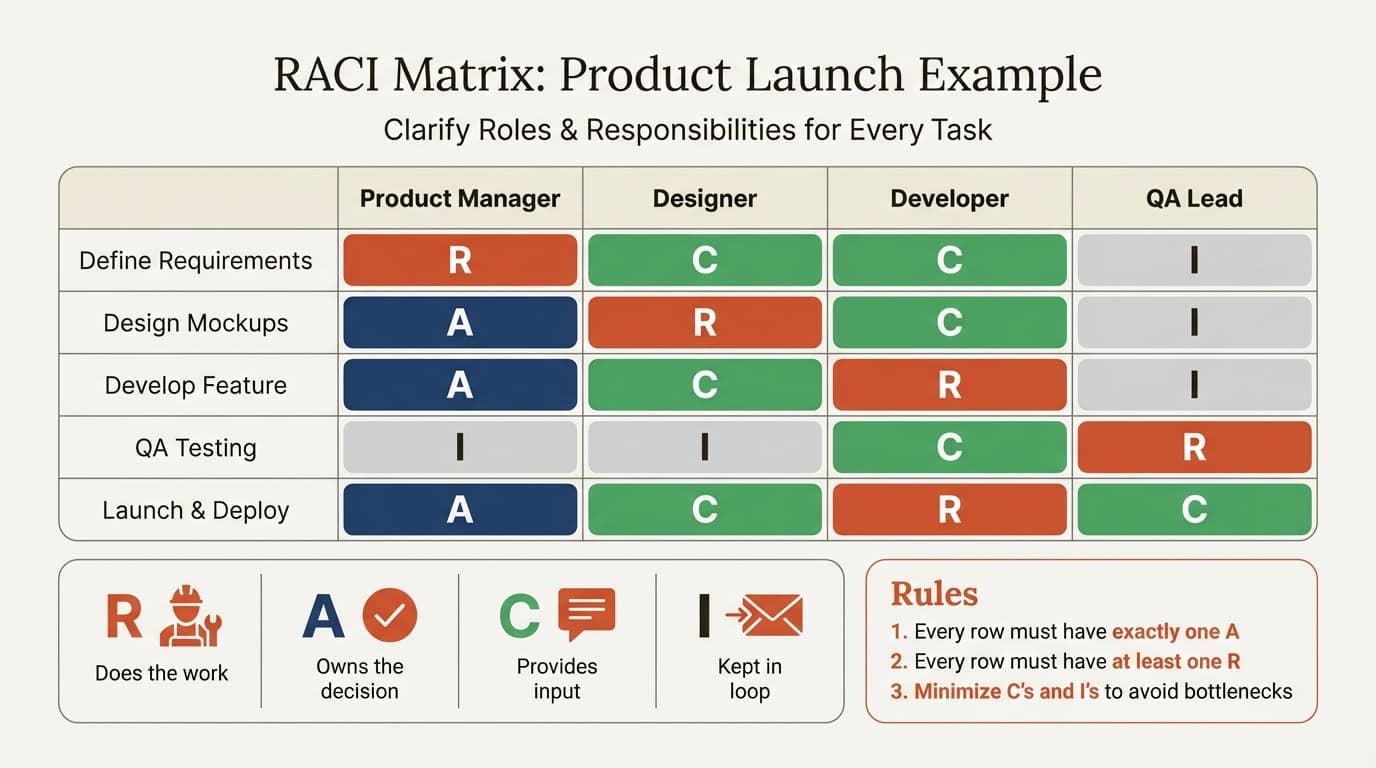
What Is a RACI Matrix?
A RACI matrix -- also known as a responsibility assignment matrix in the PMI's PMBOK Guide -- is a responsibility assignment chart that maps every key deliverable to the people involved, assigning each one a specific level of involvement:
- Responsible (R): Performs the work and delivers the output.
- Accountable (A): Owns the outcome and has final decision authority. Exactly one A per task.
- Consulted (C): Provides input before work is completed. Two-way communication.
- Informed (I): Notified after a decision is made or deliverable is completed. One-way communication.
The matrix places deliverables in rows and roles in columns. Each cell gets one letter. Empty cells mean no involvement. The critical rule is one A per row. If two people are Accountable for the same deliverable, nobody is. This is where most RACI matrices fail, and it is the first thing we check when reviewing a client's project governance.
RACI Matrix Example 1: Software Development Project
Context: A fintech company building a new payment processing module across engineering, product, design, QA, security, and DevOps over 16 weeks.
| Task / Deliverable | Product Mgr | Tech Lead | UX Designer | Dev Team | QA Lead | Security | DevOps |
|---|---|---|---|---|---|---|---|
| Requirements documentation | A | C | C | I | I | C | I |
| Technical architecture | C | A | I | R | I | C | I |
| UI/UX wireframes | C | C | A/R | I | I | I | I |
| Sprint planning | A | R | C | R | C | I | I |
| Feature development | I | A | I | R | I | I | I |
| Code review | I | A | I | R | R | C | I |
| Security audit | I | C | I | I | I | A/R | I |
| QA testing | I | C | I | C | A/R | I | I |
| Deployment pipeline | I | C | I | I | I | C | A/R |
| Production release | A | R | I | R | R | C | R |
Why this works: The Product Manager is Accountable for what gets built (requirements, sprint planning, release). The Tech Lead is Accountable for how it gets built (architecture, feature quality). Security and QA own their quality gates without ambiguity.
RACI Matrix Example 2: Marketing Campaign Launch
Context: A B2B SaaS company launching an integrated campaign for a new enterprise tier, spanning content, demand gen, product marketing, and sales enablement over 8 weeks.
| Task / Deliverable | VP Marketing | Product Mktg | Content Lead | Demand Gen | Designer | Sales Enable | Legal |
|---|---|---|---|---|---|---|---|
| Campaign strategy | A | R | C | C | I | C | I |
| Buyer persona refinement | C | A/R | C | I | I | C | I |
| Landing page copy | I | C | A/R | C | I | I | C |
| Landing page design | I | I | C | I | A/R | I | I |
| Email nurture sequence | I | C | C | A/R | I | I | C |
| Paid media plan | A | I | I | R | I | I | I |
| Blog and SEO content | I | C | A/R | I | I | I | I |
| Sales battle cards | I | A/R | C | I | I | R | I |
| Webinar production | C | A | R | R | R | I | I |
| Campaign reporting | A | I | I | R | I | I | I |
Why this works: The VP Marketing is Accountable for strategy, budget, and results but is not Consulted on every task -- that would create a bottleneck. Notice the VP has three A assignments across 10 tasks. Senior leaders should be Accountable only for strategic decisions. If a VP is the A on more than 30% of tasks, the team lacks empowered middle managers.
RACI Matrix Example 3: Organizational Restructuring
Context: A 2,000-person industrial company restructuring from a geographic to a functional operating model, involving C-suite, HR, finance, legal, and business unit leaders over 6 months.
| Task / Deliverable | CEO | CHRO | CFO | General Counsel | BU Leaders | HR Partners | Comms Director |
|---|---|---|---|---|---|---|---|
| Future-state org design | A | R | C | C | C | I | I |
| Role mapping and headcount | C | A | R | C | C | R | I |
| Compensation restructuring | C | C | A | C | I | R | I |
| Legal compliance review | I | C | I | A/R | I | I | I |
| Leadership selection | A | R | I | C | C | I | I |
| Change management plan | C | A | I | I | C | R | R |
| Employee communication | A | C | I | C | I | I | R |
| Severance and outplacement | I | A | R | R | I | R | I |
| 90-day integration tracking | A | R | R | I | R | R | I |
Why this works: The CEO is Accountable for decisions only a CEO can make: org design, leadership appointments, the communication narrative. Business Unit Leaders are Consulted -- their input matters, but they are not Accountable, because giving outgoing BU leaders veto power over a restructuring that eliminates their roles creates an obvious conflict of interest. For more on stakeholder dynamics during transformations, see our Stakeholder Mapping guide.
Continue reading: Case Study Template PowerPoint · Heat Map in PowerPoint · Competitive Landscape Slide
Use consulting-grade layouts in PowerPoint
Start from structured business slides and customize them in your own deck. 14-day free trial. No credit card required.
RACI Matrix Example 4: Product Launch
Context: A consumer electronics company launching a smart home device, involving product, engineering, manufacturing, marketing, sales, support, and regulatory over a 12-week pre-launch window.
| Task / Deliverable | VP Product | Eng Lead | Manufacturing | Marketing Dir | Sales Dir | Support Lead | Regulatory |
|---|---|---|---|---|---|---|---|
| Product specs sign-off | A | R | C | I | I | I | C |
| Manufacturing readiness | C | C | A/R | I | I | I | I |
| Regulatory certification | I | C | C | I | I | I | A/R |
| Pricing and positioning | A | I | C | R | C | I | I |
| Go-to-market strategy | C | I | I | A/R | C | I | I |
| Channel onboarding | I | I | I | C | A/R | I | I |
| Support docs and training | I | C | I | I | I | A/R | I |
| Launch event planning | C | I | I | A/R | C | I | I |
| Inventory planning | I | I | A | I | R | I | I |
| Day-1 escalation process | A | R | R | I | I | R | I |
Why this works: Each function has clear ownership without overlap. The Day-1 escalation process has three R's because different issue types route to different teams, but the VP Product is the single A ensuring the process exists and works. This is the most commonly missed task in product launch RACIs -- teams plan the launch but not the response to launch-day problems. For structuring the full timeline, see our Project Plan Examples and Project Plan Template.
RACI Matrix Example 5: Regulatory Compliance Program
Context: A financial services firm implementing data privacy regulations, spanning legal, compliance, IT, data governance, and vendor management over 9 months.
| Task / Deliverable | Chief Compliance | Legal Counsel | IT Director | Data Gov Lead | Business Ops | Vendor Mgr | Ext Auditor |
|---|---|---|---|---|---|---|---|
| Regulatory gap analysis | A | R | C | R | C | I | I |
| Data inventory and mapping | C | I | C | A/R | R | C | I |
| Privacy policy updates | C | A/R | I | C | I | I | I |
| Technical controls | I | C | A/R | C | I | I | I |
| Vendor processing agreements | C | R | I | C | I | A | I |
| Employee training | A | C | I | R | R | I | I |
| Consent management system | I | C | R | A | I | I | I |
| Incident response procedures | A | R | R | C | C | I | I |
| Pre-audit readiness | A | C | C | R | C | C | R |
| External compliance audit | I | C | C | C | I | I | A/R |
Why this works: The External Auditor is Accountable only for the audit itself and is not Consulted on implementation decisions, which would compromise audit independence. In regulated environments, the RACI must reflect the three lines of defense: business operations executes controls, compliance oversees and validates, external audit independently assesses.
Common RACI Matrix Mistakes
Too Many R's on a Single Task
When five people are all Responsible for the same deliverable, nobody knows who is actually doing the work. Fix: Limit R to 1-2 people per task. If more people contribute, break the task into sub-tasks with individual R assignments.
Missing or Multiple A's
If a task has zero A assignments, there is no final decision-maker. If it has two, disagreements stall the project with no tiebreaker. Fix: Every row gets exactly one A. If two people both believe they should be Accountable, escalate now rather than during a deadline crisis.
Everyone Is Consulted
When every stakeholder is marked C on every task, the RACI creates the bottleneck it was meant to prevent. Fix: Ask "Does this person's input materially change the output?" If yes, C. If they just need to know, I. Most people marked C should be I.
Building It and Never Revisiting
A RACI created during kickoff becomes fiction by month two as people change roles and scope shifts. Fix: Review at every phase gate. Add it as a standing agenda item in steering committee meetings.
RACI vs. RASCI vs. DACI: Responsibility Models Compared
| Model | Roles | Best For | Limitation |
|---|---|---|---|
| RACI | Responsible, Accountable, Consulted, Informed | General project management, cross-functional teams | No distinction between primary doers and support |
| RASCI | + Supportive | Large teams with many contributors per task | Extra role adds complexity |
| DACI | Driver, Approver, Contributor, Informed | Decision-focused frameworks, product orgs | Less suited for task execution |
| RAPID | Recommend, Agree, Perform, Input, Decide | Enterprise decision rights (Bain framework) | Heavyweight; best for recurring decisions |
| CAIRO | + Omitted | Projects needing explicit non-involvement | Marginal benefit over leaving cells blank |
Our recommendation: Start with standard RACI -- it covers 90% of use cases. Move to RASCI when tasks consistently have 5+ contributors. Use DACI (popularized by Atlassian's decision-making framework) or RAPID when the primary challenge is decision-making authority rather than task execution, which is common in matrix organizations.
For presenting these frameworks in stakeholder meetings, Deckary's AI slide builder can generate comparison tables and RACI grids directly in PowerPoint, formatted to consulting slide standards without manual layout work.
How to Build an Effective RACI Matrix
Step 1: List deliverables, not activities. "Requirements document signed off" is a deliverable. "Gather requirements" is an activity. Deliverables have a clear completion state that is easier to assign accountability to.
Step 2: Use roles first, then assign names. Start with functional roles (Product Manager, Tech Lead) rather than individuals. This makes the RACI portable across team changes.
Step 3: Fill A first, then R. Assigning the Accountable person is the hardest and most important step. Once every row has exactly one A, add R's, then C's, then I's.
Step 4: Validate with the rule of one. Every row: exactly one A? Every column: is anyone A on more than 40% of tasks? Are more than 3 people Consulted per task on average? If so, you have a consensus culture problem, not a RACI problem.
Step 5: Review with stakeholders. Walk through the RACI with every named person. Disagreements about who should be A or R surface the exact governance gaps the RACI exists to resolve.
For a ready-to-use layout, see our RACI Matrix Template and Stakeholder Analysis Template for the companion engagement map.
Key Takeaways
- A RACI matrix works when every row has exactly one Accountable person, tasks are framed as deliverables, and the chart is reviewed regularly.
- The most common mistakes -- multiple A's, universal C assignments, and excessive R's -- stem from avoiding difficult conversations about who truly owns each outcome.
- Standard RACI covers 90% of projects. Use RASCI for large contributor pools, DACI or RAPID for decision-heavy governance.
- Build the RACI at project kickoff, validate with every named stakeholder, and update at each phase gate.
- The framework scales from a 10-person software team to a company-wide restructuring -- what changes is the scope of deliverables and the seniority of the Accountable roles.
For more frameworks that support project governance, explore our Strategic Frameworks Guide, Stakeholder Mapping guide, and Project Plan Examples.
Use consulting-grade layouts in PowerPoint
Start from structured business slides and customize them in your own deck. 14-day free trial. No credit card required.