McKinsey 7S Framework: How to Diagnose and Align Your Organization
McKinsey 7S Framework explained with diagnostic questions, a post-merger integration example, and comparison to Burke-Litwin, Nadler-Tushman, and ADKAR models.
The McKinsey 7S Framework is the organizational alignment model that shifted management thinking from structure-first to system-wide. Developed at McKinsey & Company in the late 1970s, it maps seven interdependent elements that determine whether an organization can execute its strategy or will collapse under internal misalignment.
After using the 7S Framework across 20+ organizational diagnostics, post-merger integrations, and transformation programs, we have found that its core insight holds: optimizing any single element in isolation -- restructuring the org chart, rewriting the strategy, upgrading systems -- fails when the other six elements pull in different directions. Alignment across all seven is what separates organizations that execute from those that produce strategy decks nobody follows.
This guide covers the framework's origins, hard vs. soft elements, diagnostic questions for each element, a worked post-merger integration example, and how to use 7S for change management. For the broader landscape of strategy models, see our Strategic Frameworks Guide.
Origins of the McKinsey 7S Framework
In the late 1970s, American companies were losing ground to Japanese competitors across manufacturing, electronics, and automotive. The dominant management thinking was structural -- if the org chart was right, performance would follow. Tom Peters and Robert Waterman, then consultants at McKinsey, challenged this view.
Working alongside academics Richard Pascale and Anthony Athos, Peters and Waterman developed a framework arguing that organizational effectiveness depends on the alignment of seven elements, not just the formal structure. Their 1980 article with Julien Phillips introduced the model, and their 1982 bestseller In Search of Excellence brought it to a global audience by studying what made top American companies succeed.
The framework was a deliberate response to the structure-obsessed consulting of the era. As Peters and Waterman wrote, "an organizational structure is not an organization." The 7S model forced managers to consider culture, capabilities, and people alongside the boxes-and-lines of a traditional org chart.
The Seven Elements Explained
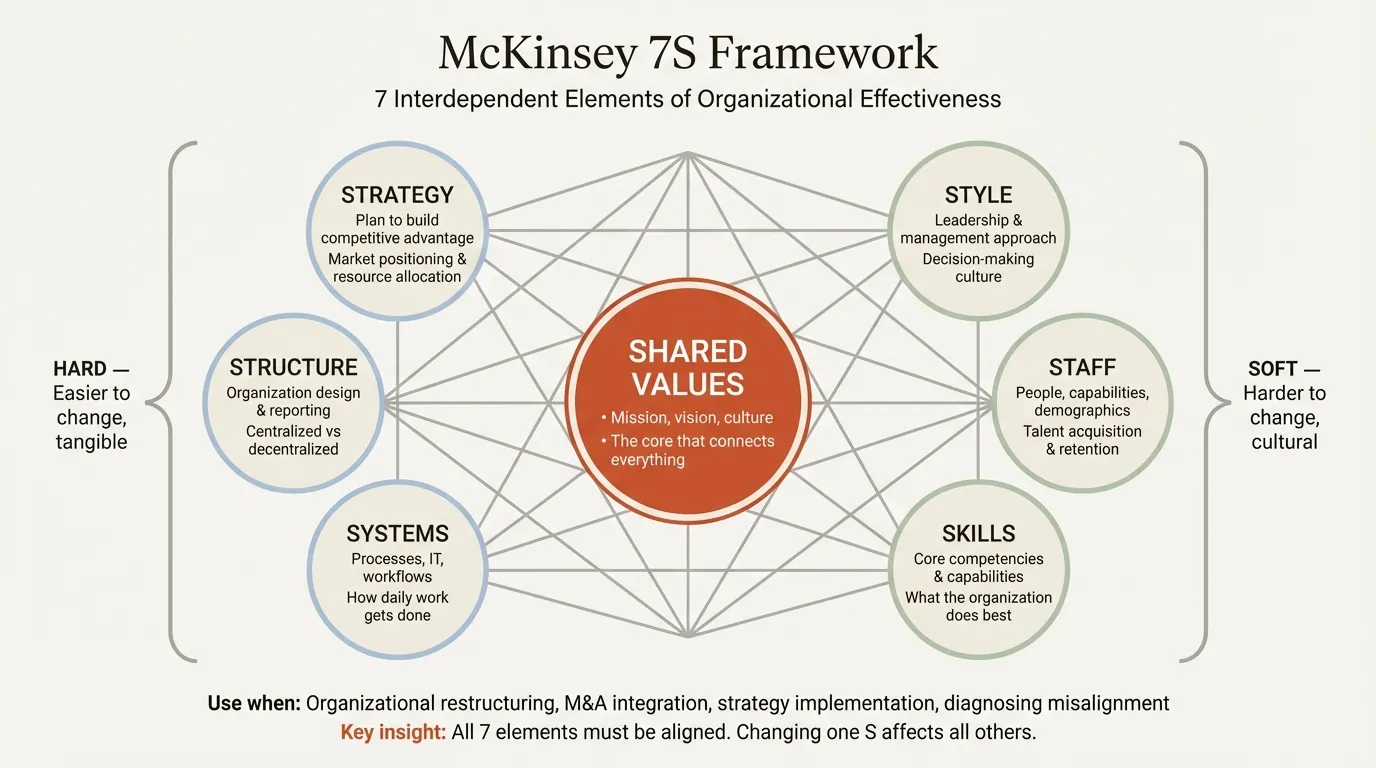
The McKinsey 7S Framework divides organizational elements into two categories: three hard elements that are tangible and directly manageable, and four soft elements that are cultural and behavioral.
Hard Elements
Hard elements are formally defined, documented, and directly controllable by leadership:
- Strategy -- The plan for building and sustaining competitive advantage. Where to compete, how to win, and how resources are allocated across priorities.
- Structure -- The organizational hierarchy, reporting lines, division of responsibilities, and coordination mechanisms. How work is divided and integrated.
- Systems -- The formal processes, procedures, and workflows that govern daily operations. Includes IT systems, financial reporting, performance management, and planning processes.
Soft Elements
Soft elements are harder to define, slower to change, and more influential than most leaders expect:
- Shared Values -- The core beliefs and cultural norms at the center of the model. These shape behavior more powerfully than any policy manual and influence every other element.
- Skills -- The distinctive capabilities the organization possesses collectively. Not individual expertise but organizational capabilities -- what the company does better than competitors.
- Style -- How leaders spend their time, what they prioritize, and how decisions actually get made (as opposed to how the org chart says they should).
- Staff -- The people, their development programs, and how the organization attracts, develops, and retains talent.
The central insight is the lack of hierarchy among these factors. As McKinsey's own retrospective on the model notes, "significant progress in one part of the organization will be difficult without working on the others."
McKinsey 7S Framework Diagnostic Questions
The framework's practical value comes from using it as a diagnostic tool. For each element, a set of questions reveals whether the element is well-defined and aligned with the other six.
| Element | Key Diagnostic Questions |
|---|---|
| Strategy | Is the strategy explicitly stated and understood at all levels? Does resource allocation match stated priorities? Is the strategy differentiated from competitors? |
| Structure | Does the structure support the strategy or create friction? Are decision rights clear? Do coordination mechanisms work across silos? |
| Systems | Do planning, budgeting, and performance systems reinforce strategic priorities? Are information systems adequate? Do processes enable or hinder execution? |
| Shared Values | Can employees articulate the organization's core values? Do stated values match actual behavior? Are values consistent across geographies and business units? |
| Skills | What are the organization's distinctive competencies? Are there critical skill gaps relative to the strategy? How does the organization build new capabilities? |
| Style | How do leaders actually spend their time? What gets rewarded vs. what gets stated? Is the decision-making approach consistent with strategic needs? |
| Staff | Does the talent pipeline match future strategic needs? What is the attrition pattern -- who is leaving and why? Are development programs building the right capabilities? |
When conducting a 7S assessment, score each element on a 1-5 scale and then evaluate alignment between each pair of elements. Seven well-designed elements that pull in seven different directions produce worse outcomes than seven mediocre elements that are aligned.
Continue reading: After Action Review Template · Bullet Charts in PowerPoint · Competitive Landscape Slide
Use consulting-grade layouts in PowerPoint
Start from structured business slides and customize them in your own deck. 14-day free trial. No credit card required.
Worked Example: Diagnosing a Failing Post-Merger Integration
Post-merger integrations are where the 7S Framework earns its diagnostic value. Consider a mid-market industrial company that acquired a technology-driven competitor 12 months ago. Revenue synergies are 60% below plan. Key engineering talent is leaving. Cross-selling has stalled.
A 7S diagnostic reveals the root causes:
| Element | Acquirer (Industrial Co.) | Target (Tech Co.) | Misalignment |
|---|---|---|---|
| Strategy | Cost leadership through scale | Innovation-driven premium pricing | Conflicting value propositions confuse customers and sales teams |
| Structure | Functional hierarchy, centralized decisions | Flat, product-team based, decentralized | Target engineers report to functional managers who do not understand their work |
| Systems | Stage-gate product development, quarterly planning | Agile sprints, continuous deployment | Target's development velocity has dropped 70% under acquirer's planning process |
| Shared Values | Operational efficiency, risk avoidance | Speed to market, experimentation | Target employees view acquirer's culture as bureaucratic; acquirer views target as reckless |
| Skills | Manufacturing excellence, supply chain optimization | Software engineering, data science | No cross-training programs exist; skill sets are complementary but siloed |
| Style | Top-down, consensus-driven before decisions | Autonomous teams, bias toward action | Target product leads lost decision authority; acquirer managers are slow to approve |
| Staff | Long-tenured, low turnover, loyalty-driven | Shorter tenure, equity-motivated, mobile | Target's best engineers are leaving because equity was cashed out and culture has degraded |
The conventional diagnosis would focus on structure and systems. The 7S diagnostic reveals that the deepest misalignment is in Shared Values and Style -- the two organizations have fundamentally different beliefs about how work should happen. Until those are addressed, no structural reorganization will fix the talent exodus or collapsed development velocity.
The 7S-informed integration plan:
- Shared Values first -- Define a joint set of operating principles that preserve the target's innovation culture within the acquirer's efficiency framework.
- Style second -- Maintain decentralized decision-making for the target's product teams while establishing shared reporting cadences.
- Systems third -- Keep separate development processes (agile for software, stage-gate for hardware) with integration points rather than forced unification.
- Structure last -- Restructure only after the cultural and process foundations are in place.
This sequence -- soft elements before hard elements -- is counterintuitive for most integration teams but is exactly what the 7S Framework prescribes. For more on managing organizational transitions, see our Change Management Models guide.
Using the McKinsey 7S Framework for Change Management
The 7S Framework is not just a diagnostic tool -- it provides a structured approach to planning organizational change in four steps:
Step 1: Map the current state. Score all seven elements and document alignment between them. Assess honestly, not aspirationally.
Step 2: Define the desired future state. Be specific for each element: "We need agile development skills" is too vague. "We need 40 engineers proficient in cloud-native architecture by Q3" is actionable.
Step 3: Identify gaps and interdependencies. Calculate the gap between current and desired state for each element. Map dependencies -- you cannot build new skills (Skills) without the right hiring programs (Staff) and supportive leadership behavior (Style).
Step 4: Sequence the changes. Start with Shared Values because they influence everything else. Then address the elements with the largest gaps, respecting interdependencies. Changing structure before aligning shared values is the single most common mistake in organizational transformations.
Changing one element creates ripple effects across the other six. A new strategy requires new skills. New skills require different staff. The 7S Framework makes these cascading effects visible before they become surprises.
McKinsey 7S vs. Other Organizational Change Models
The 7S Framework is one of several models for diagnosing and managing organizational change. Each has a different focus and level of complexity.
| Dimension | McKinsey 7S | Burke-Litwin | Nadler-Tushman | ADKAR |
|---|---|---|---|---|
| Focus | Internal alignment of 7 elements | Causal chain from external environment to individual performance | Congruence between strategy, structure, people, and work | Individual adoption of change |
| Number of factors | 7 | 12 (grouped into 5 levels) | 4 core components | 5 sequential stages |
| External environment | Not explicitly included | Central driver at top of model | Input to the system | Not addressed |
| Level of analysis | Organization-wide | Organization to individual | Organization-wide | Individual |
| Change approach | Holistic, no prescribed sequence beyond starting with Shared Values | Top-down causal flow | Fit/congruence between components | Sequential (Awareness, Desire, Knowledge, Ability, Reinforcement) |
| Complexity | Moderate | High | Moderate | Low |
| Best for | Diagnosing misalignment during mergers, restructurings, or strategy shifts | Understanding cause-and-effect relationships in organizational performance | Assessing strategy-structure fit | Managing individual-level change adoption |
Use McKinsey 7S when you suspect soft factors are undermining hard-element changes. Use Burke-Litwin to trace how external disruption cascades to individual performance. Use Nadler-Tushman when the question is strategy-structure congruence. Use ADKAR to manage individual adoption -- it complements 7S well, diagnosing system-level change with 7S and individual-level adoption with ADKAR.
Common Mistakes When Applying the McKinsey 7S Framework
Focusing only on hard elements. Strategy, structure, and systems are tangible and satisfying to redesign. But research by Peters and Waterman showed that excellent companies excelled precisely in the soft elements -- shared values, skills, and management style. Hard-element changes without soft-element alignment produce restructurings that look different on paper but feel identical on the ground.
Treating it as a one-time assessment. The 7S Framework is not a one-and-done audit. Organizations evolve continuously, and a change in any one element shifts the alignment of all seven. Build 7S reviews into quarterly strategy discussions, not just annual planning cycles.
Ignoring Shared Values as the central element. Shared Values occupies the center of the model because it connects to all six other elements. Organizations that change strategy or structure without examining whether shared values support the new direction find that the old culture undermines the new design.
Confusing current state with aspiration. Teams routinely score based on what they want the organization to be rather than what it is. Score based on observable behavior and employee feedback -- not leadership intent.
Skipping the alignment analysis. Scoring each element individually is only half the exercise. The real insight comes from evaluating alignment between pairs. A company can have a strong strategy and strong systems that are misaligned -- the systems were designed for the old strategy and now hinder the new one.
Presenting the McKinsey 7S Framework
The 7S model's interconnected structure makes it visually distinctive but challenging to present. Three formatting principles help: use the classic hub-and-spoke diagram with Shared Values at the center, add a supporting table with current-state scores, desired-state scores, and gap sizes, and color-code alignment status (green for aligned, yellow for partial, red for misaligned).
For a pre-built slide layout with the 7S diagram and scoring tables, use our McKinsey 7S Model Template. For related diagnostic frameworks, see our SWOT Analysis Examples and Stakeholder Mapping Guide. Tools like Deckary speed up the hub-and-spoke diagram and alignment tables in PowerPoint.
Summary
The McKinsey 7S Framework remains one of the most practical tools for diagnosing why organizations underperform despite sound strategies. Its enduring contribution: alignment matters more than optimization of any single element.
- Seven interdependent elements -- Strategy, Structure, Systems (hard) and Shared Values, Skills, Style, Staff (soft) must work together
- Shared Values is the center -- culture and core beliefs influence every other element and must be addressed first in any transformation
- Soft elements drive hard results -- organizations that ignore style, skills, and staff alignment will find that structural changes fail to produce performance improvements
- Use it as a diagnostic, not a one-time audit -- reassess alignment regularly as the organization evolves
- Pair with complementary models -- use Burke-Litwin for causal analysis, ADKAR for individual adoption, and Nadler-Tushman for strategy-structure fit
For ready-made slide layouts, start with our McKinsey 7S Model Template. For the full library of strategy models, see our Strategic Frameworks Guide.
Use consulting-grade layouts in PowerPoint
Start from structured business slides and customize them in your own deck. 14-day free trial. No credit card required.