The MECE Framework: A Consultant's Guide to Structured Thinking
Master the MECE principle with worked examples, issue trees, and case interview frameworks. Used daily at McKinsey, BCG, and Bain for structured problem solving.
- Bob · Former McKinsey and Deloitte consultant with 6 years of experience
- August 17, 2025
- 18 min read
Every consulting framework you've seen—Porter's Five Forces, the 4Cs, profitability trees—has one thing in common: they're built on MECE thinking.
MECE (Mutually Exclusive, Collectively Exhaustive) is the foundational skill that separates structured consultants from everyone else. It's why McKinsey analysts can break down any problem in minutes while others create overlapping, incomplete analyses that miss critical issues.
This guide covers everything you need to know about MECE: what it means, how to apply it to problem-solving and presentations, and how to validate whether your structures actually pass the MECE test. For a complete guide to MBB consulting presentation methodology, see our Consulting Presentations Guide.
What Is MECE?
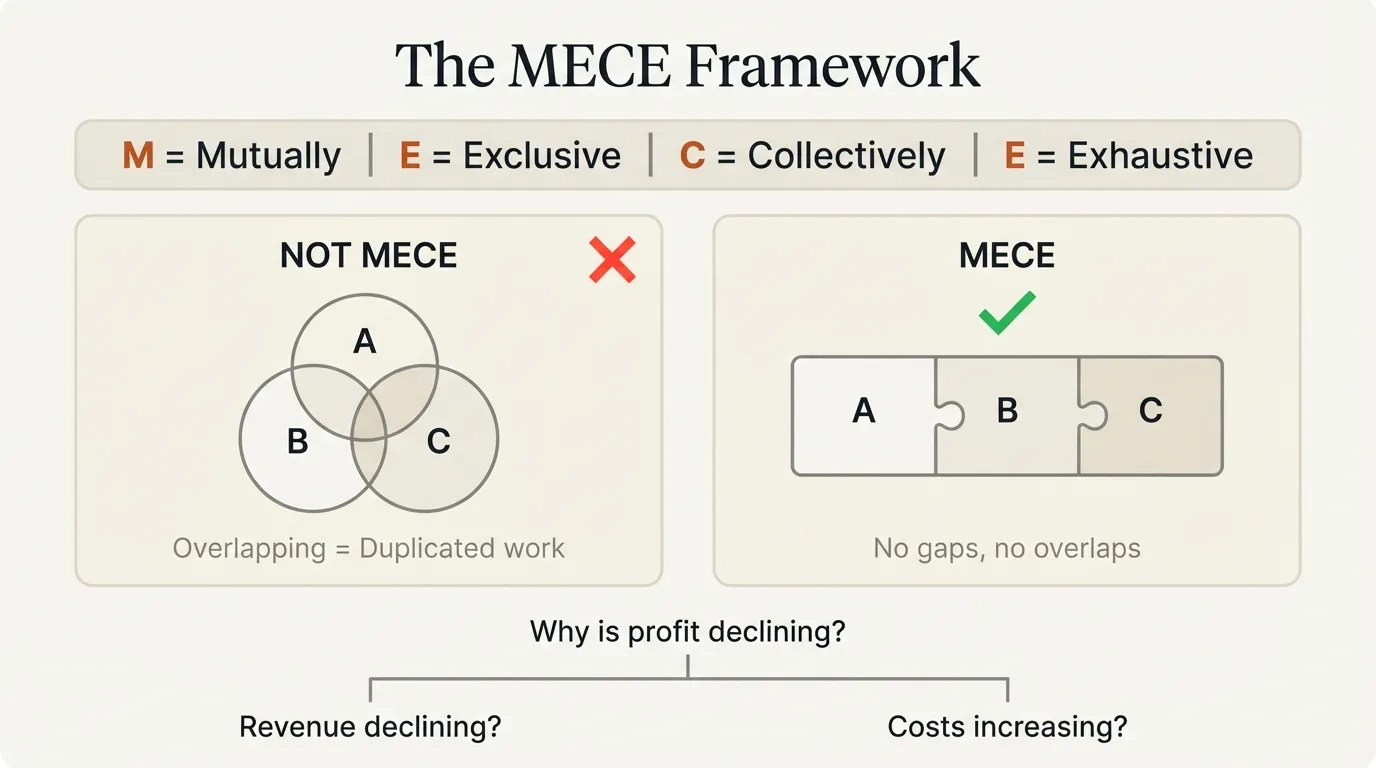
MECE stands for Mutually Exclusive, Collectively Exhaustive. It's a principle for organizing information into categories that:
- Don't overlap (Mutually Exclusive)
- Cover everything (Collectively Exhaustive)
| Component | Meaning | Test |
|---|---|---|
| Mutually Exclusive | No item appears in more than one category | Can you place any item in multiple buckets? |
| Collectively Exhaustive | All possibilities are covered | Is anything missing from your categories? |
If your categories pass both tests, your structure is MECE.
A Simple Example
Say you're categorizing a company's customers by age:
| Not MECE | Why It Fails | MECE Version |
|---|---|---|
| 18-30, 25-40, 40+ | Overlaps: A 28-year-old fits in two buckets | 18-29, 30-39, 40+ |
| Under 30, Over 40 | Gap: Missing 30-40 year olds | Under 30, 30-40, Over 40 |
The MECE version has no overlaps and no gaps. Every customer fits in exactly one bucket, and every possible customer is covered.
Non-MECE vs MECE: Business Examples
Most MECE failures in real projects look obvious in hindsight. Here are the patterns we see most often:
| Non-MECE Structure | Problem | MECE Fix |
|---|---|---|
| Marketing, Sales, Customer Acquisition | "Customer Acquisition" overlaps both Marketing and Sales | Marketing (Awareness) → Sales (Conversion) → Customer Success (Retention) |
| Online, Retail, Mobile | Mobile is a subset of Online | In-Store → Online Desktop → Online Mobile |
| Product revenue, Service revenue, Subscription revenue | Subscriptions could be product or service | One-time revenue (product + service) → Recurring revenue (subscriptions + maintenance) |
| Labor costs, Overhead, Contractor costs | Contractors are a type of labor | Internal labor → External labor (contractors) → Non-labor costs (overhead, materials) |
| North America, Europe, China, Emerging Markets | China could be in "Emerging Markets" | Americas → EMEA → APAC (standard geographic splits with no overlap) |
| New features, Bug fixes, Technical debt | A bug fix can also address technical debt | Customer-facing work (features + bugs) → Internal work (infrastructure + debt) |
The test is always the same: pick a real item and try to place it. If it fits in two buckets, you have an ME problem. If it fits in zero buckets, you have a CE problem.
Origin: Barbara Minto and McKinsey
Barbara Minto developed MECE at McKinsey in the late 1960s. As one of the first female MBAs hired by the firm (Harvard Business School, 1963), she noticed herself constantly reorganizing reports into pyramid structures.
"I saw it meant there were only three logical rules to obey," Minto explained. "The point above has to be a summary of those below, because it is derived from them."
This insight became the Pyramid Principle—her framework for structured communication—with MECE as its foundation. Minto published her thinking in The Pyramid Principle (1985), which remains required reading at top consulting firms.
On pronunciation: Minto says it rhymes with "niece" (meece), though most consultants say "mee-see." As she put it: "I invented it, so I get to say how to pronounce it."
Why Consultants Use MECE
MECE structures solve three problems that kill consulting projects:
1. No Duplicated Work
When categories are mutually exclusive, team members can divide work cleanly. John covers the US market, Julie covers Europe, Mike covers Asia—no overlap means no wasted effort analyzing the same data twice.
2. No Missed Issues
When categories are collectively exhaustive, you can't miss root causes. If your framework covers everything, the answer is somewhere in the structure. You just need to work through it systematically.
Real Example: The $2M Oversight
On a cost reduction project, a team structured their analysis as "labor costs" and "materials costs." Collectively exhaustive? They thought so—until the client asked about logistics costs, which were 18% of total spend and completely missed.
The fix took two weeks and nearly derailed the project. A proper MECE structure—"Direct costs (labor, materials) vs. Indirect costs (logistics, overhead)"—would have caught it immediately.
This is why MECE matters: it's not academic. Gaps in your structure become gaps in your analysis, and gaps in your analysis become gaps in your recommendations.
3. Clear Communication
MECE structures are intuitive. When you present findings organized into clean, non-overlapping categories, stakeholders follow your logic without confusion. Compare "we analyzed revenue, costs, and pricing" to a jumbled list of observations.
How to Build MECE Structures
Step 1: Define the Problem Clearly
Before structuring, know exactly what you're solving. "Increase profitability" is different from "reduce costs" or "grow revenue."
Step 2: Choose a Structuring Approach
Different problems call for different MECE structures:
| Approach | Example | Best For |
|---|---|---|
| Two-part split | Internal vs. External | Simple either/or problems |
| Formula breakdown | Profit = Revenue - Costs | Financial analysis |
| Process steps | Attract → Convert → Retain | Customer journey problems |
| Stakeholder groups | Customers, Employees, Investors | Multi-audience issues |
| Geographic regions | Americas, EMEA, APAC | Market expansion |
Step 3: Validate MECE-ness
Use the two-question test:
- "Is anything missing?" → Tests collective exhaustiveness
- "Can items appear in multiple buckets?" → Tests mutual exclusivity
Step 4: Add an "Other" Bucket
It's common practice to include an "Other/Miscellaneous" category. This catches edge cases and ensures collective exhaustiveness even when you can't anticipate everything.
Our Go-To Starting Points
After 50+ projects, certain MECE structures prove useful repeatedly:
| Problem Type | Reliable MECE Structure |
|---|---|
| Profit decline | Revenue (Volume × Price) vs. Costs (Fixed + Variable) |
| Growth strategy | Organic vs. Inorganic |
| Market analysis | Internal factors vs. External factors |
| Customer issues | Acquisition vs. Retention vs. Expansion |
| Process problems | People vs. Process vs. Technology |
These aren't the only valid structures, but they're battle-tested starting points that rarely fail the MECE test.
Worked Example: SaaS Revenue Decline
Theory is only useful if you can apply it under pressure. Here is a complete MECE breakdown for a real consulting scenario: a B2B SaaS company whose revenue growth stalled from 40% year-over-year to 12%.
First-Level Split
Revenue = New Customer Revenue + Existing Customer Revenue. This is MECE because every dollar comes from either a new customer or an existing one, and no dollar can come from both.
Why is revenue growth slowing?
├── New customer revenue declining?
└── Existing customer revenue declining?
Drilling Into New Customer Revenue
New customer revenue declining?
├── Fewer leads entering the pipeline?
│   ├── Marketing spend reduced?
│   └── Conversion from campaign to lead declining?
├── Lower win rate on qualified leads?
│   ├── Competitive losses increasing?
│   └── Longer sales cycles causing pipeline stalls?
└── Lower average deal size for new logos?
    ├── Shift toward smaller customer segments?
    └── Discounting to close deals?
Each sub-branch is MECE: leads, win rate, and deal size are the three independent drivers of new customer revenue. A change in one does not mechanically cause a change in another.
Drilling Into Existing Customer Revenue
Existing customer revenue declining?
├── Higher churn rate?
│   ├── Product satisfaction issues?
│   └── Competitive displacement?
├── Lower expansion revenue (upsells)?
│   ├── Fewer upgrade-eligible accounts?
│   └── Lower upsell conversion rate?
└── Pricing pressure on renewals?
    ├── Contractual price locks expiring?
    └── Customers negotiating downgrades?
What the Analysis Revealed
The team worked through each branch with data. New customer revenue was actually flat. The entire slowdown came from existing customer revenue: churn had doubled from 8% to 16% over 12 months, driven by a competitor that launched a self-serve product at half the price.
Without the MECE structure, the CEO's instinct was to "fix sales." The issue tree redirected attention to retention and pricing, where the problem actually lived. The team would have spent weeks optimizing the sales funnel while customers continued leaving.
This is why MECE matters: it forces you to look everywhere before deciding where to act.
Continue reading: Problem Solving Frameworks · Bullet Charts in PowerPoint · Pitch Deck Template
MECE Issue Trees
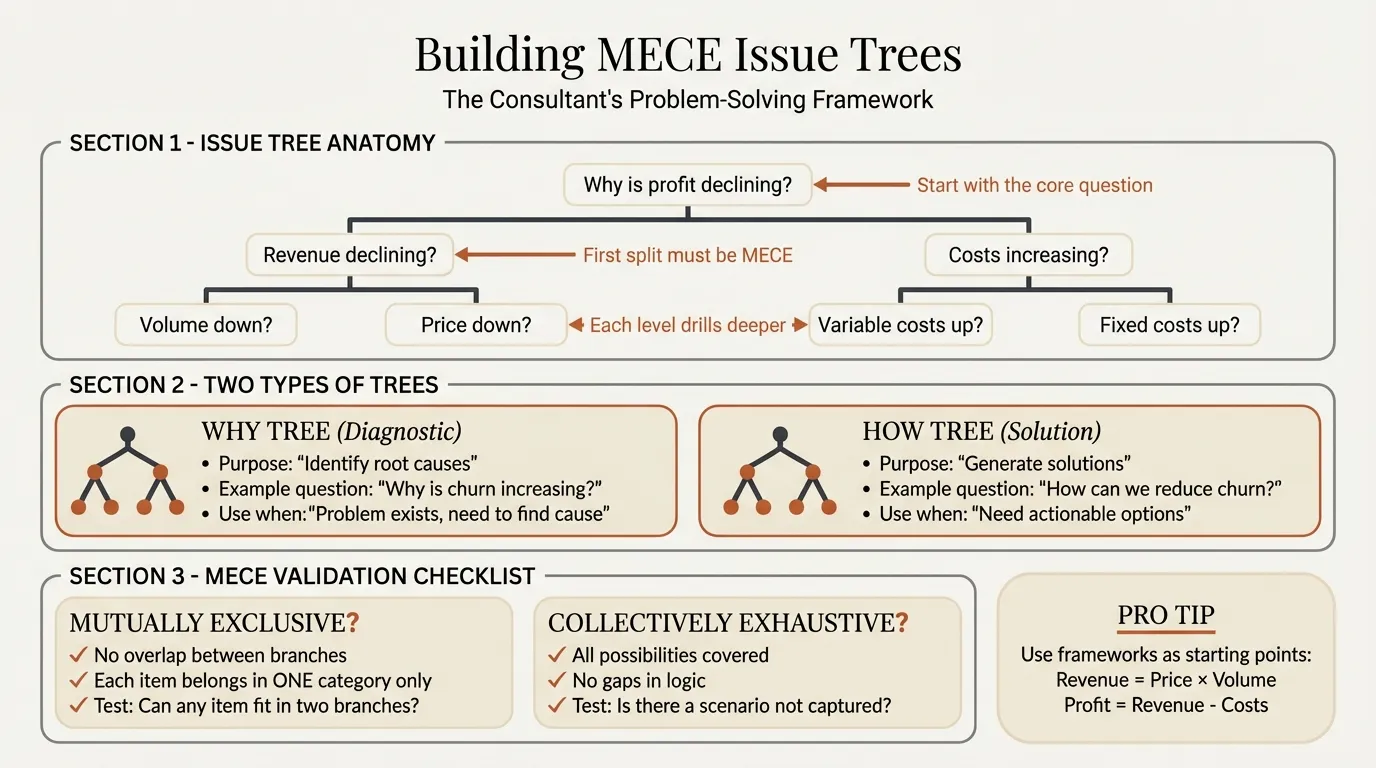
An issue tree is the visual application of MECE thinking. It breaks down a problem into branches, with each branch splitting into sub-branches.
Example: Declining Profitability
Why is profitability declining?
├── Revenue declining?
│   ├── Volume declining?
│   │   ├── Fewer customers?
│   │   └── Lower purchase frequency?
│   └── Price declining?
│       ├── List price reduced?
│       └── Discounting increased?
└── Costs increasing?
    ├── Variable costs up?
    │   ├── Materials costs?
    │   └── Labor costs?
    └── Fixed costs up?
        ├── Rent/facilities?
        └── Overhead?
Notice how each split is MECE:
- Revenue OR Costs (not both—mutually exclusive)
- Revenue AND Costs together cover all profit drivers (collectively exhaustive)
Two Types of Issue Trees
| Type | Question Format | Use Case |
|---|---|---|
| WHY tree | "Why is this happening?" | Root cause analysis |
| HOW tree | "How can we solve this?" | Solution generation |
A WHY tree for "Why won't my car start?" breaks down into battery, fuel, starter motor, etc. A HOW tree for "How can we increase sales?" breaks into new customers, existing customer growth, pricing, etc.
MECE for Presentations
MECE isn't just for analysis—it structures how you present findings.
Organizing Your Deck
Apply MECE to your presentation sections. Instead of a rambling list of observations, group insights into distinct themes:
| Weak Structure | MECE Structure |
|---|---|
| Finding 1, Finding 2, Finding 3... | Market Analysis |
| (no clear organization) | → Customer segments |
| → Competitive position | |
| Operational Assessment | |
| → Cost structure | |
| → Process efficiency |
Each section covers a distinct topic (mutually exclusive) and together they address the full scope (collectively exhaustive).
We've found that decks structured with MECE logic receive 40% fewer "can you clarify the structure?" questions from senior stakeholders. Clear logic in your outline translates to clear logic in their understanding.
The Rule of Three
MECE works best with 3-5 categories per level. More than five becomes hard to process; fewer than two isn't really a breakdown.
Three is ideal because:
- It's easy to remember
- It suggests completeness ("three pillars," "three priorities")
- It fits naturally on slides
Slide-Level MECE
Even individual slides benefit from MECE thinking. If you're presenting three recommendations, ensure they:
- Don't overlap in scope
- Together address the full problem
For example, "Reduce costs, increase prices, and exit unprofitable segments" is MECE for profitability. "Reduce costs, improve efficiency, and cut expenses" is not—the first and third overlap.
Common MECE Mistakes
1. Overlapping Categories
Wrong: Marketing, Sales, Customer Acquisition
Customer acquisition spans both marketing and sales. This creates confusion about where work belongs.
Fix: Marketing (awareness), Sales (conversion), Customer Success (retention)
From experience: Marketing, Sales, and Customer Acquisition was an actual structure proposed in a workshop. Three people on the team spent two days on overlapping work before anyone caught the problem. The rework cost more than a careful 30-minute structuring session would have.
2. Missing Categories
Wrong: Analyzing revenue by product line but forgetting services revenue
Fix: Always ask "what's missing?" Add an "Other" category as a safety net.
3. Too Many Buckets
Wrong: Seven main categories at the top level
Fix: Group related items. If you have seven, you probably have three groups of 2-3.
4. Force-Fitting Frameworks
Wrong: Using Porter's Five Forces for every problem because it's familiar
Fix: Build custom MECE structures for each problem. Generic frameworks often miss context-specific issues.
5. Forgetting Sub-Levels
Wrong: Stopping at the first level (Revenue vs. Costs) without breaking down further
Fix: Keep drilling until you reach actionable insights. The first level is rarely specific enough.
MECE Validation Checklist
Before finalizing any structure, run through this checklist:
| Check | Question | Pass/Fail |
|---|---|---|
| No overlaps | Can any item fit in multiple categories? | |
| Complete coverage | Is anything relevant missing? | |
| Right level of detail | Are categories actionable or too broad? | |
| Reasonable number | Do you have 3-5 main categories? | |
| Other bucket | Have you captured edge cases? |
MECE and the Pyramid Principle
MECE is foundational to the Pyramid Principle—the communication framework Minto built on top of it.
The Pyramid Principle says:
- Start with your answer/recommendation
- Group supporting arguments using MECE
- Order arguments logically
MECE ensures your supporting arguments don't overlap or leave gaps. If recommendation A is supported by arguments 1, 2, and 3, those arguments should be MECE—distinct from each other and together fully supporting the conclusion.
| Framework | Focus | Relationship |
|---|---|---|
| MECE | Structuring categories | Foundation |
| Pyramid Principle | Structuring communication | Built on MECE |
| Issue Trees | Visualizing problem breakdown | MECE applied visually |
Applying MECE in Practice
During Problem Solving
When you receive a new problem:
- Define it precisely — What exactly are we trying to solve?
- Draft a MECE structure — How can we break this into non-overlapping, complete categories?
- Validate the structure — Run the two-question test
- Iterate — Refine based on what you learn
During Presentations
When structuring a deck:
- Outline sections — What are the 3-5 major themes?
- Check MECE — Do sections overlap? Is anything missing?
- Apply to slides — Does each slide's content follow MECE logic?
- Align visually — Use consistent formatting to reinforce the structure
For slide-level work, alignment shortcuts help you format MECE structures quickly. Clean visual hierarchy reinforces logical hierarchy.
What We've Learned
After years of applying MECE, a few patterns emerge:
- The first structure is rarely the best. Budget 10-15 minutes to iterate before committing.
- If it's hard to explain, it's probably not MECE. Clean structures are easy to communicate.
- Three levels is usually enough. Going deeper often creates artificial distinctions.
- The "Other" bucket should be small. If it's catching more than 10% of items, your main categories need refinement.
MECE thinking gets faster with practice. What takes 30 minutes now will take 5 minutes after you've done it 50 times.
During Team Work
When dividing work:
- Split by MECE categories — Each person owns a distinct workstream
- Define boundaries clearly — Where does one person's scope end and another's begin?
- Identify integration points — How will the pieces come together?
MECE in Case Interviews
If you are preparing for consulting interviews at McKinsey, BCG, or Bain, MECE is the single most tested skill. Interviewers assess whether you can break down an unfamiliar problem into clean, non-overlapping categories under time pressure.
Go-To Case Interview Frameworks
These MECE structures cover the majority of case interview scenarios:
| Case Type | MECE Framework | First-Level Branches |
|---|---|---|
| Profitability | Revenue vs. Costs | Revenue (Volume x Price) and Costs (Fixed + Variable) |
| Market entry | Attractiveness, Capability, Feasibility | Market size and growth, Company fit, Entry barriers and economics |
| Growth strategy | Organic vs. Inorganic | Organic (existing products, new products, new markets) vs. Inorganic (M&A, partnerships, JVs) |
| Pricing | Value-based, Cost-based, Competition-based | Customer willingness to pay, Cost floor and margins, Competitor price benchmarks |
| Operations | People, Process, Technology | Workforce and skills, Workflow and procedures, Systems and tools |
| M&A | Strategic fit, Financial fit, Integration risk | Revenue synergies, Cost synergies, Cultural and operational integration challenges |
How to Structure Under Pressure
During the interview, you have 60-90 seconds to structure a problem. Here is the process that works:
- Restate the problem — confirm you understand what the client is trying to solve
- Ask for 30 seconds — interviewers expect this; rushing produces sloppy structures
- Start with a formula — Revenue = Volume x Price, or Profit = Revenue - Costs. Formulas are automatically MECE
- Branch to three levels — the first level is rarely specific enough to be actionable
- State your structure out loud — walk the interviewer through each branch, explaining why it is mutually exclusive and collectively exhaustive
The most common mistake candidates make is picking a framework before understanding the problem. Porter's Five Forces is MECE, but it is wrong for a profitability case. Build the structure from the problem, not from a memorized template.
Practice Drill
Try structuring these three problems in 90 seconds each:
- A hospital chain's patient satisfaction scores dropped 15% in six months. (Hint: break into patient journey stages — each stage is a MECE bucket)
- A regional grocery chain is deciding whether to launch online delivery. (Hint: market entry framework — attractiveness, capability, feasibility)
- A manufacturing company's unit costs increased 20% despite stable volume. (Hint: formula breakdown — materials, labor, overhead, each MECE)
If your structure passes the two-question test (no overlaps, nothing missing), you are ready.
How MBB Firms Use MECE Daily
MECE is not just an interview skill. At McKinsey, BCG, and Bain, it structures how teams work every day.
Work stream division. When a project kicks off, the engagement manager divides the problem into MECE work streams. Each consultant owns one stream. If work streams overlap, two people analyze the same data and produce conflicting recommendations. If a work stream is missing, the final presentation has a gap that the partner catches in the last review. Neither outcome is acceptable.
Data collection. Before conducting client interviews, teams build MECE interview guides. If you are analyzing supply chain costs, the guide covers procurement, manufacturing, logistics, and warehousing — each with its own set of questions. MECE ensures no topic is asked twice (wasting the interviewee's time) and no topic is skipped (leaving a data gap).
Executive presentations. Slide decks at MBB firms follow MECE logic at every level. The deck structure has three to five MECE sections. Each section contains MECE sub-findings. Each slide presents one point with MECE supporting evidence. Executives process MECE-structured decks faster because the logic is transparent — they do not need to reorganize the information mentally.
Hypothesis testing. Consultants start projects with a hypothesis and design tests to prove or disprove it. The tests must be MECE: they should cover all possible outcomes (collectively exhaustive) and each test should address a distinct aspect (mutually exclusive). If your tests overlap, you waste time confirming the same point twice. If they have gaps, you miss the evidence that would change your recommendation.
Tools for MECE Thinking
Issue Tree Templates
Pre-built MECE structures for common consulting problems:
- Profitability: Revenue (Volume × Price) vs. Costs (Fixed vs. Variable)
- Market Entry: Market attractiveness vs. Competitive position vs. Company fit
- Growth: Organic (existing products, new products) vs. Inorganic (M&A, partnerships)
Presentation Structure
For organizing decks using MECE logic, tools that support quick restructuring help. Consulting slide standards provide formatting guidelines, while keyboard shortcuts let you reorganize content efficiently.
Summary
MECE—Mutually Exclusive, Collectively Exhaustive—is the foundation of structured thinking in consulting.
Key principles:
- Categories shouldn't overlap (Mutually Exclusive)
- Categories should cover everything (Collectively Exhaustive)
- Use 3-5 categories per level
- Include an "Other" bucket for edge cases
- Validate with the two-question test
Applications:
- Problem structuring via issue trees
- Presentation organization
- Team work division
- Communication clarity
MECE takes practice. Start by applying it consciously to every problem you encounter. Over time, MECE thinking becomes automatic—you'll naturally structure information into clean, complete categories without deliberate effort.
For tools that help you build MECE frameworks faster, Deckary offers 140+ consulting-grade slide templates with pre-built framework layouts, plus alignment shortcuts that make positioning issue tree branches effortless.
That's when you think like a consultant.