Digital Transformation Roadmap: Framework, Phases, and Execution
Digital transformation roadmap framework with assessment, planning, and execution phases. Learn how to build a structured roadmap that avoids the 70% failure rate.
Seventy percent of digital transformations fail to meet their objectives. The problem is not the technology—it is the absence of a structured roadmap that connects technology investments to measurable business outcomes. Organizations launch transformation programs with vague goals like "become more digital" or "modernize our systems," spend millions on new platforms, and discover three years later that adoption is under 30% and the business runs the same way it did before.
A digital transformation roadmap translates strategic intent into phased execution. It defines where you are now, where you intend to be, which initiatives get you there, and how you measure progress at each phase. After building digital transformation roadmaps for 15+ enterprise programs spanning cloud migrations, ERP modernizations, and process automation initiatives, we have tracked which roadmap structures deliver sustainable change (phased delivery, clear governance, business-led priorities) and which create the illusion of progress until executive sponsorship runs out.
This guide covers the digital transformation roadmap framework, four core phases, how to sequence initiatives, measurement strategies, and common mistakes that turn transformation programs into multi-year IT projects with no business impact.
What Is a Digital Transformation Roadmap?
A digital transformation roadmap is a strategic blueprint outlining the steps, phases, and timelines an organization follows to adopt new technologies and processes that fundamentally change how the business operates. The roadmap includes a vision for the future state, key milestones, timelines, and a plan for integrating new technologies.
The roadmap serves three critical functions:
- Alignment: Connects technology initiatives to business goals—growth, cost reduction, customer experience improvement, risk management—so investments are not technology for technology's sake
- Sequencing: Defines which initiatives happen first based on dependencies, capacity, and value—preventing the common mistake of launching everything at once and delivering nothing well
- Accountability: Establishes who owns what, when deliverables are due, and how success is measured at each phase boundary
The roadmap is not a project plan. It is a phased execution model designed to reduce risk, control investment, and align delivery with business capacity. Unlike a linear project plan where all requirements are locked upfront, transformation roadmaps build in learning loops—pilot, measure, adjust, scale.
Why Digital Transformation Roadmaps Matter
The failure rate for digital transformation is staggering. According to McKinsey, 70% to 90% of digital transformations fall short of their objectives. BCG research found that only 30% of transformations met or exceeded their target value and resulted in sustainable change. The cost of these failures is not just wasted investment—failed digital transformation efforts cost organizations $2.3 trillion per year globally.
Organizations treat digital transformation as a technology implementation when it is actually a business change program that uses technology as the enabler. Without a roadmap that defines success criteria, sequences initiatives, and embeds accountability, programs drift into perpetual planning or launch too many initiatives simultaneously.
Roadmaps reduce failure risk by forcing clarity on objectives upfront (15% cost reduction vs. vague "modernization"), phasing execution to manage risk (pilot, prove, scale), and creating forcing functions for decision-making through phase gates with go/no-go criteria.
The difference in outcomes is dramatic. BCG found that successful transformations created 66% more value, improved corporate capabilities by 82%, and met 120% more of their targets on time compared to transformations that created only limited value. Getting six critical success factors right flips the odds for success from 30% to 80%.
Digital Transformation Roadmap Framework
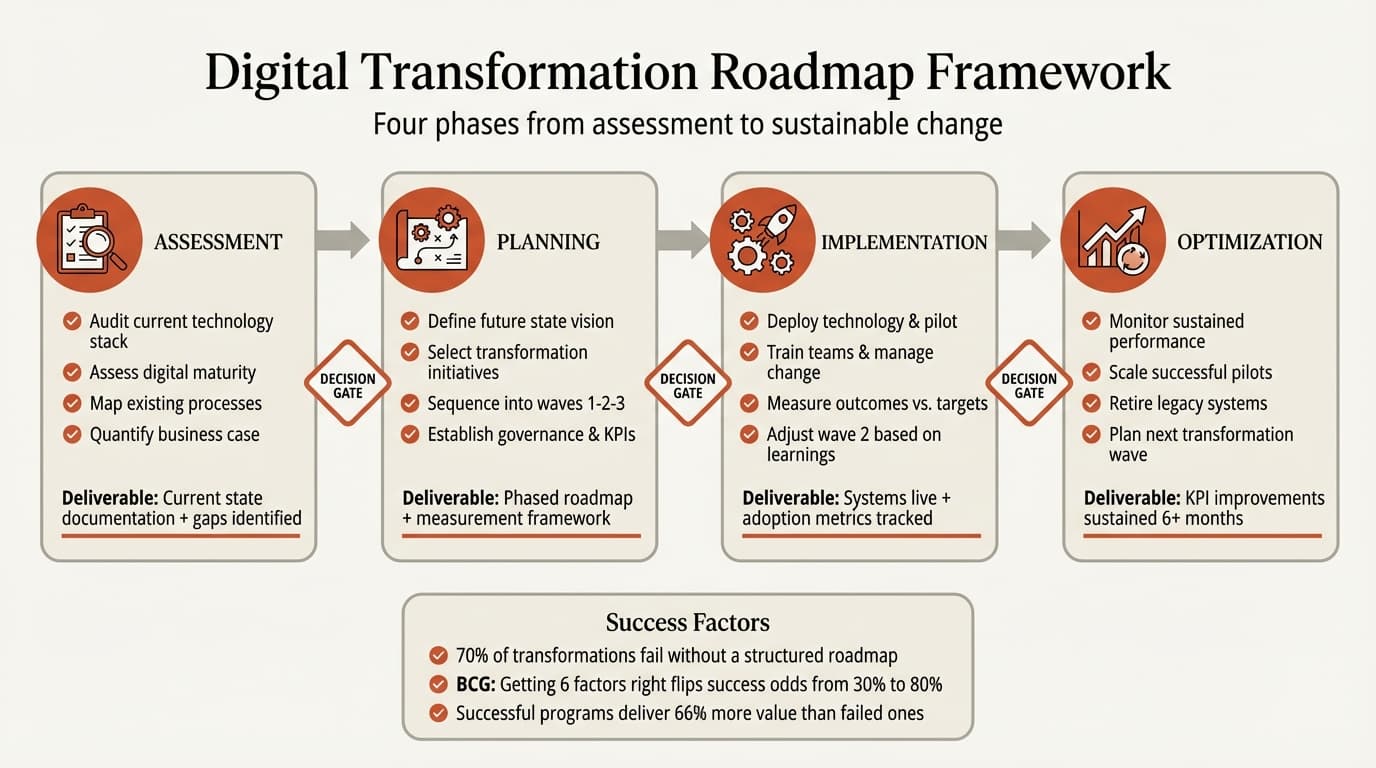
A digital transformation roadmap follows a four-phase structure: Assessment, Planning, Implementation, and Optimization. Each phase has distinct objectives, deliverables, and decision points.
Phase 1: Assessment
The assessment phase evaluates current capabilities, identifies gaps, and quantifies the business case for transformation. You cannot build a roadmap to the future state without understanding the current state.
Phase 1 objectives:
- Audit existing technology stack (systems, integrations, technical debt)
- Assess digital maturity across leadership, culture, technology, and skills
- Map current processes to identify automation opportunities
- Conduct stakeholder interviews to surface highest-impact problems
Phase 1 deliverables:
- Current state documentation and digital maturity scorecard
- Prioritized business problems ranked by impact and effort
- Quantified business case with baseline metrics
The assessment creates the burning platform—quantifying how much the current state costs in lost revenue, manual effort, or customer churn.
Phase 2: Planning
The planning phase defines the future state, selects initiatives, sequences them based on dependencies and value, and establishes governance and measurement frameworks.
Phase 2 objectives:
- Define future state vision with specific outcomes ("automated invoice processing with 48-hour cycle time" not "world-class operations")
- Identify transformation initiatives with defined scope and success criteria
- Sequence initiatives into waves based on dependencies (Wave 1: foundational infrastructure, Wave 2: analytics and automation, Wave 3: advanced capabilities)
- Establish governance with steering committee, decision rights, and executive sponsors
- Create measurement framework tracking business outcomes, operational metrics, and adoption rates
Phase 2 deliverables:
- Initiative portfolio with scope, timeline, budget, and dependencies
- Phased roadmap with governance charter and measurement framework
The right balance: detailed plans for wave 1 (next 6-9 months), directional plans for wave 2 (months 9-18), and strategic themes for wave 3 (months 18-36).
Phase 3: Implementation
The implementation phase executes wave 1 initiatives, pilots new technologies, trains teams, and measures outcomes against the success criteria defined in planning.
Phase 3 objectives:
- Deploy technology (install systems, configure platforms, migrate data, build integrations)
- Run pilots to prove value before full-scale rollout
- Train and enable teams through role-based training and support
- Address resistance through communication and visible executive support (organizations investing in culture change see 5.3x higher success rates)
- Track KPIs weekly and adjust wave 2 plans based on wave 1 learnings
Phase 3 deliverables:
- Wave 1 initiatives delivered with measured business impact
- Adoption metrics and lessons learned report
Actual success is measured by behavior change—are people using the new systems, have processes actually changed, and are business metrics improving? If adoption is low or metrics are flat, course-correct before launching wave 2.
Phase 4: Optimization
The optimization phase monitors sustained performance, scales successful pilots, retires legacy systems, and plans the next transformation cycle.
Phase 4 objectives:
- Monitor sustained performance (do early improvements hold or fade?)
- Scale successful pilots to additional teams and geographies
- Retire legacy systems (where actual cost savings materialize)
- Embed continuous improvement into business-as-usual operations
- Refine wave 3 plans based on learnings
Phase 4 deliverables:
- Performance dashboard showing sustained improvements
- Scaled rollout plans and legacy system decommissioning schedule
Only 12% of organizations sustain transformation goals for more than three years. Optimization phase discipline separates temporary gains from permanent transformation.
Continue reading: Business Case Template · Harvey Balls in PowerPoint · Startup Pitch Deck
Use consulting-grade layouts in PowerPoint
Start from structured business slides and customize them in your own deck. 10 free AI prompts. No credit card required.
Digital Transformation Roadmap Example
Program: Finance and Supply Chain Transformation Objective: Reduce operational costs by 20%, improve forecast accuracy by 30%, decrease order-to-cash cycle time by 40% Duration: 24 months across 3 waves
Wave 1: Foundation (Months 1-9)
- Assessment: 15 applications, 8 data silos, 60% manual reporting, $4.2M savings opportunity
- Planning: Unified ERP, data warehouse, finance automation (AP, AR, close)
- Implementation: Deploy cloud ERP in North America, automate accounts payable, train 150 users
- Results: 25% reduction in invoice processing time, 15% faster close cycle
Wave 2: Scale (Months 10-18)
- Scale ERP to EMEA and APAC
- Deploy supply chain planning module with demand forecasting
- Automate revenue close and management reporting
- Results: 30% forecast accuracy improvement, 35% order-to-cash cycle time reduction
Wave 3: Advanced Capabilities (Months 19-24)
- Deploy predictive analytics for inventory optimization
- Integrate AI-driven demand forecasting, launch customer portal
- Retire 12 legacy systems
- Results: 22% operational cost reduction, 95% user adoption, 40% cycle time improvement
Best Practices for Building Digital Transformation Roadmaps
Start with business outcomes, not technology. The roadmap should answer "what business problem are we solving?" before "what technology are we buying?"
Phase delivery to manage risk and capacity. Break execution into waves—pilot first, prove value, then scale. Each wave should deliver measurable business outcomes.
Get the governance structure right upfront. Define who owns each initiative, who makes decisions at phase gates, and how escalations get resolved. Steering committees should meet monthly with clear decision authority.
Prioritize change management as much as technology. Culture and organizational factors drive transformation success more than technology selection. Budget at least 20% of transformation spend for change management.
Measure business outcomes, not activity. Track whether business metrics actually improved—did costs go down, did cycle times decrease, did revenue increase? If metrics are flat after implementation, the transformation did not work.
Plan in detail for wave 1, directionally for wave 2-3. Detailed 36-month plans become obsolete as soon as execution starts. Plan wave 1 (6-9 months) in detail, wave 2 (9-18 months) directionally, and wave 3 (18-36 months) as strategic themes.
Build learning loops into the roadmap. Every wave should end with a retrospective—what worked, what did not, what should change.
Retire legacy systems explicitly. Cost savings do not materialize if you deploy new systems but keep paying for old ones.
Common Digital Transformation Roadmap Mistakes
1. Treating transformation as an IT project. When IT owns the roadmap without deep business partnership, transformation optimizes for technical architecture instead of business outcomes. The CFO, COO, or Chief Customer Officer should co-own transformation.
2. No clear business case or success metrics. Quantify the business case upfront—15% cost reduction, 20% revenue growth, 30% faster cycle time—and track actual vs. target at each phase gate.
3. Launching too many initiatives simultaneously. Launching 10 initiatives at once spreads resources thin and delivers mediocre results. Sequence initiatives into waves.
4. Underinvesting in change management. Allocate at least 20% of budget to change management—training, communication, and resistance management.
5. Declaring victory at system go-live. Actual success is measured 6-12 months after deployment when you can assess sustained behavior change and business impact.
6. No governance or accountability. Assign executive sponsors, establish steering committees with monthly meetings, and create phase gates with go/no-go decisions.
7. Ignoring quick wins. Build quick wins into wave 1—high-impact, low-complexity initiatives that demonstrate progress and build momentum.
Using PowerPoint for Digital Transformation Roadmaps
Most digital transformation roadmaps are presented in PowerPoint. Recommended slide structure: executive summary (objectives, business case, ROI), current state assessment, future state vision, phased roadmap (Gantt chart showing waves and dependencies), wave 1 detail, governance model, and measurement framework.
Deckary provides roadmap and timeline templates inside PowerPoint with pre-built Gantt charts and milestone tracking. For creating timeline visuals, see our guide on timeline slides in PowerPoint.
Key Takeaways
- A digital transformation roadmap translates strategic intent into phased execution with defined objectives, sequenced initiatives, and measurable outcomes at each phase. 70% of transformations fail because organizations lack this structure.
- The four core phases are Assessment (evaluate current state and gaps), Planning (define future state and sequence initiatives), Implementation (deploy technology and manage change), and Optimization (monitor sustained performance and scale successful pilots).
- BCG found that getting six critical success factors right flips the odds for success from 30% to 80%. Structured roadmaps with clear governance, phased delivery, and measurement frameworks deliver those success factors.
- Start with business outcomes, not technology. Roadmaps anchored in measurable goals (cost reduction, revenue growth, cycle time improvement) achieve higher success rates than technology-first approaches.
- Phase execution into waves to manage risk and capacity. Wave 1 delivers foundational capabilities and quick wins. Wave 2 scales successful pilots. Wave 3 adds advanced capabilities. Each wave proves value before the next starts.
- Organizations investing heavily in culture change see 5.3x higher success rates than technology-only approaches. Allocate at least 20% of transformation budget to change management.
- Successful transformations created 66% more value, improved capabilities by 82%, and met 120% more targets on time compared to failed programs. The difference is structured execution with accountability.
Related Guides
- 30-60-90 Day Plan Template — onboarding structure for transformation team members
- Agile vs Waterfall — methodology selection for transformation execution
- Timeline Slide PowerPoint — creating roadmap visuals for stakeholder presentations
- Progress Report Template — weekly and monthly reporting for transformation programs
- Status Report Template — steering committee updates and phase gate reviews
Sources
- Melting Spot: Digital Transformation Failure Rate 2025
- BCG: Flipping the Odds of Digital Transformation Success
- BCG Press Release: Companies Can Flip the Odds of Success from 30% to 80%
- Taylor & Francis: $2.3 Trillion Wasted Globally in Failed Digital Transformation
- Product School: How to Create a Digital Transformation Roadmap
- Geeks Ltd: Digital Transformation Roadmap Steps and Best Practices
- InvGate: Digital Transformation Roadmap Plan and Execute
- StartUs Insights: Digital Transformation Roadmap 2026
- TechTarget: How to Build a Digital Transformation Roadmap in 6 Steps
Use consulting-grade layouts in PowerPoint
Start from structured business slides and customize them in your own deck. 10 free AI prompts. No credit card required.