Project Management Frameworks: The Complete Guide for Consultants
Compare 11 project management frameworks with decision criteria, adoption data, and real-world application guidance for selecting the right methodology.
Most organizations choose project management frameworks based on what other companies in their industry use, what certifications their PMs hold, or what the last consultant recommended. The result: Agile ceremonies layered onto sequential work that cannot adapt, or Waterfall documentation imposed on teams that need iteration speed. Framework mismatches cause 15% of projects to miss goals and budgets, according to ProProfs Project Management's 2026 analysis.
The framework decision is structural, not ideological. It depends on requirement certainty, delivery model constraints, stakeholder expectations, and team capability. After advising on 80+ transformation programs across financial services, healthcare, technology, and retail, we have tracked which frameworks succeed in which contexts and which combinations produce the best outcomes when pure approaches fall short.
This guide covers the 11 most widely adopted project management frameworks, provides side-by-side comparison tables, explains when each framework fits, and gives you a decision matrix for selecting the right approach for your project characteristics.
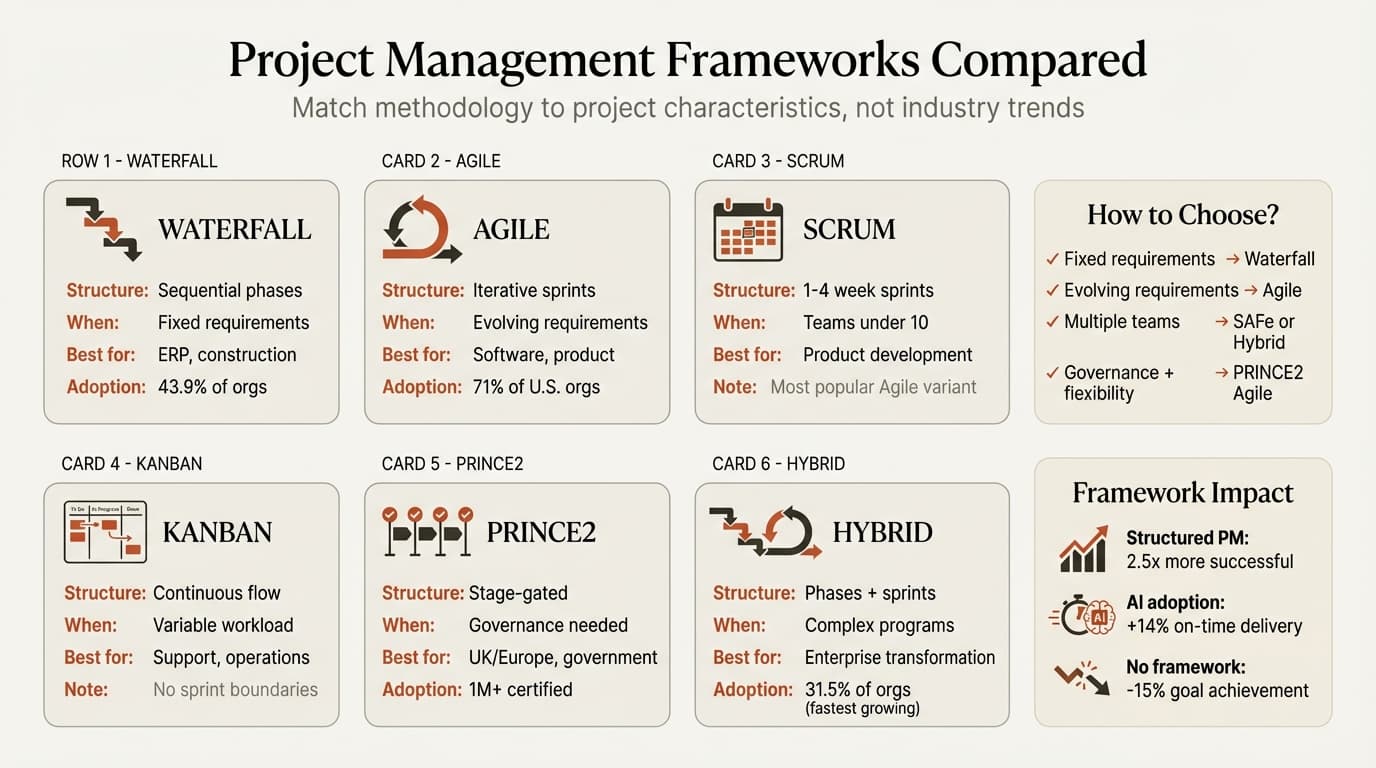
What Is a Project Management Framework?
A project management framework is a structured methodology that defines how to plan, execute, monitor, and close projects. Frameworks specify the processes (planning rituals, status reviews, change control), roles (who decides what), artifacts (the documents or outputs each phase produces), and success criteria.
Frameworks exist because repeatable structures produce more consistent outcomes than ad hoc approaches. ProProfs Project's 2026 research found that projects using structured PM frameworks are 2.5 times more successful than those without defined methodologies. However, the same study found that 42% of project managers do not follow a defined framework, and their projects are 15% less likely to meet goals and budgets.
The distinction between "framework" and "methodology" is technical but matters in practice. A framework provides the scaffolding (principles, phases, roles). A methodology prescribes specific processes and tools. PMBOK is a framework -- it describes what to do. Your company's implementation with specific templates, approval workflows, and tools is the methodology.
The Major Project Management Frameworks
Eleven frameworks account for the majority of adoption in enterprise and consulting environments. Each emerged to solve specific problems and fits distinct project types.
Waterfall
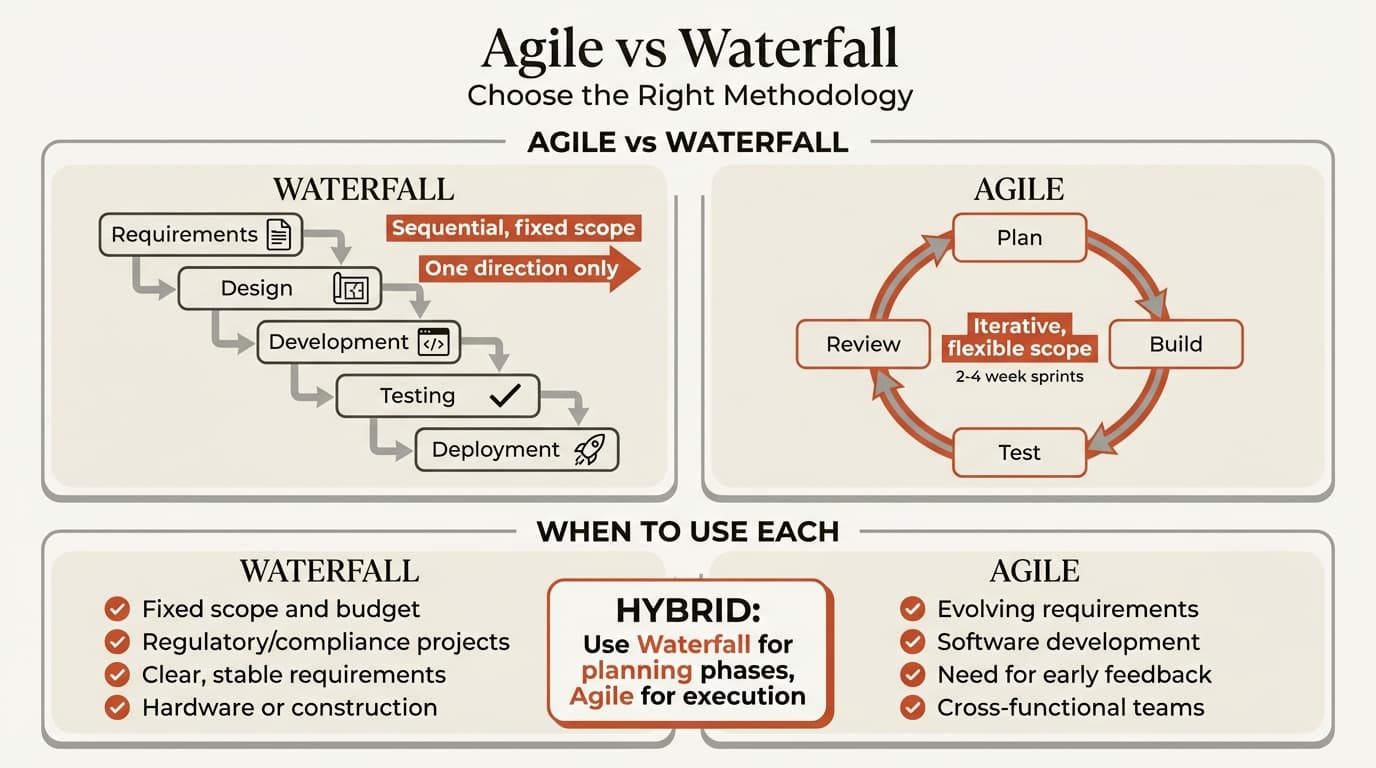
Waterfall is a linear, sequential framework where each phase completes before the next begins. Developed in manufacturing and construction, it assumes requirements can be defined upfront and changes during execution are costly.
Standard phases: Requirements → Design → Implementation → Testing → Deployment → Maintenance
When it works: Fixed-scope projects where deliverables cannot be released incrementally -- ERP implementations, regulatory compliance programs, construction, hardware development, fixed-price vendor contracts.
Adoption: Still used by 43.9% of organizations, though declining from 58% in 2020 (Monday.com's 2025 PM statistics).
Strengths: Predictable timelines, clear milestone reporting, strong audit trail, well-defined handoffs between teams.
Weaknesses: Late risk discovery, expensive late-stage changes, assumes stable requirements.
For a detailed breakdown of when Waterfall outperforms iterative approaches, see our Agile vs Waterfall guide.
Agile
Agile is an iterative framework that delivers work in short cycles (sprints), incorporating feedback after each iteration. Originated from the Agile Manifesto in 2001 to address software project failure rates.
Core principles: Working software over documentation, responding to change over following a plan, customer collaboration over contract negotiation, individuals over processes.
When it works: Projects with evolving requirements, incremental delivery potential, available stakeholders for regular feedback, teams experienced in self-organization.
Adoption: 71% of U.S. organizations now integrate Agile frameworks (DevTeam.Space 2026 analysis). Among organizations using defined methodologies, 24.6% use pure Agile approaches.
Strengths: Early risk identification, faster time to value, higher stakeholder satisfaction, adapts to changing priorities.
Weaknesses: Difficult to estimate total scope and cost upfront, requires disciplined backlog management, stakeholders must commit ongoing time.
Scrum
Scrum is the most popular Agile implementation, designed for cross-functional teams of 10 or fewer people working in 1-4 week sprints.
Key ceremonies: Sprint planning, daily standup, sprint review, sprint retrospective.
Key roles: Product Owner (prioritizes backlog), Scrum Master (facilitates process), Development Team (executes).
Key artifacts: Product backlog, sprint backlog, increment (working output each sprint).
When it works: Software development, product teams, marketing execution with testing cycles, teams that can commit to sprint cadence and ceremonies.
Adoption: Scrum is the most common Agile variant. Most project managers name Scrum as the predominant framework for teams under 10 people (Meegle's 2026 PM framework guide).
Strengths: Clear roles and ceremonies, predictable sprint delivery, continuous improvement built into retrospectives.
Weaknesses: Requires full team availability during sprints, struggles with external dependencies, ceremony overhead for small tasks.
For implementation details, see our Scrum framework guide and sprint planning template.
Kanban
Kanban visualizes work-in-progress using boards with columns representing workflow stages. Unlike Scrum, Kanban has no fixed sprints -- work flows continuously with work-in-progress limits preventing bottlenecks.
Core concepts: Visualize workflow, limit work-in-progress, manage flow, make process policies explicit, implement feedback loops, improve collaboratively.
When it works: Continuous flow environments (support tickets, content production, operations), teams that need flexibility without sprint boundaries, processes with variable input rates.
Adoption: Popular for teams that want Agile principles without sprint structure. Common in DevOps, customer support, and content teams.
Strengths: No ceremony overhead, highly visual, adapts to variable capacity, easy to start incrementally.
Weaknesses: No built-in planning horizon, less structure for teams that need it, work-in-progress limits require discipline.
Lean
Lean focuses on maximizing value while minimizing waste. Originated from Toyota's Production System, adapted for knowledge work and services.
Core principles: Define value from customer perspective, map the value stream, create flow, establish pull (work starts when capacity exists), pursue perfection through continuous improvement.
When it works: Process improvement initiatives, manufacturing, service delivery optimization, situations where cycle time and resource efficiency matter.
Adoption: Widely applied in operations and continuous improvement programs. Often combined with Six Sigma for process optimization.
Strengths: Waste reduction focus, value stream mapping reveals bottlenecks, cultural emphasis on continuous improvement.
Weaknesses: Requires organizational buy-in, heavy upfront analysis, difficult to apply when value definition is ambiguous.
Six Sigma
Six Sigma is a data-driven framework for reducing defects and variation. Uses DMAIC methodology: Define, Measure, Analyze, Improve, Control.
When it works: Quality improvement programs, manufacturing defect reduction, process standardization, situations requiring statistical rigor.
Adoption: Common in manufacturing, healthcare, financial services for compliance and quality initiatives.
Strengths: Rigorous data analysis, clear defect reduction targets, strong governance through belt certification system.
Weaknesses: Heavy on analysis and documentation, slower than Agile approaches, requires statistical expertise.
Often combined with Lean as "Lean Six Sigma" for waste reduction plus quality improvement.
PRINCE2 (Projects in Controlled Environments)
PRINCE2 is a process-based framework emphasizing governance, roles, and stage gates. Developed by the UK government, now used globally.
Seven principles: Continued business justification, learn from experience, defined roles, manage by stages, manage by exception, focus on products, tailor to environment.
Seven processes: Starting up, directing, initiating, controlling stages, managing product delivery, managing stage boundaries, closing.
When it works: Government projects, large enterprises requiring governance and audit trails, fixed-scope programs with executive oversight, UK and European projects.
Adoption: Over 1 million certified practitioners globally (Edureka's 2024 PRINCE2 vs PMP analysis). Strong adoption in UK, Western Europe, and government sectors.
Strengths: Clear governance structure, stage gates enable go/no-go decisions, scalable across project sizes, strong documentation.
Weaknesses: Heavy process overhead for small projects, less flexible than Agile, steep learning curve.
PRINCE2 Agile blends PRINCE2 governance with Agile delivery and is gaining adoption for hybrid environments.
PMBOK (Project Management Body of Knowledge)
PMBOK is PMI's framework outlining 10 knowledge areas (integration, scope, schedule, cost, quality, resource, communications, risk, procurement, stakeholder) and five process groups (initiating, planning, executing, monitoring, closing).
When it works: Enterprise programs requiring standardized processes, industries with strong PMI presence (construction, aerospace, defense), teams with PMP-certified managers.
Adoption: Over 1.6 million PMP-certified professionals globally (Learning Tree's 2025 PMP vs PRINCE2 comparison). Highest recognition in U.S., Canada, and Asia-Pacific. PMI reports that PMP holders earn 33% higher median salaries across 21 countries surveyed.
Strengths: Globally recognized, complete knowledge coverage, flexible across industries, strong community and training resources.
Weaknesses: Framework not methodology (requires local implementation), can feel abstract without specific process guidance, heavy on documentation.
SAFe (Scaled Agile Framework)
SAFe scales Agile to large programs with multiple teams. Adds program-level planning increments (typically 8-12 weeks) on top of team-level sprints, with defined roles for coordinating across teams.
Four configurations: Essential SAFe (1-125 people), Large Solution SAFe (hundreds), Portfolio SAFe (strategy alignment), Full SAFe (enterprise-wide).
When it works: Programs with 5+ Agile teams needing coordination, enterprises transitioning from Waterfall to Agile at scale, portfolio-level planning.
Adoption: 20,000 enterprises have adopted SAFe globally, with over 2 million people trained (Scaled Agile Framework official data). Digital AI's 2025 State of Agile Report shows 44% of enterprises using SAFe. It's the most common scaling approach at 30% and growing.
Strengths: Proven scaling model, maintains Agile benefits at enterprise scale, clear coordination mechanisms, extensive training ecosystem.
Weaknesses: Criticized as too hierarchical and bureaucratic, heavy process overhead, expensive certification and training, requires broad organizational change.
For coordination approaches in large programs, see our RACI matrix examples and download our RACI matrix template.
Critical Path Method (CPM)
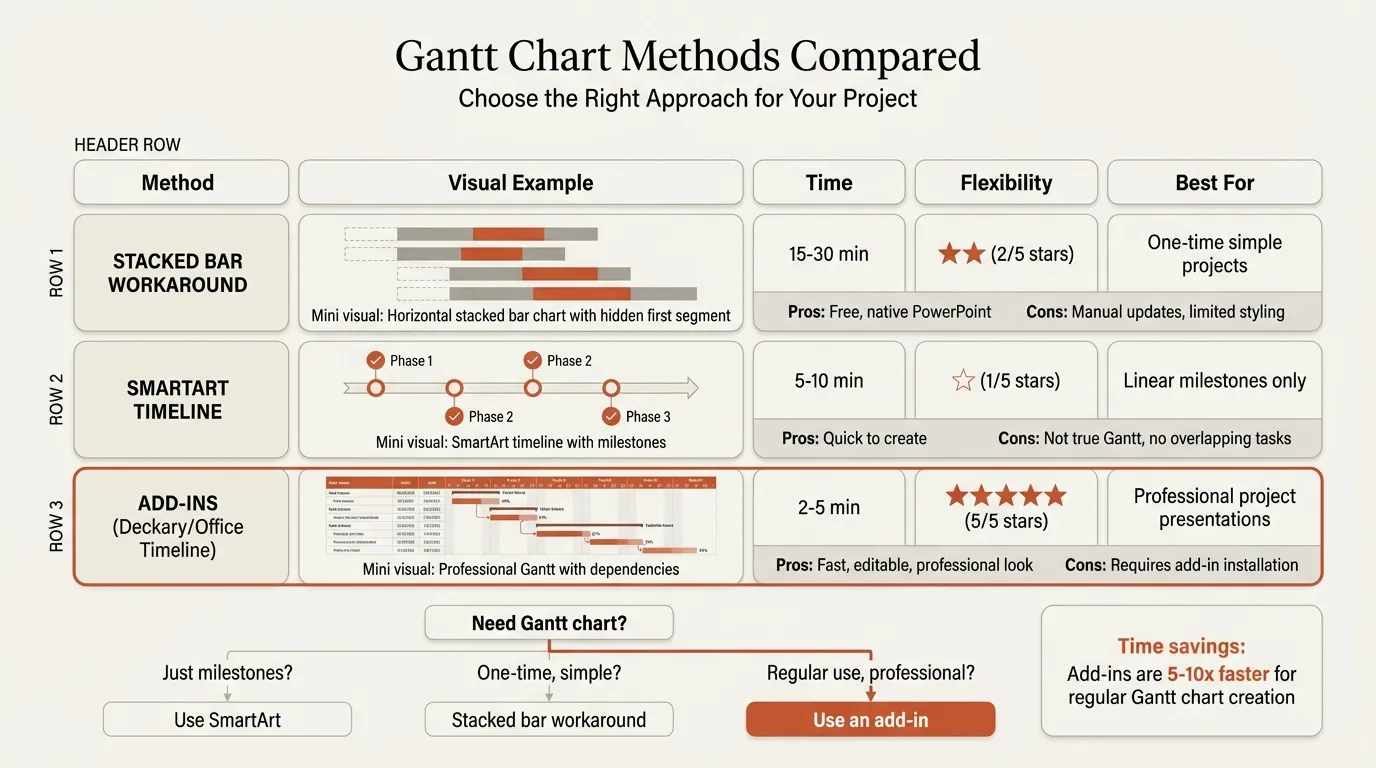
CPM identifies the longest sequence of dependent tasks that determines minimum project duration. Tasks on the critical path have zero slack -- delays directly extend the project.
When it works: Construction, manufacturing, complex schedules with hard dependencies, projects where timeline is the primary constraint.
Adoption: Standard in construction and engineering disciplines. Often visualized using Gantt charts.
Strengths: Identifies schedule bottlenecks, quantifies impact of task delays, enables what-if scenario planning.
Weaknesses: Requires detailed upfront task definition, assumes task durations are known, does not address resource constraints directly.
For visualizing critical paths, see our guide on making Gantt charts in PowerPoint or use a timeline template to map dependencies.
Hybrid Approaches
Hybrid frameworks combine elements of multiple methodologies to match organizational reality. Most common pattern: Waterfall governance with Agile execution.
When it works: Enterprise transformations requiring phase gates and milestone reporting but needing execution flexibility, programs with fixed external dependencies but adaptable internal work, teams transitioning from Waterfall to Agile.
Adoption: 31.5% of companies now use hybrid models combining predictive and Agile practices (Monday.com's 2025 PM statistics). This represents the fastest-growing segment.
Common patterns:
- Waterfall phases with Agile sprints within each phase
- Agile core with Waterfall dependencies (vendor timelines, regulatory gates)
- SAFe (formalized hybrid with program increments)
Strengths: Matches complex organizational constraints, provides governance plus flexibility, easier stakeholder buy-in than pure Agile.
Weaknesses: Risk of "doing both badly" without clear boundaries, can become bureaucratic if not disciplined, requires explicit definition of which elements follow which methodology.
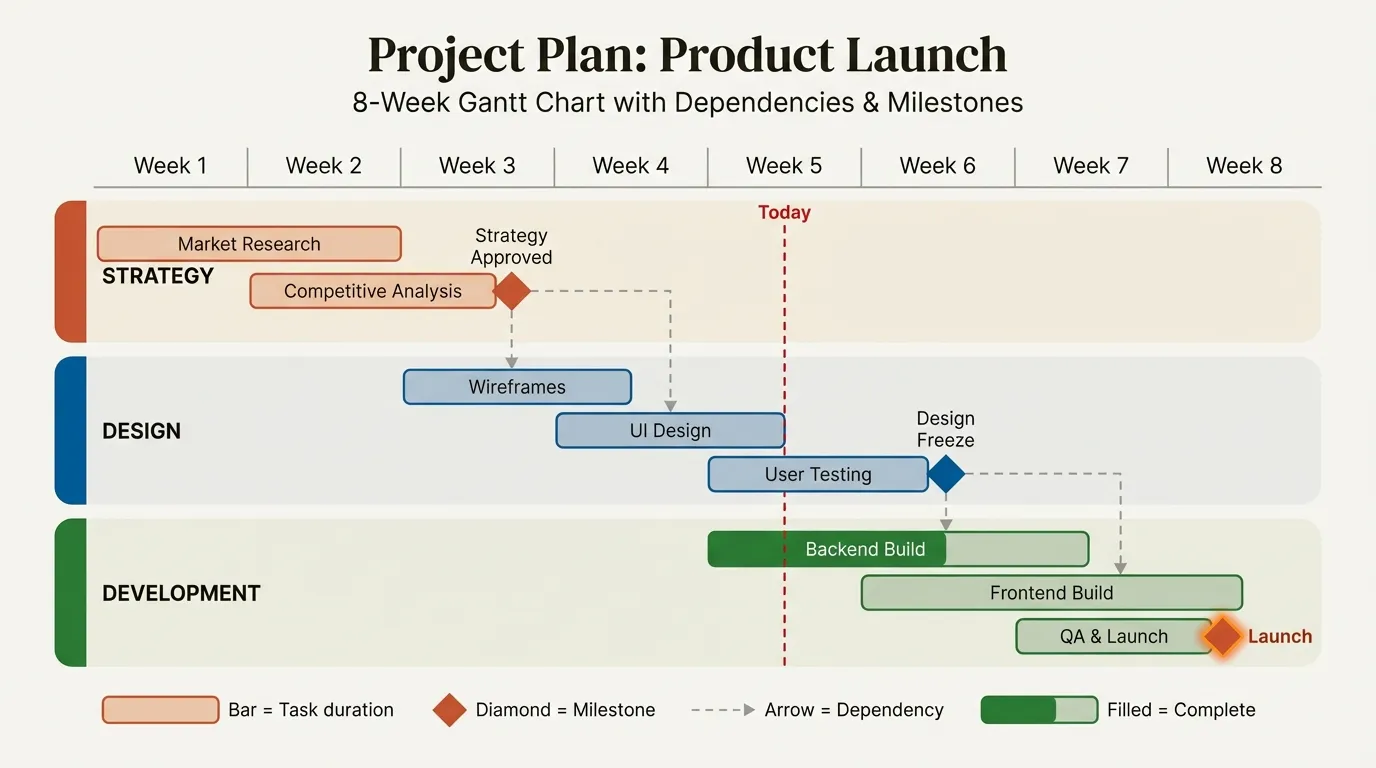
For structuring phase-level plans in hybrid models, see our project plan examples or start with our project plan template.
Continue reading: Agile vs Waterfall · How to Make a Gantt Chart in PowerPoint (Free Template) · Investment Banking Pitch Book
Create professional charts in PowerPoint
Build native waterfall, Mekko, Gantt, and business charts without manual formatting. 10 free AI prompts. No credit card required.
Project Management Framework Comparison
This table compares frameworks across the dimensions that matter most for selection decisions. When presenting these comparisons to stakeholders, consulting-grade charts help visualize adoption rates and framework fit scores.
| Framework | Structure | Planning Horizon | Change Flexibility | Best For | Certification Body |
|---|---|---|---|---|---|
| Waterfall | Sequential phases | Full project upfront | Low (formal change control) | Fixed requirements, single deliverable | None (foundational) |
| Agile | Iterative sprints | Rolling 1-4 sprints | High (backlog reprioritization) | Evolving requirements, incremental delivery | Various (Scrum Alliance, SAFe, etc.) |
| Scrum | 1-4 week sprints | Sprint planning + backlog | High within sprint boundaries | Software, product teams under 10 people | Scrum Alliance, Scrum.org |
| Kanban | Continuous flow | Just-in-time | Very high (pull-based) | Support, operations, continuous flow | None (methodology) |
| Lean | Value stream focus | Ongoing improvement | Moderate (process changes) | Waste reduction, process optimization | Various (Lean Enterprise Institute) |
| Six Sigma | DMAIC phases | Project-based | Low (data-driven) | Quality improvement, defect reduction | ASQ, IASSC (belt levels) |
| PRINCE2 | Stage-gated | Stage by stage | Moderate (stage boundaries) | Governance-heavy, UK/Europe | AXELOS |
| PMBOK | Process groups | Phase-appropriate | Framework-dependent | Enterprise programs, PMP environments | PMI |
| SAFe | Program increments | 8-12 week PI planning | Moderate (PI boundaries) | Large Agile programs, 5+ teams | Scaled Agile Inc. |
| CPM | Task dependencies | Full schedule upfront | Low (rescheduling required) | Construction, hard dependencies | None (technique) |
| Hybrid | Varies by design | Phase + sprint levels | Mixed by component | Complex programs, transition scenarios | Varies (e.g., PRINCE2 Agile) |
Framework Adoption by Industry and Geography
Different frameworks dominate in different contexts. Understanding these patterns helps predict stakeholder expectations.
| Industry | Dominant Frameworks | Why |
|---|---|---|
| Software / SaaS | Agile, Scrum, Kanban | Iterative development, frequent releases |
| Construction | Waterfall, CPM | Sequential execution, hard dependencies |
| Consulting | Hybrid, PRINCE2, PMBOK | Client governance needs + execution flexibility |
| Manufacturing | Lean, Six Sigma, Waterfall | Process optimization, quality control |
| Financial services | PRINCE2, PMBOK, Waterfall | Regulatory compliance, audit requirements |
| Healthcare | Six Sigma, Lean, Hybrid | Quality standards, process improvement |
| Government | PRINCE2, PMBOK, Waterfall | Governance, documentation, accountability |
| Retail / E-commerce | Agile, Scrum, Hybrid | Fast iteration, seasonal demands |
Geographic patterns:
- United States / Canada: PMBOK and Agile frameworks dominate. PMP certification has highest recognition.
- United Kingdom / Western Europe: PRINCE2 strong in government and large enterprises. PRINCE2 practitioners earn average £54,000, 29.4% above UK national average (Learning Tree's 2025 comparison).
- Asia-Pacific: Growing adoption of both PMP and PRINCE2. India shows rapid increase in both certifications.
- Global enterprises: SAFe and hybrid models to coordinate across regions and methodologies.
How to Choose the Right Framework
Use this decision matrix to match project characteristics to framework strengths. Score each dimension for your project. For a reusable scoring tool, try our prioritization matrix template.
Decision Criteria Matrix
| Criterion | Points to Waterfall | Points to Agile | Points to Hybrid | Points to PRINCE2/PMBOK |
|---|---|---|---|---|
| Requirements | Fixed and documented | Will evolve with feedback | Partially fixed (scope boundaries clear) | Fixed with formal change control |
| Deliverable type | Single output (building, system) | Incremental releases possible | Major milestones + iterative work | Phased deliverables with stage gates |
| Stakeholder availability | Bookend (kickoff and close) | Continuous (sprint reviews) | Periodic (phase gates) | Stage reviews and governance boards |
| Regulatory needs | Phase documentation mandatory | Lightweight acceptable | Governance gates + agile execution | Strong audit trail required |
| Contract structure | Fixed-price, fixed-scope | Time and materials or internal | Mixed (phases fixed, execution flexible) | Fixed with change control process |
| Team experience | Traditional PM background | Agile/Scrum trained | Mixed skill sets | Certified PMs (PMP or PRINCE2) |
| Change tolerance | Low (changes costly) | High (changes expected) | Moderate (within boundaries) | Controlled (formal approval) |
| Timeline certainty | Fixed deadline, known scope | Flexible scope, fixed velocity | Phase deadlines, sprint flexibility | Milestone commitments required |
| Organization size | Any | Teams under 125 people | Enterprise (multi-team) | Large programs |
Scoring guide:
- If six or more criteria clearly point to one category, start with that framework
- If split across categories, hybrid is likely your answer
- If criteria conflict (e.g., fixed requirements but incremental delivery needed), design a custom hybrid specifying which elements follow which methodology
Framework Selection by Project Type
This table provides starting recommendations by common project archetypes.
| Project Type | Recommended Framework | Why | Alternative |
|---|---|---|---|
| ERP implementation | Waterfall or PRINCE2 | Fixed requirements, phase-based rollout, vendor dependencies | Hybrid (Waterfall phases, Agile configuration) |
| Software product development | Scrum | Iterative delivery, user feedback loops, small teams | Kanban (continuous flow) |
| Digital transformation (enterprise) | SAFe or Hybrid | Multiple teams, governance needs, cultural change | PRINCE2 Agile |
| Marketing campaign | Kanban or Scrum | Testing cycles, creative iteration, variable input | Agile |
| Compliance program | PRINCE2 or Waterfall | Documentation requirements, audit trail, sequential gates | PMBOK |
| Process improvement | Lean Six Sigma | Data-driven, waste reduction, quality focus | Lean |
| Construction / infrastructure | Waterfall or CPM | Hard dependencies, sequential execution, single output | None (pure approach required) |
| Product innovation / R&D | Agile or Scrum | Uncertain outcomes, experimentation, pivots | Lean Startup (outside traditional PM) |
| Consulting engagement | Hybrid or PRINCE2 | Client governance + evolving findings | PMBOK |
| IT operations / support | Kanban | Continuous flow, variable workload, no sprints | ITIL (service management) |
Common Mistakes When Choosing a Framework
After reviewing 80+ programs and their framework selections, these are the errors that most consistently lead to project struggles.
Choosing Based on Trend Rather Than Fit
"We should be Agile because everyone is doing Agile" ignores whether your project actually fits iterative delivery. An ERP implementation forced into two-week sprints creates chaos when modules require end-to-end integration before anything works. Match the framework to the work, not the industry trend.
Renaming Waterfall and Calling It Agile
If your "Agile" project has fixed scope with no backlog reprioritization, sprint reviews where nothing is demoed, and stakeholders who only see output at project close, you are running Waterfall with daily standups. The label does not change the outcome. Be honest about your actual methodology.
No Governance in Agile Projects
Agile does not mean no oversight. Executives and sponsors still need visibility into budget, timeline, and risk. Track progress using KPI dashboards and OKRs that align sprint outputs to strategic goals. Build governance checkpoints into your framework -- monthly business reviews, quarterly planning cycles, or program increment planning in SAFe. Stakeholder management practices apply regardless of framework -- see our stakeholder mapping guide and stakeholder analysis template.
Ignoring Team Capability
Agile requires self-organizing teams that can estimate capacity and make decisions without constant escalation. If your team has never worked in sprints, a pilot project is cheaper than converting an entire program. PRINCE2 and PMBOK assume PMs trained in those frameworks. Do not select a framework your team cannot execute.
Treating Hybrid as "Do Everything"
Hybrid does not mean layering Waterfall documentation on top of Agile sprints. It means explicitly defining which decisions follow which methodology. Document which elements are governed by phase gates (budget, scope boundaries, regulatory milestones) and which follow Agile practices (sprint planning, backlog prioritization, daily execution). Without clear boundaries, hybrid becomes bureaucratic.
Framework Dogma Over Project Needs
Every framework has zealots. Pure Scrum practitioners insist on no scope changes mid-sprint. Waterfall advocates reject any deviation from the plan. PRINCE2 can become process-heavy. The framework serves the project, not the other way around. Tailor the methodology to your constraints rather than forcing your project into a textbook implementation.
Changing Frameworks Mid-Project Without Cause
Switching from Waterfall to Agile (or vice versa) mid-execution because "things are not working" rarely fixes the underlying problem. Poor planning, unclear requirements, or weak stakeholder management will follow you into the new framework. Diagnose the actual failure mode before switching methodologies. For managing project priorities regardless of framework, see our guide on how to prioritize tasks and our Eisenhower matrix template for urgent-vs-important decisions.
Emerging Trends in Project Management Frameworks
The project management field continues to evolve. These trends are reshaping how frameworks get applied.
AI Integration Across Frameworks
With 75% of knowledge workers now using AI and the AI-PM market growing 40% annually, AI tools are being integrated into every framework. ProProfs' 2026 PM statistics show that early AI adopters complete 61% of projects on time versus 47% for slower adopters. AI is enhancing risk prediction, resource allocation, and schedule optimization regardless of underlying framework. Tools like the AI Slide Builder can generate project status slides and risk matrices from plain-text descriptions in seconds.
Hybrid as the New Default
Hybrid approaches now represent 31.5% of organizational adoption and are the fastest-growing segment. Productive.io's 2026 methodology overview notes that hybrid models are evolving from "combining two frameworks" to "fit-for-purpose customization" where teams select practices from multiple frameworks based on project phase and context.
Framework Decoupling from Tools
Traditional tight coupling between frameworks and tools (e.g., Jira for Scrum, MS Project for Waterfall) is loosening. Modern platforms support multiple methodologies, enabling teams to shift approaches without changing systems. This reduces switching costs and enables more granular hybrid implementations.
Shift from Certification to Application
While certifications remain valuable (PMP holders earn 33% higher salaries), organizations increasingly prioritize demonstrated framework application over certification alone. Real-world hybrid experience often outweighs pure methodology credentials.
Sources
- ProProfs Project Management — Project Management Statistics (2026)
- Monday.com — Project Management Statistics (2025)
- Agile Manifesto
- DevTeam.Space — Best Project Management Frameworks (2026)
- Meegle — Project Management Framework Guide (2026)
- Edureka — PMP vs PRINCE2 Comparison (2024)
- Learning Tree — PMP vs PRINCE2: Salary, ROI, Project Fit (2025)
- Atlassian — What is SAFe?
- Productive.io — Project Management Methodologies (2026)
Key Takeaways
- Project management frameworks provide structure, but the wrong framework creates overhead without value. Projects using structured approaches are 2.5 times more successful, but 42% of PMs still work without defined frameworks, leading to 15% lower goal achievement.
- The 11 major frameworks each fit specific project types. Waterfall for fixed requirements and sequential work, Agile for evolving scope and incremental delivery, PRINCE2 and PMBOK for governance-heavy environments, SAFe for scaling Agile, Lean and Six Sigma for process improvement, hybrid for complex enterprise programs.
- 71% of U.S. organizations have adopted Agile frameworks, but 43.9% still use Waterfall approaches. The methodology split reflects project diversity, not a universal winner. Hybrid models (31.5%) are the fastest-growing category.
- Choose frameworks based on requirement certainty, delivery constraints, stakeholder expectations, and team capability. Use the decision matrix to score project characteristics rather than defaulting to industry trends or PM backgrounds.
- Common mistakes include choosing based on trend rather than fit, renaming Waterfall as Agile, running Agile without governance, selecting frameworks teams cannot execute, and treating hybrid as "do everything."
- Global adoption patterns vary: PMBOK and Agile dominate the U.S., PRINCE2 is strong in UK and Europe, SAFe leads for enterprise scaling with 44% of large organizations adopting it.
- Emerging trends point toward AI integration, hybrid customization, and tool-agnostic frameworks. Early AI adopters in project management show 14 percentage point higher on-time completion rates.
The right framework accelerates delivery and reduces risk. The wrong framework creates ceremony without value. Match your selection to project characteristics, not ideology, and tailor implementation to organizational reality rather than textbook purity.
Related Guides
- Agile vs Waterfall: How to Choose the Right Methodology -- detailed comparison with decision framework
- Scrum Framework Guide -- Scrum implementation for teams under 10
- Project Plan Examples -- five real project plans across Agile, Waterfall, and hybrid formats
- RACI Matrix Examples -- accountability framework that works across methodologies
- How to Make a Gantt Chart in PowerPoint -- visualizing timelines for any framework
- Stakeholder Mapping Guide -- managing expectations across framework transitions
- How to Prioritize Tasks -- backlog prioritization techniques for Agile frameworks
Create professional charts in PowerPoint
Build native waterfall, Mekko, Gantt, and business charts without manual formatting. 10 free AI prompts. No credit card required.