Resource Allocation Template: Structure, Methods, and Best Practices
Resource allocation template guide with structure, assignment methods, and optimization strategies. Learn how to match the right people to the right tasks using data-driven allocation.
The most common resource allocation failure is assigning the same person to three simultaneous projects at 80% allocation on each one. The math shows 240% commitment on a resource who has 100% capacity. The result is missed deadlines on all three projects when that person becomes the bottleneck.
Resource allocation assigns specific employees, equipment, and budget to tasks or projects based on skills, availability, and priority. After building resource allocation frameworks for 70+ transformation programs across strategy, technology, and operational implementations, we identified which allocation methods prevent bottlenecks (skill-based matching, 80-85% utilization caps, time-phased matrices) and which create perpetual firefighting.
This guide covers resource allocation structure, assignment methods, and optimization strategies.
What Is Resource Allocation?
Resource allocation assigns appropriate employees, equipment, and budget to specific tasks or projects over a given time period. The goal is matching the right people with the right skills to the right task at the right time to maximize productivity while minimizing bottlenecks.
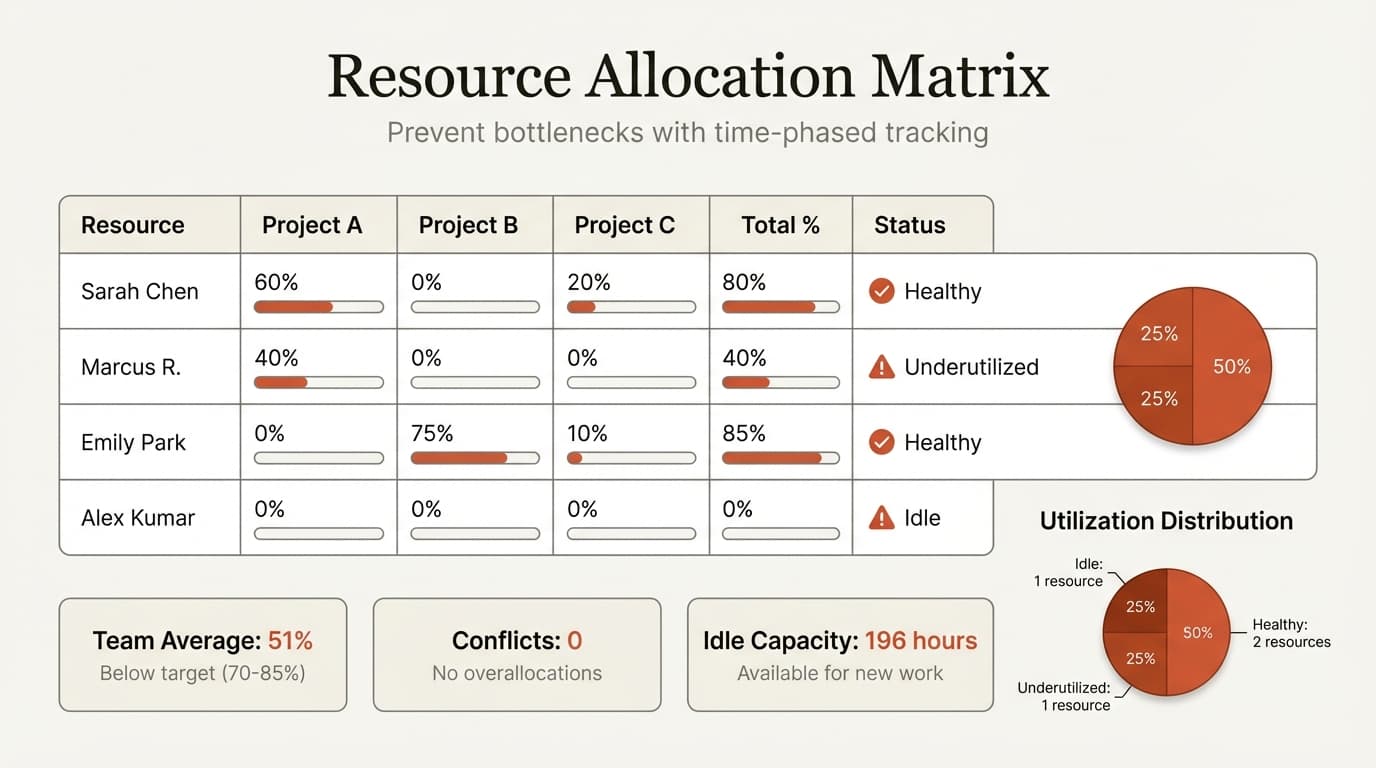
Resource allocation operates at the individual assignment level—Sarah works on API development at 60% capacity from March 1-31, Marcus handles QA testing at 40% for the same period. This differs from resource planning which forecasts aggregate needs (we need 3 backend developers in Q2) without naming specific people.
Organizations with mature resource management practices achieve 25% higher project success rates and 30% higher resource utilization than those with ad hoc approaches.
Resource Allocation vs Resource Planning
Resource planning is the strategic process of forecasting what resources will be needed before projects begin. Resource allocation is the tactical execution of assigning those resources to specific tasks during project implementation.
| Factor | Resource Allocation | Resource Planning |
|---|---|---|
| Focus | Tactical assignment—who does what | Strategic forecasting—what will we need |
| Granularity | Named individuals to specific tasks | Aggregate headcount by role or skill |
| Time horizon | Weekly or daily | Quarterly or annual |
| Decision output | Sarah assigned to API work at 60%, Marcus to QA at 40% | Need 3 backend developers in Q2 |
| Update frequency | Real-time or daily | Monthly reviews |
| Prerequisites | Resource pool must exist | Informs hiring and budgeting decisions |
Resource planning determines headcount and budget (hire 2 QA engineers in Q2). Resource allocation assigns those people to work (Maria tests payment flow, James tests checkout). For the planning phase, see our guide on capacity planning templates.
Standard Resource Allocation Template Structure
A resource allocation template maps people to tasks over time, tracks utilization, and surfaces conflicts when demand exceeds capacity.
1. Resource Inventory
List all available resources with roles, skills, and maximum capacity. Use a table for clarity:
| Resource | Role | Key Skills | FTE | Max Allocation/Week |
|---|---|---|---|---|
| Sarah Chen | Senior Developer | React, Node.js, Python | 1.0 | 40 hours |
| Marcus Rodriguez | QA Engineer | Selenium, API testing | 1.0 | 40 hours |
| Emily Park | Product Designer | Figma, UX research | 0.8 | 32 hours |
| Alex Kumar | DevOps Engineer | AWS, Docker, Terraform | 1.0 | 40 hours |
Skill categorization matters. Generic "developer" labels hide critical dependencies. If Sarah is the only React expert, allocating her at 100% to one project blocks all other React work—a bottleneck invisible in aggregate "developer" capacity.
2. Task and Project List
Document all active work requiring resource allocation. Include task names, estimated effort, required skills, and priority:
| Project | Task | Est. Hours | Skills Required | Priority | Deadline |
|---|---|---|---|---|---|
| Customer Portal | API integration | 80 | Backend (Node.js) | P0 | Mar 15 |
| Mobile App V2 | UX design | 60 | Product Design | P1 | Mar 20 |
| Analytics Dashboard | Frontend build | 120 | Frontend (React) | P1 | Apr 5 |
| Infrastructure | CI/CD pipeline | 40 | DevOps | P2 | Apr 15 |
Estimate effort by skill, not total hours. A task requiring 80 hours of Node.js development cannot be delivered by allocating 80 hours of Python developers.
3. Assignment Matrix
Map resources to tasks with allocation percentages and time periods:
| Resource | Project | Task | % Allocation | Hours/Week | Start Date | End Date |
|---|---|---|---|---|---|---|
| Sarah Chen | Customer Portal | API integration | 60% | 24 | Mar 1 | Mar 15 |
| Sarah Chen | Design System | Ongoing maintenance | 20% | 8 | Ongoing | Ongoing |
| Marcus Rodriguez | Customer Portal | Integration testing | 40% | 16 | Mar 8 | Mar 22 |
| Emily Park | Mobile App V2 | UX design | 75% | 24 | Mar 1 | Mar 20 |
If Sarah is assigned 60% to Customer Portal and 50% to Analytics Dashboard simultaneously, the total 110% allocation flags overcommitment before work starts.
4. Utilization Summary
Calculate utilization percentage for each resource across all assignments. The formula:
Utilization % = (Allocated Hours / Available Hours) × 100
| Resource | Available Hours/Week | Allocated Hours | % Utilization | Status |
|---|---|---|---|---|
| Sarah Chen | 40 | 32 (24 + 8) | 80% | Healthy |
| Marcus Rodriguez | 40 | 16 | 40% | Underutilized |
| Emily Park | 32 | 24 | 75% | Healthy |
| Alex Kumar | 40 | 0 | 0% | Idle |
The optimal utilization rate for successful project delivery is around 80%. Below 70% means idle capacity. Above 85% risks burnout and leaves no buffer for unplanned work.
5. Conflict Identification
Surface allocation conflicts requiring resolution:
| Resource | Conflict Type | Impact | Proposed Resolution |
|---|---|---|---|
| Sarah Chen | Overallocation (110% in Week 2) | API work delayed | Shift Design System maintenance to Emily |
| Analytics Dashboard | Skill gap (no React developers available) | Project blocked | Defer to April when Sarah finishes Portal |
| Marcus Rodriguez | Underutilization (40% average) | Idle capacity | Assign to regression testing backlog |
6. Time-Phased Allocation Matrix
For multi-week projects, show allocation by time period to catch conflicts:
MARCH 2026 ALLOCATION MATRIX

Resource      | Week 1 | Week 2 | Week 3 | Week 4 | Total
--------------|--------|--------|--------|--------|------
Sarah Chen    | 80%    | 110% ⚠ | 80%    | 60%    | 82%
Marcus R.     | 20%    | 40%    | 60%    | 40%    | 40%
Emily Park    | 75%    | 75%    | 85%    | 0%     | 59%
Alex Kumar    | 0%     | 0%     | 30%    | 50%    | 20%
The ⚠ flag on Sarah's Week 2 allocation (110%) identifies the specific period requiring rebalancing. Without time-phased visibility, the 82% average utilization looks healthy while hiding the mid-month bottleneck.
Continue reading: Eisenhower Matrix · How to Make a Gantt Chart in PowerPoint (Free Template) · Competitive Landscape Slide
Build and improve Excel workbooks with AI
Create models, audit formulas, clean data, and generate output sheets inside Excel. 10 free AI prompts. No credit card required.
Resource Allocation Methods and Assignment Strategies
After testing allocation approaches across 70+ projects, methods prioritizing skill matching and utilization balance consistently outperform first-available assignment.
Skills-Based Allocation
Match tasks to resources based on competency and experience, not just availability. If a task requires React expertise, assign it to a React developer rather than the first available developer.
42% of businesses do not track skills at all, while over half (53%) of those that do rely on spreadsheets, meaning teams staff projects based on whoever is free, not who is best suited to the work. An API integration task assigned to a Node.js expert completes in 20 hours versus 40 hours when assigned to a beginner—the quality difference is even larger.
Priority-Based Allocation
Allocate resources to the highest-priority work first, deferring lower-priority projects when conflicts arise. Use an explicit prioritization framework (P0/P1/P2, MoSCoW, weighted scoring) to make trade-offs transparent.
When three projects compete for the same person, priority classification determines allocation: P0 (regulatory deadlines, executive mandates) gets resources first, P1 (planned work) fills remaining capacity, P2 (nice-to-have) defers until constraints ease.
Resource Leveling and Smoothing
When someone is overallocated, either extend deadlines (leveling) or shift non-critical tasks within available slack (smoothing). Leveling accepts schedule impact to eliminate overallocation. Smoothing maintains the critical path by redistributing work across periods with available capacity.
Agile Capacity-Based Allocation
For agile teams running sprints, allocate based on velocity (historical delivery rate) rather than hours. Assign story points equal to the team's average velocity, let the team self-assign tasks during sprint planning. For agile-specific allocation patterns, see our Scrum framework guide.
Resource Allocation Template Examples
Weekly Resource Allocation Matrix (Software Development)
MARCH 2026 RESOURCE ALLOCATION
TEAM: Product Development (4 people)

Sarah Chen (Senior Developer)
- Customer Portal API: 24 hours (60%)
- Design System: 8 hours (20%)
- Total: 32 hours (80% utilization) ✓

Marcus Rodriguez (QA Engineer)
- Customer Portal testing: 16 hours (40%)
- Total: 16 hours (40% utilization) ⚠ Underutilized

Emily Park (Product Designer, 0.8 FTE)
- Mobile App UX: 24 hours (75%)
- Total: 24 hours (75% utilization) ✓

Alex Kumar (DevOps Engineer)
- Total: 0 hours (0% utilization) ⚠ Idle

CONFLICTS
- Marcus underutilized → Assign to regression testing
- Alex idle → Pull forward infrastructure work
- Team average: 48% (below target 70-85%)
Monthly Resource Allocation Plan (Consulting Practice)
APRIL 2026 RESOURCE ALLOCATION
PRACTICE: Strategy & Operations (8 consultants)
CAPACITY: 952 billable hours

ALLOCATIONS
Client A - Digital Transformation (P0): 220 hours
Client B - M&A Due Diligence (P0): 300 hours
Client C - Cost Reduction (P1): 220 hours
Internal (Proposals, Training): 88 hours

TOTAL: 828 hours (78% utilization) ✓
IDLE: 212 hours

CONFLICTS
- Michael Chen overallocated (104%)
  → Reduce Client B by 8 hours, shift to Sarah Williams
Common Resource Allocation Mistakes
1. Assigning people without checking existing commitments. Result: 160% total commitment and missed deadlines. Check utilization before assigning.
2. Allocating based on availability rather than skills. Mismatched skills mean work takes 3× longer and requires extensive rework.
3. No time-phased visibility. Monthly averages hide week-level conflicts. Week 2 shows 140% allocation that monthly 75% average conceals.
4. Treating allocation as one-time assignment. Resource allocation requires weekly reviews comparing plan to actuals and rebalancing when conflicts appear.
5. Allocating at 100% utilization with no buffer. Healthy utilization is 70-85%—the buffer prevents constant firefighting.
6. Ignoring context switching costs. Allocating someone to 4 projects at 25% each creates overhead consuming 20-30% of productive time. Limit to 2-3 concurrent projects. For defining accountability, see RACI matrices.
Best Practices for Resource Allocation
Track skills, not just headcount. 42% of businesses do not track skills at all. Build a skills inventory listing competencies and proficiency levels. Allocate based on who can do the work well, not just who is free.
Allocate at 70-85% utilization, not 100%. The buffer absorbs meetings, email, unplanned work, and estimation variance. Teams allocated at 80% have capacity to handle volatility without constant reallocation.
Use time-phased allocation matrices for multi-week projects. Monthly averages hide week-level conflicts. Show allocation by week to catch conflicts before work starts.
Limit concurrent project assignments. Allocating one person to 4 projects at 25% each creates context-switching overhead consuming 20-30% of productive time. Limit to 2-3 concurrent projects—one primary (60-80%) plus 1-2 secondary (10-20%).
Review allocations weekly, not just at kickoff. Projects change—priorities shift, people leave, estimates prove wrong. Weekly reviews catch divergence while mitigation is still possible.
Define explicit prioritization criteria. Use a framework (P0/P1/P2) to decide which projects get resources and which defer. Makes trade-offs transparent and defensible.
Key Takeaways
- Resource allocation assigns specific employees to specific tasks based on skills, availability, and priority. It operates at the individual level (Sarah works on API development at 60%) versus resource planning which forecasts aggregate needs (need 3 backend developers).
- Allocate at 70-85% utilization to maintain buffer for unplanned work, meetings, and estimation variance. Above 85% risks burnout and constant firefighting. Below 70% means idle capacity.
- Track allocation by time period (weekly or daily) to catch conflicts invisible in monthly averages. A person allocated 140% in Week 2 but 60% in Week 3 shows 100% monthly average that hides the bottleneck.
- Match skills to requirements, not just availability. Allocating available people to work they are not qualified for produces low-quality output requiring rework that exceeds the time saved.
- Limit concurrent assignments to 2-3 projects per person. Spreading individuals across 4+ projects creates context-switching overhead consuming 20-30% of productive time.
- Review allocations weekly, comparing plan to actuals. Projects change—priorities shift, people leave, estimates prove wrong. Weekly reviews catch divergence while mitigation is still possible.
For visualizing resource allocation timelines and capacity in PowerPoint, Deckary provides resource allocation templates, Gantt charts, and capacity dashboards optimized for stakeholder presentations—see our guide on making Gantt charts in PowerPoint.
Related Guides
- Capacity Planning Template — strategic workforce planning framework for forecasting resource needs at portfolio level
- Progress Report Template — reporting framework for tracking resource consumption and project accomplishments
- RACI Matrix Examples — accountability framework for defining who delivers allocated work
- Scrum Framework Guide — agile-specific allocation patterns for sprint planning
- Project Plan Examples — five real project plans with resource allocation and timeline structures
Sources
- Saviom: Resource Allocation Guide for Project Success
- Runn: Resource Management Statistics - What the Numbers Reveal
- GanttPRO: 8 Tried-and-True Resource Allocation Methods
- Tempo: Resource Allocation in Project Management Best Practices
- D-Tools: Resource Allocation in Project Management - 3 Methods
- Saviom: Resource Planning Guide to Coordinate and Allocate Resources
- PPM Express: What Is Resource Planning? The Complete Guide
- The Digital Project Manager: Resource Allocation Spreadsheet Example & Template
- Rocketlane: Guide to Resource Allocation for Team Workloads
Build and improve Excel workbooks with AI
Create models, audit formulas, clean data, and generate output sheets inside Excel. 10 free AI prompts. No credit card required.