Process Improvement Template: 5 Frameworks to Optimize Your Business
Process improvement template guide with DMAIC, SIPOC, Kaizen, and A3 frameworks. Choose the right methodology and track efficiency gains.
- Bob · Former McKinsey and Deloitte consultant with 6 years of experience
- 13 min read
Every process improvement project fails the same way: teams jump straight to solutions without defining the problem, measuring current performance, or agreeing on what success looks like. The result is wasted effort on fixing symptoms rather than root causes, solutions that do not address the actual constraint, and no baseline to prove the improvement delivered value.
A process improvement template provides the structure to avoid these traps. After guiding 40+ operational excellence programs across manufacturing, service delivery, and back-office operations, we have tracked which frameworks produce measurable results and which become compliance theater. The determining factors: whether the template forces you to measure the current state before proposing changes, whether it assigns accountability for each action, and whether it includes a control mechanism to sustain gains after the project closes.
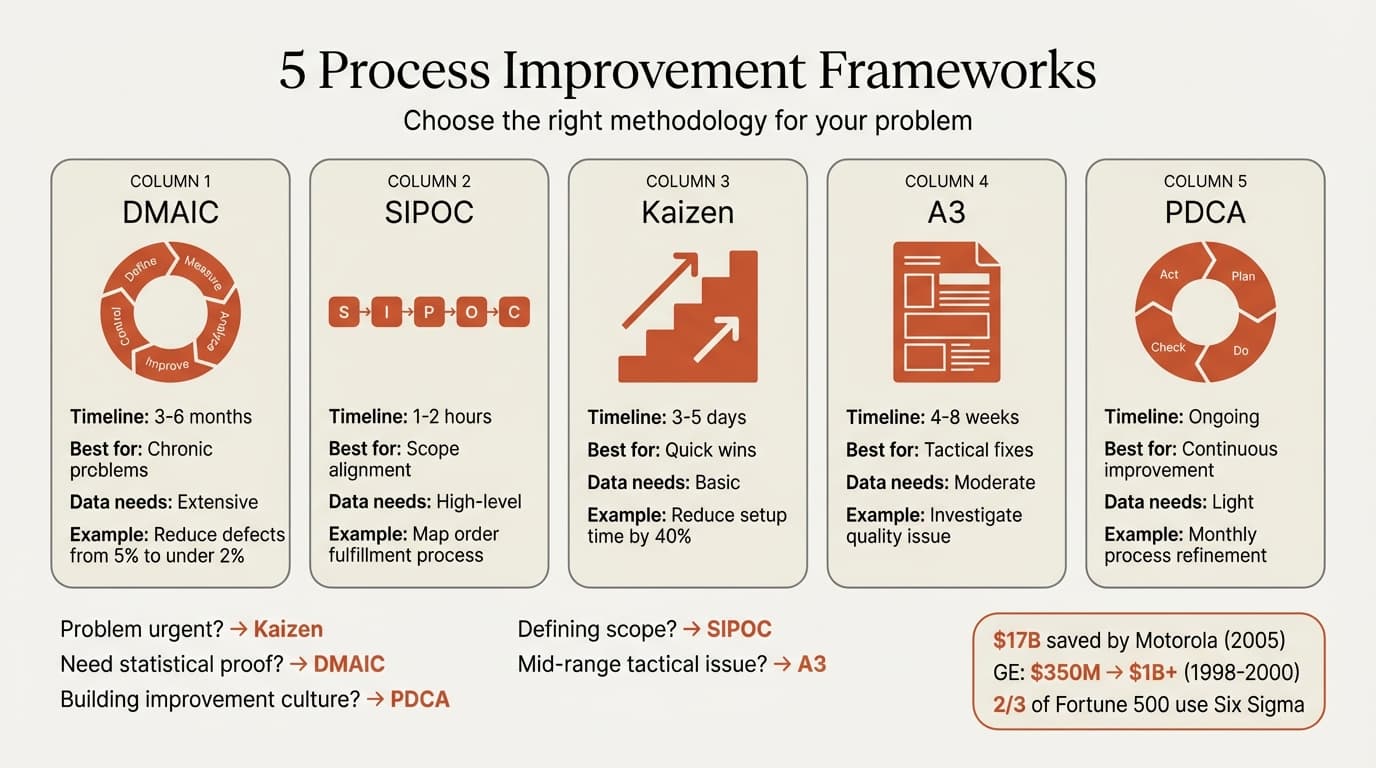
This guide covers five proven process improvement frameworks with templates for each—DMAIC, SIPOC, Kaizen, A3, and PDCA—when to use each methodology, and how to structure the template to drive actual implementation rather than just documentation.
What Is a Process Improvement Template?
A process improvement template is a structured framework that guides teams through identifying inefficiencies, analyzing root causes, implementing solutions, and measuring results. Effective templates share four components regardless of which framework they follow:
- Current state baseline — quantified performance before changes (cycle time, defect rate, cost per unit)
- Target state definition — specific, measurable goals with timelines
- Action plan — detailed steps, owners, resources required, and completion dates
- Measurement system — metrics tracked, data collection method, review frequency
DMAIC Template: Data-Driven Process Improvement
DMAIC (Define, Measure, Analyze, Improve, Control) is the structured problem-solving methodology at the core of Six Sigma. Each phase produces specific deliverables that feed into the next. Use DMAIC when you need analytical rigor for chronic problems that justify multi-month projects.
The DMAIC methodology was formalized within Six Sigma, introduced by Motorola in the 1980s. By 2005, Motorola attributed over $17 billion in savings to Six Sigma. GE reported $350 million in initial Six Sigma savings in 1998. By the late 1990s, roughly two thirds of Fortune 500 companies had launched Six Sigma initiatives.
DMAIC Template Structure
| Phase | Key Questions | Deliverables | Tools |
|---|---|---|---|
| Define | What is the problem? Who is the customer? What is in scope? | Project charter, process map, stakeholder analysis, Voice of Customer | SIPOC diagram, project charter template |
| Measure | How is the process performing now? What data proves the problem exists? | Data collection plan, baseline performance metrics, process capability | Control charts, process sigma calculation, measurement system analysis |
| Analyze | What are the root causes? Which factors have the biggest impact? | Root cause analysis, hypothesis testing results, prioritized cause list | Fishbone diagram, Pareto chart, 5 Whys, statistical analysis |
| Improve | What solutions address root causes? Which solution is best? | Pilot test results, implementation plan, cost-benefit analysis | Failure Modes and Effects Analysis (FMEA), design of experiments, pilot testing |
| Control | How do we sustain the gains? How will we detect if performance degrades? | Control plan, standard operating procedures, training materials, monitoring dashboard | Statistical process control charts, audits, documentation |
When to Use DMAIC
DMAIC fits problems that justify 3-6 months of focused analysis and have quantifiable business impact.
Strong DMAIC candidates: Defect reduction (product quality issues, service errors), cycle time optimization (long lead times, bottlenecks), cost reduction (high scrap rates, labor waste), and process capability improvement (output variability).
When NOT to use DMAIC: Quick wins needing implementation within 1-2 weeks (use Kaizen), problems without available data, and situations where the root cause is already known.
For teams new to DMAIC, download free templates from the American Society for Quality or GoLeanSixSigma.
SIPOC Template: High-Level Process Mapping
SIPOC (Suppliers, Inputs, Process, Outputs, Customers) is a one-page process map that clarifies boundaries and relationships. Unlike detailed process flows, SIPOC diagrams summarize the process in 5-7 high-level activities. Use SIPOC at project kick-off to align stakeholders.
A SIPOC template typically breaks down into five columns:
| Element | Definition | Example (Order Fulfillment) |
|---|---|---|
| Suppliers | Who provides inputs to the process? | Vendors, warehouse, procurement team |
| Inputs | What materials, information, or resources enter the process? | Purchase orders, inventory, shipping labels |
| Process | What are the 5-7 high-level steps? | Receive order → Pick items → Pack → Generate label → Ship |
| Outputs | What does the process produce? | Shipped package, tracking number, invoice |
| Customers | Who receives the outputs? | End customer, internal sales team, finance |
When to Use SIPOC
SIPOC works when you need quick alignment without deep analysis.
Strong SIPOC candidates: Define phase of DMAIC (clarify scope before collecting data), kick-off meetings (align cross-functional teams within the first hour), documenting undocumented processes, and training new hires.
Within Six Sigma, SIPOC is used during the Define phase to articulate scope and align project goals. The Juran Institute recommends SIPOC as the first step before creating detailed flowcharts.
SIPOC best practices: Limit the process to 5-7 high-level steps. If you have more than 10, you are going too detailed. Complete the SIPOC in a single working session (1-2 hours maximum).
Continue reading: Agile vs Waterfall · Process Flow in PowerPoint · Competitive Landscape Slide
Kaizen Template: Rapid Improvement Events
Kaizen means "continuous improvement" in Japanese. In process improvement, a Kaizen event is a rapid workshop—typically 3 to 5 days—where a cross-functional team implements quick wins. Use Kaizen when you need fast results and the solution does not require deep statistical analysis.
Kaizen Event Template Structure
Day 1: Observe and Define
- Walk the process (Gemba walk)
- Collect baseline data
- Identify obvious waste (waiting, excess motion, defects)
- Define improvement goal and scope
Days 2-3: Analyze and Design
- Root cause analysis (5 Whys, fishbone)
- Brainstorm solutions
- Prioritize quick wins (low effort, high impact)
- Create implementation plan
Day 4: Implement
- Execute changes
- Test new process
- Train affected staff
- Adjust based on immediate feedback
Day 5: Measure and Standardize
- Collect post-improvement data
- Document new standard work
- Create visual controls (checklists, mistake-proofing)
- Plan 30-day follow-up
When to Use Kaizen
Kaizen fits operational improvements that benefit from immediate action and team ownership.
Strong Kaizen candidates: Workspace organization (cluttered work areas, 5S implementations), simple process redesign (unnecessary handoffs, redundant approvals), setup time reduction (changeover time between product runs), and visible waste elimination (excess inventory, overproduction).
When NOT to use Kaizen: Complex problems requiring weeks of data analysis, issues involving multiple departments with conflicting incentives, and situations requiring capital investment or leadership approval beyond team authority.
GoLeanSixSigma notes that Kaizen events integrate well with DMAIC—they are often conducted during the Improve phase to rapidly test solutions before full rollout.
A3 Template: One-Page Problem Solving
The A3 template fits on a single page (A3 paper size: 11x17 inches) and structures problem-solving using Plan-Do-Check-Act (PDCA) logic. Toyota popularized this method, and it remains standard in Lean manufacturing. Use A3 for tactical problems that need structured thinking without a full DMAIC project.
A3 Template Sections
The template follows a left-to-right flow that mirrors the problem-solving sequence:
| Section | Purpose | Key Content |
|---|---|---|
| Background | What is the context? | Business case, why this problem matters now |
| Current Condition | What is happening today? | Process map, baseline metrics, problem statement |
| Goal/Target | What does success look like? | Specific target (reduce defect rate from 5% to under 2%), deadline |
| Root Cause Analysis | Why is the problem occurring? | 5 Whys, fishbone diagram, data analysis |
| Countermeasures | What actions will address root causes? | Proposed solutions with owners and timelines |
| Implementation Plan | How will we execute? | Gantt chart, resource requirements, risk mitigation |
| Follow-Up | How will we track results? | Metrics, review dates, escalation process |
When to Use A3
A3 works for mid-range problems—more structured than Kaizen, less intensive than DMAIC.
Strong A3 candidates: Quality issues (defect modes, customer complaints), cost variances (budget overruns, price increases), delivery delays (late shipments, backlog growth), and safety incidents (injury investigations, near-miss analysis).
A3 strengths: Leadership can review the entire problem and solution in 5 minutes. Typical completion time: 4-8 weeks.
PDCA Template: Continuous Improvement Cycle
PDCA (Plan-Do-Check-Act) is the simplest process improvement framework. It is iterative—each cycle informs the next. Use PDCA when you need continuous incremental improvements rather than a one-time project.
PDCA Cycle Template
Plan
- Identify the opportunity or problem
- Analyze the current situation (collect data, understand root causes)
- Develop hypothesis for improvement
- Define success metrics
Do
- Implement change on a small scale (pilot test)
- Document what happens
- Collect data on results
Check
- Compare results to prediction
- Analyze data: did the change improve performance?
- Identify lessons learned
Act
- If successful: standardize the change and roll out broadly
- If unsuccessful: adjust hypothesis and run another cycle
- Document the new standard
- Identify next improvement opportunity
When to Use PDCA
PDCA fits ongoing improvement cultures where teams continuously test and refine processes. Unlike project-based frameworks (DMAIC, A3), PDCA has no end date.
Strong PDCA candidates: Operational reviews (monthly or quarterly process assessments), standard work evolution (incrementally improving procedures based on operator feedback), low-risk experimentation (testing new methods without disrupting operations), and training development (pilot approaches, measure effectiveness, refine).
PDCA strengths: Low overhead—no extensive data collection or statistical analysis required. Builds improvement capability into daily work rather than treating it as separate project activity. For managing PDCA cycles across teams, see our guide on project plan examples.
Choosing the Right Process Improvement Framework
Use this decision matrix to match problem characteristics to the appropriate template:
| Criteria | DMAIC | SIPOC | Kaizen | A3 | PDCA |
|---|---|---|---|---|---|
| Timeline | 3-6 months | 1-2 hours | 3-5 days | 4-8 weeks | Ongoing |
| Data requirements | Extensive statistical analysis | High-level only | Basic before/after | Moderate | Light |
| Team commitment | Full-time or significant part-time | Single meeting | Full-time for event duration | Part-time over weeks | Integrated into daily work |
| Problem complexity | Chronic, complex, unknown root cause | Scope definition only | Obvious waste, known solution | Tactical issues | Incremental improvements |
| Best for | Defect reduction, capability improvement | Process mapping, alignment | Quick wins, visible waste | Quality issues, cost variances | Continuous improvement culture |
Decision framework: Urgent problem with clear solution → Kaizen. Chronic problem requiring statistical proof → DMAIC. Need stakeholder alignment on scope → SIPOC. Tactical problem needing leadership visibility → A3. Building continuous improvement culture → PDCA.
Common Process Improvement Template Mistakes
1. Skipping the current state baseline. Without quantified baseline performance, you cannot prove the improvement delivered value. Statements like "the process is slow" are not baselines. "Current average cycle time: 7.2 days" is a baseline.
2. Vague goals. "Improve customer satisfaction" is not actionable. "Reduce complaint rate from 8% to under 5% within 90 days" is specific, measurable, and time-bound.
3. No assigned owners. Every action needs an owner, a due date, and status tracking.
4. Analyzing without implementing. The goal is changed outcomes, not documented analysis.
5. No control mechanism. Process improvements decay without monitoring. Define who checks performance, how often, and what happens if metrics regress. For defining accountability, see our RACI matrix examples.
6. Using DMAIC for everything. Not every problem justifies a Six Sigma project. Match methodology rigor to problem complexity.
7. Running projects without stakeholder buy-in. If leadership has not committed resources or decision authority, the project will stall.
Measuring Process Improvement Success
Track these metrics to assess whether your process improvement efforts deliver value:
| Metric | Definition | Target | Review Frequency |
|---|---|---|---|
| Cycle time | Time from process start to completion | 20-30% reduction | Monthly |
| Defect rate | Defects per unit or transaction | Below 2% (or Six Sigma: 3.4 per million) | Weekly |
| First pass yield | % of units completed without rework | Above 95% | Weekly |
| Cost per unit | Total cost divided by output volume | 15-25% reduction | Monthly |
| Employee satisfaction | Team sentiment about process changes | Above 70% positive | After implementation |
| Sustainability | % of improvements still in place after 6 months | Above 80% | 6-month follow-up |
What NOT to measure: Number of improvement projects launched, hours spent in training, or documentation volume. Process improvement success is measured by better business outcomes—lower cost, higher quality, faster delivery.
Key Takeaways
- Process improvement templates provide structure to define problems, measure baselines, analyze root causes, implement solutions, and sustain gains—without this structure, teams jump to solutions without understanding what they are solving.
- DMAIC suits chronic problems requiring statistical rigor and 3-6 month analysis. SIPOC provides quick stakeholder alignment on process boundaries. Kaizen delivers rapid improvements in 3-5 days. A3 structures tactical problem-solving on one page. PDCA embeds continuous improvement into daily operations.
- Every template must include four elements: quantified current state baseline, specific measurable goals, action plan with owners and deadlines, and control mechanism to sustain improvements.
- Match methodology rigor to problem complexity—not every issue justifies a Six Sigma project. Use the decision matrix to select the right framework based on timeline, data requirements, and problem type.
- Process improvement fails when teams analyze without implementing, set vague goals, skip baseline measurement, or lack control mechanisms. Templates document plans, but results require accountability and follow-through.
For visualizing process improvement timelines and milestones, Deckary provides project management templates and Gantt charts inside PowerPoint—see our guide on making Gantt charts in PowerPoint. For coordinating improvement teams and defining decision authority, see our RACI matrix examples.
Sources
- Six Sigma — Wikipedia
- American Society for Quality — DMAIC Resources
- Six Sigma Statistics — MSI Certified
- Implementation of the Six Sigma Methodology in the US Health Care Systems — NCBI
- GoLeanSixSigma — DMAIC: Five Basic Phases of Lean Six Sigma
- SIPOC — Process Mapping Resource
- Monday.com — SIPOC Template Guide
- SixSigma.us — SIPOC in Six Sigma
- Juran Institute — Guide to High-Level Process Mapping (SIPOC)
- Kaizen.com — Continuous Improvement: DMAIC & Six Sigma
- GoLeanSixSigma — DMAIC, A3, and Kaizen Success
Related Guides
- Agile vs Waterfall: How to Choose the Right Methodology — methodology selection for transformation programs
- Scrum Framework Guide — iterative improvement within agile sprints
- Project Plan Examples — five real project plans with timelines and milestones
- RACI Matrix Examples — accountability framework for process improvement teams
- Stakeholder Mapping Guide — securing buy-in for improvement initiatives