SWOT Analysis PowerPoint Template: The Consultant's Guide
Create professional SWOT analysis slides in PowerPoint. Learn the framework, see real examples, and get templates used by McKinsey, BCG, and Bain consultants.
SWOT analysis is a strategic planning framework that evaluates Strengths, Weaknesses, Opportunities, and Threats affecting an organization or decision. The 2x2 matrix helps teams systematically assess internal capabilities and external factors—making it one of the most widely used frameworks in consulting and corporate strategy.
The framework itself takes 30 minutes to build. Making it actionable—connecting insights to strategic recommendations—is what separates useful SWOT analysis from a checkbox exercise.
This guide covers what SWOT actually is, when to use it, how to build it in PowerPoint, and the mistakes that make executives tune out. We include templates, real examples, and the techniques that work at top consulting firms.
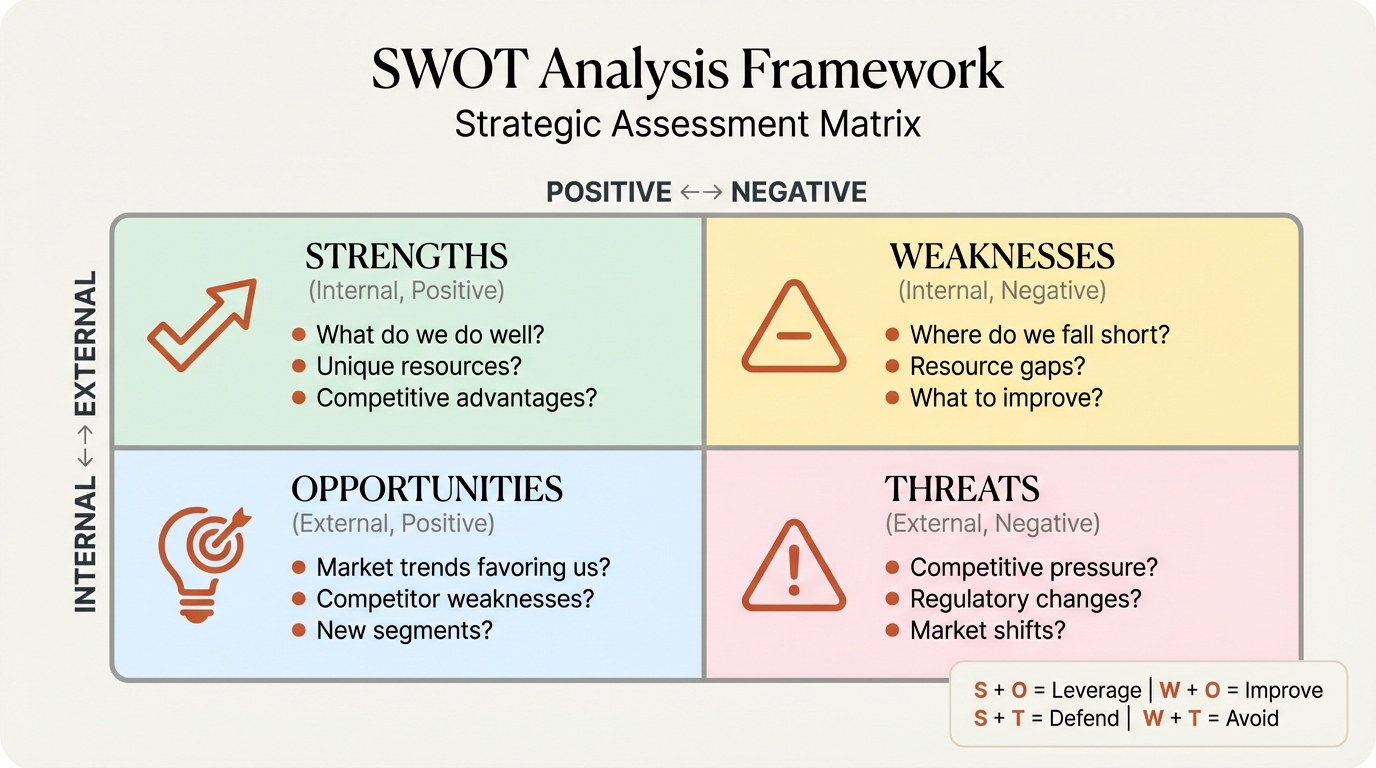
What Is a SWOT Analysis?#
SWOT stands for Strengths, Weaknesses, Opportunities, and Threats. It's a strategic planning framework that evaluates internal capabilities and external factors affecting an organization, product, or decision.
| Category | Type | Definition | Key Question |
|---|---|---|---|
| Strengths | Internal | Advantages you have over competitors | What do we do well? |
| Weaknesses | Internal | Areas where you underperform | Where do we fall short? |
| Opportunities | External | Favorable conditions you could exploit | What trends favor us? |
| Threats | External | Obstacles or risks from the environment | What could hurt us? |
The framework was developed in the 1960s at Stanford Research Institute as part of a project to understand why corporate planning failed. Albert Humphrey and his team interviewed Fortune 500 executives and distilled their planning processes into this simple 2x2 matrix.
Why the 2x2 Matrix Works#
The power of SWOT lies in its structure:
- Internal vs. External (rows): Forces you to distinguish between what you control and what you must respond to
- Positive vs. Negative (columns): Balances optimism with realism
This simple split creates clarity. Without structure, strategic discussions become unfocused brainstorming sessions. With SWOT, every insight has a home.
SWOT vs. Other Frameworks#
SWOT is often the starting point, not the endpoint. It works alongside other strategic tools:
| Framework | Purpose | Relationship to SWOT |
|---|---|---|
| PESTLE | Macro-environmental scanning | Feeds into Opportunities and Threats |
| Porter's Five Forces | Industry competitive analysis | Identifies external threats |
| Value Chain Analysis | Internal capability assessment | Identifies Strengths and Weaknesses |
| TOWS Matrix | Strategy development | Uses SWOT outputs to generate strategies |
The MECE framework also applies here: your SWOT categories should be mutually exclusive (no item fits in multiple quadrants) and collectively exhaustive (nothing important is missing).
When to Use SWOT Analysis#
SWOT works best in specific contexts. Knowing when to use it—and when not to—saves time and improves outcomes.
Ideal Use Cases#
Strategic planning kickoffs. SWOT creates a shared understanding of where an organization stands. It's often the first slide in a strategy deck, setting context before diving into recommendations.
Market entry decisions. Before entering a new market, SWOT captures internal readiness (do we have the capabilities?) and external attractiveness (are conditions favorable?).
Competitive assessments. Comparing your SWOT to competitors' SWOTs reveals gaps and opportunities. Where are you strong and they're weak?
M&A due diligence. Understanding a target company's strengths and weaknesses, plus the opportunities and threats of integration, is foundational to deal evaluation.
Product launches. Is the product ready? Is the market ready? SWOT answers both questions.
Annual business reviews. What changed since last year? SWOT provides a structured way to assess progress and emerging challenges.
When SWOT Falls Short#
Highly dynamic situations. SWOT captures a snapshot. If the environment changes weekly, the analysis becomes stale before you act on it.
Detailed operational issues. SWOT is strategic, not tactical. It won't tell you how to fix a specific process problem.
Quantitative decisions. SWOT is qualitative. For financial modeling or pricing decisions, you need numbers, not bullet points.
Standalone deliverable. SWOT identifies issues; it doesn't solve them. Always pair it with recommendations. That partner's question—"Now what do we actually do about it?"—is the point.
The Four Quadrants Explained#
Each quadrant requires different thinking. Here's how to approach them:
Strengths: Internal Advantages#
Strengths are positive internal factors—capabilities, resources, or attributes that give you an advantage.
Good strengths are:
- Specific: "98% customer retention rate" not "good customer relationships"
- Comparative: "20% lower cost structure than competitors"
- Verified: Based on data, not assumptions
Common strength categories:
- Brand and reputation
- Financial resources
- Technical capabilities
- Talent and expertise
- Customer relationships
- Operational efficiency
- Intellectual property
- Distribution networks
Questions to identify strengths:
- What do customers say we do better than competitors?
- What resources do we have that others lack?
- What processes give us an edge?
- What's our unfair advantage?
Weaknesses: Internal Disadvantages#
Weaknesses are negative internal factors—gaps, limitations, or areas where you underperform.
Good weaknesses are:
- Honest: The real issues, not the safe ones
- Addressable: Within your power to improve (eventually)
- Prioritized: Focus on what matters most
Common weakness categories:
- Skill gaps
- Outdated technology
- Limited geographic presence
- High cost structure
- Weak brand awareness
- Customer service issues
- Bureaucratic processes
- Talent retention problems
Questions to identify weaknesses:
- Where do we lose to competitors?
- What do customers complain about?
- What internal processes frustrate employees?
- Where are we underinvesting?
Opportunities: External Positives#
Opportunities are favorable external conditions you could exploit—market trends, competitive gaps, or environmental changes.
Good opportunities are:
- External: Not things you already have, but things you could pursue
- Actionable: Realistic given your capabilities
- Timely: Available now or in the near future
Common opportunity categories:
- Market growth
- Emerging customer needs
- Competitor weaknesses
- Regulatory changes
- Technology shifts
- Partnership possibilities
- Geographic expansion
- Demographic trends
Questions to identify opportunities:
- What trends favor our business model?
- Where are competitors falling short?
- What new customer segments are emerging?
- What technological changes could we leverage?
Threats: External Negatives#
Threats are unfavorable external conditions—risks from the environment, competition, or trends.
Good threats are:
- External: Not internal weaknesses, but outside forces
- Specific: "Amazon entering our category" not "increased competition"
- Plausible: Realistic scenarios, not remote possibilities
Common threat categories:
- New competitors
- Substitute products
- Regulatory risk
- Economic downturn
- Supply chain disruption
- Technology obsolescence
- Talent competition
- Customer behavior shifts
Questions to identify threats:
- Who could disrupt our business model?
- What regulations could affect us?
- How could customer preferences change?
- What macroeconomic risks matter?
How to Conduct a SWOT Analysis#
A rigorous SWOT analysis follows a structured process. Here's the step-by-step approach we use at consulting firms.
Step 1: Define the Scope#
Before brainstorming, clarify what you're analyzing:
- Object: The whole company? A specific product? A business unit?
- Time horizon: Current state? Next 12 months? Five-year outlook?
- Purpose: Strategic planning? Competitive assessment? Decision support?
A SWOT for "entering the German market in 2026" is different from a SWOT for "our global business over the next five years."
Step 2: Gather Inputs#
SWOT quality depends on input quality. Sources include:
| Source | What It Provides | Watch Out For |
|---|---|---|
| Customer interviews | Perception of strengths/weaknesses | Recency bias, small samples |
| Employee surveys | Internal capability assessment | Politics, defensiveness |
| Competitive analysis | Relative positioning | Incomplete competitor data |
| Market research | Opportunity and threat identification | Outdated reports |
| Financial data | Objective performance metrics | Lagging indicators |
| Industry experts | Forward-looking insights | Bias toward familiar patterns |
Pro tip: Triangulate sources. If customers, employees, and data all point to the same weakness, it's real. If only one source mentions it, dig deeper.
Step 3: Brainstorm Broadly#
Gather a cross-functional team—diverse perspectives catch blind spots. Use these prompts:
For Strengths: "What would competitors say we do well? What do customers choose us for?"
For Weaknesses: "Where do we struggle? What keeps leadership up at night?"
For Opportunities: "What's changing in the market that could help us? Where are competitors vulnerable?"
For Threats: "What's changing that could hurt us? What risks aren't we addressing?"
Generate 15-20 items per quadrant initially. Quantity enables quality—you'll filter later.
Step 4: Filter and Prioritize#
Not all SWOT items are equal. Evaluate each on:
- Impact: How much does this matter to strategic outcomes?
- Likelihood (for O/T): How probable is this opportunity or threat?
- Evidence: How confident are we in this assessment?
Reduce each quadrant to 3-5 priority items. More than five dilutes focus; fewer than three seems incomplete.
Step 5: Validate and Challenge#
Before finalizing, stress-test your SWOT:
- Is it MECE? No item should fit in multiple quadrants. "Strong brand" is a strength; "brand could be damaged by PR crisis" is a threat—different quadrants.
- Is it specific? "Good team" is too vague. "Deep expertise in AI/ML with 15 PhDs on staff" is specific.
- Is it actionable? Each item should connect to potential strategic moves.
- Is it honest? Political SWOTs that only include safe answers waste everyone's time.
Step 6: Connect to Strategy#
This is where most SWOTs fail. The analysis identifies issues; now you need to act.
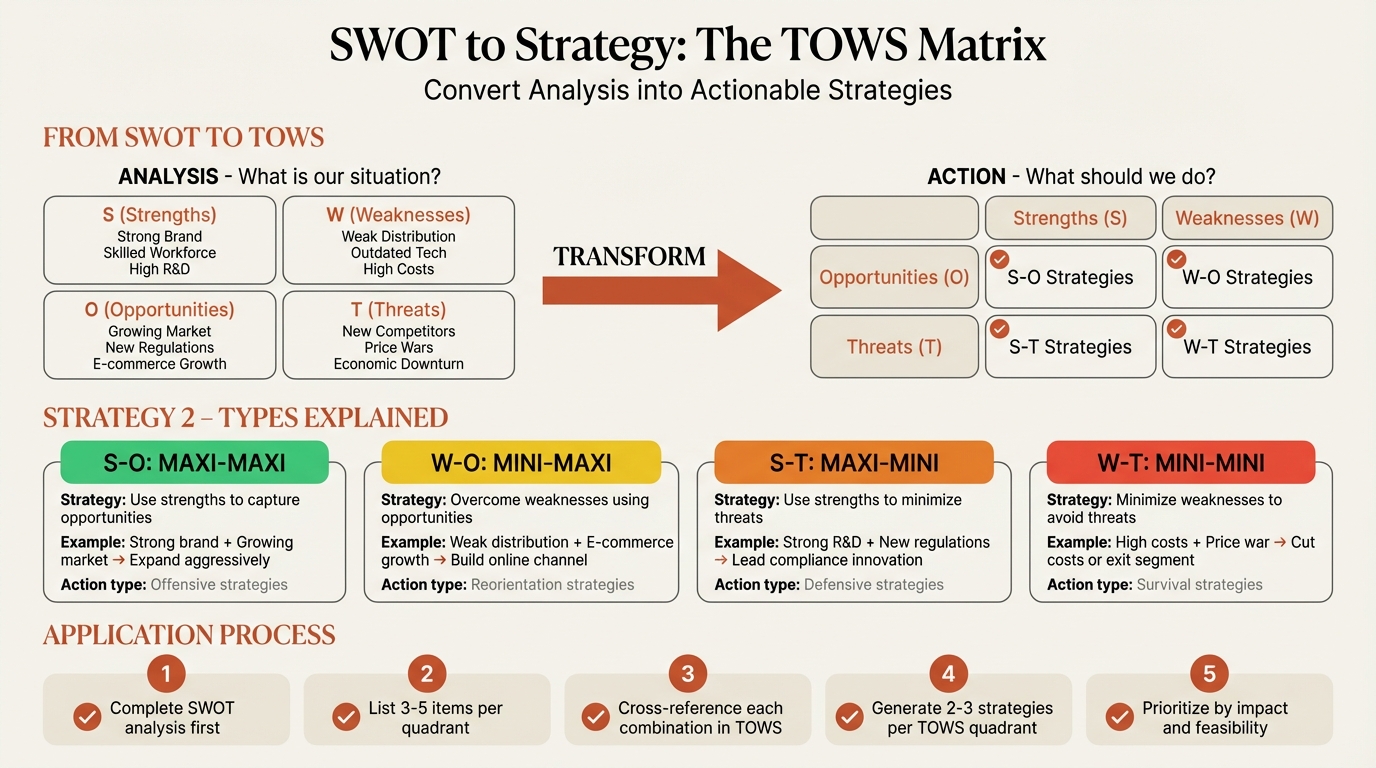
Use the TOWS matrix to generate strategic options:
| Strengths | Weaknesses | |
|---|---|---|
| Opportunities | S-O: Use strengths to capture opportunities | W-O: Address weaknesses to capture opportunities |
| Threats | S-T: Use strengths to defend against threats | W-T: Minimize weaknesses to avoid threats |
Each cell generates strategic questions:
- S-O: "How can we leverage our strong brand to capture the growing millennial segment?"
- W-O: "What capability gaps prevent us from serving enterprise customers?"
- S-T: "Can our cost advantage help us survive a price war?"
- W-T: "How do we address our weak digital presence before online competitors enter?"
Continue reading: Bullet Charts in PowerPoint · Deloitte Presentation Template · Traction Slide
Create slides 2x faster with Deckary
Charts, keyboard shortcuts, icons, templates and more. The only PowerPoint add-in you need.
SWOT Analysis Best Practices#
After building dozens of SWOT analyses across industries, patterns emerge. These practices separate good SWOTs from great ones.
Keep It Focused#
3-5 items per quadrant. A SWOT with 15 strengths isn't more thorough—it's unfocused. If everything is a strength, nothing is. Prioritization is the work.
One slide, one message. The SWOT matrix itself should fit on a single slide. Supporting detail can live in backup slides, but the summary should be scannable.
Be Specific and Evidence-Based#
| Weak | Strong |
|---|---|
| "Good customer relationships" | "NPS of 72 vs. industry average of 45" |
| "Strong brand" | "Ranked #1 in brand awareness in our category (Kantar 2025)" |
| "Experienced team" | "Average tenure of 8 years; 40% of staff have industry certifications" |
| "Market is growing" | "Category CAGR of 12% through 2028 (Gartner)" |
Specificity builds credibility. When executives see vague SWOTs, they discount the analysis.
Balance Optimism and Realism#
SWOTs often skew positive—more strengths and opportunities than weaknesses and threats. This is political, not analytical.
A balanced SWOT acknowledges hard truths. If the competitive analysis shows you're losing market share, the weaknesses section should reflect that.
Test: Would a smart competitor agree with your self-assessment? If your SWOT paints an unrealistically rosy picture, it's not useful.
Connect Quadrants#
The best SWOTs show relationships between quadrants:
- A strength enables capturing an opportunity
- A weakness makes a threat more dangerous
- An opportunity could address a weakness
- A threat could neutralize a strength
These connections drive strategic thinking. "We have a strong brand (S) but weak digital presence (W). The shift to online purchasing (O for digital-native competitors, T for us) means our brand strength may erode if we don't invest in e-commerce."
Update Regularly#
SWOT is a snapshot. Markets change, competitors move, capabilities evolve.
Review cadence:
- Annual: Full SWOT refresh
- Quarterly: Quick scan for material changes
- Event-driven: Major competitive moves, regulatory changes, or M&A require immediate updates
Common SWOT Mistakes to Avoid#
These errors appear repeatedly. Avoid them, and your SWOT will outperform 90% of what we see.
Mistake 1: Confusing Internal and External#
Wrong: Listing "market growth" as a strength (it's an opportunity—external)
Wrong: Listing "need to improve customer service" as a threat (it's a weakness—internal)
Fix: Apply the control test. If you can directly change it through internal decisions, it's internal (S or W). If it's happening in the environment regardless of what you do, it's external (O or T).
Mistake 2: Being Too Vague#
Wrong: "Strong team" / "Good technology" / "Market opportunities"
Right: "Engineering team with 5 patents in battery technology" / "Proprietary ML model with 15% better accuracy than alternatives" / "EV adoption in Europe growing 25% annually"
Vague SWOTs are useless. Anyone could write them without doing any analysis.
Mistake 3: List Dumping#
A SWOT with 20 items per quadrant isn't thorough—it's lazy. The work is prioritization.
Fix: Force rank items. What are the top 3 strengths that actually differentiate us? What are the 3 weaknesses that most limit our success? Cutting is harder than listing.
Mistake 4: Ignoring Competitive Context#
Strengths and weaknesses are relative. You're not strong or weak in absolute terms—you're stronger or weaker than competitors.
Fix: Frame items comparatively. "20% lower manufacturing costs than industry average." "Brand awareness 30 points below market leader." This context makes findings actionable.
Mistake 5: Stopping at the Matrix#
The SWOT matrix is a diagnostic tool, not a strategy. Identifying that you have "weak digital capabilities" doesn't tell you what to do about it.
Fix: Every SWOT should lead to "so what?" recommendations. Build, buy, partner? Invest, divest, maintain? Connect analysis to action.
Mistake 6: Political Editing#
SWOTs often get sanitized before reaching executives. Hard truths get softened. Uncomfortable weaknesses disappear.
Fix: Present the honest assessment. Executives respect candor. A SWOT that only contains good news isn't credible.
SWOT Templates and Formats#
Different contexts call for different SWOT formats. Here's what works for various situations.
Classic 2x2 Matrix#
The standard format: four quadrants in a grid. Works for most situations.
Best for: Presentations to executives, strategic planning documents, competitive comparisons
Format:
- Equal-sized quadrants
- 3-5 bullet points per quadrant
- Consistent color coding (typically: green for S, yellow for W, blue for O, red for T)
- Clear labels
Weighted SWOT#
Adds prioritization by scoring each item on impact and likelihood.
Best for: Detailed strategic analysis, resource allocation decisions
Format:
- Standard 2x2 matrix
- Each item scored (e.g., 1-5 scale)
- Items ranked within quadrant
- Total score per quadrant enables quadrant-level comparison
SWOT with Action Items#
Extends the matrix to include strategic implications.
Best for: Planning sessions, strategy development workshops
Format:
- Standard 2x2 matrix
- Additional column/row for "Implications" or "Actions"
- Connects each SWOT item to potential strategic moves
Comparison SWOT#
Side-by-side SWOTs for multiple options or competitors.
Best for: M&A evaluation, market entry decisions, competitive analysis
Format:
- Multiple 2x2 matrices aligned horizontally
- Enables direct comparison across options
- Highlights relative strengths and gaps
SWOT Presentation Template Comparison#
| Template Type | Slides | Best For | Complexity |
|---|---|---|---|
| Single matrix | 1 | Executive summary | Low |
| Quadrant breakdown | 5 | Detailed presentations | Medium |
| SWOT + TOWS | 3-4 | Strategy development | Medium-High |
| Comparative SWOT | 2-3 | Competitive analysis | Medium |
| Weighted SWOT | 2-4 | Prioritization exercises | High |
Creating SWOT in PowerPoint#
Now for the practical part: how to actually build SWOT slides in PowerPoint.
Option 1: Native PowerPoint Shapes#
The manual approach. Full control, more effort.
Steps:
- Insert > Shapes > Rectangle
- Create four equal rectangles arranged in a 2x2 grid
- Color-code each quadrant
- Add text boxes for labels and bullet points
- Align using PowerPoint's alignment tools
Pros: Complete control over design, no dependencies
Cons: Time-consuming, alignment fiddly, updates require manual work
Time estimate: 20-30 minutes for a polished SWOT matrix
Option 2: SmartArt Graphics#
PowerPoint's built-in diagrams include matrix options.
Steps:
- Insert > SmartArt
- Choose Matrix category
- Select a 2x2 layout (Basic Matrix or Grid Matrix)
- Customize colors and text
Pros: Quick to create, easy to update, consistent formatting
Cons: Limited customization, can look generic, not all layouts work well for SWOT
Time estimate: 5-10 minutes
Option 3: PowerPoint Add-ins#
Tools like Deckary, think-cell, and Mekko Graphics include SWOT templates or matrix builders.
Add-ins like Deckary include pre-built templates designed for consulting presentations. These maintain consistent formatting and make updates faster.
Pros: Professional designs, consistent with consulting standards, faster iteration
Cons: Requires subscription, learning curve
Time estimate: 5 minutes with templates
Formatting Best Practices#
Regardless of method, these formatting rules apply:
Colors:
- Strengths: Green (positive, internal)
- Weaknesses: Yellow or orange (caution, internal)
- Opportunities: Blue (external, positive direction)
- Threats: Red (external, negative)
Alternative: Use brand colors for a more corporate look, with intensity indicating positive/negative.
Typography:
- Quadrant labels: Bold, 14-16pt
- Bullet points: 10-12pt
- Keep text concise—SWOT isn't the place for paragraphs
Layout:
- Equal-sized quadrants (the classic approach)
- Or proportionally sized to emphasize certain quadrants
- Leave white space—don't cram 15 bullets into each box
Alignment: Following consulting slide standards, ensure:
- Quadrants are perfectly aligned
- Margins are consistent
- Text alignment is uniform across all quadrants
For faster formatting, PowerPoint alignment shortcuts help maintain consistency.
Real-World SWOT Examples#
Theory matters, but examples clarify. Here are three SWOT analyses from real consulting contexts (details anonymized).
Example 1: Regional Retailer Considering E-commerce#
Context: A 50-store regional retailer was evaluating a major e-commerce investment.
| Strengths | Weaknesses |
|---|---|
| Strong local brand recognition (85% unaided awareness in-region) | No existing e-commerce platform |
| Loyal customer base (65% repeat purchase rate) | Limited digital marketing expertise |
| Established supplier relationships with negotiated terms | Legacy inventory systems not integration-ready |
| 50 locations usable for buy-online-pickup-in-store | Higher cost structure than pure-play competitors |
| Opportunities | Threats |
|---|---|
| Regional e-commerce penetration growing 18% YoY | Amazon expanding same-day delivery in market |
| Competitors slow to adopt omnichannel | National chains investing heavily in digital |
| Demographic shift toward online shopping accelerating | Customer expectations for delivery speed rising |
| Potential for delivery partnerships with gig platforms | Economic uncertainty may delay large capital investments |
Strategic implication: The SWOT revealed that store locations (a strength) could offset e-commerce inexperience (a weakness) through buy-online-pickup-in-store. The strategy focused on omnichannel rather than pure e-commerce, playing to existing strengths.
Example 2: B2B Software Company Entering New Segment#
Context: A B2B software company serving mid-market clients was considering moving upmarket to enterprise.
| Strengths | Weaknesses |
|---|---|
| Product rated #1 in G2 for mid-market | No enterprise-grade security certifications (SOC 2 Type II in progress) |
| 94% customer satisfaction score | Sales team lacks enterprise selling experience |
| Modern architecture enables rapid feature development | No customer references above $500M revenue |
| Strong engineering talent (40% from FAANG) | Support model not designed for enterprise SLAs |
| Opportunities | Threats |
|---|---|
| Enterprise buyers increasingly open to best-of-breed vs. suite | Incumbent vendors have deep enterprise relationships |
| Dissatisfaction with legacy enterprise solutions (40% considering switch) | Enterprise sales cycles 2-3x longer than mid-market |
| Growing enterprise demand for modern UX | Price sensitivity lower but procurement complexity higher |
| Partner ecosystem could accelerate enterprise reach | Reputational risk if early enterprise deals fail publicly |
Strategic implication: The SWOT showed capability gaps (weakness) that needed addressing before the opportunity could be captured. The strategy phased the move: first achieve certifications and build reference customers in "enterprise-adjacent" accounts, then target true enterprise.
Example 3: Manufacturing Company Facing Digital Disruption#
Context: A traditional manufacturing company was assessing the threat from Industry 4.0 and IoT-enabled competitors.
| Strengths | Weaknesses |
|---|---|
| 80-year brand heritage and customer trust | Limited internal digital expertise |
| Extensive installed base (15,000 machines in field) | Legacy products not IoT-enabled |
| Strong service network in 40 countries | R&D focused on mechanical, not software |
| Customer relationships with plant managers and operators | Organizational culture resistant to change |
| Opportunities | Threats |
|---|---|
| Retrofitting installed base with IoT sensors | New entrants offering smart machines at lower prices |
| Recurring revenue from data analytics services | Customers expecting predictive maintenance as standard |
| Partnering with tech companies for digital capabilities | Talent competition from tech sector |
| Customer willingness to pay for uptime guarantees | Commoditization of traditional product categories |
Strategic implication: The installed base (a strength) became the cornerstone of the digital strategy. Rather than competing on new smart machines, the company focused on retrofitting existing customers with IoT capabilities—a S-O strategy that leveraged existing advantages.
Summary#
SWOT analysis remains one of the most widely used strategic frameworks because it works. The 2x2 matrix forces structured thinking about internal capabilities and external conditions.
Key principles:
- Internal vs. External — Strengths and weaknesses are what you control; opportunities and threats are what you respond to
- Specific and evidence-based — "NPS of 72" beats "good customer relationships"
- Prioritized — 3-5 items per quadrant, not a comprehensive list
- Actionable — Always connect SWOT to "so what?" recommendations
- Honest — Political SWOTs that hide hard truths waste everyone's time
PowerPoint execution:
- Use consistent color coding (green, yellow, blue, red)
- Keep text concise—bullets, not paragraphs
- Ensure perfect alignment and equal sizing
- Consider add-ins like Deckary for professional templates
SWOT is a starting point, not an endpoint. The framework identifies issues; strategy addresses them. As that McKinsey partner reminded me years ago: the matrix is the beginning of the conversation, not the end.
Build the SWOT. Then answer "now what?"
Ready to build professional strategy slides faster? Deckary includes consulting-grade templates for SWOT matrices, strategic frameworks, and more. Start your free 14-day trial—no credit card required.
Related Articles
The only PowerPoint add-in you need
20+ shortcuts, Think-Cell style charts, 1,000+ icons and templates. Free 14-day trial for Mac & Windows.
Try Deckary Free