Storytelling in Presentations: Techniques That Keep Audiences Engaged
Storytelling in presentations uses narrative structure to turn information into persuasive, memorable communication. Learn proven techniques backed by neuroscience research.
Presentations fail most often not because the information is wrong, but because the audience never connects with it. A 40-slide deck packed with insights still loses the room when those insights are presented as disconnected facts. Storytelling in presentations solves this problem by structuring information the way human brains are wired to process it.
After reviewing narrative structure across 180+ board presentations, investor pitches, and client engagements, we found that presentations built around story arcs consistently outperform those organized by topic. Audiences stay engaged longer, ask better questions, and act on recommendations more frequently. The technique works because it respects how people make decisions — through narrative, not bullet points.
This guide covers why storytelling works in presentations, the narrative structures that drive business outcomes, specific techniques for building story arcs, and the mistakes that undermine otherwise strong content.
Why Storytelling Works in Presentations
Storytelling is not a stylistic preference. It is a neurobiological advantage. When audiences hear structured narratives, their brains process information differently than when receiving disconnected data points.
Stanford professor Chip Heath conducted a study where students gave one-minute speeches on crime statistics. Most students presented data — averaging 2.5 statistics per speech. Only 10% told stories. When Heath tested audience recall, 63% remembered the stories while only 5% could recall any individual statistic.
Research from Claremont Graduate University neuroscientist Paul Zak explains why. Character-driven stories trigger oxytocin release in the brain, a neurochemical associated with trust and empathy. When participants received synthetic oxytocin in controlled studies, they donated to 57% more charities and gave 56% more money than those given a placebo. Stories literally change behavior.
Princeton neuroscience research found that during effective storytelling, listeners' brain activity mirrors the speaker's — a phenomenon called neural coupling. Audiences do not just hear the story, they experience it. This neural synchronization makes stories vastly more persuasive than static information delivery.
The practical implication: a presentation structured as a narrative will drive more decisions than one organized as a list of findings, even when both contain identical information.
The Story Arc Framework for Presentations
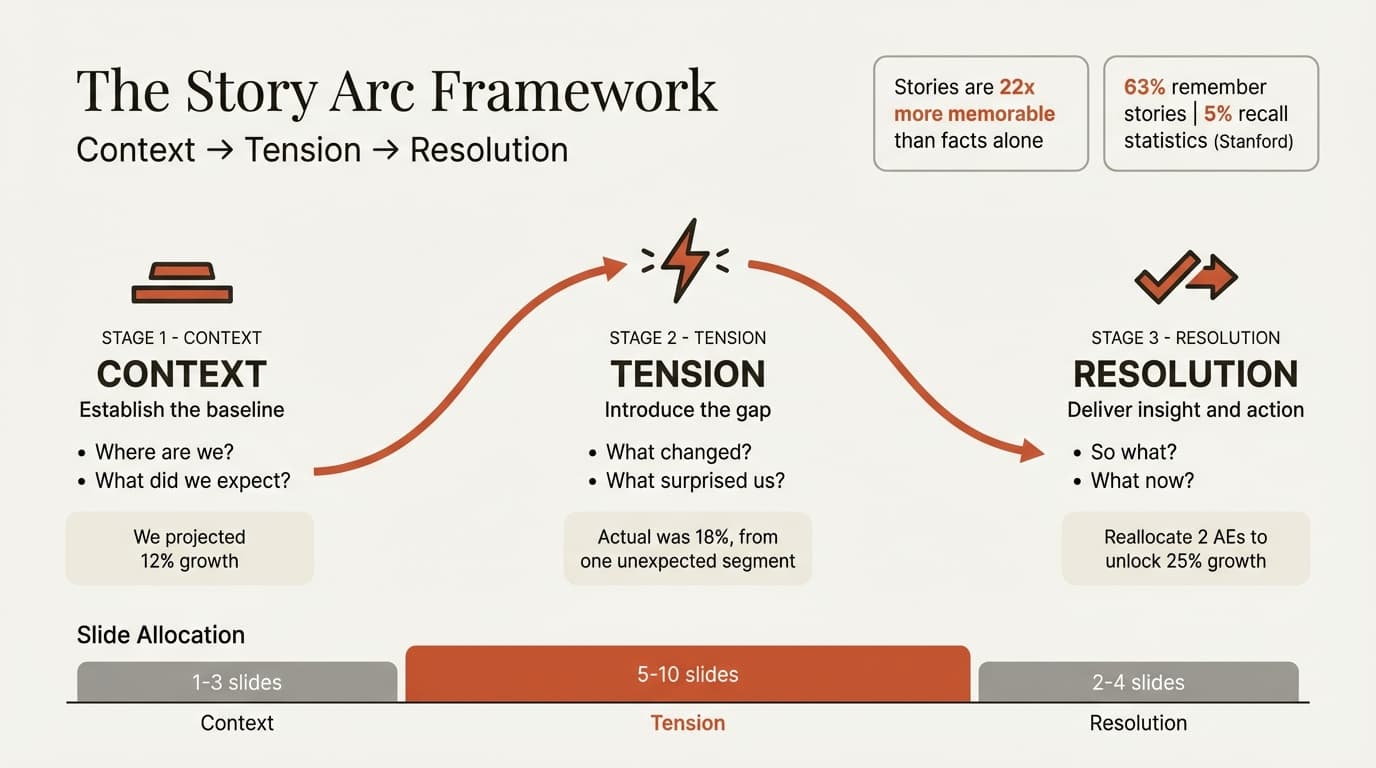
Every effective business presentation follows a narrative arc. The most reliable structure for professional contexts is context-tension-resolution.
Context: Establish the Baseline
Context answers "where are we?" and "what did we expect?" This is the status quo, the benchmark, or the shared assumption your audience holds. Without context, the rest of your presentation has no anchor.
A financial review that opens with "revenue was $4.2M" communicates nothing until the audience knows the target was $3.8M and last quarter was $3.5M. Context provides the frame that makes data meaningful.
How to apply it: Lead with what the audience already believes or knows. Use one to two slides maximum. The goal is alignment, not education.
Tension: Introduce the Gap
Tension is the narrative engine. This is where something changed, broke, exceeded expectations, or revealed a pattern that challenges assumptions. Tension creates the reason to keep listening.
In business presentations, tension typically appears as:
- Performance gaps — "We hit our revenue target but churn doubled"
- Market shifts — "The competitor we dismissed just raised $50M"
- Unexpected findings — "Customer interviews revealed the opposite of what surveys predicted"
- Strategic dilemmas — "We can enter this market fast or right, not both"
A presentation without tension has no story. "Everything is on track" may be true, but it is not engaging. Research on unstructured information shows it increases cognitive load and reduces comprehension by up to 40%. Tension provides the structure that guides attention.
How to apply it: Devote the majority of your slides to establishing and exploring the tension. Show the data, the implications, and why it matters. This is where your analysis lives.
Resolution: Deliver the Insight and Action
Resolution answers "so what?" and "what now?" This is your recommendation, the decision you need, or the strategic implication of your findings. Without resolution, the story has no payoff.
The best resolutions feel earned. When context and tension are well established, the recommendation becomes almost inevitable. The audience arrives at the conclusion alongside you rather than being told what to think.
How to apply it: State your recommendation clearly on one slide. Follow with specific next steps: what action is needed, who owns it, when it happens. For guidance on structuring closing slides, see our guide on presentation tips.
| Arc Component | Purpose | Slide Allocation | Example |
|---|---|---|---|
| Context | Set expectations | 1-3 slides | "We projected 12% growth based on Q1-Q3 trends" |
| Tension | Show the gap | 5-10 slides | "Actual growth was 18%, but entirely from one unexpected segment" |
| Resolution | Drive action | 2-4 slides | "Reallocating two AEs to that segment could unlock 25% growth" |
Storytelling Techniques That Work in Business Presentations
Beyond the arc structure, specific narrative techniques make presentations more engaging and persuasive.
Use Character-Driven Narratives
Abstract analysis rarely persuades. Character-driven narratives do. This means grounding insights in specific people or organizations facing real decisions.
Weak approach: "Market research indicates demand for this product category." Strong approach: "Three enterprise buyers we interviewed said they would switch vendors immediately if this capability existed. The largest spends $2M annually on the current workaround."
Harvard Business Review research on neurobiology and storytelling found that "character-driven stories with emotional content result in better understanding of key points." The characters in business presentations are customers, competitors, internal teams, or the organization itself.
Start with the End in Mind
Traditional presentations build to a conclusion. Storytelling presentations state the conclusion first, then use the narrative to prove it. This is the Pyramid Principle applied to story arcs.
Board members and executives decide whether to engage within the first 60 seconds. If you make them wait 20 minutes to learn what you recommend, you have lost attention before delivering the answer. Lead with your resolution, then walk through context and tension as supporting evidence.
Example structure:
- Slide 1: "We recommend entering the Southeast Asian market via direct-to-consumer rather than retail partnerships"
- Slides 2-4 (context): Market size, competitive landscape, regulatory environment
- Slides 5-12 (tension): Why traditional retail is blocked, what changed, customer insights
- Slides 13-15 (resolution): Unit economics, go-to-market plan, next steps
This inversion respects audience time and allows them to engage critically with your logic rather than waiting passively for the reveal.
Use Contrast to Create Tension
Effective storytelling relies on contrast. "Before and after" structures, "expected versus actual" comparisons, and "option A versus option B" frameworks all create narrative energy by highlighting gaps.
| Contrast Type | When to Use | Example |
|---|---|---|
| Before/After | Demonstrating impact | "Customer onboarding took 45 minutes; now it takes 8" |
| Expected/Actual | Revealing surprises | "We expected enterprise growth; SMB drove 80% of revenue" |
| Current/Proposed | Arguing for change | "Current CAC is $180; this approach gets us to under $100" |
| Option A/Option B | Decision frameworks | "Fast launch with moderate risk versus delayed launch with validation" |
Contrast provides the tension that makes stories compelling. For visual techniques that emphasize contrast, see our guide on PowerPoint design tips.
Incorporate Specific Details
Specific details make narratives credible and memorable.
Generic: "A consulting client struggled with productivity issues." Specific: "A mid-market SaaS company with 85 employees discovered their sales team spent 14 hours per week on manual data entry — the equivalent of two full-time roles."
Specificity builds trust.
Show, Don't Tell
The narrative principle "show, don't tell" applies directly to business presentations. Rather than stating conclusions, use visuals and data to guide audiences toward those conclusions themselves.
Telling: "Our product adoption is strong." Showing: A chart displaying 78% of accounts activating a key feature within 30 days, with annotations highlighting the inflection point after the onboarding redesign.
Showing requires more preparation but produces stronger conviction. When audiences draw conclusions from evidence you present, they own those conclusions. For techniques on presenting data visually, see our PowerPoint charts guide.
Build Anticipation with Questions
Questions create forward momentum in narratives. They signal upcoming insights and engage audiences actively.
Examples:
- "Why did enterprise growth stall while SMB accelerated?"
- "What changed in Q3 that unlocked this segment?"
- "If we had to choose one market to enter this year, which delivers the fastest payback?"
Continue reading: Presentation Outline Template · Bar Charts in PowerPoint · Investment Banking Pitch Book
Create an editable presentation in your browser
Turn a prompt or source files into slides you can edit and export to PowerPoint. 10 free AI prompts. No credit card required.
Common Storytelling Mistakes in Presentations
Even experienced presenters fall into narrative traps that undermine otherwise strong content.
Leading with Background Instead of Story
The most common mistake is front-loading presentations with methodology, company background, or market context before establishing why the audience should care. This violates the core principle of storytelling: hook first, context second.
Weak opening: "Today I will walk you through our three-month analysis of market trends, starting with a review of our research methodology." Strong opening: "We found that 40% of our target customers are actively looking for a solution that does not exist yet. Here is how we discovered that and what it means for our roadmap."
Burying the Tension
Presentations that delay introducing the problem, gap, or insight until slide 15 lose audiences before the story begins. Tension should appear early — ideally by slide 3.
No Resolution or Weak Call to Action
A story without resolution is not a story. It is a data dump. Every business presentation must end with a clear recommendation and specific next steps. "Any questions?" is not a resolution.
Audiences need to know what happens next: what decision is required, who owns it, when it happens. For structuring effective closings, see our guide on how to make a good presentation.
Confusing Story with Anecdote
Storytelling is not about opening with a personal anecdote. A formulaic "when I was at McKinsey" story does not create a narrative arc.
Effective storytelling means structuring the entire presentation as a narrative — using context, tension, and resolution to guide the audience through your logic.
Overloading with Data, Underdelivering on Meaning
Including every supporting data point kills narrative flow. Three strong pieces of evidence are more persuasive than twelve mediocre ones.
Choose which data advances the narrative and cut the rest. Ruthless editing separates effective storytelling from information overload.
Applying Storytelling Across Presentation Contexts
Board Presentations
Board members value strategic clarity and speed. Use abbreviated arcs: one slide for context, two to three slides for tension, one slide for resolution with explicit next steps. Lead with your recommendation.
Investor Pitches
Investor pitches are pure storytelling. The narrative arc typically follows: market opportunity (context), why existing solutions fail (tension), your differentiated approach (resolution). For specifics on pitch structure, see our guide on pitch deck templates.
Tools That Support Narrative-Driven Presentations
Strong storytelling fails when execution drags. Add-ins like Deckary reduce production friction so you can focus on story structure. The AI slide builder generates consulting-grade slides from text descriptions, allowing you to draft narrative arcs in minutes rather than hours.
When building waterfall charts, Mekko diagrams, or timeline visuals that support your narrative, tools that automate formatting keep the focus on the story.
Putting Storytelling Into Practice
Storytelling in presentations is not about performance or charisma. It is about structure.
Start with these three:
- Structure every presentation using context-tension-resolution. This arc works across industries, audiences, and formats.
- Lead with your conclusion. State the resolution first, then prove it with context and tension.
- Use character-driven narratives. Ground insights in specific people, companies, or scenarios.
Build anticipation with questions, use contrast to create tension, show rather than tell, and end with clear next steps. Deckary's AI Slide Builder generates narrative-ready slides in seconds, complete with structured layouts and consulting-grade charts — less time formatting, more time refining the story that drives decisions.
Sources
- Stanford Women's Leadership — Harnessing the Power of Stories (Chip Heath study)
- Why Inspiring Stories Make Us React: The Neuroscience of Narrative — Paul J. Zak, Claremont Graduate University (2015)
- The Neuroscience of Storytelling: How Leaders Can Build Lasting Connections — DISRUPTS (Princeton research)
- Learn to Structure Presentations Using a Narrative Arc — Texas Wesleyan University
Key Takeaways
- Stories are 22 times more memorable than facts alone. Stanford research shows 63% of audiences remember stories while only 5% recall statistics. Storytelling triggers oxytocin release, building trust and empathy.
- Use the context-tension-resolution arc. Establish the baseline, introduce the gap or challenge, then deliver your insight and recommendation. This structure keeps audiences engaged and makes conclusions feel earned.
- Lead with your resolution. State your recommendation on slide one, then use the rest of the deck to prove it. Executives decide whether to engage within 60 seconds.
- Character-driven narratives outperform abstract analysis. Ground insights in specific customers, competitors, or scenarios. Details build credibility and make stories tangible.
- Tension is the narrative engine. Presentations without gaps, surprises, or strategic dilemmas have no story. Show the change, the problem, or the unexpected finding early.
- Contrast creates engagement. Before/after, expected/actual, and option A/option B frameworks generate narrative energy by highlighting differences.
- Show, don't tell. Use visuals and data to guide audiences toward conclusions rather than stating them outright. When audiences draw conclusions from evidence, they own them.
- End with clear next steps. Every presentation needs explicit actions, owners, and deadlines. "Any questions?" is not a resolution.
- Cut ruthlessly. Three strong pieces of evidence beat twelve mediocre ones. Storytelling requires selectivity — include only data that advances the narrative.
Storytelling in presentations is not decoration. It is the difference between information that gets filed and information that changes decisions. Structure your presentations as narratives, and audiences will stay engaged, remember your message, and act on your recommendations.
Create an editable presentation in your browser
Turn a prompt or source files into slides you can edit and export to PowerPoint. 10 free AI prompts. No credit card required.