How to Give a Presentation: 8 Delivery Techniques for Confident Speakers
Master presentation delivery with 8 proven techniques covering voice control, body language, eye contact, and audience engagement. Deliver with confidence and impact.
The slides are finished. The data is solid. The message is clear. Then you stand in front of the room and everything changes. Your voice sounds different. Your hands do not know where to go. The audience stares, waiting, and the opening you rehearsed three times feels suddenly foreign.
After delivering presentations across 200+ client engagements, board meetings, and strategy reviews, we have found that presentation delivery is a separate skill from presentation design. A well-structured deck does not present itself. The gap between a strong slide deck and a strong presentation is the speaker's ability to control voice, body language, eye contact, and pacing.
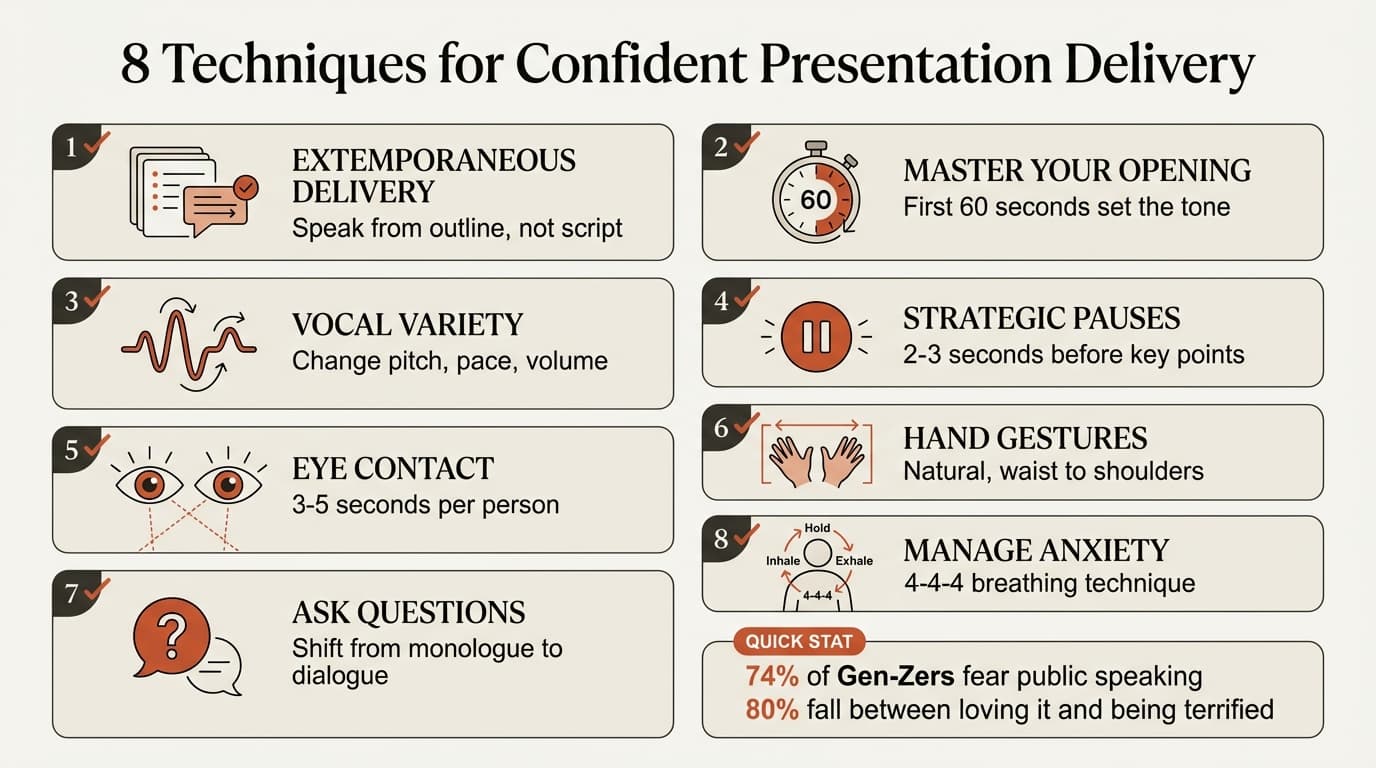
This guide covers eight research-backed delivery techniques that turn nervous presenters into confident speakers. Whether you are presenting to executives, clients, investors, or internal teams, these techniques make your delivery natural, engaging, and persuasive.
What Makes Effective Presentation Delivery
Effective presentation delivery combines preparation, technique, and adaptability. Research shows that 10 percent of people love speaking in front of audiences, 10 percent are terrified, and 80 percent fall somewhere in the middle. The difference between effective and ineffective delivery is the ability to channel nervous energy into controlled, purposeful delivery.
Three elements define effective delivery:
Voice control. Speakers who use vocal variety—changing pitch, pace, and volume—are rated more persuasive than those who speak in a monotone. Strategic pauses before and after key points signal importance and allow ideas to land.
Physical presence. Research from Harvard DCE shows that maintaining eye contact keeps the focus on the speaker and message, while appropriate gestures give personality to the speech.
Audience engagement. Effective presenters treat presentations as conversations rather than monologues. They ask questions, respond to interruptions, and adapt based on audience reactions.
| Weak Delivery | Strong Delivery |
|---|---|
| Reads from slides verbatim | Speaks naturally using slides as visual anchors |
| Monotone voice with no pauses | Vocal variety with strategic pauses for emphasis |
| Avoids eye contact, looks at slides | Maintains eye contact with individuals in the audience |
| Rigid posture, no hand gestures | Natural movement and expressive gestures |
| Ignores questions as interruptions | Welcomes questions as engagement signals |
The techniques that follow address each of these elements with specific, actionable methods you can practice before your next presentation.
1. Use Extemporaneous Delivery, Not Memorization
Public speaking courses recommend extemporaneous delivery as the most effective method for business presentations. Extemporaneous delivery means speaking from an outline or notes rather than reading a script or reciting from memory.
There are four basic delivery methods:
| Method | Description | When to Use |
|---|---|---|
| Manuscript | Reading from a written script | Legal statements, policy announcements where every word matters |
| Memorized | Reciting from memory | Short ceremonial speeches, toasts |
| Extemporaneous | Speaking from an outline with preparation | Business presentations, client meetings, board reviews |
| Impromptu | Speaking with no preparation | Responding to unexpected questions, informal updates |
Memorization creates fragility. If someone interrupts with a question, your carefully memorized sequence breaks. Extemporaneous delivery gives you structure without rigidity—you know your opening, main points, and closing, but speak naturally rather than reciting.
How to prepare:
- Write out your opening and closing verbatim
- Create a one-page outline with main points and supporting evidence
- Practice the full presentation twice speaking from the outline
- Memorize your transitions between sections
2. Master Your Opening in the First 60 Seconds
Audiences form credibility judgments within the first 60 seconds. If you stumble through your introduction or take three minutes to get to your point, you lose them before delivering value.
Your opening should accomplish three things in under two minutes:
- State your main message. Give the audience your conclusion upfront.
- Explain why it matters. Connect the message to a decision they face or a problem they recognize.
- Preview your structure. Tell them what sections are coming so they know where you are headed.
Weak opening: "Good morning everyone. Thanks for being here. Today I want to talk about our Q3 performance. We have a lot to cover, so let's get started. First, some background on what we projected..."
This opening wastes 30 seconds on filler and still has not stated the message. The audience does not know what they are supposed to conclude.
Strong opening: "Q3 revenue exceeded forecast by 22%, but it came entirely from one customer segment we had deprioritized. Our core segment contracted by 8%. This presentation explains what happened, why the shift matters, and what we recommend doing next quarter. We will cover three sections: revenue breakdown by segment, the drivers behind each trend, and our reallocation plan."
The strong opening delivers the insight in 15 seconds, explains the stakes, and previews the structure. The audience knows immediately what they are evaluating.
How to nail your opening:
- Write it out verbatim. Do not improvise your first two minutes.
- Practice it three times before your presentation until it feels effortless.
- Start with your message, not pleasantries. Skip "Good morning" and "Thanks for being here" if time is limited.
The opening sets the tone for everything that follows. Get it right and the rest flows naturally. For more on structuring your presentation message, see our guide on how to make a good presentation.
3. Use Vocal Variety to Emphasize Key Points
Speakers who use a dynamic range of vocal pitches are rated as more engaging and competent than those who speak in a monotone. Vocal variety—changing your pitch, pace, and volume—signals which points matter most and keeps the audience engaged.
Three vocal techniques make your delivery more persuasive:
Vary Your Pitch
Pitch is how high or low your voice sounds. Speaking in a monotone makes even compelling content feel boring.
- Raise pitch slightly when introducing a new section or asking a question
- Lower pitch when making a definitive statement or closing a section
- Avoid upward inflection at the end of declarative statements
Adjust Your Pace
Nervous presenters rush. Confident presenters vary pace based on content complexity.
- Slow down for complex ideas or important recommendations
- Speed up slightly for transitions or background context
- Never rush through numbers—audiences need extra time to internalize data
Control Your Volume
Volume changes signal importance. A sudden shift captures attention.
- Speak louder when making your core recommendation
- Lower your volume when sharing a story—this creates intimacy
- Maintain consistent volume for supporting evidence
The biggest vocal mistake is speaking too quickly without variation. Practice your presentation with a timer. If your 15-minute presentation runs 11 minutes in rehearsal, you are rushing. Slow down by 20 percent and add pauses.
4. Pause Strategically Before and After Key Points
Research shows that speakers who use pauses are perceived as more persuasive than those who do not. Pauses signal importance and give the audience time to process what you just said.
Most presenters fear silence. They fill every gap with words and filler sounds like "um" and "uh." This constant verbal flow prevents ideas from landing.
Strategic pauses serve three purposes:
Before a key point. Pausing 2-3 seconds signals that something important is coming.
After a key point. Pausing 2-3 seconds allows the idea to land. The audience processes what you said and forms reactions.
During transitions. Pausing between sections signals a shift in topic.
How to practice pausing:
- Mark your outline or notes with the word "PAUSE" before and after each key point.
- During rehearsal, count to three silently before continuing.
- Record yourself presenting. If you hear "um," "uh," or "so," replace those fillers with silence.
Pausing feels unnatural at first. In rehearsal, it feels like an eternity. In delivery, it feels perfectly timed. Trust the pause—it makes your message more persuasive.
Continue reading: Brainstorming Template · Bar Charts in PowerPoint · Traction Slide
Create an editable presentation in your browser
Turn a prompt or source files into slides you can edit and export to PowerPoint. 10 free AI prompts. No credit card required.
5. Maintain Eye Contact with Individuals
By maintaining eye contact with the audience, you keep the focus on yourself and your message. Eye contact signals confidence, builds trust, and turns a monologue into a conversation.
Weak presenters stare at their slides, read from notes, or scan the room without landing on anyone. This creates distance between the speaker and the audience. It feels like a performance rather than communication.
Strong presenters make eye contact with individuals. They hold someone's gaze for 3-5 seconds, then shift to another person. This creates connection and keeps people engaged.
How to practice eye contact:
- Divide the room into zones. Mentally split the audience into three sections: left, center, right. Make sure you address all three zones evenly.
- Hold eye contact for complete thoughts. Pick one person and maintain eye contact while you finish a sentence or idea. Then shift to someone else.
- Avoid the "lighthouse scan." Do not sweep your eyes back and forth across the room. This looks nervous and connects with no one.
- If presenting virtually, look directly at your webcam when making key points. This simulates eye contact for remote audiences.
For small groups (under 10 people), make eye contact with every person at least once. For larger audiences (over 30 people), focus on individuals scattered throughout the room rather than trying to reach everyone.
Eye contact is one of the fastest ways to improve perceived confidence. Even if you feel nervous, sustained eye contact makes you appear composed.
6. Use Natural Hand Gestures and Movement
Appropriate body language and hand gestures give personality to your presentation. Research shows that expressive gestures help audiences retain information and make speakers appear more confident.
Most presenters fall into one of two traps: they either stand completely rigid with their hands at their sides, or they fidget constantly—shifting weight, touching their face, playing with a pen.
Natural movement and gestures fall between these extremes. Your hands should be spontaneously expressive, supporting your words without distracting from them.
Hand Gesture Guidelines
- Start with hands at waist level
- Use gestures to emphasize key points—when you say "three main drivers," hold up three fingers
- Avoid repetitive gestures—if you point on every slide, the gesture loses meaning
- Keep gestures within your "gesture box"—the space between your waist and shoulders, within arm's width
Movement Guidelines
- Stand in one spot when delivering key points
- Move during transitions—step to a different position when shifting topics
- Avoid pacing—walking back and forth divides the audience's attention
7. Ask Questions to Shift from Monologue to Dialogue
Research on audience engagement shows that incorporating questions—even rhetorical ones—significantly improves retention and engagement. Questions break the one-way flow and shift the audience from passive listening to active thinking.
Static presentations where the speaker talks for 30 minutes straight produce passive audiences. People mentally check out, scroll on phones, or think about the next meeting on their calendar.
Questions reset attention and create interaction. Even if the question is rhetorical and you do not expect an answer, it forces the audience to mentally engage.
Types of Questions That Work
Rhetorical questions. You ask but do not expect a verbal response. These work well in large group settings.
- "What would you prioritize if budget were unlimited?"
- "Has anyone here tried to build a waterfall chart manually in PowerPoint?"
- "Why did this happen three quarters in a row?"
Direct questions. You ask and pause for responses. These work best in small groups or interactive sessions.
- "Based on what you have seen so far, what would you recommend?"
- "Which of these three options feels most realistic?"
- "What concerns do you have about this approach?"
Polling questions. You ask for a show of hands or quick poll. These work in any group size and create immediate engagement.
- "How many of you have experienced this issue in the past quarter?"
- "Who prefers option A versus option B?"
How to use questions effectively:
- Plan 2-3 questions in advance. Mark them in your outline so you do not forget.
- Pause after asking. Give the audience 5-10 seconds to think before moving on or calling for responses.
- Welcome interruptions. If someone raises their hand or jumps in with a question, treat it as engagement rather than disruption.
Questions work because they make the audience co-creators of the conversation rather than passive recipients of information. For more on engaging audiences, see our guide on presentation tips.
8. Manage Presentation Anxiety with Preparation and Breathing
Seventy-four percent of Gen-Zers and 24 percent of college graduates express fear of public speaking. Presentation anxiety is common across experience levels. The goal is not to eliminate nerves—it is to channel that energy into focused, controlled delivery.
Research from a 2024 study of 1,745 university students found that gender, education level, and prior experience significantly predict public speaking anxiety. The most effective interventions focus on preparation and physiological control.
Preparation Reduces Anxiety
How to prepare:
- Practice the full presentation at least twice
- Rehearse your opening until it feels automatic—the first two minutes are the most nerve-wracking
- Arrive early to familiarize yourself with the room, test the projector, and run through your slides
Breathing Techniques Control Physiological Responses
Anxiety produces physical symptoms: racing heart, shallow breathing, shaky hands. Controlled breathing counters these responses by activating the parasympathetic nervous system.
The 4-4-4 breathing technique:
- Breathe in slowly for 4 counts.
- Hold your breath for 4 counts.
- Exhale slowly for 4 counts.
- Repeat three times before you begin presenting.
This technique lowers heart rate, steadies your voice, and reduces physical shakiness. Use it in the 60 seconds before you start speaking.
Reframe Nervousness as Energy
Anxiety and excitement produce the same physiological response. The difference is interpretation. Telling yourself "I am nervous" reinforces anxiety. Telling yourself "I am energized and ready" reframes the feeling as positive. For more on managing anxiety, see our full guide on presentation anxiety.
Common Delivery Mistakes to Avoid
Even experienced presenters fall into these traps. Recognizing them early improves delivery immediately.
Reading from Slides
If you are reading bullet points verbatim, the audience does not need you. Slides should support your spoken words, not replace them. Use slides as visual anchors while you provide the narrative.
Fix: Speak naturally and use slides to show charts, diagrams, and key phrases—not full paragraphs.
Speaking in a Monotone
Speaking in a single pitch and pace makes even compelling content feel boring. Vocal variety signals which points matter most.
Fix: Record yourself presenting. Listen for pitch variation and pauses. If it sounds flat, practice emphasizing key points by raising or lowering your pitch.
Fidgeting or Avoiding Eye Contact
Playing with a pen, shifting weight constantly, or staring at your slides signals nervousness and distracts the audience.
Fix: Practice presenting with your hands free. Film yourself to identify repetitive movements. Replace nervous gestures with purposeful hand gestures that support your message.
Rushing Through Content
Nervous presenters tend to rush, packing words together without breathing. This makes complex ideas harder to follow.
Fix: Slow down by 20 percent. Add pauses before and after key points. If your 15-minute presentation runs 11 minutes in rehearsal, you are going too fast.
Ignoring Questions as Interruptions
When someone interrupts with a question, it signals engagement. Dismissing questions with "I will get to that later" risks losing the audience's trust.
Fix: Answer questions directly, then return to your structure. If a question takes you off track, acknowledge it and offer to follow up in detail after the presentation.
No Rehearsal
Seventy-five percent of people who give presentations report fear of public speaking, yet many skip rehearsal entirely.
Fix: Rehearse the full presentation at least twice before delivery. Focus on your opening, transitions, and closing.
Putting Delivery Techniques Into Practice
Effective presentation delivery is not about charisma or natural stage presence. It is about mastering specific techniques that make your message land: voice control, strategic pauses, eye contact, natural gestures, audience engagement, and preparation.
Start with these three changes to immediately improve your next presentation:
- Practice your opening until it feels automatic. Write it out verbatim and rehearse it three times. The first 60 seconds set the tone for everything that follows.
- Add pauses before and after key points. Mark your outline with "PAUSE" and count to three silently. This makes your message more persuasive.
- Make eye contact with individuals. Hold someone's gaze for 3-5 seconds while finishing a thought, then shift to another person. This creates connection and confidence.
The rest follows from there. Use vocal variety to emphasize key points, ask questions to engage the audience, and manage anxiety through preparation and breathing.
For professionals building presentations regularly, the right tools reduce production friction so you can focus on delivery. Deckary's AI Slide Builder generates consulting-grade slides in seconds, complete with charts, icons, and structured layouts. The keyboard shortcuts and chart templates eliminate the manual formatting work that otherwise consumes hours. When slides are easier to build, you spend more time refining your message and practicing delivery.
Presentation delivery is a learnable skill. The techniques matter more than natural talent. Get the opening right, use vocal variety and pauses, make eye contact, and welcome questions. When delivery is controlled and purposeful, your message lands—regardless of the room, the stakes, or the audience.
Sources
- NovoResume — Public Speaking Statistics
- Harvard DCE — 10 Tips for Improving Your Public Speaking Skills
- Lumen Learning — Methods of Delivery
- FSCJ — Techniques for Effective Delivery
- Maricopa Open — Methods of Delivery
- PMC — Audience Engagement Research
- Springer Link — Public Speaking Anxiety Study (2024)
- Insivia — Presentation Skills Statistics
Key Takeaways
- Use extemporaneous delivery. Speak from an outline rather than reading a script. Memorize your opening and closing, but deliver the middle sections naturally. This balances preparation with adaptability.
- Master your opening in 60 seconds. State your main message upfront, explain why it matters, and preview your structure. Write your opening verbatim and practice it three times.
- Vocal variety signals importance. Change your pitch, pace, and volume to emphasize key points and keep the audience engaged. Monotone delivery makes even compelling content feel boring.
- Pause strategically. Research shows that speakers who pause before and after key points are perceived as more persuasive. Count to three silently—it feels long in rehearsal but perfectly timed in delivery.
- Maintain eye contact with individuals. Hold someone's gaze for 3-5 seconds while finishing a thought, then shift to another person. This creates connection and signals confidence.
- Use natural hand gestures. Let your hands be spontaneously expressive, supporting your words without distracting. Keep gestures within your "gesture box" between waist and shoulders.
- Ask questions to engage. Even rhetorical questions shift the audience from passive listening to active thinking. Plan 2-3 questions in advance and pause for responses.
- Manage anxiety with preparation and breathing. Practice your full presentation twice. Rehearse your opening until it feels automatic. Use 4-4-4 breathing before you start to control physiological responses.
- Avoid common mistakes. Do not read from slides, speak in a monotone, rush through content, or ignore questions. Rehearsal eliminates avoidable errors.
Presentation delivery is not talent—it is technique. Practice these eight methods and your delivery will improve immediately, regardless of experience level or natural speaking ability.
Create an editable presentation in your browser
Turn a prompt or source files into slides you can edit and export to PowerPoint. 10 free AI prompts. No credit card required.