Presentation Anxiety: Research-Based Strategies That Actually Work
Presentation anxiety affects 74% of people. Learn 11 research-backed techniques from cognitive behavioral therapy, neuroscience, and performance psychology.
Most advice on presentation anxiety treats the symptom, not the source. "Just breathe" and "imagine the audience naked" do nothing when your heart rate spikes to 130 beats per minute and your hands start shaking three slides into a board presentation.
After coaching presenters across 200+ high-stakes presentations — board meetings, investor pitches, client deliverables, and conference keynotes — we have found that effective anxiety management requires understanding the mechanism, not just generic calming techniques. The professionals who present confidently despite nerves use specific, research-backed strategies that address the cognitive and physiological components of anxiety simultaneously.
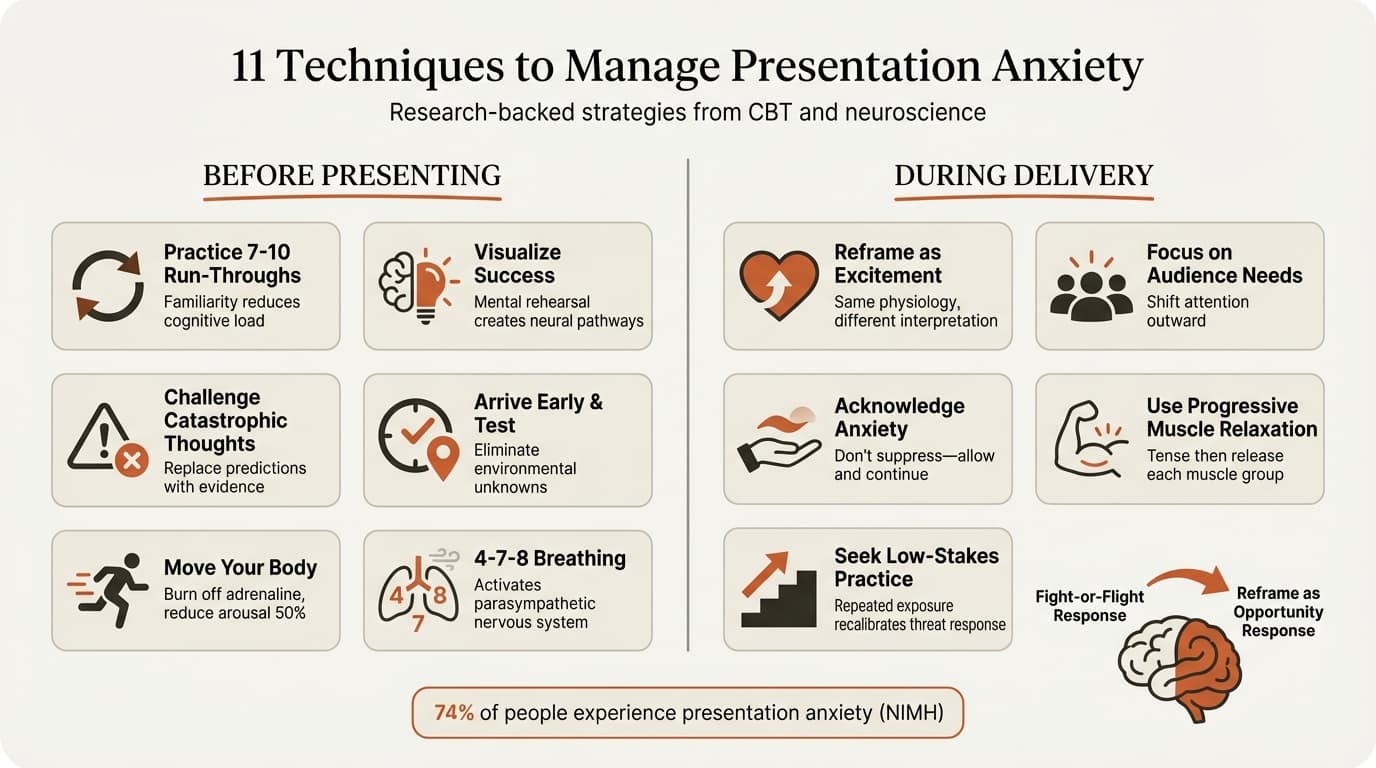
This guide covers 11 evidence-based techniques from cognitive behavioral therapy, neuroscience research, and performance psychology that reduce presentation anxiety in measurable ways.
What Is Presentation Anxiety (and Why It Happens)
Presentation anxiety is the experience of fear, nervousness, or physiological arousal triggered by the prospect or act of speaking before an audience. It manifests through three channels: cognitive (racing thoughts, catastrophic predictions), physiological (increased heart rate, sweating, trembling), and behavioral (avoidance, rushed delivery, poor eye contact).
Approximately 74% of people experience some form of presentation anxiety, according to the National Institute of Mental Health. This makes public speaking anxiety more prevalent than fear of death, heights, or spiders. Around 5-10% of the population experiences severe glossophobia (fear of public speaking), while roughly 25% experience moderate levels of anxiety when presenting.
The evolutionary explanation is straightforward: humans evolved in small social groups where exclusion meant death. Your brain interprets audience evaluation as social threat and activates the same fight-or-flight response that protected our ancestors from predators. This response was adaptive for survival. Heart rate increases, blood flow redirects to large muscles, cortisol floods your system, and non-essential functions like digestion and rational thinking shut down.
This response is adaptive when facing actual danger. It becomes maladaptive when the threat is a quarterly business review presentation where the worst outcome is clarifying questions, not physical harm.
| Anxiety Component | How It Manifests | Underlying Mechanism |
|---|---|---|
| Cognitive | Catastrophic thinking, memory blanks, rumination | Amygdala activation overrides prefrontal cortex function |
| Physiological | Increased heart rate, sweating, trembling, dry mouth | Sympathetic nervous system triggers cortisol and adrenaline release |
| Behavioral | Avoidance, rushed delivery, minimal eye contact | Brain prioritizes threat escape over communication goals |
Understanding this mechanism reveals why surface-level advice fails. Telling yourself to "relax" does not override a hardwired threat response. Effective anxiety management requires techniques that either reframe the perceived threat or directly counteract the physiological arousal.
The Research on What Actually Works
Cognitive behavioral therapy (CBT) shows strong effectiveness for reducing public speaking anxiety. A 2019 meta-analysis found that structured exposure combined with cognitive restructuring outperformed exposure alone. Addressing both thought patterns and behavioral avoidance works better than targeting either in isolation.
Acceptance-based exposure therapy shows higher remission rates than traditional habituation-based exposure. The difference: acceptance-based approaches teach presenters to perform effectively despite anxiety rather than waiting for anxiety to fully diminish.
11 Research-Backed Techniques for Managing Presentation Anxiety
These techniques span preparation, cognitive reframing, physiological regulation, and performance strategies. Use them in combination rather than relying on a single approach.
1. Practice 7-10 Full Run-Throughs
Research shows that familiarity with material reduces anxiety. When you know your content deeply, cognitive load shifts from recall to delivery. This frees mental resources to manage nerves.
Practice means standing up, speaking aloud, and advancing through your deck exactly as you will during delivery. By the seventh run-through, transitions become automatic.
How to apply it: Run through the full deck at least 7 times starting 3-4 days before presenting. Focus rehearsal on your opening, transitions, and closing.
2. Use the 4-7-8 Breathing Technique
Controlled breathing is not generic relaxation advice — it is a direct intervention that activates your parasympathetic nervous system and reduces cortisol. The 4-7-8 breathing pattern, developed by Dr. Andrew Weil, produces measurable physiological changes within 90 seconds.
The technique:
- Exhale completely through your mouth
- Close your mouth and inhale through your nose for 4 counts
- Hold your breath for 7 counts
- Exhale completely through your mouth for 8 counts
- Repeat the cycle 3-4 times
The extended exhale triggers your vagus nerve, which signals your brain to shift from sympathetic (fight-or-flight) to parasympathetic (rest-and-digest) nervous system dominance. Heart rate slows, cortisol drops, and the physical symptoms of anxiety diminish.
How to apply it: Use this technique 5 minutes before you present, again right before entering the room, and during any natural pause in your presentation if anxiety spikes mid-delivery.
3. Reframe Anxiety as Excitement
Your body produces nearly identical physiological responses for anxiety and excitement: increased heart rate, heightened alertness, adrenaline release. Research shows that telling yourself "I'm excited" rather than "I'm anxious" changes how you experience arousal. When you label your elevated heart rate as excitement rather than threat, your brain shifts from threat response to opportunity response.
How to apply it: When you notice anxiety symptoms, say aloud: "I'm excited to present this." The narrative shift takes 30-60 seconds to register but changes how your brain processes the arousal.
4. Arrive Early and Test Everything
Uncertainty amplifies anxiety. Walking into an unfamiliar room with untested technology five minutes before presenting adds environmental unknowns to the social threat you are already managing.
Arriving 15-20 minutes early lets you test slides, confirm the clicker works, verify screen resolution, and familiarize yourself with the space. By the time the audience arrives, the environment feels known rather than threatening.
How to apply it: Build a 20-minute buffer. Load your deck, advance through all slides, and stand at the presenting position.
5. Move Your Body Before Presenting
Anxiety produces adrenaline designed to fuel physical action. When you stand still while flooded with adrenaline, the energy manifests as trembling and racing thoughts. Physical movement burns off excess adrenaline and reduces anxiety by up to 50%.
How to apply it: Do jumping jacks, run in place, stretch your arms, or walk briskly for 3-5 minutes before presenting.
6. Challenge Catastrophic Thoughts
Presentation anxiety is sustained by cognitive distortions: "Everyone will think I'm incompetent," "I'll forget everything," "This will ruin my career." These predictions feel like certainty but are not supported by evidence.
Cognitive restructuring involves identifying catastrophic thoughts and testing them against evidence.
How to apply it: Write down the specific thought (e.g., "I'll freeze and forget my opening"). Ask: "What evidence supports this?" and "What evidence contradicts it?" Generate a more accurate thought: "I've practiced this opening ten times. If I blank, I have notes."
7. Use Progressive Muscle Relaxation
Progressive muscle relaxation systematically tenses and releases each muscle group. You cannot sustain high anxiety when your muscles are relaxed.
How to apply it: Starting 10 minutes before presenting, tense your feet for 5 seconds, then release. Move to calves, thighs, abdomen, chest, arms, shoulders, neck, and face. The sequence takes 3-4 minutes.
8. Visualize Success
Visualization research shows that imagining successful performance improves actual performance by creating neural pathways. Your brain cannot fully distinguish between vividly imagined experiences and real ones.
How to apply it: Spend 5 minutes the night before and morning of visualizing yourself delivering successfully. Imagine standing confidently, making eye contact, speaking clearly, and handling questions well. Focus on sensory details — what it feels like to present well.
9. Focus on the Audience, Not Yourself
Presentation anxiety is self-focused: "What if I mess up?" "Can they see me shaking?" Research shows that shifting attention outward — toward the audience's needs and goals — reduces self-consciousness and improves delivery.
How to apply it: Before presenting, remind yourself why this matters to the audience. During delivery, focus on their reactions. Are they nodding? Taking notes? Use those signals to adjust pacing, not to judge your performance.
10. Acknowledge Anxiety Instead of Suppressing It
Suppressing anxiety creates a rebound effect. Acceptance-based approaches teach a different strategy: acknowledge the anxiety and present anyway. You do not need to eliminate anxiety to perform well.
How to apply it: When anxiety arises, name it: "I'm feeling anxious right now." Notice the sensations without fighting them. Then redirect your focus to the task: advance to the next slide, make your next point. Anxiety loses power when you stop treating it as an obstacle.
11. Start with Low-Stakes Practice
Avoidance strengthens fear by confirming that presenting is dangerous. Exposure therapy research shows that gradual, repeated exposure reduces anxiety more effectively than avoidance.
How to apply it: Seek low-stakes opportunities. Volunteer for team meetings, deliver project updates, or join Toastmasters. Accumulate experience in environments where mistakes have minimal consequences. Over time, your brain learns that presenting is not dangerous.
Continue reading: Eisenhower Matrix · Line Charts in PowerPoint · Private Equity Pitch Deck
Create an editable presentation in your browser
Turn a prompt or source files into slides you can edit and export to PowerPoint. 10 free AI prompts. No credit card required.
When Presentation Anxiety Becomes Clinical
For 5-10% of the population, public speaking anxiety reaches clinical severity — triggering panic attacks, chronic avoidance, or career impairment. If your anxiety includes these symptoms, professional treatment may be warranted.
Cognitive behavioral therapy works well for clinical-level anxiety, with many patients achieving remission after 6-12 sessions. Acceptance-based exposure therapy shows particularly high success rates.
Only 10% of people with public speaking anxiety seek treatment despite high effectiveness. If anxiety limits your career or causes significant distress, CBT can produce measurable improvements within weeks.
Applying These Techniques in Practice
Presentation anxiety does not respond to generic advice. It requires addressing the cognitive, physiological, and behavioral components simultaneously. The 11 techniques in this guide work because they target the mechanisms that sustain anxiety rather than just masking symptoms.
Before your next presentation, use this sequence:
- 3-4 days out: Begin practicing full run-throughs. Aim for 7-10 complete rehearsals before the event.
- The night before: Visualize successful delivery for 5 minutes. Challenge any catastrophic thoughts with cognitive restructuring.
- The morning of: Use progressive muscle relaxation or the 4-7-8 breathing technique to reduce baseline arousal.
- 1 hour before: Move your body for 3-5 minutes to burn off adrenaline.
- 20 minutes before: Arrive early, test technology, familiarize yourself with the space.
- 5 minutes before: Use 4-7-8 breathing again. Reframe anxiety as excitement.
- During delivery: Focus on the audience's needs, not your performance. Acknowledge anxiety if it arises, but continue presenting anyway.
The techniques compound. Practicing 10 times reduces baseline anxiety. Controlled breathing manages physiological symptoms. Cognitive restructuring prevents catastrophic spiraling. Physical movement burns off adrenaline. Audience focus shifts attention outward. Together, they create manageable anxiety rather than debilitating fear.
For professionals who present frequently, building presentation decks efficiently also reduces anxiety by eliminating last-minute production stress. When slide formatting is handled by tools like Deckary, you spend less time aligning objects at 2 AM and more time rehearsing your delivery. The AI Slide Builder generates consulting-grade slides in seconds, complete with charts and structured layouts. The keyboard shortcuts for alignment and distribution eliminate manual formatting work. The result: presentations built faster, with more time allocated to the preparation that actually reduces anxiety.
Sources
- National Social Anxiety Center — Public Speaking Anxiety
- NCBI — Cognitive Behavioral Therapy for Public Speaking Anxiety (2009)
- Frontiers in Psychology — Meta-analysis of CBT for Public Speaking Anxiety (2019)
- Drexel University — Acceptance-Based Exposure Therapy Research
- Hamilton College — Dealing with Speech Anxiety
- Calm — 4-7-8 Breathing for Presentation Anxiety
- BetterUp — How to Not Be Nervous for a Presentation
- University of Iowa Counseling — 30 Ways to Manage Speaking Anxiety
- Indeed — How to Not Be Nervous for a Presentation
- Mayo Clinic — Fear of Public Speaking
Key Takeaways
- Presentation anxiety affects 74% of people and is more common than fear of death, heights, or spiders. It is a normal evolutionary response to perceived social threat, not a personal failing.
- Cognitive behavioral therapy shows strong effectiveness for reducing presentation anxiety. Structured exposure combined with cognitive restructuring outperforms either approach alone.
- Practice 7-10 full run-throughs before presenting. Familiarity with material reduces cognitive load during delivery, freeing mental resources to manage nerves.
- Use the 4-7-8 breathing technique to activate your parasympathetic nervous system and reduce cortisol within 90 seconds. Apply it before and during presentations.
- Reframe anxiety as excitement. Your body produces identical physiological responses for both. Changing the label changes how you experience arousal.
- Arrive early and test everything. Eliminating environmental unknowns reduces the number of variables your brain categorizes as threats.
- Move your body before presenting to burn off excess adrenaline. Even 2-3 minutes of physical activity reduces anxiety symptoms by up to 50%.
- Challenge catastrophic thoughts with cognitive restructuring. Replace irrational predictions with evidence-based assessments.
- Visualize successful delivery to create neural pathways that support confident performance. Your brain rehearses what you imagine.
- Focus on the audience's needs, not your performance. Shifting attention outward reduces self-consciousness and improves delivery quality.
- Acknowledge anxiety instead of suppressing it. You can feel nervous and still present effectively. Fighting anxiety creates rebound effects.
- Seek structured exposure through low-stakes presentations. Repeated exposure recalibrates your brain's threat assessment over time.
Presentation anxiety is highly treatable. The techniques above are not theoretical — they are evidence-based interventions from cognitive behavioral therapy, neuroscience, and performance psychology research. Applied consistently, they reduce anxiety from debilitating to manageable. The goal is not to eliminate nerves entirely but to perform effectively despite their presence. With practice, that becomes not just possible but routine.
Create an editable presentation in your browser
Turn a prompt or source files into slides you can edit and export to PowerPoint. 10 free AI prompts. No credit card required.