Business Model Slide: How to Show Investors Your Path to Revenue
Build a business model slide that investors actually trust. Learn proven formats, avoid common pitch deck mistakes, and show a clear path to profitability.
The business model slide is where most pitch decks lose investor credibility. Founders either overcomplicate it by forcing the full Business Model Canvas onto one slide, or they oversimplify it by saying "we take 10% commission" without explaining how customer acquisition works or when margins turn positive.
After reviewing business model slides across 85+ pitch decks for seed and Series A startups, the ones that earn follow-up meetings share three traits: they show exactly who pays, they quantify what they pay for, and they prove the math works at scale. Investors evaluate business models by asking whether revenue grows faster than costs—and your slide needs to answer that in 30 seconds.
This guide covers the business model slide structure that VCs expect, unit economics benchmarks that signal viability, visual formats that make revenue mechanics clear, and the mistakes that turn "interesting idea" into "pass."
What a Business Model Slide Actually Communicates
A business model slide explains how your startup converts customer problems into revenue streams. It is not a feature list or a marketing plan—it is the economic engine that determines whether the business can scale profitably.
According to Sketchbubble's 2024 pitch deck survey, 89% of venture capitalists expect a stellar pitch deck during fundraising, and 78% of investors say a clear pitch deck is a top factor in funding decisions. The business model slide sits at the center of that judgment because it answers the question every investor asks first: how does this company make money?
This slide differs from your problem slide, your solution slide, and your traction slide. The problem slide identifies the market pain. The solution slide shows what you built. The business model slide explains the transaction: who pays, what they pay for, how much they pay, and why the economics scale.
| Slide Type | Core Question | Investor Focus |
|---|---|---|
| Problem | What customer pain exists? | Market size, urgency |
| Solution | What did you build? | Product differentiation |
| Business Model | How do you earn revenue? | Path to profitability |
| Traction | Does anyone pay yet? | Validation, growth rate |
| Go-to-Market | How do you acquire customers? | CAC, sales efficiency |
The Three Essential Components
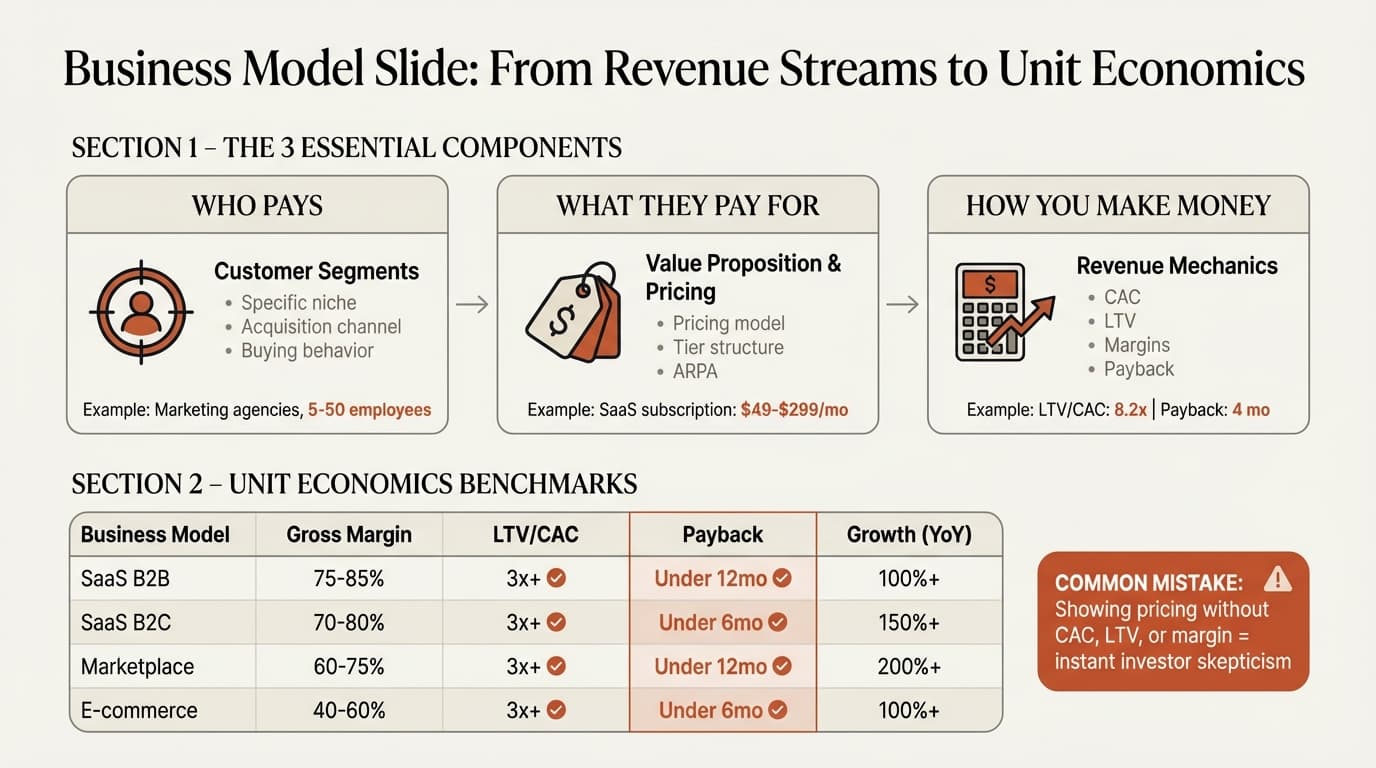
Every business model slide must answer three questions in order: who you sell to, what you sell, and how you make money.
1. Who You Sell To (Customer Segments)
Specify your target customer with precision. "Small businesses" is too vague. "Marketing agencies with 5-50 employees spending over $5K/month on paid ads" is specific.
Different segments have radically different acquisition costs, sales cycles, and willingness to pay. Enterprise buyers require longer sales cycles but tolerate higher prices. Consumers convert faster but expect lower price points.
If you serve multiple segments, show your beachhead market and expansion path.
2. What You Sell (Value Proposition and Pricing)
State what customers buy and how you price it. Use specific numbers, not ranges. "Starting at $49/month" tells investors nothing about ARPA. "$49/month for Basic, $119/month for Pro, $299/month for Enterprise, with 65% of customers on Pro" shows pricing structure and mix.
Include your pricing model type:
- SaaS subscription: Recurring monthly or annual fees
- Transaction-based: Percentage or fixed fee per transaction
- Freemium: Free tier with paid upgrades
- Marketplace take rate: Commission on transactions
- Usage-based: Pay per API call, storage, compute, or seats
3. How You Make Money (Revenue Mechanics and Unit Economics)
Saying "we charge $99/month" is incomplete. Investors need CAC, LTV, gross margin, and payback period.
Key metrics:
- CAC: Marketing + sales costs divided by new customers — factor in sales compensation costs and track them with Carvd
- LTV: Total revenue expected from one customer
- LTV/CAC Ratio: Should be 3x or higher for healthy SaaS
- Gross Margin: Revenue minus COGS, as a percentage
- Payback Period: Months to recover CAC from customer revenue
If you lack traction data, use industry benchmarks or cohort assumptions from pilot customers.
Four Visual Formats That Work
The right format depends on your business model complexity and whether you need to emphasize pricing tiers, customer segments, or revenue streams.
Format 1: Revenue Stream Breakdown
Use this when you have multiple revenue sources or a multi-sided marketplace.
Structure:
Revenue Stream 1: Subscription ($49-299/mo)
- 65% of revenue
- 2,400 active subscribers
- $98 average ARPA

Revenue Stream 2: Add-on Features (one-time)
- 20% of revenue
- 35% attach rate
- $79 average purchase

Revenue Stream 3: Enterprise Licenses ($2,400/yr)
- 15% of revenue
- 120 enterprise customers
- $2,400 ARPA
This format works for SaaS companies with tiered pricing plus add-ons, or marketplaces with multiple monetization levers (subscription + transaction fees + advertising).
Format 2: Unit Economics Table
Use this when you need to prove profitability math to skeptical investors.
Structure:
| Metric | Value | Benchmark |
|--------|-------|-----------|
| ARPA (Annual) | $1,188 | — |
| Gross Margin | 82% | 75%+ (SaaS) |
| CAC | $285 | — |
| LTV | $3,564 | — |
| LTV/CAC Ratio | 12.5x | 3x+ (healthy) |
| Payback Period | 7 months | Under 12 mo (SaaS) |
This format is essential for Series A pitches where investors expect detailed financial modeling. It shows you understand the economics required for venture-scale returns.
Format 3: Customer Journey with Revenue Touchpoints
Use this when revenue depends on multi-step conversion or upsells over time.
Structure:
Free Trial → Paid Subscriber → Power User → Enterprise

Day 0: Free trial (0% conversion)
Day 14: 28% convert to $49/mo Basic
Month 6: 35% upgrade to $119/mo Pro
Month 18: 12% upgrade to $299/mo Enterprise

Result: $98 average ARPA, 82% annual retention
Works for freemium models or product-led growth where expansion revenue drives LTV.
Format 4: Simplified Business Model Canvas
Use this only if your business model requires showing multiple value propositions, customer segments, and channels.
Alexander Osterwalder's Business Model Canvas, proposed in 2005 and popularized in his 2010 book Business Model Generation, maps nine building blocks: customer segments, value propositions, channels, customer relationships, revenue streams, key resources, key activities, key partnerships, and cost structure.
Critical warning: Do not put the full canvas in your pitch deck. Extract the three investor-relevant sections (customer segments, value propositions, revenue streams).
Customer Segments → Value Proposition → Revenue Streams
Works for multi-sided platforms or businesses with complex value chains.
Continue reading: Business Case Template · Stacked Bar Charts in PowerPoint · Series A Pitch Deck
Create an editable presentation in your browser
Turn a prompt or source files into slides you can edit and export to PowerPoint. 10 free AI prompts. No credit card required.
Benchmarks Investors Expect by Business Model Type
Different revenue models have different benchmarks. CAC payback of 18 months works for enterprise software but not consumer SaaS.
| Business Model | Gross Margin | LTV/CAC | Payback Period | Revenue Growth (YoY) |
|---|---|---|---|---|
| SaaS B2B | 75-85% | 3x+ | Under 12 months | 100%+ (early stage) |
| SaaS B2C | 70-80% | 3x+ | Under 6 months | 150%+ (early stage) |
| Marketplace | 60-75% | 3x+ | Under 12 months | 200%+ (early stage) |
| E-commerce | 40-60% | 3x+ | Under 6 months | 100%+ |
| Transactional | 50-70% | 3x+ | Under 9 months | 150%+ |
These benchmarks come from public SaaS financial data and venture portfolio standards. If your metrics fall below, acknowledge it and explain your improvement path.
Common Mistakes That Kill Credibility
These errors appear repeatedly in the pitch decks we review.
Mistake 1: No Pricing Transparency
Problem: "Our pricing is customized based on customer needs."
Why it fails: Investors interpret vague pricing as no customers yet or inability to articulate value. Custom pricing works for enterprise deals, but show typical deal sizes and ARPA.
Fix: "Enterprise pricing ranges from $12K to $60K annually, with average deal size of $28K."
Mistake 2: Revenue Model Without Unit Economics
Problem: Showing only revenue or pricing without CAC, LTV, or margin.
Why it fails: Revenue growth is meaningless if CAC exceeds LTV. Investors evaluate profitability potential, not revenue alone.
Fix: Pair revenue with CAC, LTV, LTV/CAC ratio, and gross margin. If you lack data, use cohort assumptions from your first 20-50 customers.
Mistake 3: Overcomplicating the Slide
Problem: Forcing the full Business Model Canvas (nine sections) onto one pitch deck slide.
Why it fails: As noted by pitch deck experts, the full canvas is too detailed for investor presentations. Decks with 11-20 slides have 43% more chances of securing funds, and cramming too much onto the business model slide wastes precious space.
Fix: Simplify to three components: who pays, what they pay for, how you make money. Move detailed canvas work to your appendix or financial model.
Mistake 4: No Proof of Validation
Problem: Presenting a hypothetical business model with zero traction.
Why it fails: Investors discount untested models. If pre-revenue, show evidence of willingness to pay: letters of intent, pilot agreements, or survey data.
Fix: "12 pilot customers committed to $49/month subscriptions upon launch" or "3 design partners signed $10K annual contracts for beta access."
Mistake 5: Ignoring Competitive Pricing
Problem: Pricing significantly higher or lower than competitors without explanation.
Why it fails: If you charge 3x competitors, justify it with 10x better outcomes or fundamentally different value. If you charge less, investors worry about race-to-the-bottom dynamics.
Fix: Briefly acknowledge positioning: "Priced 20% below incumbents to accelerate market share capture while maintaining 75% gross margins."
Building the Slide Faster
Most founders spend hours aligning boxes, formatting tables, and redoing charts when unit economics change. This is where production tools matter.
PowerPoint handles basic layouts, but add-ins reduce repetitive work. Deckary's AI Slide Builder generates business model slides from text descriptions, auto-formatting revenue streams, pricing tables, and unit economics. The slide library includes pre-built templates for SaaS pricing, marketplace models, and freemium funnels.
For pitch decks specifically, Excel-linked charts update automatically when financial projections change, eliminating manual chart rebuilding. Keyboard shortcuts for alignment and distribution save hours on multi-element slides. For broader pitch deck design guidance, see our pitch deck template guide.
Sources
- Sketchbubble — Pitch Deck Statistics: What Investors Prefer the Most (2024)
- Wikipedia — Business Model Canvas
- OpenVC — Business Model Slide Best Practices
Summary
Business model slides convert investor skepticism into follow-up meetings when they answer three questions clearly: who pays, what they pay for, and whether the math works at scale.
Key principles:
- Focus on three components: Customer segments, value proposition with specific pricing, and revenue mechanics with unit economics.
- Show unit economics, not just pricing: Include CAC, LTV, LTV/CAC ratio, gross margin, and payback period. Investors evaluate profitability potential, not revenue alone.
- Use industry benchmarks as context: SaaS should show 75%+ gross margin, 3x+ LTV/CAC, and under 12-month payback. Marketplace and e-commerce models have different targets.
- Simplify the Business Model Canvas: Do not force all nine sections onto one slide. Extract the three most investor-relevant components.
- Provide validation signals: Early traction, pilot revenue, or customer commitments reduce perceived risk for pre-revenue startups.
- Choose the right visual format: Revenue stream breakdown for multi-source models, unit economics table for Series A pitches, customer journey for freemium/PLG, simplified canvas for multi-sided platforms.
- Acknowledge competitive pricing: If you price significantly above or below competitors, explain why your economics still work.
The business model slide is where founders prove they understand not just what to build, but how to build a sustainable company. Get the unit economics right, show a clear path to profitability, and demonstrate early validation—and investors will believe the rest of your pitch deck.
Create an editable presentation in your browser
Turn a prompt or source files into slides you can edit and export to PowerPoint. 10 free AI prompts. No credit card required.