Problem Solution Slide: 4 Formats That Drive Buy-In
Build problem-solution slides that get approved. Learn proven formats, design principles, and common mistakes from 140+ business proposals and consulting decks.
Problem-solution slides determine whether your recommendation gets approved or sent back for revision. When a steering committee evaluates a process improvement proposal, a board considers a technology investment, or an investor decides whether your startup solves a real pain point, the problem-solution slide is where clarity either emerges or collapses.
At McKinsey and BCG, problem-solution slides follow the SCR framework: Situation, Complication, Resolution. The complication (problem) must be specific enough to quantify, significant enough to justify action, and urgent enough that delaying a decision costs more than implementing the solution. The resolution (solution) must directly address the stated problem with evidence that the approach works.
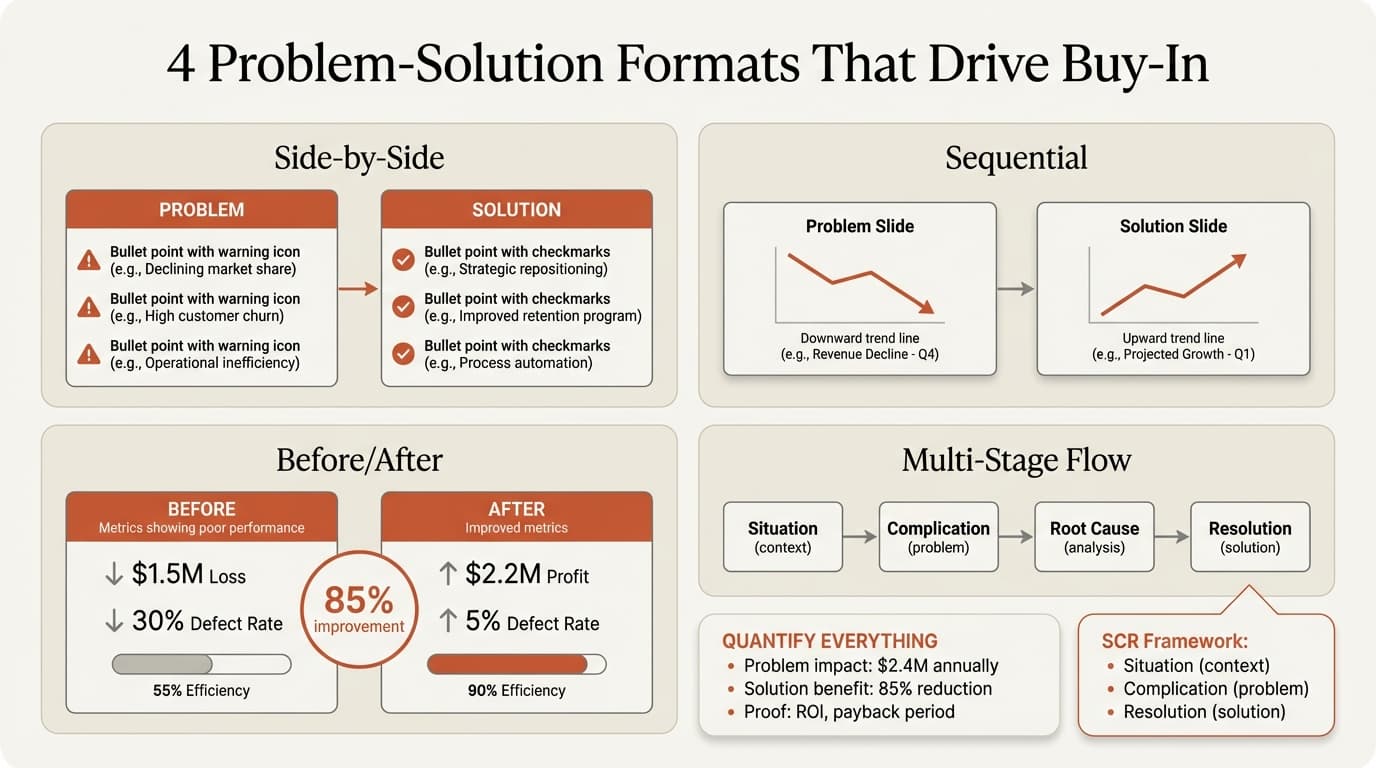
After building problem-solution slides for 140-plus business cases, transformation proposals, and pitch decks, we have identified four formats that consistently earn buy-in, the design principles that make problems feel urgent without exaggeration, and the mistakes that turn compelling proposals into rejected requests.
Why Problem-Solution Slides Drive Decisions
Problem-solution slides answer two questions every decision-maker asks: "Why should we care?" and "What should we do?"
1. Establishing urgency. Revenue declining 8% quarter-over-quarter is concerning. Revenue declining 8% while competitors grow 15% is urgent. The problem slide provides that context.
2. Making the solution defensible. Solutions without clearly stated problems feel like answers searching for questions.
3. Aligning stakeholders. Finance cares about cost. Operations cares about efficiency. A well-structured problem slide bridges these perspectives.
| Context | Problem Focus | Solution Emphasis |
|---|---|---|
| Pitch deck | Market pain point, existing solution gaps | Product differentiation |
| Business case | Cost/risk/inefficiency with quantified impact | ROI, payback period, risk reduction |
| Consulting deck | Strategic misalignment or operational bottleneck | Recommended path forward with implementation plan |
| Change management | Resistance drivers or capability gaps | Roadmap with stakeholder engagement |
The McKinsey SCR Framework
McKinsey's Situation-Complication-Resolution (SCR) framework provides the structure for defining business challenges and solutions.
Situation: Setting the Context
The situation establishes baseline facts without opinion.
Example:
Situation: The company processes 12,000 expense reports monthly
using a 15-year-old system requiring manual approval at three levels.
Complication: Articulating the Problem
The complication is where the situation becomes problematic. According to McKinsey's problem-solving approach, the characteristic method is a structured, inductive approach that defines problems with precision.
Example:
Complication: Processing time averages 18 days, causing $2.4M annually
in late payment penalties and 340+ hours per month of finance team
time on manual corrections.
Resolution: Proposing the Solution
The resolution directly addresses the complication with a specific, actionable recommendation.
Example:
Resolution: Implement automated expense management platform with
mobile receipt capture, real-time approval workflows, and policy
enforcement. Reduces processing time to under 3 days, eliminates
$2.4M penalty exposure, frees 85% of finance team capacity.
Four Problem-Solution Slide Formats That Work
Format 1: Side-by-Side (Problem | Solution)
Two columns dividing the slide vertically—problem on the left, solution on the right. Most common format for business proposals and consulting decks.
Structure:
PROBLEM                          | SOLUTION
--------------------------------|--------------------------------
[Problem headline]              | [Solution headline]
- Impact 1 (quantified)         | - Approach 1 (specific)
- Impact 2 (quantified)         | - Approach 2 (specific)
- Impact 3 (quantified)         | - Expected outcome (quantified)
Best for: Business cases, process improvement proposals, technology investment decks.
Design tips:
- Use 50/50 column split for balanced emphasis
- Quantify both problem impact and solution benefits
- Add icons to distinguish problem (warning) from solution (checkmark)
- Limit to 3-4 bullets per side
Format 2: Sequential (Separate Problem and Solution Slides)
Pitch decks and investor presentations typically separate problem and solution into distinct slides. According to pitch deck research, investors skim an entire pitch deck in roughly 2-3 minutes.
Problem Slide Structure:
[Problem headline: one sentence, specific]

Impact Data:
- Quantified pain point 1
- Quantified pain point 2
- Customer quote or anecdote

Why Existing Solutions Fail:
- Gap 1
- Gap 2
Solution Slide Structure:
[Solution headline: how you solve the problem]

How It Works:
- Core approach 1
- Core approach 2
- Core approach 3

Proof:
- Validation metric or early traction
Best for: Pitch decks, sales presentations.
Design tips:
- Use one impactful stat per problem slide
- Add visuals like trend lines or user pain points
- On the solution slide, directly reference the problem elements
Format 3: Before/After Comparison
A variation of side-by-side that emphasizes transformation.
Structure:
BEFORE (Current State)          | AFTER (With Solution)
--------------------------------|--------------------------------
Manual reconciliation           | Automated reconciliation
- 18 days processing time       | - Under 3 days processing time
- $2.4M annual penalties        | - Zero penalty exposure
- 340 hours/month manual work   | - 51 hours/month (85% reduction)
- 15% error rate                | - Under 2% error rate
Best for: Transformation business cases, process improvement proposals, change management decks.
Design tips:
- Use left-to-right flow (before on left, after on right)
- Include delta percentages between columns
- Keep language parallel ("Manual X" vs. "Automated X")
Format 4: Multi-Stage Problem-Solution Flow
A flow across three or more stages. Works for complex problems requiring multi-step solutions.
Structure:
Situation → Complication → Root Cause → Solution → Expected Outcome

[Context]   [Problem]     [Why it      [What we    [Quantified
                          happens]     recommend]   impact]
Best for: Consulting decks, transformation roadmaps, strategic planning presentations.
Design tips:
- Use arrows or numbered stages
- Limit to 4-5 stages maximum
- Emphasize the solution stage with bolder formatting or color
- Include icons for each stage
Format Comparison
| Format | Problem Emphasis | Solution Emphasis | Complexity | Best Use Case |
|---|---|---|---|---|
| Side-by-Side | Equal | Equal | Low | Business cases, proposals |
| Sequential | High (separate slide) | High (separate slide) | Medium | Pitch decks, sales |
| Before/After | High | High | Low | Process improvement, transformation |
| Multi-Stage | Medium | Medium | High | Strategic planning, consulting |
Continue reading: Business Case Template · Bar Charts in PowerPoint · Startup Pitch Deck
Use consulting-grade layouts in PowerPoint
Start from structured business slides and customize them in your own deck. 10 free AI prompts. No credit card required.
Design Principles for Effective Problem-Solution Slides
Principle 1: Quantify Everything
Generic problems signal inexperience. According to pitch deck experts, "Small businesses struggle with marketing" says nothing, while "B2B SaaS companies waste $50K annually on unqualified leads" gets attention.
Quantification rules:
- Problem impact: Use dollar amounts, time waste, error rates
- Solution benefits: Use ROI, payback period, percentage improvement
- Comparison metrics: Show deltas as percentages and absolutes
Example transformation:
- Before: "The current process is inefficient and error-prone."
- After: "The current process wastes 340 hours monthly, costs $2.4M annually in penalties, and produces a 15% error rate."
Principle 2: One Slide, One Message
Problem-solution slides should communicate one core problem and one core solution. If you have three unrelated problems, create three separate slides.
Rules:
- Slide titles should be action-oriented statements, not topic labels ("Automate expense approvals to eliminate $2.4M penalty risk" not "Expense Management System")
- Supporting data should reinforce the headline
Principle 3: Show, Don't Just Tell
Visual elements make abstract problems tangible.
Visual elements that work:
- Trend lines with decline or growth
- Process flow diagrams with bottlenecks
- Icons for problem (warning) vs. solution (checkmark)
- Before/after comparisons with delta arrows
- Customer quotes
Common Problem-Solution Slide Mistakes
Mistake 1: Problem Too Generic
Problem: "Employees struggle with productivity" or "Marketing is expensive."
Why it fails: Generic problems are not actionable. As noted by pitch deck experts, generic problems signal inexperienced founders.
Fix: "Sales team spends 12 hours weekly on manual lead qualification, resulting in 40% of pipeline being unqualified prospects and $180K in wasted sales capacity annually."
Mistake 2: Solution Mismatched to Problem
Problem: "Customer churn is 8% monthly."
Solution: "We will implement a new CRM system."
Why it fails: The solution does not explain how a new CRM reduces churn.
Fix: "Customer churn is 8% monthly, driven by poor onboarding. Implementing a CRM with automated onboarding workflows and churn risk alerts will reduce time-to-value by 60% and flag at-risk accounts 30 days earlier, targeting 8% churn reduction to under 5% within 6 months."
Mistake 3: No Evidence of Solution Viability
Problem: Stating a solution without proof it works.
Why it fails: Audiences evaluate risk. Without validation, they discount your recommendation.
Fix: Include evidence—pilot results, benchmarks, case studies. "Similar implementations at [Company X] reduced processing time by 82% and achieved 18-month payback."
Mistake 4: Burying the Problem
Problem: Starting with 3-4 slides of background before introducing the problem.
Why it fails: McKinsey presentations start with the conclusion. Audiences want the problem and recommendation upfront.
Fix: Lead with the problem-solution slide, then provide supporting analysis.
Mistake 5: Overloading One Slide
Problem: Combining situation, complication, root cause, solution, implementation plan, and ROI on one slide.
Why it fails: Cognitive overload.
Fix: Use the multi-stage format or break into separate slides. One message per slide.
Real-World Applications by Context
Pitch Decks: Problem + Solution (Sequential)
According to pitch deck research, 10 required slides include a problem slide and a solution slide as separate elements.
Problem Slide Structure:
- Headline: "B2B SaaS companies waste $50K annually on unqualified leads"
- Impact data: "68% of marketing budgets go to broad targeting with under 12% conversion"
- Why existing solutions fail: "Generic ad platforms lack intent signals"
Solution Slide Structure:
- Headline: "AI-powered account scoring identifies high-intent buyers before they search"
- How it works: "Analyzes 150+ buying signals across web activity, job changes, funding events"
- Proof: "Pilot customers reduced lead qualification time 70%, improved pipeline quality 40%"
Business Cases: Problem | Solution (Side-by-Side)
| Problem | Solution |
|---|---|
| Manual expense processing takes 18 days | Automated platform reduces processing to under 3 days |
| $2.4M annually in late payment penalties | Real-time approval workflows eliminate penalty exposure |
| 340 hours/month on corrections | Policy enforcement reduces manual work 85% |
| 15% error rate | OCR and validation rules reduce errors to under 2% |
Include ROI summary: "18-month payback, $1.8M net savings over 3 years."
Consulting Decks: SCR Framework (Multi-Stage)
Example: Supply Chain Optimization
Situation → Complication → Resolution
Fulfillment | Current 4-day | Centralized
network spans | lead time | distribution
23 regional | causes 12% | model reduces
warehouses  | stockouts and | lead time to
            | $8M excess   | under 2 days,
            | inventory    | cuts inventory
                          | 35%, eliminates
                          | stockouts
Change Management: Before/After (Transformation)
| Before | After |
|---|---|
| 18-step manual approval process | 6-step automated workflow |
| 23-day average deal cycle | Under 9-day deal cycle (61% reduction) |
| 32% win rate | 47% win rate |
| Sales reps spend 40% of time on admin | Sales reps spend under 15% of time on admin |
Tools and Shortcuts
| Tool | Best For | Price |
|---|---|---|
| Deckary | AI-generated problem-solution slides, auto-formatting | $120-180/yr |
| PowerPoint SmartArt | Basic flow diagrams | Built-in |
| PowerPoint Tables | Side-by-side layouts | Built-in |
Deckary's AI Slide Builder generates problem-solution slides from text descriptions, automatically structuring SCR frameworks. For manual slide creation, see PowerPoint design tips.
Summary
Problem-solution slides answer "Why should we care?" and "What should we do?"
Key principles:
- Use the SCR framework: Situation (context), Complication (quantified problem), Resolution (specific solution with evidence).
- Choose the right format: Side-by-side for business cases, sequential for pitch decks, before/after for transformation, multi-stage for consulting decks.
- Quantify everything: Problem impact in dollars/time/errors, solution benefits in ROI/payback/percentage improvement.
- One slide, one message: Complex issues need multiple slides.
- Show, don't just tell: Use trend lines, process diagrams, icons, and customer quotes.
- Lead with the conclusion: State the problem and solution immediately, then provide supporting evidence.
- Bridge problem to solution: Explain how your solution addresses the stated problem.
The best problem-solution slides make the case for action in under 30 seconds. For ready-to-use templates, explore Deckary's slide library or build custom slides with the AI Slide Builder.
Sources
- Top 10 Problem Solution Slide PowerPoint Presentation Templates in 2026
- Problem Solving PowerPoint Templates
- 8-Step Framework to Problem-Solving from McKinsey
- McKinsey SCR Framework: What It Is & How To Use It
- The BCG and McKinsey problem solving process - A step-by-step guide
- How to use the SCR framework (with examples)
- How McKinsey Uses the SCR Framework for Powerful Slide Outlines
- McKinsey Problem Solving: Six steps to solve any problem
- The McKinsey Approach to Problem Solving
- How to Use Statistics and Numbers in Presentations
- Problem Slide Pitch Deck Best Practices and Examples
- How to craft a perfect problem solution slide in 2025
- 10 Required Slides in a Pitch Deck
Use consulting-grade layouts in PowerPoint
Start from structured business slides and customize them in your own deck. 10 free AI prompts. No credit card required.