How to Do a SWOT Analysis: Step-by-Step Process for Strategists
How to do a SWOT analysis that drives strategy. Step-by-step process, workshop facilitation tips, the TOWS strategy matrix, and validation methods.
Most SWOT analyses fail not because the framework is flawed, but because teams skip the process that makes it work. They gather in a conference room, fill four quadrants with gut feelings, and leave with a matrix that sits in a shared drive untouched. The framework is only as useful as the methodology behind it.
Knowing how to do a SWOT analysis properly means following a structured process: defining scope before brainstorming, separating internal from external factors with clear tests, and converting findings into strategy through the TOWS matrix. After facilitating SWOT workshops across 80+ strategy engagements, we have found that the process matters more than the template.
This guide covers the complete methodology: preparation, the four-step analysis process, facilitation techniques for group workshops, how to validate your findings, common mistakes, and how to present SWOT results to executives. For filled-in examples by industry, see our SWOT Analysis Examples. For the broader strategy toolkit, see our Strategic Frameworks Guide.
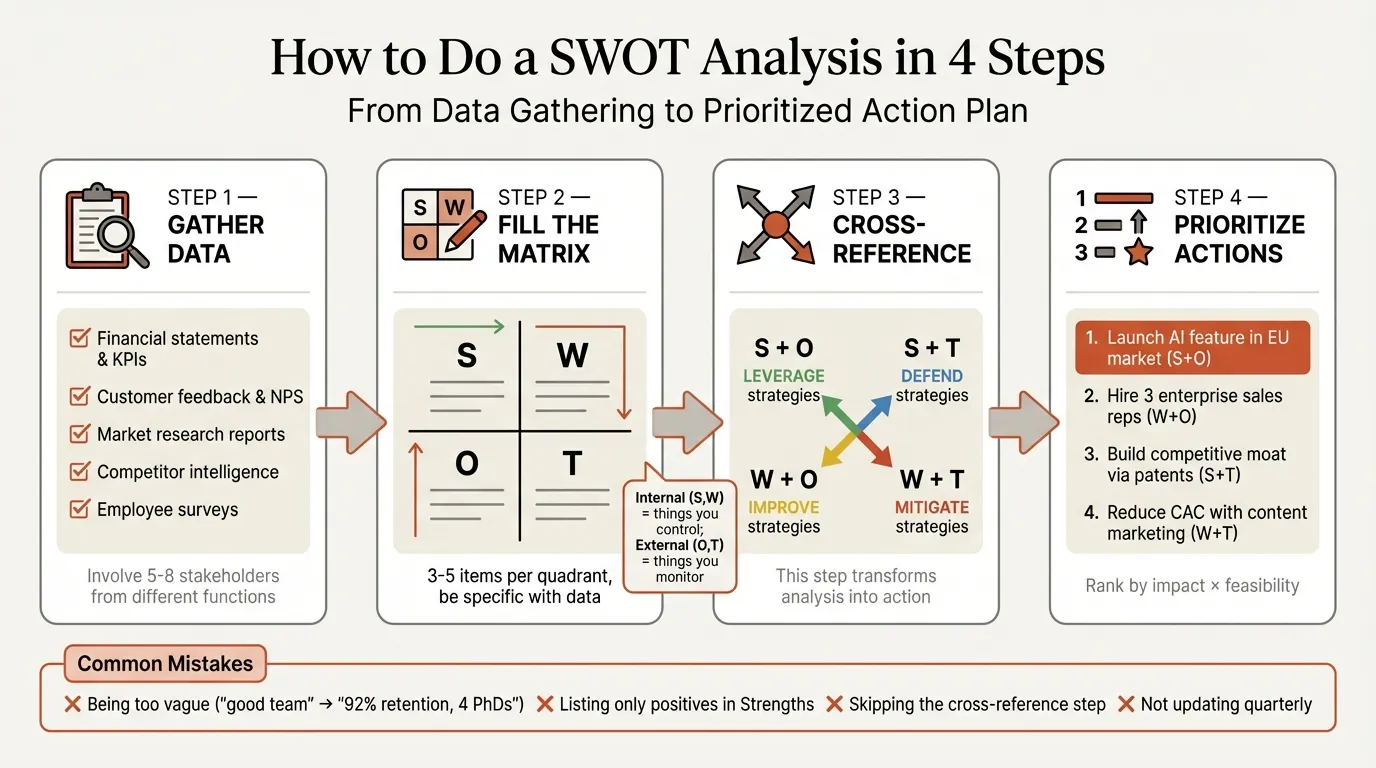
Step 1: Define Scope and Assemble the Right Team
The most common reason a SWOT produces generic results is starting without a defined objective. "Do a SWOT analysis of our company" is too broad. "Assess our position for entering the Southeast Asian market in Q3" gives the team a focused lens for every factor they identify.
Define the scope clearly. A SWOT can evaluate a product line, a market entry decision, a competitive position, or an annual strategy refresh. Pin it down before anyone brainstorms. As Harvard Business Review notes, an unfocused SWOT session produces disconnected thoughts rather than actionable strategy.
Assemble 6-10 cross-functional participants. Include representatives from sales, operations, finance, product, and customer success. Senior leaders bring strategic context. Frontline staff bring operational reality. A SWOT built by the leadership team alone consistently misses weaknesses visible only to people doing the daily work.
Gather data before the session. Distribute relevant materials 3-5 days in advance: financial performance data, customer satisfaction scores (NPS, CSAT), market share figures, competitor updates, and industry trend reports. Data-grounded analysis produces measurably better strategic outcomes than sessions that rely on opinions alone. Ask each participant to come with 2-3 items per quadrant already drafted.
Step 2: How to Do a SWOT Analysis -- The Four Quadrants
HBR's research suggests starting with external factors (opportunities and threats) before internal ones (strengths and weaknesses). The logic is sound: grounding your internal assessment in real market conditions prevents "we are good at X, so let us do X" bias. We recommend the same approach.
External Scan: Opportunities and Threats First
Opportunities are favorable external conditions that exist independently of your actions. Threats are external risks you cannot directly control but must respond to. Neither are things you plan to do -- they are conditions in the environment.
Use this diagnostic table to surface the right factors:
| Quadrant | Questions to Ask |
|---|---|
| Opportunities | What market trends favor our position? Which underserved segments are growing? What regulatory changes create openings? Are competitor weaknesses creating gaps we can fill? What technology shifts could we leverage? |
| Threats | Which competitors are gaining share, and why? What regulatory or political changes could constrain us? Are customer preferences shifting away from our model? What economic conditions could reduce demand? Are substitutes emerging? |
Feed external analysis from complementary frameworks into this step. A PESTLE analysis maps macro-environmental forces that become the raw material for your O and T quadrants. A competitive analysis identifies specific rival moves and market positioning shifts.
Internal Audit: Strengths and Weaknesses
Strengths are internal capabilities, resources, or advantages your organization controls. Weaknesses are internal limitations or gaps. The key word is internal -- if it would exist even if your company disappeared, it is external.
| Quadrant | Questions to Ask |
|---|---|
| Strengths | Where do we outperform competitors on measurable metrics? What unique resources, IP, or talent do we control? Which processes consistently deliver results? What do customers cite as reasons for choosing us? What financial advantages do we hold (margins, cash position, cost structure)? |
| Weaknesses | Where do we underperform benchmarks? What skills or capabilities are we missing? Which processes are slow, fragile, or manual? What do we lose deals over? Where are our highest-cost or lowest-margin areas? What does our employee attrition data reveal? |
Be specific and metric-driven. "Strong brand" is not a strength. "72% unaided brand recall in target segment, 15 points above the nearest competitor" is a strength. Vague bullets make the entire analysis less actionable. Every item should pass the "so what?" test -- if an executive reads it and asks "what does this mean for our strategy?", the bullet needs more specificity.
Continue reading: After Action Review Template · Waterfall Chart Excel · Competitive Landscape Slide
Use consulting-grade layouts in PowerPoint
Start from structured business slides and customize them in your own deck. 14-day free trial. No credit card required.
Step 3: Validate Your SWOT -- The Classification Tests
Before finalizing, run each item through validation. Misclassifying factors is one of the most common SWOT analysis mistakes, and it undermines the entire framework.
The Control Test. Can your organization directly change this factor through investment, hiring, process changes, or leadership decisions? If yes, it is internal (strength or weakness). If no, it is external (opportunity or threat). "High employee turnover" is a weakness, not a threat -- you can address it through retention programs. "Industry-wide talent shortage" is a threat -- it exists regardless of your actions.
The Competitor Test. Would this factor appear on a competitor's SWOT in the same quadrant? If a "strength" also applies to three competitors, it is not a differentiator. Either remove it or reframe it with specific metrics showing where you lead.
The Specificity Test. Could this bullet apply to virtually any company in any industry? "Strong customer relationships" and "increasing competition" fail this test. Replace them with facts: "94% client retention rate over 3 years in mid-market segment" and "Two VC-backed entrants launched competing products in Q2, pricing 30% below market."
Prioritize ruthlessly. Aim for 3-5 items per quadrant. Ten factors per quadrant signals a lack of prioritization. Rank by impact and likelihood, then cut everything below the threshold.
How to Facilitate a SWOT Workshop
Running a SWOT as a group exercise introduces facilitation challenges that solo analysis does not. Here are the techniques that consistently produce better results.
Use silent brainstorming first. Give participants 10 minutes to write items on sticky notes or a digital whiteboard individually before any group discussion. This prevents anchoring bias where the first speaker's ideas dominate the session. Research on group decision-making consistently shows that independent idea generation followed by group discussion outperforms open brainstorming.
Separate generation from evaluation. Spend the first half of the session listing factors without debating them. Spend the second half validating, merging duplicates, and prioritizing. Mixing the two phases causes the team to argue over the first item for 30 minutes and rush through the rest.
Assign a devil's advocate. Designate one person to challenge every item. If a strength goes unchallenged, the advocate asks: "What evidence supports this? Would a competitor agree this differentiates us?" This role prevents groupthink, which is particularly common when senior leaders are in the room.
Time-box each quadrant. Allocate 15 minutes per quadrant for generation and 10 minutes for validation. A 90-minute session is ideal. Longer sessions produce diminishing returns as energy fades.
How to Do a SWOT Analysis That Converts to Strategy: The TOWS Matrix
A completed SWOT is a diagnostic tool -- it tells you where you stand. The TOWS matrix, developed by Heinz Weihrich, takes the analysis one step further by cross-referencing internal and external factors to generate four categories of strategic initiatives.
| Opportunities | Threats | |
|---|---|---|
| Strengths | SO Strategies: Use strengths to capture opportunities. "Our 130% net dollar retention (S) positions us to expand into the adjacent mid-market analytics segment (O)." | ST Strategies: Use strengths to counter threats. "Our proprietary data pipeline (S) creates switching costs that neutralize new entrant pricing pressure (T)." |
| Weaknesses | WO Strategies: Address weaknesses to exploit opportunities. "Investing in enterprise sales capabilities (W) would let us capture the growing demand for consolidated platforms (O)." | WT Strategies: Minimize weaknesses to avoid threats. "Our 94-day sales cycle (W) makes us vulnerable to faster-moving competitors (T) -- streamlining qualification criteria is defensive priority." |
The TOWS matrix transforms a descriptive exercise into prescriptive strategy. Each cell produces 2-3 specific initiatives, giving leadership a prioritized list of strategic moves grounded in the SWOT findings.
Use the following sentence structure from HBR to generate recommendations: "Given the condition of [external factor], our ability to [internal factor] leads to our recommendation that we [specific action]." This formula forces every recommendation to connect an external reality with an internal capability or gap.
How to Present a SWOT Analysis to Executives
A SWOT that stays in a shared folder accomplishes nothing. Presenting it effectively determines whether it drives decisions.
Lead with the strategic implication, not the matrix. The slide title should never be "SWOT Analysis." It should state the conclusion: "Strong unit economics and R&D pipeline offset regulatory headwinds in core market." This follows the Pyramid Principle that underpins all consulting communication -- lead with the answer.
Use the 2x2 matrix as a supporting visual, not the main event. Place the SWOT grid on a single slide with 3-5 concise, metric-backed bullets per quadrant. Then dedicate a second slide to the TOWS-derived strategic initiatives with owners and timelines.
Prioritize visually. Bold or highlight the top-priority item in each quadrant. Executives do not read every bullet. They scan for the most critical factors, and your formatting should guide that scan.
For ready-to-use layouts, our SWOT Analysis Template provides consulting-grade formatting with pre-built quadrant layouts that you can populate directly in PowerPoint using Deckary's slide builder.
Common Mistakes That Undermine SWOT Analysis
After reviewing hundreds of SWOT analyses, these are the five errors we see most frequently:
Mixing internal and external factors. "New competitor entering the market" is not a weakness -- it is a threat. "Our inability to respond quickly to new competitors" is a weakness. Applying the control test to every item eliminates this confusion.
Being too vague to act on. "Good culture" as a strength and "market uncertainty" as a threat are both useless. If you cannot attach a metric, an example, or a specific comparison to a bullet, it does not belong in the final version.
Confusing opportunities with goals. "Launch a mobile app" is a strategic initiative, not an opportunity. "42% increase in mobile-first B2B buyers over the past 18 months" is an opportunity. Opportunities describe external conditions; goals describe actions you choose to take.
Stopping at the matrix. A SWOT without the TOWS step is diagnosis without prescription. If leadership walks away with only a four-quadrant grid, they have a description of the current state but no roadmap for what to do about it.
Running a single-perspective session. When only the executive team contributes, the SWOT reflects strategic aspirations rather than operational reality. The sales team knows why deals are lost. The support team knows which product gaps generate the most tickets. Their input changes what appears in the weaknesses quadrant.
Key Takeaways
- Define a specific scope and objective before starting -- "SWOT of our company" is too broad to produce actionable results.
- Start with external factors (O and T) before internal ones (S and W) to ground the analysis in market reality.
- Apply the control test, competitor test, and specificity test to validate every item.
- Limit each quadrant to 3-5 metric-backed, specific bullets.
- Use the TOWS matrix to convert diagnostic findings into four categories of strategic initiatives.
- Present with a conclusion-driven title, not "SWOT Analysis."
- Revisit every six months, or immediately after major market changes.
For filled-in examples you can reference, see our SWOT Analysis Examples. To build a complete strategic toolkit, explore the Strategic Frameworks Guide, PESTLE Analysis Examples, and Competitive Analysis Examples.
Use consulting-grade layouts in PowerPoint
Start from structured business slides and customize them in your own deck. 14-day free trial. No credit card required.