Go-to-Market Slide: How to Show Investors Your Customer Acquisition Plan
Build a go-to-market slide that proves you can scale customer acquisition. Learn what investors expect, proven formats, and the metrics that matter.
Most go-to-market slides lose investor attention in 15 seconds because founders list channels without proving they work. "We will use Facebook ads, content marketing, and partnerships" tells investors nothing about customer acquisition cost, conversion rates, or whether the strategy scales beyond the first 100 customers.
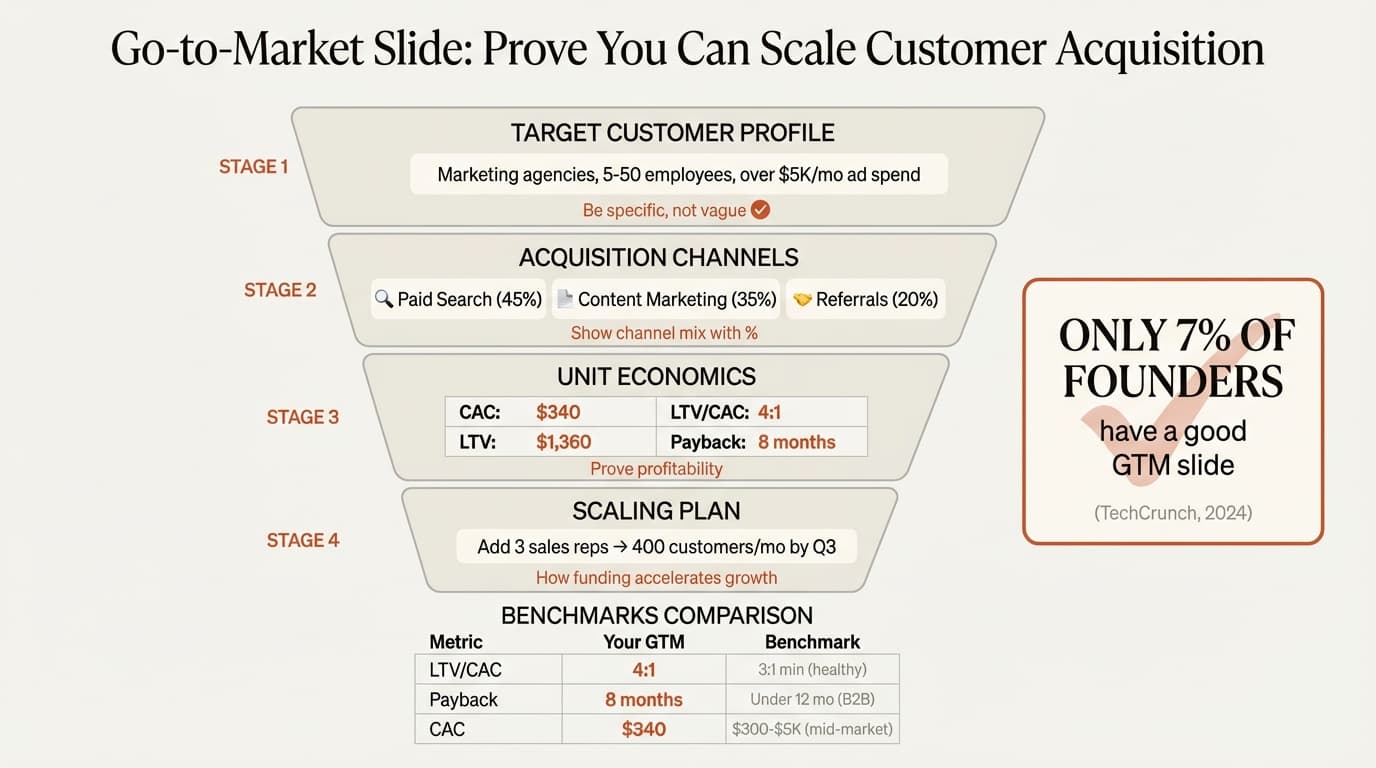
The GTM slide exists to answer one question investors ask every time: can you acquire customers profitably and predictably at scale? According to TechCrunch's 2024 pitch deck analysis, only 7% of founders have a pitch deck with a reasonably good go-to-market narrative—which means nailing this slide creates immediate differentiation.
After reviewing go-to-market slides across 95+ pitch decks for seed and Series A startups, the ones that earn follow-up meetings share three traits: they specify target customer segments with precision, they show channel economics with real CAC and LTV numbers, and they provide evidence from tests or pilots instead of hypothetical projections.
This guide covers the go-to-market slide structure that VCs expect, customer acquisition metrics that prove scalability, visual formats that clarify channel strategy, and the mistakes that turn investor skepticism into hard passes.
What a Go-to-Market Slide Actually Communicates
A go-to-market slide explains how your startup acquires customers, what it costs to acquire them, and how you scale that process predictably. It differs from your business model slide (which shows pricing and revenue streams) and your traction slide (which shows current growth metrics). The GTM slide bridges the two by proving the mechanics of customer acquisition work.
| Slide Type | Core Question | Investor Focus |
|---|---|---|
| Business Model | How do you earn revenue? | Pricing, unit economics, margins |
| Go-to-Market | How do you acquire customers? | CAC, channels, scalability |
| Traction | Does anyone pay yet? | Growth rate, retention, MRR/ARR |
| Competitive Landscape | Who else solves this problem? | Differentiation, market positioning |
The Four Essential Components
Every effective go-to-market slide answers four questions in order: who you target, how you reach them, what it costs, and how you scale.
1. Target Customer Profile (Who You Acquire)
Specify your initial beachhead market with enough precision that investors can evaluate channel fit. "Small businesses" is meaningless. "Marketing agencies with 5-50 employees spending over $5K/month on paid ads" defines a segment with specific acquisition characteristics.
This matters because different customer segments require different channels and economics. Enterprise buyers need enterprise sales teams. Consumers respond to performance marketing. Mid-market B2B companies often convert through product-led growth or inside sales.
2. Acquisition Channels and Tactics (How You Reach Them)
List your primary acquisition channels with specific tactics, not generic labels. Saying "content marketing" is incomplete. Saying "SEO-optimized comparison posts targeting '[competitor] alternative' keywords, driving 2,400 monthly organic visitors at $0.12 per visitor" shows channel strategy and economics.
Effective channel descriptions include:
- The specific tactic within the channel
- Performance metrics (conversion rate, cost per lead, close rate)
- Sample size or test duration
- Evidence from pilots or early customers
Common channels by business model:
| Business Model | Primary Channels | Secondary Channels |
|---|---|---|
| B2B SaaS | Product-led growth, inside sales, paid search | Content marketing, partnerships |
| B2C Consumer | Performance marketing (Meta, Google), influencers | Referral programs, App Store optimization |
| Enterprise Software | Outbound sales, industry events, account-based marketing | Thought leadership, channel partnerships |
| Marketplace | Two-sided growth (supply + demand), paid ads, SEO | Referrals, local partnerships |
| E-commerce | Paid social, Google Shopping, influencer marketing | Email marketing, retargeting |
3. Customer Acquisition Economics (What It Costs)
This is where most founders fail. Investors evaluate go-to-market strategies based on unit economics: customer acquisition cost (CAC), lifetime value (LTV), LTV/CAC ratio, and payback period.
Key metrics to include:
| Metric | Definition | Benchmark (SaaS) |
|---|---|---|
| Customer Acquisition Cost (CAC) | Marketing + sales costs divided by new customers acquired | $300-$5,000 (mid-market B2B) |
| Lifetime Value (LTV) | Total revenue expected from one customer over their lifetime | 3x-5x CAC |
| LTV/CAC Ratio | LTV divided by CAC | 3:1 minimum, 4:1-5:1 ideal |
| Payback Period | Months to recover CAC from customer revenue | Under 12 months (B2B), under 6 months (B2C) |
| CAC Payback | CAC divided by monthly revenue per customer | Under 12 months |
According to 2025 SaaS benchmarks, the median SaaS company has a 6.8-month CAC payback period, with B2C apps recovering costs in 4.2 months and B2B SaaS taking 8.6 months—acceptable given higher LTV.
For 2025, the benchmark for a healthy SaaS business is a 3:1 LTV to CAC ratio, meaning for every dollar spent on acquisition, you should make at least three dollars back. Top-tier companies hit 4:1 or even 5:1. If your LTV to CAC ratio falls below 3:1, you're spending too much to acquire customers relative to their value.
If you have no traction yet, use assumptions based on industry benchmarks or pilot tests: "We project CAC of $425 based on our first 30 trial users who converted at 18% after 7-day free trials." This is more credible than omitting metrics entirely.
4. Scaling Plan (How You Grow)
Explain how additional funding accelerates customer acquisition. Investors want to know: if we invest $2M, how does that translate into customer growth?
Effective scaling narratives include:
- Current monthly acquisition rate and CAC
- Target acquisition rate with additional funding
- Which channels you will scale (and why those channels)
- Hiring plan (sales reps, marketers, customer success)
- Expected CAC at scale (often improves with volume and learning)
Example: "Currently acquiring 120 customers/month at $340 CAC via Google Ads and content marketing. With $1.5M seed funding, we will expand to LinkedIn Ads and hire two inside sales reps, targeting 400 customers/month at $280 CAC by month 9." Align your commission structure with GTM milestones -- Carvd.
Continue reading: Business Case Template · Mekko Charts in PowerPoint · Pre-Seed Pitch Deck
Create an editable presentation in your browser
Turn a prompt or source files into slides you can edit and export to PowerPoint. 10 free AI prompts. No credit card required.
Four Visual Formats That Work
The right format depends on your business model complexity and whether you need to emphasize channel mix, customer journey, or sales funnel.
Format 1: Channel Breakdown with Metrics
Use this when you have 2-4 primary channels and need to show performance data for each.
Structure:
Channel 1: Paid Search (Google Ads)
- 45% of customer acquisition
- $280 CAC
- 3.2% conversion rate
- 8-month payback period

Channel 2: Content Marketing (SEO)
- 35% of customer acquisition
- $120 CAC (organic, amortized over content investment)
- 1.8% conversion rate
- 4-month payback period

Channel 3: Referral Program
- 20% of customer acquisition
- $45 CAC (referral credit cost)
- 8% conversion rate from referred leads
- 2-month payback period
This format works for SaaS companies, marketplaces, or any business where channel mix and economics vary significantly. It proves you understand which channels drive efficient growth.
Format 2: Customer Acquisition Funnel
Use this when your go-to-market strategy depends on multi-step conversion and you need to show funnel metrics.
Structure:
Traffic → Lead → Trial → Paying Customer

10,000 visitors/mo (Google Ads, SEO, referrals)
↓ 12% conversion to lead (1,200 leads)
↓ 35% start free trial (420 trials)
↓ 18% convert to paid (76 customers)

Result:
- 76 new customers/month
- $340 blended CAC
- 7-day trial-to-paid conversion
- 8.2-month payback period
This format is essential for product-led growth (PLG) businesses where free trials or freemium models drive acquisition. It shows investors you understand conversion bottlenecks and can optimize each stage.
Format 3: Beachhead Market + Expansion
Use this when your go-to-market strategy involves sequencing customer segments over time.
Structure:
Phase 1 (Year 1): Marketing Agencies — 5-50 employees
- CAC: $420
- LTV: $1,890
- Channel: Paid search + content marketing
- Target: 500 customers by Q4

Phase 2 (Year 2): In-House Marketing Teams — mid-market companies
- CAC: $680 (higher, but longer contracts)
- LTV: $4,200
- Channel: Outbound sales + industry events
- Target: 200 customers by Q4

Phase 3 (Year 3): Enterprise Marketing Departments
- CAC: $2,400 (enterprise sales cycle)
- LTV: $18,000
- Channel: Account-based marketing + channel partnerships
- Target: 50 customers by Q4
This format works for B2B companies where initial customers are smaller and easier to acquire, but expansion into larger segments drives long-term revenue growth. It shows disciplined go-to-market sequencing.
Format 4: Sales Team Scaling Model
Use this for businesses where customer acquisition depends on hiring sales reps or account executives.
Structure:
Current State (Pre-Seed):
- Founders selling: 15 customers/month
- $450 CAC (mostly founder time)

With Seed Funding ($1.5M):
- Hire 3 inside sales reps by Q2
- Each rep closes 8 deals/month at full productivity (month 4)
- Target: 40 customers/month by Q3
- CAC: $380 (includes salaries, tools, marketing support)

With Series A ($5M):
- Scale to 12 sales reps by end of year 2
- Add 2 account executives for enterprise deals
- Target: 120 customers/month by month 18
- CAC: $320 (improved efficiency from sales playbook, onboarding processes)
This format is critical for enterprise software or any business where direct sales drive revenue. It shows investors how funding translates directly into sales capacity and customer growth.
Common Mistakes That Kill Credibility
These errors appear repeatedly in the go-to-market slides we review.
Mistake 1: Generic Channel Lists Without Metrics
Problem: "We will acquire customers through Facebook ads, content marketing, SEO, partnerships, and referrals."
Why it fails: This lists channels but provides zero information about performance, cost, or prioritization. Investors interpret vague channel lists as either no customer acquisition experience or inability to articulate strategy.
Fix: "Primary channel: Google Ads targeting '[competitor] alternative' keywords. Current performance: $280 CAC, 2.8% conversion rate, 420 trials started in Q1. Secondary channel: SEO via comparison posts, driving 2,100 organic visitors/month at effectively $0.08 per visitor (amortized content cost)."
Mistake 2: No CAC or LTV Metrics
Problem: Showing acquisition channels and customer targets without unit economics.
Why it fails: Customer growth is meaningless if acquisition costs more than customer lifetime value. According to 2025-2026 benchmarks, B2B SaaS companies average $702 CAC, with acceptable ranges from $300 to $5,000 depending on sales complexity. Investors evaluate businesses based on profitable unit economics, not just revenue growth.
Fix: Always pair channel descriptions with CAC, LTV, LTV/CAC ratio, and payback period. If you lack real data, use cohort assumptions from your first 20-50 customers or industry benchmarks: "Projected CAC: $425 (based on pilot of 30 trial users converting at 18%)."
Mistake 3: Hypothetical Projections Without Evidence
Problem: "We project 10,000 customers by end of year 2 through viral growth and word-of-mouth."
Why it fails: Investors discount unproven projections. Viral growth rarely happens by accident, and word-of-mouth needs measurement and optimization just like paid channels.
Fix: Provide test results, pilot data, or comparable benchmarks: "In our beta with 150 users, 22% referred at least one new user within 30 days, generating a 0.28 viral coefficient. We are building referral incentives to push this above 0.4."
Mistake 4: Scaling Plan Without Specifics
Problem: "We will use seed funding to accelerate growth and scale customer acquisition."
Why it fails: This provides no information about how funding translates to customer growth, which channels scale, or what milestones you expect.
Fix: "Seed funding of $1.5M enables: hiring 3 inside sales reps ($450K annually), expanding Google Ads budget from $8K/month to $25K/month, and building 40 new SEO landing pages ($120K). Target: grow from 120 customers/month to 380 customers/month by Q4, reducing blended CAC from $340 to $280."
Real-World Examples by Business Model
Product-Led Growth SaaS (Deckary)
Target Customer Profile: Consultants and business professionals at MBB firms, Big 4, investment banks
Acquisition Channels:
- SEO content (40%): 126 blog posts targeting PowerPoint keywords, 8,200 organic visitors/month
- Paid search (35%): Google Ads on "[competitor] alternative" and chart-related keywords
- Referral program (15%): 20% of users refer colleagues within 90 days
- Partnerships (10%): Co-marketing with consulting bootcamps and MBA programs
Economics:
- CAC: $38 (mostly organic, low paid spend)
- LTV: $261 (3-year average retention)
- LTV/CAC: 6.9:1
- Payback: 4 months
Scaling Plan: Expand content from 126 to 200+ posts by Q4, add programmatic SEO for 300+ template pages, increase paid budget to capture high-intent keywords during peak consulting hiring season (Sept-Nov).
This model works because CAC is low (content compounds over time), gross margins are high (software), and retention is strong (daily workflow tool).
Enterprise B2B SaaS
Target Customer Profile: Finance teams at mid-market companies ($50M-$500M revenue) needing FP&A automation
Acquisition Channels:
- Outbound sales (60%): Account executives targeting VP Finance, CFO via LinkedIn and cold email
- Industry events (25%): Sponsorships at CFO conferences, booth demos
- Thought leadership (15%): Webinars on financial modeling best practices, driving inbound leads
Economics:
- CAC: $12,400 (includes 9-month sales cycle, AE salaries, travel)
- LTV: $68,000 (multi-year contracts, high retention)
- LTV/CAC: 5.5:1
- Payback: 14 months
Scaling Plan: Hire 6 additional AEs by end of year (currently 3), targeting 8 closed deals per rep per year. Expand event sponsorships from 4 to 12 annually. Launch partner program with accounting firms who recommend software to clients.
Enterprise sales require longer payback periods but generate higher LTV, making 14-month payback acceptable when LTV/CAC exceeds 5:1.
Two-Sided Marketplace
Target Customer Profile: Supply: freelance designers. Demand: startups needing branding and pitch decks.
Acquisition Channels:
- Supply: Job boards (Behance, Dribbble), designer referrals, design school partnerships
- Demand: Paid search (60%), content marketing (25%), startup accelerator partnerships (15%)
Economics:
- CAC (designer): $45 | CAC (client): $120
- Average project: $1,200 | Take rate: 15%
Scaling Plan: Currently 240 designers, 1,800 client projects/month. Target: 600 designers, 4,500 projects/month by end of year.
Marketplace GTM strategies require showing both sides of the flywheel and proving liquidity.
Summary
Go-to-market slides convert investor skepticism into follow-up meetings when they prove you can acquire customers profitably and predictably at scale.
Key principles:
- Define your target customer with precision—specific firmographics and segments, not "small businesses."
- Show acquisition economics—CAC, LTV, LTV/CAC ratio (3:1 minimum, 4:1-5:1 ideal), payback period (under 12 months for B2B SaaS).
- Provide evidence from tests or pilots—conversion rates, sample sizes, cohort data instead of hypothetical projections.
- Use industry benchmarks as context—median B2B SaaS CAC is $702, median payback is 6.8 months.
- Explain how funding accelerates growth—hiring sales reps, scaling paid channels, building content assets.
- Choose the right visual format—channel breakdown, acquisition funnel, beachhead market, or sales scaling model.
Get the unit economics right, show evidence from real tests, and explain how additional capital scales customer growth. For broader pitch deck design guidance, see our pitch deck template guide and business model slide breakdown.
Sources
- TechCrunch — If you're going to market, your GTM slide needs to be awesome (2024)
- Base Templates — Pitch Deck Slides: Go-to-Market Slide
- OpenVC — Go-to-Market Slide Guide
- WaveUp — How to Build a Killer Go-to-Market Slide
- Proven SaaS — CAC Payback Benchmarks 2026
- Eqvista — SaaS CAC Ratio 2025
- Usermaven — Average Customer Acquisition Cost
- White Page Studio — The Ultimate Guide to Crafting the Perfect Go-to-Market Slide
Create an editable presentation in your browser
Turn a prompt or source files into slides you can edit and export to PowerPoint. 10 free AI prompts. No credit card required.