Eisenhower Matrix Examples: 6 Filled-In Matrices by Role
Eisenhower matrix examples for project managers, consultants, founders, marketers, engineers, and executives. Filled-in quadrants with role-specific tasks.
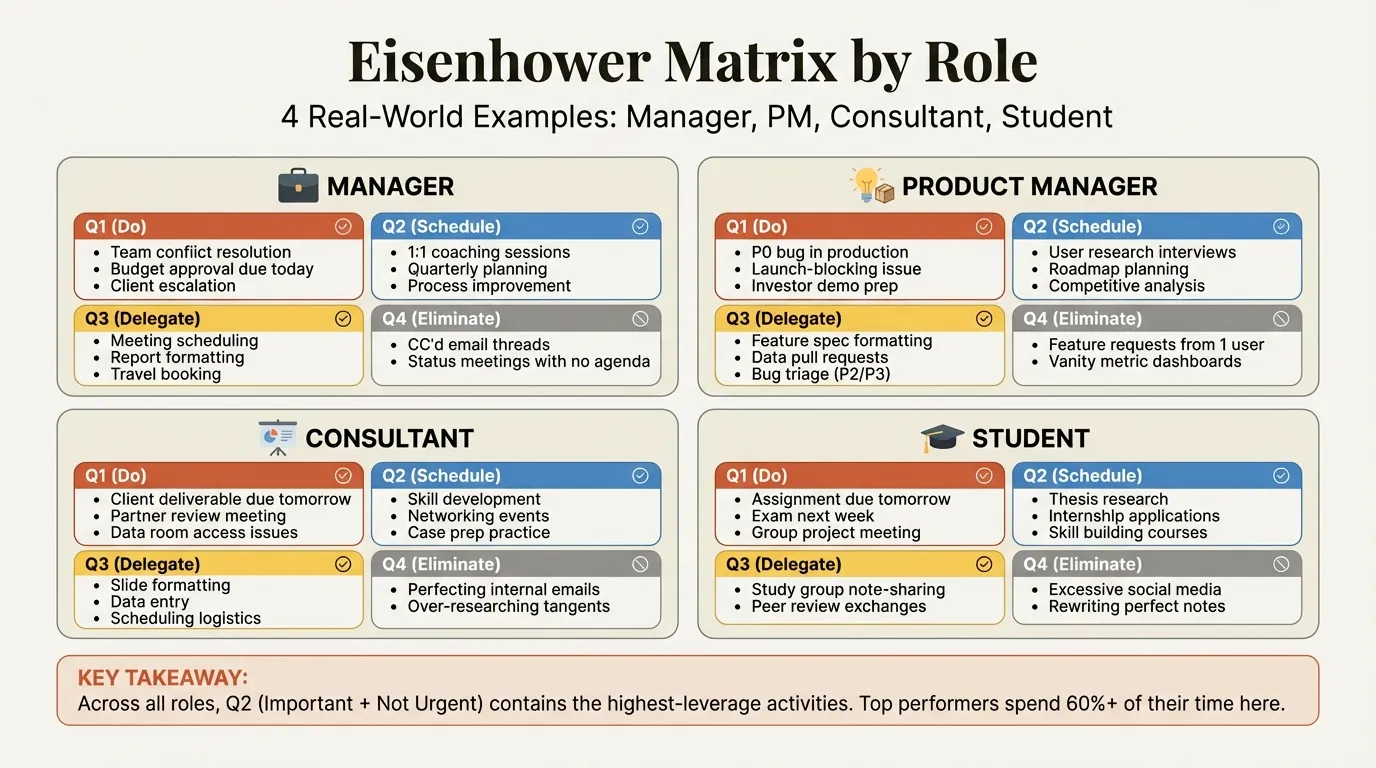
Generic Eisenhower Matrix examples -- "respond to emails" in Q3, "scroll social media" in Q4 -- are not helpful when you are a project manager with 40 open tickets or a startup founder deciding between a product demo and a fundraising call. The matrix only works when the tasks inside it reflect your actual role.
After applying the Eisenhower Matrix across 90+ strategy and operations engagements, we have found that the same task lands in completely different quadrants depending on who you are and what you are accountable for. A customer escalation is Q1 for a support lead and Q3 for a CEO. A market research report is Q2 for a marketing director and Q4 for a software engineer.
This guide provides six filled-in Eisenhower Matrix examples for specific professional roles, shows how context changes categorization, and covers a practical triage process for when everything feels urgent. For the methodology behind the framework, see our Eisenhower Matrix Guide. For a ready-to-use layout, grab the Eisenhower Matrix Template.
Why Role-Specific Eisenhower Matrix Examples Matter
Stephen Covey popularized the urgent-important matrix in The 7 Habits of Highly Effective People, arguing that effective people spend the majority of their time in Quadrant 2 -- important but not urgent work like planning, relationship building, and prevention. The framework is sound, but the challenge is deciding which quadrant a specific task belongs in.
Research on the mere urgency effect by Zhu, Yang, and Hsee (2018) found that people consistently choose urgent tasks over important ones, even when the important tasks offer objectively better payoffs. Role-specific examples counteract this bias by showing you what "important but not urgent" actually looks like in your context, making Q2 tasks harder to ignore.
Eisenhower Matrix Example 1: Project Manager
| Quadrant | Tasks |
|---|---|
| Q1: Do First | Fix critical bug blocking client UAT sign-off; Resolve resource conflict delaying sprint delivery; Prepare exec steering committee deck due tomorrow; Address scope change request with contractual deadline |
| Q2: Schedule | Build resource forecasting model for next quarter; Document lessons learned from completed workstream; Set up automated testing pipeline; Develop onboarding guide for new team members |
| Q3: Delegate | Compile weekly status report from team updates; Schedule recurring meeting rooms for next month; Respond to vendor procurement questionnaire; Update project wiki with latest decisions |
| Q4: Eliminate | Attend standing meeting where your workstream is not on the agenda; Reformat internal deck that nobody presents; Manually track metrics already captured in the PM tool; Join optional brainstorm for a project you are not staffed on |
Key insight: Project managers overload Q1 because every stakeholder frames their request as urgent. The test is whether a 48-hour delay creates material consequences. Most "urgent" stakeholder requests are actually Q3: urgent for them, not important for your delivery goals.
Eisenhower Matrix Example 2: Marketing Director
| Quadrant | Tasks |
|---|---|
| Q1: Do First | Approve final creative for campaign launching this week; Respond to PR crisis on social media; Fix tracking pixel breaking attribution on live ads; Submit regulatory compliance review before product launch |
| Q2: Schedule | Develop Q3 content strategy and editorial calendar; Build attribution model linking spend to pipeline; Run customer research interviews for positioning refresh; Establish brand guidelines for new market entry |
| Q3: Delegate | Review and approve routine social media posts; Process marketing swag order for upcoming conference; Respond to partnership inquiry with standard evaluation criteria; Update monthly dashboard with latest metrics |
| Q4: Eliminate | Attend weekly all-hands where marketing is never on the agenda; Produce monthly report that no stakeholder has referenced in 6 months; Manually resize images that the design tool auto-generates; Join recurring vendor demo calls for tools you already evaluated |
Key insight: Marketing is a service function -- every department wants "just a quick design." Delegating Q3 requests with clear SLAs protects Q2 time for the strategy work that compounds.
Eisenhower Matrix Example 3: Startup Founder
| Quadrant | Tasks |
|---|---|
| Q1: Do First | Close contract with enterprise client before quarter-end; Fix production outage affecting paying users; Prepare board deck for investor meeting in 48 hours; Resolve co-founder disagreement on product direction |
| Q2: Schedule | Build hiring pipeline for the next two critical roles; Develop 12-month product roadmap with customer input; Establish financial controls and reporting cadence; Cultivate relationships with three strategic advisors |
| Q3: Delegate | Respond to inbound partnership requests with standard criteria; Process office logistics and vendor payments; Draft social media content for company updates; Handle routine customer support escalations |
| Q4: Eliminate | Attend networking events with no qualified prospects; Optimize internal slide formatting for deck aesthetics; Research competitors who are not in your target segment; Join accelerator alumni calls with no actionable content |
Key insight: Founders treat everything as Q1 because the emotional stakes are personal. The fix is defining importance against one metric: does this directly increase revenue, reduce burn, or de-risk the next funding milestone? If no, it is not Q1. For more on systematic prioritization, see how to prioritize tasks.
Continue reading: Progress Report Template · How to Make a Gantt Chart in PowerPoint (Free Template) · Competitive Landscape Slide
Use consulting-grade layouts in PowerPoint
Start from structured business slides and customize them in your own deck. 14-day free trial. No credit card required.
Eisenhower Matrix Example 4: Management Consultant
| Quadrant | Tasks |
|---|---|
| Q1: Do First | Finalize client deliverable due for steering committee tomorrow; Resolve data discrepancy flagged by partner before client review; Prepare materials for client workshop happening this week; Address staffing gap on active engagement |
| Q2: Schedule | Develop thought leadership on emerging industry trend; Build reusable frameworks and templates for future engagements; Mentor junior consultants on structured problem-solving; Cultivate two new client relationships for pipeline |
| Q3: Delegate | Format appendix slides to firm visual standards; Compile benchmarking data from public sources; Schedule internal knowledge-sharing sessions; Update CRM with latest client interaction notes |
| Q4: Eliminate | Attend internal committee meetings with no decision items; Refine internal process documents nobody follows; Join pitch prep for proposals outside your industry focus; Produce weekly time tracking summaries beyond what compliance requires |
Key insight: Consulting culture pressures people to treat Q3 as Q1 because a partner's request feels non-negotiable. The distinction: does the request advance the client engagement (Q1) or is it operational overhead a junior can handle (Q3)? Senior consultants who delegate Q3 formatting and data compilation free 8-12 hours per week for Q2 work that drives career progression.
Eisenhower Matrix Example 5: Software Engineer
| Quadrant | Tasks |
|---|---|
| Q1: Do First | Fix P1 production bug causing data loss for users; Complete feature code that is blocking QA before sprint deadline; Resolve security vulnerability flagged in dependency audit; Unblock teammate waiting on your code review for a release |
| Q2: Schedule | Refactor authentication module to reduce tech debt; Write integration tests for the payment service; Evaluate and prototype new caching architecture; Contribute to engineering team's on-call runbook |
| Q3: Delegate | Respond to non-blocking code review requests; Update Jira tickets with latest status and estimates; Triage low-severity bug reports from support queue; Set up dev environment for new team member |
| Q4: Eliminate | Attend sprint retro where the same three issues are raised with no action items; Optimize code that is not in a performance-critical path; Refactor a module scheduled for deprecation next quarter; Join optional architecture review for a service you do not own |
Key insight: Engineers struggle most with the Q2/Q4 boundary. The test: does the work prevent a foreseeable production issue or improve a metric you are measured on? Refactoring a module scheduled for deprecation is Q4 regardless of how satisfying the code cleanup feels.
Eisenhower Matrix Example 6: Executive (VP/C-Suite)
| Quadrant | Tasks |
|---|---|
| Q1: Do First | Make final decision on acquisition that has a term sheet deadline; Address executive team conflict that is paralyzing a division; Present quarterly results to the board; Respond to major customer escalation that threatens a top-10 account |
| Q2: Schedule | Define 3-year strategic vision and communicate to the organization; Build succession pipeline for two critical leadership roles; Develop relationships with industry peers and potential acquirers; Review and pressure-test annual budget assumptions |
| Q3: Delegate | Approve routine budget reallocation requests under threshold; Respond to media interview requests through comms team; Review and sign standard vendor contracts; Provide input on office space and facilities decisions |
| Q4: Eliminate | Attend operational meetings that your direct reports already run; Review individual contributor performance ratings (delegate to VPs); Join product demos for features already in the approved roadmap; Read detailed technical architecture documents (read the summary instead) |
Key insight: The executive trap is not Q1 overload -- it is failing to delegate Q3. Effective executives set delegation thresholds: any decision under $50K, any hire below director level, any contract within standard terms gets delegated with a reporting mechanism, not a bottleneck.
How the Same Task Changes Quadrants by Role
Context determines categorization. Here is how the same task lands differently depending on who you are.
| Task | Project Manager | Startup Founder | Executive |
|---|---|---|---|
| Customer support escalation | Q3 -- Delegate to support lead | Q1 -- Every customer matters | Q3 -- Delegate unless top-10 account |
| Quarterly strategy review | Q2 -- Not your primary output | Q1 -- Survival depends on it | Q2 -- Critical but not a daily fire |
| Update project documentation | Q2 -- Knowledge transfer value | Q4 -- Pre-PMF, no one reads it | Q4 -- Your team handles this |
| Respond to investor email | Q4 -- Not your responsibility | Q1 -- Runway depends on it | Q3 -- Delegate to IR or CFO |
| Fix broken analytics dashboard | Q1 -- Team needs data to deliver | Q3 -- Delegate to engineer | Q4 -- Delegate entirely |
This is why copying someone else's matrix does not work. Your matrix must reflect your goals and accountability. For multi-criteria decisions where two dimensions are not enough, a decision matrix with weighted scoring provides more nuance.
When Everything Feels Urgent: A 3-Step Triage Process
"Everything on my list is urgent and important" is the most common objection we hear. Research on the illusion of urgency confirms this is a perceptual problem, not a reality. Here is the triage process we use when a client team's Q1 is overflowing:
Step 1: Deadline-test. For each task, ask: does this have a hard, externally imposed deadline within 48 hours? "Hard" means contractual, regulatory, or a client commitment. "My manager would prefer it sooner" is not a hard deadline. Typically, 60-70% of "urgent" tasks fail this test.
Step 2: Consequence-test. For tasks that passed Step 1, ask: what happens if this slips by one week? If the answer involves lost revenue, regulatory penalty, or a broken commitment, it is genuinely Q1. If the answer is "someone will be annoyed," it is Q3.
Step 3: Check whose urgency it is. If a task is urgent for a colleague but does not advance your stated goals, it belongs in Q3, not Q1. As Covey noted, spending time on other people's urgencies while neglecting your own important work is the defining pattern of ineffective professionals.
After this triage, most people find that genuine Q1 drops to 3-5 tasks.
Common Mistakes With Worked Examples
Mistake 1: Confusing Urgent-for-Others With Urgent-for-You
A sales rep emails you at 4 PM asking for updated pricing slides "ASAP for a meeting tomorrow." It feels urgent because someone is waiting. But updating pricing slides does not advance your revenue target -- it advances theirs. This is Q3: delegate or provide a self-service template.
The fix: before categorizing any task as Q1, ask "whose goal does this advance?"
Mistake 2: Overloading Quadrant 1
A product manager lists 15 tasks in Q1. That is not prioritization -- it is a to-do list with a Q1 label. Apply the 48-hour deadline test: of those 15 tasks, probably three have genuine deadlines and material consequences this week. The rest belong in Q2 or Q3.
Mistake 3: Leaving Quadrant 2 Empty
When Q1 and Q3 fill the week, Q2 gets postponed indefinitely. The irony: neglecting Q2 is exactly what creates future Q1 crises. Skipping the capacity plan means scrambling when three projects hit peak resourcing simultaneously.
The fix: block Q2 time on Monday morning before the week's urgencies arrive. Four hours of protected Q2 time per week prevents more crises than four hours of reactive Q1 work.
Building Your Own Eisenhower Matrix
Use these examples as starting points, not templates to copy:
- List 20-30 tasks from your current backlog, inbox, and project tracker.
- Define your goals. Write down your three most important quarterly objectives. Importance is measured against these, not general intuition.
- Apply the two tests. For each task: deadline within 48 hours? Advances a stated goal? Sort accordingly.
- Check the distribution. If Q1 has more than five items, tighten your urgency criteria. If Q2 is empty, you are in reactive mode.
- Review weekly. Tasks move between quadrants as deadlines approach. A static matrix goes stale within days.
For presenting your prioritization to stakeholders, the Eisenhower Matrix Template provides a ready-to-use 2x2 layout. For the full methodology, see the Eisenhower Matrix Guide, and for how this fits alongside other strategy tools, explore the Strategic Frameworks Guide.
Use consulting-grade layouts in PowerPoint
Start from structured business slides and customize them in your own deck. 14-day free trial. No credit card required.