Customer Journey Mapping: A Consultant's Guide to CX Transformation
Customer journey mapping methodology for consultants and CX professionals. Workshop facilitation, touchpoint analysis, and key metrics for every stage.
Customer journey mapping is the single most effective tool for aligning an organization around the customer's actual experience rather than the experience leadership assumes they deliver. As McKinsey's research on customer experience has shown, the gap between those two things is where revenue leaks, churn hides, and competitive differentiation dies.
After facilitating customer journey mapping workshops across 60+ CX transformation engagements, we have found that the quality of the map depends far less on the template and far more on who is in the room, what data informs the conversation, and whether the output connects to measurable business outcomes.
This guide covers the methodology behind effective customer journey mapping: the five stages, four mapping approaches, workshop facilitation, touchpoint analysis, and the metrics that turn maps into action. For a broader look at how journey mapping fits into strategic analysis, see our Strategic Frameworks Guide.
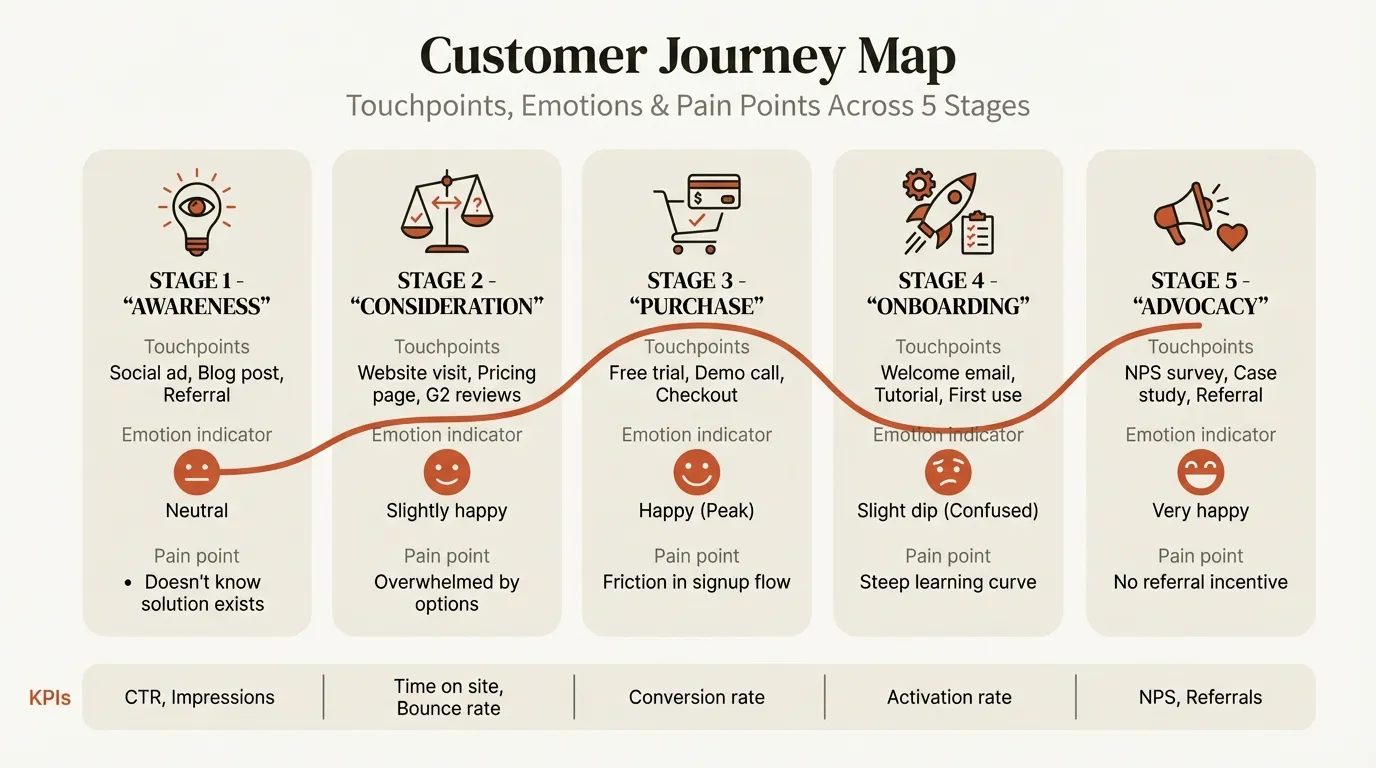
What Is Customer Journey Mapping?
Unlike process maps that document internal workflows, customer journey mapping adopts the customer's perspective -- visualizing every interaction across the full lifecycle, capturing what they do, think, feel, and experience at each stage.
A well-built journey map includes five layers:
| Layer | What It Captures | Example |
|---|---|---|
| Actions | What the customer does | Visits website, reads reviews, contacts support |
| Touchpoints | Where the interaction happens | Website, email, store, call center, app |
| Thoughts | What the customer is thinking | "Is this worth the price?" "Why is this so complicated?" |
| Emotions | How the customer feels | Excited, frustrated, confused, confident |
| Opportunities | Where the organization can improve | Reduce response time, simplify checkout, add self-service |
Journey maps force cross-functional teams to see the experience as a connected whole. Marketing owns awareness, sales owns conversion, support owns retention -- but as Harvard Business Review's research on journey mapping demonstrates, the customer experiences one journey, and the handoff gaps between departments are often the worst moments in it.
The 5 Stages of a Customer Journey
Most customer journeys follow five stages regardless of industry.
Stage 1: Awareness
The customer recognizes a need and begins looking for solutions. They may not know your brand exists. Touchpoints are broad -- search engines, social media, word of mouth, industry publications.
What matters: Speed to relevance. First impressions here set the emotional tone for the entire journey.
Stage 2: Consideration
The customer has identified potential solutions and is actively evaluating them -- visiting websites, reading case studies, requesting demos, comparing pricing. This is where B2B and B2C diverge most: B2B consideration can last months and involve multiple stakeholders.
What matters: Reducing friction and building trust. Every unanswered question pushes the customer toward a competitor who answered it.
Stage 3: Decision
The customer commits. In B2C, this is often a single transaction. In B2B, it involves procurement, legal review, contract negotiation, and budget approval.
What matters: Removing last-mile friction. Complicated checkout processes, unclear pricing, and slow proposal turnarounds kill deals that were otherwise won.
Stage 4: Retention
The customer is using your product or service. Onboarding quality, support responsiveness, and product reliability determine whether they stay.
What matters: Delivering on the promise. The gap between marketing messaging and actual product experience is the number one driver of churn in the first 90 days.
Stage 5: Advocacy
Satisfied customers become promoters -- leaving reviews, referring colleagues, expanding usage. Dissatisfied customers do the opposite, and they are louder.
What matters: Making advocacy easy. Referral programs, review prompts, and community platforms convert passive satisfaction into active promotion.
Four Approaches to Customer Journey Mapping
Choosing the right approach depends on what question you are trying to answer.
| Approach | Focus | Best For | Typical Duration |
|---|---|---|---|
| Current State | Documents the experience as it exists today | Diagnosing pain points, baselining metrics | 1-2 day workshop |
| Future State | Envisions the ideal target experience | Designing transformation roadmaps | 2-3 day workshop |
| Day-in-the-Life | Maps a full day in the customer's life, beyond your product | Understanding unmet needs and context | Ethnographic research + workshop |
| Service Blueprint | Adds operational layers (frontstage, backstage, support processes) | Aligning internal processes to CX goals | 2-4 day cross-functional workshop |
Current State Maps
Start here. Current state maps are built from real data -- customer interviews, support tickets, analytics, NPS verbatims, and session recordings. The most common mistake is relying on internal assumptions. We have seen cases where the marketing team's version of the journey and the actual customer journey shared almost nothing in common.
Future State Maps
Future state maps define where you want to go. They are most effective after a thorough current state analysis, because the gaps between current and future state become the transformation backlog -- specific, prioritized initiatives with clear ownership.
Day-in-the-Life Maps
This approach zooms out beyond your product to understand the customer's full context. A healthcare patient's journey does not start when they open your app -- it starts when they wake up feeling unwell. That broader context reveals opportunities product-centric maps miss.
Service Blueprints
Service blueprints, a methodology pioneered by Lynn Shostack and widely adopted in service design, extend the journey map by adding operational depth: frontstage (what the customer sees), backstage (what employees do behind the scenes), and support processes (systems and policies). They connect CX improvements to specific process changes.
Continue reading: Go-to-Market Slide · Marimekko Charts in Excel · Competitive Landscape Slide
Use consulting-grade layouts in PowerPoint
Start from structured business slides and customize them in your own deck. 14-day free trial. No credit card required.
How to Run a Customer Journey Mapping Workshop
A poorly facilitated workshop produces a map that reflects the loudest voice in the room. A well-facilitated one produces actionable insights backed by data.
Pre-Workshop Preparation
Start preparation 2-3 weeks before the workshop:
-
Gather data. Pull customer interviews, NPS scores, support ticket themes, web analytics, and sales cycle data. Raw data on the wall is more persuasive than anyone's opinion.
-
Select the persona. Map one persona per workshop. Choose the persona that represents the highest-value or highest-volume segment. For guidance on building those segments, see the Customer Segmentation Template.
-
Invite the right people. You need 8-12 participants from every function that touches the customer: marketing, sales, product, support, operations, and at least one executive sponsor who can authorize follow-up actions.
-
Prepare the room. Large wall space, sticky notes in five colors (one per journey stage), markers, and printed customer quotes. Physical workshops produce better collaboration for first-time mapping exercises, though digital tools work for remote teams.
Workshop Structure (Half-Day Format)
Hour 1: Align on the customer. Present the persona, share data, and read customer quotes aloud. Shift participants from "what I think happens" to "what the data shows."
Hour 2: Map the stages. Walk through each stage sequentially, capturing actions, touchpoints, thoughts, and emotions. Use sticky notes so participants contribute simultaneously.
Hour 3: Identify pain points. Mark where the experience breaks down (red dots) and exceeds expectations (green dots). Prioritize by severity and frequency using a 2x2 matrix.
Hour 4: Define opportunities. For each high-priority pain point, brainstorm improvements. Assign ownership, define success metrics, and set a 30-day follow-up.
Workshop Facilitation Tips
- Ban solution-jumping. Participants will want to fix problems immediately. Resist this. Map the full journey first, then prioritize, then solve.
- Use customer quotes as anchors. When debate stalls, read a customer quote. It redirects the conversation from internal politics to external reality.
- Time-box ruthlessly. Set clear time limits per stage and enforce them.
- Capture dissent. When participants disagree about the experience, that disagreement is itself a finding -- the organization does not have a shared understanding of the customer.
Touchpoint Analysis and Pain Point Prioritization
Each touchpoint should be evaluated across three dimensions:
| Dimension | Question | Measurement |
|---|---|---|
| Reach | How many customers use this touchpoint? | % of customers who encounter it |
| Impact | How much does it influence satisfaction or conversion? | Correlation with NPS or conversion rate |
| Performance | How well is it working today? | Customer satisfaction score, completion rate |
High-reach, high-impact, low-performance touchpoints are your priority targets -- the moments where the most customers have the worst experiences on the interactions that matter most.
Pain Point Categories
Categorize pain points to guide the right type of response:
| Category | Example | Typical Fix |
|---|---|---|
| Process friction | 7-step checkout when 3 would suffice | Process redesign |
| Information gaps | Customer cannot find pricing without contacting sales | Content and UX improvements |
| Handoff failures | Customer repeats their story to every new agent | System integration, CRM investment |
| Expectation mismatches | Marketing promises 24-hour response, actual SLA is 48 hours | Align messaging to reality (or improve SLA) |
| Channel inconsistencies | Mobile app and website show different information | Omnichannel platform investment |
For alignment on which pain points to tackle first, stakeholder mapping helps identify who has decision-making authority over each part of the journey.
Integrating Personas Into Customer Journey Mapping
A journey map without a specific persona is a process diagram wearing a customer mask. The behaviors, motivations, and emotional responses that make journey maps valuable are persona-specific. Each persona needs: a demographic/firmographic profile, goals and motivations, pain points, preferred channels, and decision criteria.
When multiple personas share the same journey but experience it differently, create a base map and annotate persona-specific variations. A first-time buyer and a repeat enterprise customer follow the same stages but encounter different pain points at each one.
Customer Journey Mapping Metrics by Stage
Journey maps without metrics are opinion pieces. Connecting each stage to measurable KPIs transforms the map into a management tool.
| Stage | Primary Metrics | Leading Indicators |
|---|---|---|
| Awareness | Brand awareness, share of search, website traffic | Content engagement rate, social mention volume |
| Consideration | Lead volume, demo requests, content downloads | Time on site, pages per session, return visit rate |
| Decision | Conversion rate, sales cycle length, win rate | Proposal-to-close ratio, average deal size |
| Retention | Churn rate, NPS, customer lifetime value | Support ticket volume, feature adoption rate, login frequency |
| Advocacy | Referral rate, review volume, expansion revenue | Net promoter score, customer effort score |
Track these monthly and overlay them on your journey map. When a metric degrades, you know exactly which stage to investigate. For tracking progress across a marketing funnel that aligns with these stages, the Marketing Funnel Template provides a structured visualization.
B2B vs. B2C Customer Journey Mapping
The five stages apply to both B2B and B2C, but the execution differs significantly.
| Dimension | B2C | B2B |
|---|---|---|
| Decision-makers | 1-2 people | 6-10 stakeholders (buying committee) |
| Sales cycle | Minutes to days | Weeks to months |
| Emotional drivers | Personal desire, convenience, price | Risk mitigation, ROI, career impact |
| Touchpoints per stage | 2-4 | 8-15 |
| Data sources | Web analytics, transaction data, reviews | CRM data, sales call recordings, RFP responses |
| Journey complexity | Linear with some loops | Non-linear with parallel evaluation tracks |
B2B journey maps must account for the buying committee -- the end user, budget holder, technical evaluator, procurement team, and executive sponsor each have a different journey through the same purchase. The most effective B2B maps layer multiple stakeholder perspectives onto a single timeline. This complexity is why B2B workshops often require two days instead of one.
Common Customer Journey Mapping Mistakes
-
Mapping from the inside out. If your journey stages are named after departments (Marketing, Sales, Onboarding, Support), you have built an org chart, not a journey map. Name stages from the customer's perspective.
-
Skipping the data. Journey maps built from internal assumptions reflect what the organization believes, not what customers experience. Even 10-15 customer interviews change the output dramatically.
-
Mapping once and filing it away. Customer behavior changes, new channels emerge, competitors shift the baseline. Review and update your journey map quarterly.
-
Trying to map everything at once. Start with one persona, one journey, and one mapping approach. Teams that try to map every persona across every journey produce maps too broad to be actionable.
-
No clear ownership of follow-through. The workshop is not the deliverable. The improvements that come from it are. Every pain point needs an owner, a timeline, and a success metric.
From Journey Map to Action
The best journey maps share three characteristics: they are data-informed, specific to a persona, and connected to a prioritized improvement backlog.
Key principles:
- Start with current state mapping grounded in real customer data
- Use workshops to build cross-functional alignment, not just the map itself
- Prioritize pain points by reach, impact, and performance gap
- Assign ownership and metrics to every identified opportunity
- Review and update quarterly -- journey maps are living documents
For practical examples, see our Customer Journey Map Examples. If you need a ready-to-use starting point for your next workshop, the Customer Journey Map Template provides a structured layout you can customize in PowerPoint with Deckary's framework templates and alignment tools.
Journey mapping done well is not a design exercise. It is a strategic discipline that forces organizations to confront the gap between the experience they deliver and the one customers actually receive. Closing that gap is where CX transformation begins.
Use consulting-grade layouts in PowerPoint
Start from structured business slides and customize them in your own deck. 14-day free trial. No credit card required.