Business Case Examples: 5 Worked Models That Got Approved
Business case examples with filled-in financials across technology, market entry, automation, hiring, and relocation. Includes NPV, IRR, and payback analysis.
Knowing the structure of a business case is one thing. Filling in each section with credible numbers, defensible assumptions, and a recommendation that survives executive scrutiny is another. The gap between understanding the template and producing a case that gets funded is where most teams stall.
This guide closes that gap with five fully worked business case examples -- each with a completed executive summary, quantified problem statement, options analysis, financial comparison, risk assessment, and recommendation. These are not outlines or placeholders. They are filled-in models based on real engagement patterns.
After building and reviewing business cases across 90+ investment committee presentations -- informed by principles from PMI's business case framework -- we have found that the examples that win approval share three traits: they quantify the cost of doing nothing, they present conservative base cases that still clear the hurdle rate, and they address the top objection before the executive raises it. For the structural framework behind these examples, see our Business Case Template Guide. For the broader strategic context, see the Strategic Frameworks Guide.
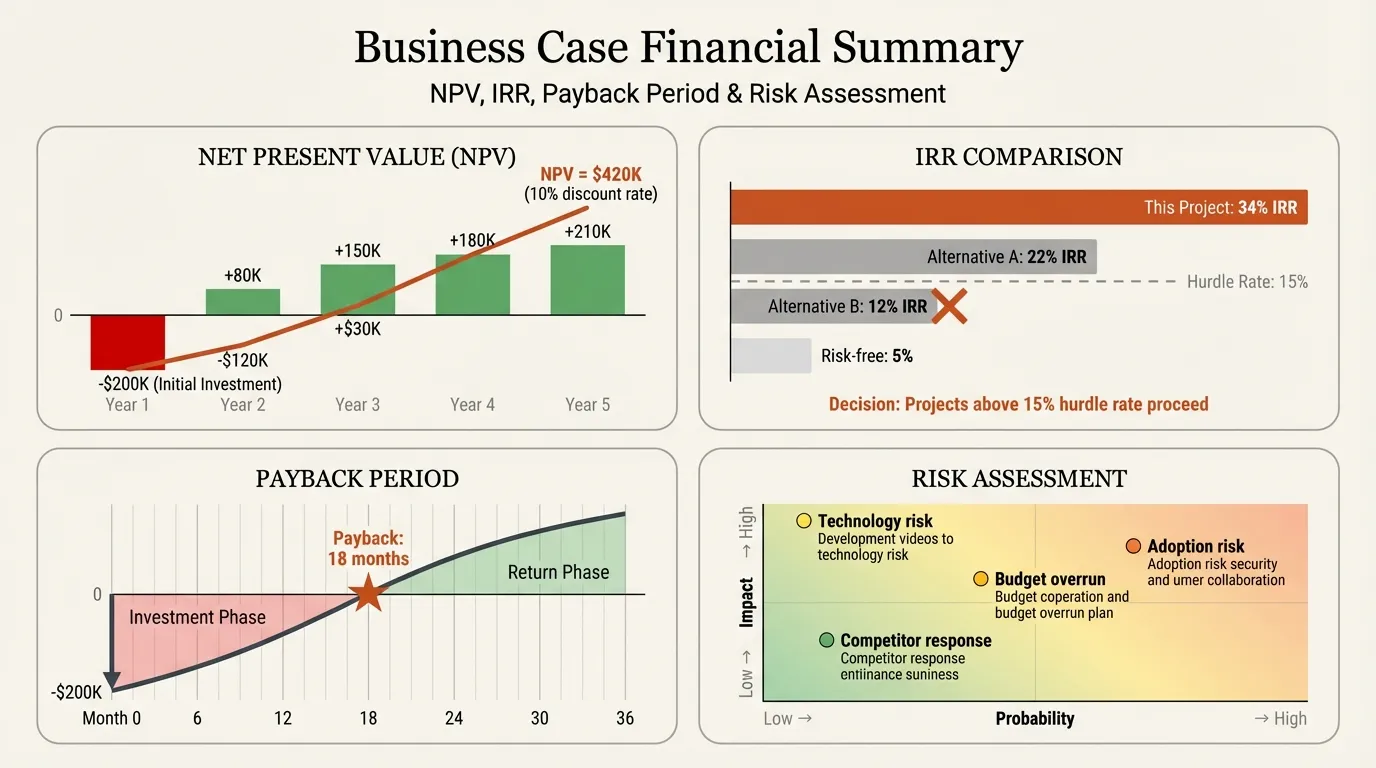
Business Case Example 1: Technology Investment (CRM Platform)
Context: A 400-person professional services firm running client tracking on spreadsheets and Outlook. The managing partner wants a business case for a CRM platform.
Executive Summary: We recommend implementing Salesforce Professional at a total three-year cost of $486K to address the $1.2M annual revenue leakage caused by missed follow-ups and duplicate outreach. The investment yields a 3-year NPV of $1.14M, IRR of 68%, and payback within 11 months. The recommendation holds under a pessimistic scenario where adoption reaches only 60%.
Problem Statement: The current spreadsheet-based system causes three measurable problems: missed follow-ups on 18% of qualified leads (estimated $840K in lost annual revenue), duplicate outreach to the same prospects by different partners ($210K in wasted BD time), and zero pipeline visibility for leadership ($150K in misallocated partner time on manual reporting). Total annual cost of inaction: $1.2M.
Options Analysis:
| Option | Description | 3-Year Cost | 3-Year Benefit | Net |
|---|---|---|---|---|
| Do nothing | Maintain spreadsheets | $0 | -$3.6M (cumulative leakage) | -$3.6M |
| Lightweight CRM (HubSpot Free + customization) | Basic tracking, limited reporting | $85K | $1.4M | +$1.32M |
| Mid-tier CRM (Salesforce Professional) | Full pipeline, reporting, integration | $486K | $2.7M | +$2.21M |
| Enterprise CRM (Salesforce Enterprise + consultant) | Advanced analytics, AI scoring | $920K | $3.1M | +$2.18M |
Recommendation: Option 3 (Salesforce Professional). Option 4 delivers only marginally higher net benefit ($2.18M vs. $2.21M) at nearly double the cost, making Option 3 the clear risk-adjusted choice. Option 2 solves the tracking problem but lacks the reporting capabilities that eliminate the $150K in manual reporting costs.
Key Risks: Adoption below 70% in Year 1 (mitigation: dedicated admin and mandatory training); data migration errors from 12 years of spreadsheets (mitigation: phased migration with validation checkpoints); partner resistance to new workflows (mitigation: pilot with two willing partners first, use early wins to build momentum).
Business Case Example 2: New Market Entry
Context: A UK-based B2B SaaS company ($28M ARR) evaluating expansion into the DACH region (Germany, Austria, Switzerland).
Executive Summary: We recommend organic market entry into Germany with a Munich-based team of four, at a first-year investment of $1.1M. This approach yields a 3-year NPV of $2.8M and IRR of 42%, with break-even at Month 18. The acquisition alternative (acquiring a German competitor for $8M) offers higher upside but introduces integration risk that makes the risk-adjusted return lower.
Problem Statement: Growth in the UK market is decelerating from 45% to 22% year-over-year. The DACH region represents the largest untapped market for our category in Europe -- $340M TAM with 12% SaaS penetration versus 31% in the UK. Without geographic expansion, our growth trajectory drops below the 30% threshold that supports our current valuation multiple.
Options Analysis:
| Option | Year 1 Investment | 3-Year NPV | IRR | Payback | Key Risk |
|---|---|---|---|---|---|
| Do nothing | $0 | $0 | -- | -- | Growth falls below 30%, valuation compression |
| Organic entry (Munich team of 4) | $1.1M | $2.8M | 42% | 18 months | Slow pipeline build, 12-month ramp |
| Acquisition ($8M target) | $8M + $2M integration | $4.1M | 24% | 31 months | Integration failure, key employee departure |
| Channel partnership (local reseller) | $180K | $0.9M | 51% | 9 months | Low control, brand dilution, margin compression |
Recommendation: Organic entry. While the acquisition has a higher absolute NPV ($4.1M vs. $2.8M), the $10M total capital deployed produces a lower IRR (24% vs. 42%) and a longer payback (31 vs. 18 months). The organic approach also preserves the option to acquire later if initial traction validates the market. The channel partnership has an attractive IRR but caps long-term upside -- use it as a complementary strategy in Austria and Switzerland while the direct team focuses on Germany.
Key Risks: Longer-than-expected sales cycles in Germany (mitigation: hire a country manager with an existing network; budget for 9-month ramp instead of 6); GDPR and data residency requirements (mitigation: deploy EU-hosted infrastructure before first sales call); currency fluctuation (mitigation: price in EUR, hedge quarterly).
Continue reading: Case Study Presentation · Marimekko Charts in Excel · Competitive Landscape Slide
Use consulting-grade layouts in PowerPoint
Start from structured business slides and customize them in your own deck. 10 free AI prompts. No credit card required.
Business Case Example 3: Process Automation
Context: A 2,000-person insurance company where the claims processing team of 45 people handles 8,000 claims per month. Average processing time is 4.2 days; the industry benchmark is 1.8 days.
Executive Summary: We recommend implementing an RPA and document-processing solution at a total investment of $1.4M (Year 1) to reduce claims processing time from 4.2 to 1.9 days and cut per-claim cost from $68 to $31. The initiative yields a 3-year NPV of $3.2M, IRR of 89%, and payback within 8 months. We do not recommend reducing headcount -- redeployed staff will address the 2,200-claim monthly backlog that currently drives 14% of customer complaints.
Problem Statement: Slow claims processing costs the company $2.1M annually across three categories: $890K in overtime during peak periods, $740K in customer churn attributed to processing delays (exit survey data, last 24 months), and $470K in error-related rework (6.3% error rate versus 2.1% industry benchmark).
Financial Comparison:
| Metric | Do Nothing | Partial Automation (RPA Only) | Full Automation (RPA + Document AI) |
|---|---|---|---|
| Year 1 investment | $0 | $620K | $1.4M |
| Annual operating cost | $3.7M | $2.8M | $2.1M |
| Per-claim cost | $68 | $47 | $31 |
| Processing time | 4.2 days | 2.8 days | 1.9 days |
| Error rate | 6.3% | 3.8% | 1.7% |
| 3-Year NPV (10% discount) | -$6.3M (cumulative cost) | $1.4M | $3.2M |
| IRR | -- | 52% | 89% |
| Payback period | -- | 14 months | 8 months |
Recommendation: Full automation. The incremental $780K investment over partial automation delivers more than double the NPV ($3.2M vs. $1.4M). The document AI component drives the majority of error reduction (from 3.8% to 1.7%), which eliminates the rework costs that partial automation leaves on the table. Phase the rollout: RPA in Months 1-3, document AI in Months 4-6, full integration by Month 8.
Key Risks: Staff resistance to automation (mitigation: frame as backlog elimination, not headcount reduction; retrain 12 staff for complex claims that require human judgment); vendor lock-in with document AI provider (mitigation: negotiate data portability clause; architect abstraction layer); accuracy below threshold on non-standard documents (mitigation: manual fallback queue for documents below 85% confidence score).
Business Case Example 4: Hiring and Team Expansion
Context: A Series B startup ($12M ARR) where the sales team of 8 reps is at capacity. Pipeline coverage has dropped from 3.5x to 2.1x over two quarters. The VP of Sales requests headcount for 4 additional reps plus 1 sales manager.
Executive Summary: We recommend hiring 3 reps and 1 sales manager (not 4 reps) at a first-year fully loaded cost of $680K. This team structure yields projected incremental ARR of $2.4M by Month 18, a payback period of 10 months, and preserves the option to add a fourth rep in Q3 once the manager has established coaching infrastructure. Hiring 4 reps without a manager risks repeating the current problem -- high activity, low conversion.
Problem Statement: Pipeline coverage at 2.1x is below the 3.0x minimum that historically correlates with hitting quarterly targets. Over the last two quarters, the team missed quota by 18% and 12% respectively. Each missed quota percentage point costs approximately $45K in ARR, meaning current under-capacity costs roughly $540K-$810K annually. The bottleneck is not lead generation (marketing delivers 340 MQLs/month against a capacity of 280) -- it is rep bandwidth.
Options Analysis:
| Option | Year 1 Cost | Projected Y1 Incremental ARR | Pipeline Coverage | Risk |
|---|---|---|---|---|
| Do nothing | $0 | -$540K to -$810K (continued miss) | 2.1x (declining) | Continued quota misses, rep burnout |
| Hire 2 reps | $340K | +$960K | 2.7x | Still below 3.0x threshold |
| Hire 3 reps + 1 manager | $680K | +$1.6M (Year 1), +$2.4M (Month 18) | 3.2x | Manager ramp, culture fit |
| Hire 4 reps + 1 manager | $850K | +$1.8M (Year 1), +$2.9M (Month 18) | 3.6x | Over-hiring before process is proven |
Recommendation: Option 3 (3 reps + 1 manager). The manager role is the critical differentiator. Current reps operate without structured coaching, leading to a 22% conversion rate versus the 31% benchmark for teams with dedicated management. A manager who raises conversion by even 5 percentage points across 11 reps (8 existing + 3 new) generates more incremental ARR than a fourth rep operating at current conversion rates.
Key Risks: Sales manager takes 4-6 months to reach full effectiveness (mitigation: hire a player-coach who carries a small book while ramping the team); new reps ramp slower than modeled (mitigation: assume 6-month ramp, not the 4-month company average -- pad the timeline); existing reps leave during transition (mitigation: retention bonuses for top 3 performers during the first two quarters).
Business Case Example 5: Office Relocation
Context: A 180-person consulting firm occupying 22,000 sq ft in a CBD location. The lease expires in 8 months. Current rent is $62/sq ft; renewal is offered at $71/sq ft. The firm has been hybrid (3 days in-office) since 2022.
Executive Summary: We recommend relocating to a smaller, modern space (16,000 sq ft at $54/sq ft) in a secondary business district, saving $338K annually versus the current lease renewal. The one-time relocation cost of $410K pays back in 15 months. The recommendation assumes hybrid work continues at current levels -- if the firm shifts to 4+ days in-office, the smaller footprint becomes a constraint by Year 3.
Problem Statement: The current lease renewal at $71/sq ft represents a $198K annual increase ($1.56M to $1.76M). Utilization data from the last 12 months shows average daily occupancy of 58%, meaning the firm pays for 9,240 sq ft of space that sits empty on a typical day. The combination of above-market rent and low utilization creates $520K in annual waste.
Options Analysis:
| Option | Annual Rent | Relocation Cost | 3-Year Total | Annual Savings vs. Renewal |
|---|---|---|---|---|
| Renew current lease | $1.76M | $0 | $5.28M | Baseline |
| Relocate to 16,000 sq ft (secondary district) | $864K | $410K | $3.00M | $338K/year after Year 1 |
| Relocate to 18,000 sq ft (same district) | $1.19M | $380K | $3.95M | $119K/year after Year 1 |
| Sublease half + renovate | $780K + $320K reno | $320K | $3.62M | $234K/year after Year 1 |
Recommendation: Option 2 (16,000 sq ft, secondary district). It offers the highest annual savings and lowest 3-year total cost. The sublease option (Option 4) is attractive financially but creates operational complexity with shared floors and uncertain sublease income. Option 3 keeps the firm in the same district but only saves $119K/year -- not enough to justify the disruption of moving.
Key Risks: Employee resistance to new location (mitigation: survey showed 72% of staff prioritize commute time over prestige address; new location is 8 minutes from a metro station); client perception of non-CBD address (mitigation: retain one meeting room at a co-working space in the CBD for client-facing meetings; cost: $18K/year); space becomes too small if hybrid policy changes (mitigation: negotiate a first-right-of-refusal on adjacent 4,000 sq ft suite).
What Separates Approved Business Cases From Rejected Ones
After reviewing the outcomes of dozens of investment committee decisions, the pattern is consistent. Approved cases share traits that rejected cases lack.
Approved cases quantify the cost of doing nothing. As Harvard Business Review notes on investment decisions, every example above includes a "do nothing" option with a dollar figure. When executives see that inaction costs $1.2M annually (Example 1) or $540K-$810K in missed quota (Example 4), the question shifts from "should we spend money?" to "which option gives us the best return?"
Approved cases present conservative numbers. Notice that Example 4 models a 6-month ramp instead of the 4-month company average. Example 3 includes a manual fallback queue for edge cases rather than assuming 100% automation accuracy. Conservative assumptions that still clear the hurdle rate are more persuasive than optimistic projections that require everything to go right.
Approved cases address the top objection directly. In Example 1, the obvious objection is "why not the cheaper option?" -- the case explains why HubSpot Free falls short on reporting. In Example 4, the objection is "why hire a manager instead of a fourth rep?" -- the case shows the conversion math. Anticipating and answering the objection in the document prevents it from derailing the presentation.
Rejected cases share these patterns:
| Rejection Pattern | What It Looks Like | Fix |
|---|---|---|
| Vague problem statement | "We need to modernize our systems" | Attach a dollar figure: "$1.2M annual cost of current state" |
| Single option presented | "We recommend X" with no alternatives | Always include 3-4 options including "do nothing" |
| Missing sensitivity analysis | "NPV is $3.2M" with no scenario range | Show the result holds at -20% benefits and +25% costs |
| No implementation plan | Financial analysis stops at approval | Include a phased rollout with milestones |
| Benefits without evidence | "This will improve productivity by 30%" | Cite the data source: benchmarks, pilot results, industry studies |
For structuring these financial comparisons in a presentation, our budget table template provides pre-formatted layouts that match the table formats used in these examples. Deckary's AI Slide Builder can generate the full business case slide from a text description, including the options comparison and financial summary.
Key Takeaways
- Lead every business case example with a one-paragraph executive summary that states the recommendation, total investment, expected return, and payback period
- Quantify the cost of doing nothing -- it reframes the decision from "should we spend?" to "which option?"
- Present 3-4 options with a financial comparison table showing NPV, IRR, and payback across each
- Use conservative assumptions that still clear the hurdle rate -- they build more trust than optimistic projections
- Address the most likely objection in the document before the executive raises it in the room
- Include 3-5 risks with specific mitigations -- not generic risks, but ones tailored to the specific initiative
For the structural framework behind these examples, see our Business Case Template Guide. For related worked examples, explore Decision Tree Examples for modeling sequential decisions under uncertainty and Project Plan Examples for turning approved business cases into execution plans.
Use consulting-grade layouts in PowerPoint
Start from structured business slides and customize them in your own deck. 10 free AI prompts. No credit card required.