ROI Calculator
Calculate Return on Investment instantly. The standard metric for business cases, capital expenditure analysis, and corporate investment decisions.
ROI Formula:(Final Value - Initial Investment) / Initial Investment × 100
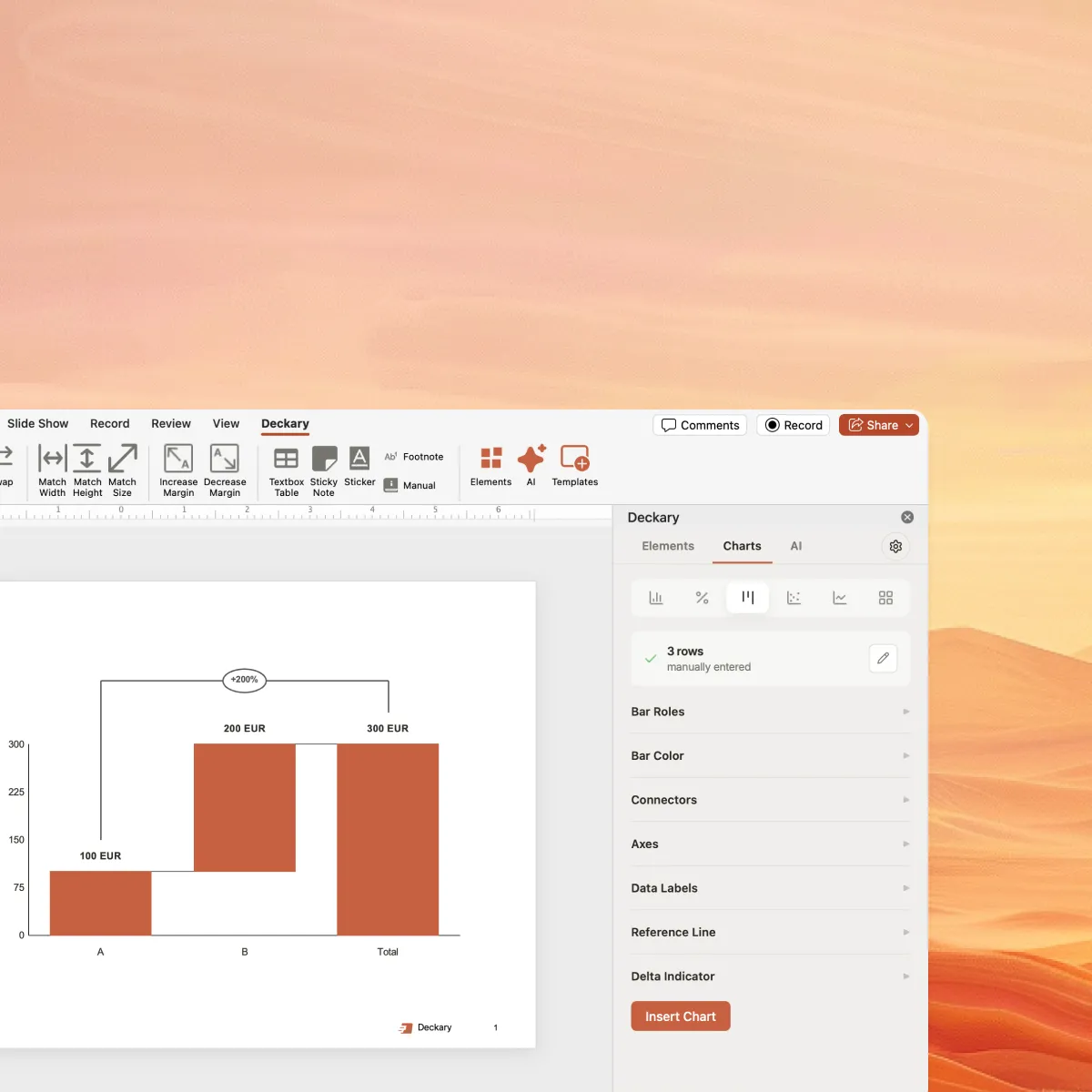
Present ROI in your business case
Create professional waterfall charts and bar charts to visualize ROI, costs, and benefits in your presentations.
What is ROI?
ROI (Return on Investment) is a financial metric that measures the profitability of an investment relative to its cost. It answers the fundamental question: "For every dollar invested, how much did I get back?"
ROI is the go-to metric in business for evaluating investments because it's simple, universal, and directly comparable. Whether you're analyzing a marketing campaign, capital expenditure, or technology investment, ROI provides a standardized way to measure success.
- Comparing different investment opportunities objectively
- Justifying project funding in business cases
- Measuring the success of completed initiatives
- Setting performance targets and benchmarks
Example ROI Calculation
ROI = (150,000 - 100,000) / 100,000 × 100
ROI = 50,000 / 100,000 × 100
ROI = 50%
This means for every $1 invested, the company received $1.50 back—a 50% return.
When to Use ROI
ROI is the standard metric for investment decisions in consulting, finance, and business strategy
Business Case Development
Capital Allocation & Budgeting
Capital Investment Decisions
M&A Synergy Analysis
ROI Benchmarks by Category
| Investment Type | Typical ROI | Notes |
|---|---|---|
| Capex Hurdle Rate | 10-15% | Minimum ROI required for capital approval |
| IT/Digital Transformation | 15-30% | Enterprise software, automation projects |
| Process Improvement | 20-50% | Lean, Six Sigma, operational efficiency |
| M&A Synergies | 10-25% | Cost synergies, revenue synergies |
| Cost Reduction Programs | 30-50% | Sourcing, consolidation, automation |
| Training & Development | 30-50% | Employee productivity gains |
How to Present ROI in Business Cases
In consulting and corporate settings, ROI is typically presented as part of an executive summary "value sandwich" that includes the investment cost, expected benefits, and calculated ROI.
Cost-Benefit Slides
Payback Timeline
The Executive Summary Format
When presenting to leadership, structure your ROI slide with these elements:
- Recommendation: Clear ask (approve/invest/proceed)
- Problem/Opportunity: 1-2 sentence context
- Investment Required: Total cost with breakdown
- Expected Returns: Quantified benefits over time
- ROI & Payback: Headline metrics with sensitivity analysis
- Next Steps: Immediate actions if approved
ROI vs. NPV vs. IRR vs. Payback Period
Understanding when to use each metric for capital allocation and investment decisions
| Metric | What It Measures | Best For | Limitation |
|---|---|---|---|
| ROI | Total return as % of investment | Quick comparison, executive communication | Ignores time value of money |
| NPV | Present value of future cash flows minus investment | Large capital decisions, comparing absolute value | Requires discount rate assumption |
| IRR | Discount rate that makes NPV = 0 | Comparing projects of different sizes | Can give multiple results; assumes reinvestment at IRR |
| Payback | Time to recover initial investment | Liquidity assessment, risk screening | Ignores cash flows after payback |
When to Use ROI
- Executive summaries needing quick, intuitive metrics
- Comparing investments of similar time horizons
- Early-stage project screening
- Marketing and training program evaluation
When to Use NPV + IRR
- Large capital expenditures ($1M+)
- Long-term investments (5+ years)
- Board presentations and investment committee reviews
- Projects with irregular cash flow patterns
Consulting Best Practice
McKinsey, BCG, and Bain typically present all four metrics for major capital decisions: ROI for intuitive communication, NPV for absolute value, IRR for comparing differently-sized projects, and payback period for risk assessment. Use our calculator for ROI and payback, then build NPV/IRR in Excel for the full picture.
Ready to build your business case?
Calculate ROI here, then create professional charts to visualize your investment analysis in PowerPoint with Deckary.
14-day free trial. No credit card required.
Frequently Asked Questions
Everything you need to know about ROI calculations
Related Calculators
CAGR Calculator
Compound Annual Growth Rate for measuring growth over time.
NPV Calculator
Net Present Value for capital budgeting and investment analysis.
IRR Calculator
Internal Rate of Return to evaluate project attractiveness.
WACC Calculator
Weighted Average Cost of Capital for DCF valuations.
TAM SAM SOM Calculator
Total Addressable Market for strategy and due diligence.