NPV Calculator
Calculate Net Present Value instantly. The gold standard for capital budgeting, investment analysis, and corporate finance decisions.
Annual Cash Flows ($)
NPV Formula:Σ(CFt / (1 + r)^t) - Initial Investment
Present NPV in your business case
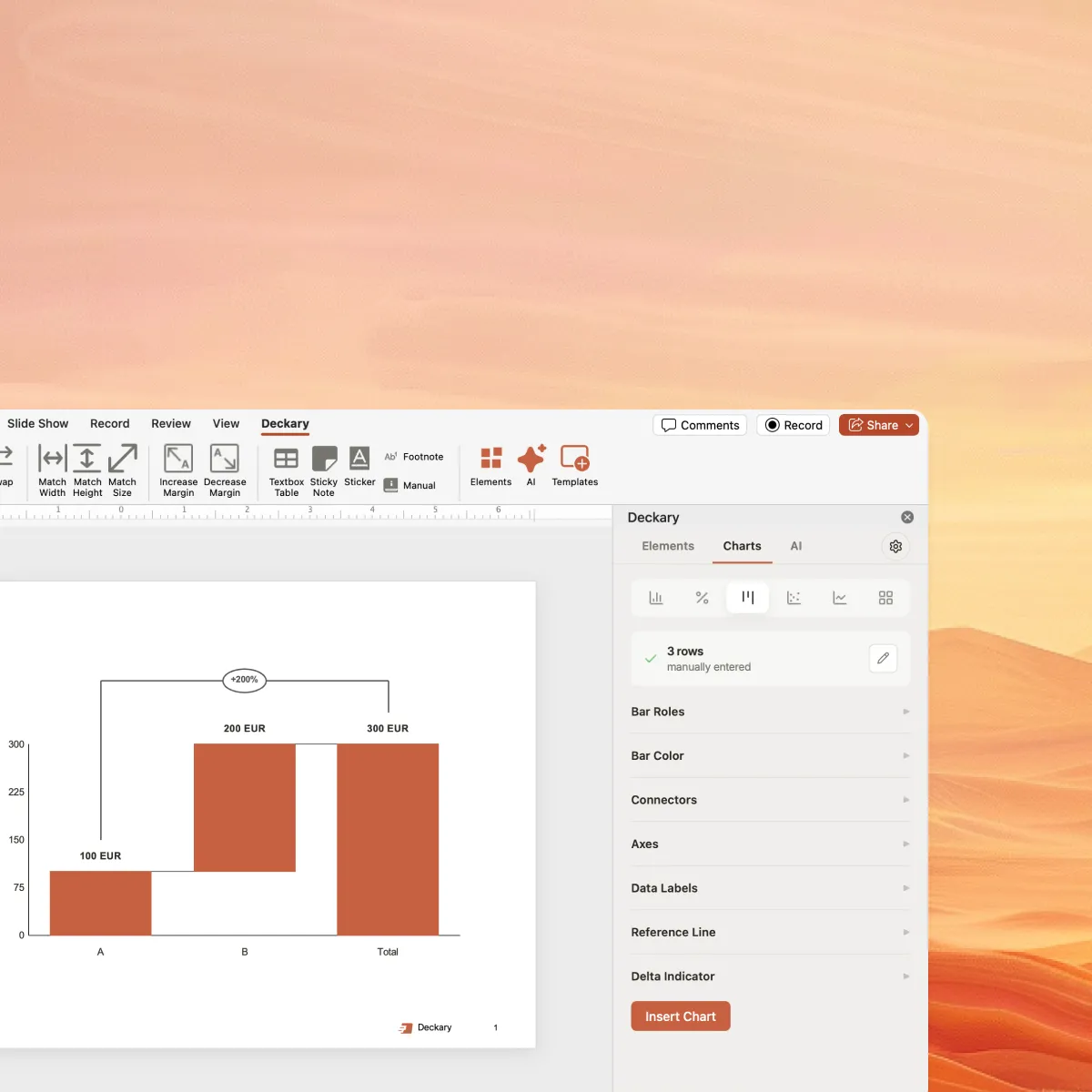
Create professional waterfall charts and bar charts to visualize NPV, cash flows, and investment returns in your presentations.
What is NPV?
NPV (Net Present Value) is a financial metric that calculates the present value of all future cash flows from an investment, minus the initial investment cost. It accounts for the time value of money—the principle that a dollar today is worth more than a dollar tomorrow.
NPV is considered the gold standard in corporate finance for evaluating investments because it directly measures value creation. If NPV is positive, the investment is expected to generate returns above the required rate of return (discount rate).
- Accounts for time value of money with discounting
- Shows absolute dollar value created (or destroyed)
- Enables apples-to-apples comparison of different projects
- Forms the basis for all DCF (Discounted Cash Flow) analysis
Example NPV Calculation
Year 1: $30,000 / 1.10 = $27,273
Year 2: $30,000 / 1.21 = $24,793
Year 3: $30,000 / 1.33 = $22,539
Year 4: $30,000 / 1.46 = $20,490
Year 5: $30,000 / 1.61 = $18,628
PV of Cash Flows = $113,723
NPV = $113,723 - $100,000 = $13,723
A positive NPV of $13,723 indicates the project creates value above the 10% required return.
When to Use NPV
NPV is the preferred metric for major capital decisions in corporate finance and consulting
Capital Budgeting
M&A Valuation
Project Prioritization
Real Estate Investment
Choosing the Right Discount Rate
| Discount Rate | Typical Range | When to Use |
|---|---|---|
| Risk-Free Rate | 3-5% | Government bond baseline, theoretical minimum |
| Corporate WACC | 8-12% | Standard corporate investments, most business cases |
| Higher Risk Projects | 15-20% | New market entry, R&D, unproven technology |
| Venture/Startup | 25-50% | Early-stage investments, high uncertainty |
| Private Equity | 20-30% | Leveraged buyouts, operational turnarounds |
How to Present NPV in Business Cases
In consulting and corporate settings, NPV is presented alongside complementary metrics to give a complete picture of investment value and risk.
Sensitivity Analysis
Scenario Planning
The Investment Committee Format
When presenting to leadership or investment committees, include these elements:
- Executive Summary: NPV, IRR, and payback at a glance
- Investment Required: Total capital with deployment timeline
- Cash Flow Projections: Year-by-year breakdown with assumptions
- Sensitivity Analysis: NPV tornado chart showing key drivers
- Scenario Analysis: Conservative/Base/Optimistic cases
- Risk Assessment: Key risks and mitigation strategies
NPV vs. ROI vs. IRR vs. Payback Period
Understanding when to use each metric for capital allocation and investment decisions
| Metric | What It Measures | Best For | Limitation |
|---|---|---|---|
| NPV | Present value of cash flows minus investment | Large capital decisions, absolute value | Requires discount rate assumption |
| ROI | Total return as % of investment | Quick comparison, executive communication | Ignores time value of money |
| IRR | Discount rate that makes NPV = 0 | Comparing projects of different sizes | Can give multiple results; assumes reinvestment at IRR |
| Payback | Time to recover initial investment | Liquidity assessment, risk screening | Ignores cash flows after payback |
When to Use NPV
- Major capital expenditures ($1M+)
- Long-term projects (5+ years)
- When comparing projects with different cash flow patterns
- M&A and valuation analysis
NPV Decision Rule
- NPV > 0: Accept the project
- NPV < 0: Reject the project
- NPV = 0: Indifferent (returns equal cost of capital)
- When comparing: Choose higher NPV
Consulting Best Practice
McKinsey, BCG, and Bain typically present all four metrics for major capital decisions: NPV for absolute value creation, IRR for percentage return, ROI for intuitive communication, and payback period for risk assessment. The investment committee gets a complete picture.
Ready to build your business case?
Calculate NPV here, then create professional charts to visualize your investment analysis in PowerPoint with Deckary.
14-day free trial. No credit card required.
Frequently Asked Questions
Everything you need to know about NPV calculations
Related Calculators
ROI Calculator
Return on Investment for business cases and project justification.
CAGR Calculator
Compound Annual Growth Rate for measuring growth over time.
IRR Calculator
Internal Rate of Return to evaluate project attractiveness.
WACC Calculator
Weighted Average Cost of Capital for DCF valuations.
TAM SAM SOM Calculator
Total Addressable Market for strategy and due diligence.